Home Blog Page 41

The State of Security Tokens Under US Law

0

The state of security tokens under US law is fraught. It has been that way since at least 2016, and the situation became particularly acute in 2017 with the rise of so-called initial coin offerings or ICO, which are a form of capital raising for start-up companies.(1)

While the staff of the US Securities and Exchange Commission (SEC) has sought to provide guidance on the question of when a token is a security, and a few trial courts have issued opinions discussing the issue, there remains a significant lack of clarity not only on that important question but also on the implications in other areas of the federal securities laws when a token issued as a “utility” or “network” token is treated as a security under the now-famous Howey test for investment contracts (“Howey security tokens”).

This article highlights certain key matters in this regard. It first focuses on understanding when a token is a security, drawing a distinction between tokenization of traditional securities (i.e., stocks and bonds) and Howey security tokens. Next, we discuss significant practical implications for security tokens under the Securities Act of 1933, the Securities Exchange Act of 1934, the Investment Advisers Act of 1940, and the Investment Company Act of 1940. The article leaves for others a discussion of state law.

The nature of this article is not to provide an in-depth discussion for the expert but an overview of the issues. For those interested in more detailed information, we have included selected resources at the end for reference. This broad-scope approach should not lead readers to believe that these issues are not significant. In fact, if the matters raised herein do not receive greater clarity, the US cannot in any real sense make progress toward achieving the promise that blockchain brings to capital markets.

Security Tokens Generally

This article focuses on two classes of security tokens: traditional securities that have been tokenized on a blockchain or other distributed ledger technology (DLT) and Howey security tokens, a form of “investment contract” under federal securities laws.(2)

Since the benchmark “DAO report”(3) and the Munchee cease-and-desist order, the SEC’s position on token sales in the US has been virtually unshakeable:(4) digital assets created and distributed by an entity or group are securities under the Howey test. In Howey, the US Supreme Court defined “investment contract” as any “contract, transaction, or scheme” whereby (a) a person invests money (or, in later interpretations, anything else of value), (b) in a common enterprise, (c) and is led to expect profits, (d) solely (or, in later interpretations, predominantly) from the efforts of others.(5)

Since the DAO report, two types of security tokens emerged: those that will always remain a security (tokenized traditional securities) and those that are sold as part of a “contract, transaction or scheme” at the time of fundraising but are meant to serve a certain purpose within a blockchain network, for example, as a payment mechanism and/or as a way to incentivize developers and/or users.

Tokenized Traditional Securities

Tokenizing traditional securities—in other words, issuing and maintaining stocks, bonds and other securities in a digital form on a blockchain—offers various benefits ranging from increased transparency and security to ease of transfer, cap table administration, and investor management. These advantages, coupled with access to global capital and the promise of increased liquidity, make tokenization of securities an innovative way to raise capital for both emerging and established companies.

In the US, primary issuance of tokenized securities should be a fast, straightforward, and cost-efficient process due to the existence of a robust framework for exempt offerings, which applies equally to tokenized and normally-issued securities. Registered offerings, however, require SEC approval and therefore are not easily accomplished. We discuss both exempt and registered offerings in the next section.

An issuer may tokenize common or preferred shares, limited partnership interests, membership interests in a limited liability company, debt instruments, or convertible instruments. The nature of the interest being tokenized, as well as the corporate structure of the offering, may impact specific regulations that apply to token creation and to the offering of such token.

Legal and technical considerations go hand-in-hand during the process of tokenizing traditional securities to ensure compliance and a smooth path to secondary trading. Various regulatory restrictions, as well as tax and KYC/AML considerations, need to be addressed and implemented on a technical level and perhaps built into the token through the underlying technology. Corporate and governance structure, jurisdiction, and token features all affect regulatory compliance, a situation which differs from that of non-tokenized traditional securities. Such compliance requirements should be discussed with a knowledgeable attorney before undertaking tokenization of traditional securities.

For exempt offerings, the broad definition of “security” under federal securities laws has allowed issuers to use the existing US framework to tokenize traditional securities without the need for legislative or regulatory amendments. Issuers in many other countries, with more rigid lists of instruments that are considered securities,(6) have found themselves in regulatory limbo, without a workable framework for issuing tokenized securities, even when new regulations covered cryptocurrencies and “utility” tokens.

In many other aspects, however, application of US securities regulations has not been smooth due to lack of regulatory guidance and leadership, as we will discus in further articles that will be published in the following weeks.

1 What are securities and why are they regulated?
2 2020 OECD Report on asset tokenization; 2020 Article explaining the difference between technology wrappers and legal classification
3 2017 SEC DAO report
4 With the exception of three extremely narrow no-action letters: 2019 TurnKey Jet; 2019 Pocketful of Quarters; 2020 IMVU.
5 Supreme Court cases on investment contracts — Howey and Edwards;
court decisions on investment contract analysis of digital assets — Telegram and Kik
6 For example, many European jurisdictions have very specific lists of what constitutes a security that are limited to stocks, bonds, and other items specifically part of a legal entity’s capital stack as well as “collective investment schemes” to cover pooled investment vehicles or funds.

This article is an extract from the 90+ page Security Token Report 2021 co-published by the Crypto Research Report and Cointelegraph Consulting, written by thirteen authors and supported by Crypto Finance, Blocklabs Capital Management, HyperTrader, Ten31 Bank, Stadler Völkel Attorneys at Law, Riddle&Code, Coinfinity, Bitpanda Pro, Tokeny Solutions, AlgoTrader, and Elevated Returns.


What Progress Has Been Made on the Regulatory Front?

0

Unlike the utility and hybrid tokens created through initial coin offerings (ICOs), security tokens are designed to fall within existing regulatory frameworks, and offer the associated legal safeguards to investors.

Up until recently, therefore, it would only have been possible to set up security token exchanges with licenses that were designed for the exchange of traditional securities. But the differences in structure between the two markets meant that it was never a good fit.

Take Switzerland, for example. The existing system for regulating traditional securities aims to create a degree of competition and separation of power in a centralized system. As a result, Swiss regulations prescribe the maintenance of separate, licensed legal entities to operate various functions of the securities system such as the exchange(s), the securities depository, the clearing system and the registry. This structure is designed to provide clear accountability and avoid any single entity acquiring too much market power.

Part of the thinking is that aspiring market entrants that want to set up a new exchange can make use of the same underlying infrastructure as incumbents, thereby lowering the barriers of entry to the market. You can think of it as being akin to the telecommunications market, where new entrants are allowed to use some of the same basic communications infrastructure as their competitors. However, given that 7 of the 8 licenses in Switzerland are held by entities owned by the same parent, the effectiveness of this approach is certainly open to debate.

Now consider how tokenized assets would fit into this system. One of the key advantages of DLT is that it allows for greater efficiency and automation by enabling trading and settlement to take place in the same transaction. If the law were to insist that these functions are controlled by separate legal entities, it would negate the central benefit of tokenized assets. Furthermore, as existing traditional institutions are not equipped to deal with tokenized assets on a technical level, any new security token exchange would need an array of separately licensed entities to be established first. Thus, what was designed to stimulate competition in the traditional securities market served as a major barrier to development of a secondary market for tokenized assets.

Thankfully, this contradiction has now been recognized and corrected by Swiss lawmakers. The new DLT Act, which comes into full force in August 2021, creates a new type of authorized body for trading DLT-based assets. This will make it a lot easier to establish exchanges for security tokens, allowing functions to be combined under one roof. AlgoTrader board member and digital asset expert, Luzius Meisser, who was involved in the consultation process during the drafting of the law, describes the implications as follows:

“Swiss lawmakers have recognized that crypto markets are structured differently than traditional securities markets. Consequently, they have decided to allow security token exchanges to integrate vertically: offering the full set of services necessary to operate an exchange. This enables them to be independent of traditional entities such as banks, settlement systems, and centralized securities depositories.”

Furthermore, in order to further reduce barriers to entry, Swiss law exempts small, non-commercially run exchanges from requiring a license, for example when a company organizes a free blockchain-based market for its own shares as a service to its investors. Meisser’s latest venture, Aktionariat, specializes in enabling such markets.

On the wider European level, although plans are considerably less advanced, the direction of travel appears to be similar. In September 2020, the European Commission (EC) published a proposal for a DLT Pilot Regime as part of its Digital Finance Package. Like Switzerland, the EC recognized that digital assets do not fit well into the existing regulatory structure and that a legal foundation will be required to support secondary markets.

Industry watchers view the DLT Pilot regime as a flexible, regulatory sandbox from which a fitting framework for digital assets can evolve. Indeed, the EC’s stated objective is to “create an EU framework that both enables markets in crypto-
assets as well as the tokenization of traditional financial assets and wider use of DLT in financial services”.

In what ways do the regulatory requirements differ in an international comparison? In order to answer this question, we will start next week by taking an in-depth look at the regulations that currently apply in the USA. In the process, we will also turn to the topic of the “Howey Test”, which always plays a major role in this question.

This article is an extract from the 90+ page Security Token Report 2021 co-published by the Crypto Research Report and Cointelegraph Consulting, written by thirteen authors and supported by Crypto Finance, Blocklabs Capital Management, HyperTrader, Ten31 Bank, Stadler Völkel Attorneys at Law, Riddle&Code, Coinfinity, Bitpanda Pro, Tokeny Solutions, AlgoTrader, and Elevated Returns.
Security Token Regulation

0

Which investment contracts can be tokenized may vary from country to country (and even between regions within a country) based on which country the issuer is in, which country the investors are in, what type of investment contract is being tokenized, and what class of investors is being targeted.

Some companies issuing security tokens prefer to call the offering a “regulatory compliant token offering” rather than security token offering, because the latter can be a legal admission by the company that the assets being sold are securities.

Different jurisdictions define tokens in different ways, and a popular approach is to let the tokens be treated as needed in each given jurisdiction instead of a uniform classification for the whole world. For example, In the US, a token can be a security where in another country it is a utility token (see XRP in U.S. vs. Japan(1)).

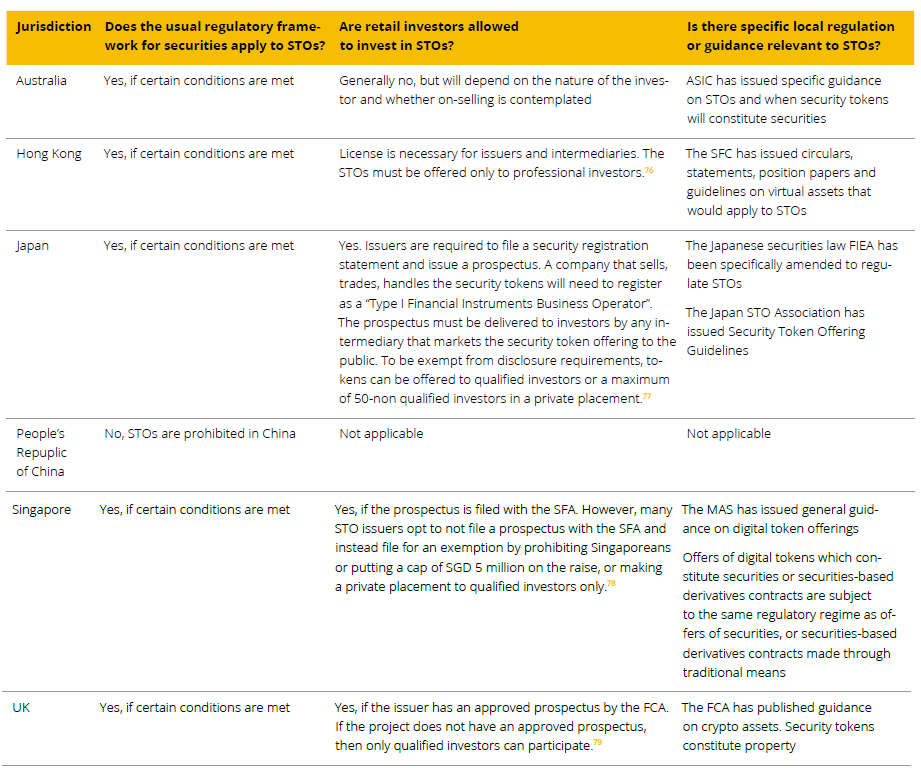
STOs are already regulated in major financial jurisdictions such as the U.S., the U.K., Hong Kong, Singapore, and Japan. Most regions allow retail investors to invest in security tokens if the issuer has an approved prospectus. However, there are regions such as Hong Kong that only allow security tokens to be sold to professional investors and other regions such as China that have outlawed security tokens.

In continental Europe, STOs are not currently regulated at an EU level, but a draft proposal for regulation of the use of distributed ledger technologies in financial services was published in September 2020. A few countries in Europe have designed new legislation for security tokens including Liechtenstein’s Blockchain Act, Switzerland’s DLT Act, Luxembourg’s Bill 7637(2), and the German ministerial draft law for the introduction of securities in electronic form.(3)

Overall, all the EU countries have similar rules. If an STO qualifies as a transferable security, then EU securities laws apply to the token. Basically, if the project has an approved prospectus then it can publicly offer the tokens and anyone can purchase them regardless if they are retail or professional. Otherwise, only qualified investors can participate.

Security Token Regulation per Country

Source: Adapted from Security Token Offerings — A European Perspective on Regulation by Clifford Chance, Cointelegraph Research

Regulations is not static. It is constantly changing and it can change in many different directions, making the issuance of Security Tokens easier or harder depending on difference systems that the companies have to navigate through.

This article is an extract from the 90+ page Security Token Report 2021 co-published by the Crypto Research Report and Cointelegraph Consulting, written by thirteen authors and supported by Crypto Finance, Blocklabs Capital Management, HyperTrader, Ten31 Bank, Stadler Völkel Attorneys at Law, Riddle&Code, Coinfinity, Bitpanda Pro, Tokeny Solutions, AlgoTrader, and Elevated Returns.
The Emerging Security Token Product Portfolio

0

For banks and financial market infrastructure providers, tokenization is an obvious fit. It increases the scope of diversification for clients by opening up asset classes that were traditionally illiquid such as real estate, fine art, jewelry, antiques, classic cars and other collectibles.

Practitioner Perspective with Andy Flury, Founder & Chief Executive Officer of AlgoTrader AG

Given the progress in building a regulatory foundation discussed in Section 5 of this report, what type of developments will we see in the coming years? It has been well documented that an increasing number of traditional banks are seeking to provide crypto custody services to their clients, with recent high-profile examples including BNY Mellon, Goldman, JPMorgan and Citi. The logical extension of this trend would be banks offering tokenized assets to their clients.

Private banks, which are primarily engaged in wealth management, will be in pole position to capitalize here but when you consider that WEF estimates that up to 10% of GDP will be secured on the blockchain by 2027, the potential market extends far wider.

The ability to easily fractionalize less fungible assets will also result in some spin-off benefits. For example, a client could use a fraction of a tokenized property portfolio to serve as collateral for a loan. This will not only make it easier to find appropriate collateral to match the size of each loan, it also greatly reduces credit risk for the bank, as tokens are far easier and less costly to liquify in the event of default.

In addition, tokenization will make the trading of equity and bonds far more efficient by simplifying settlement, automating processes through smart contracts, and deepening the digitization of compliance procedures thanks to the transparency provided by the underlying DLT ledger.

A key success factor for these products will be the degree to which they are integrated with existing industry norms and frameworks, expanding rather than replacing existing financial services at first. This point was underlined by Markus Abbassi, Head of Tokenization at Sygnum, a licensed Swiss bank which specializes in digital assets:

“Tokenized assets require both a sound technical and legal implementation to ensure the enforceability of all associated rights and obligations, in the same way as traditional assets. In order to unlock the full potential of tokenization and ensure mass adoption, having an integrated, regulated and standardized end-to-end solution for the primary as well as the secondary market is an important step-forward for the industry.”

As we can see above, tokenization offers clear benefits for both banks and their clients. But what type of services are they likely to develop in the near future?

In addition to large national exchanges and some smaller, specialized newcomers, there will be a compelling business case for banks to create a marketplace for tokenized assets in the form of an organized trading facility (OTF) or multilateral trading facility (MTF) as defined in MiFID 2 regulations. The potential approaches for banks can be divided into four categories, depending on whether it is acting as a principal or agent and what types of assets are being traded.

Source: WIRESWARM / AlgoTrader

Potential Business Cases

А. Bank as Principal

Banks adopting Approach 1 will act as the principal, executing trades against their own balance sheet and thus becoming a market maker for security tokens based on traditional financial instruments such as equities, bonds or futures. Take S&P futures, for example, which typically involve maintenance margins in the region of $55,000. Such minimum capital requirements will price many out of the market. By offering tokenized futures, banks could greatly lower the barriers of entry to such markets, offering more fine-grained diversification possibilities to their customers. Of course, the potential extends far beyond futures — from shares and ETFs to bonds, the possibilities are broad.

From an operational perspective, Approach 1 is probably one of the most straightforward strategies. Banks buy and sell tokens to create the market, calculating prices based on the value of the underlying asset on traditional markets. In addition, the bank could easily hedge its positions by trading equities on traditional exchanges.

Moving to Approach 2, the bank would also act as the principal, but this time trading security tokens that are not based on existing instruments. This would include any tokenized assets that are legally classified as securities but were issued exclusively using DLT. Examples include companies who raised capital using equity-based security tokens, debt-based tokens such as bonds, and asset-backed tokens.

Both the potential risks and rewards are quite high with this approach. On the one hand, banks moving into this space would gain first-mover advantage in their jurisdiction. However, the big challenge and flip side of this advantage would be how to price the tokens, particularly early on when the volumes being traded through other liquidity venues remain light. As a result, this approach would inevitably require either the development of proprietary pricing methodology or the use of an external market maker.

B. Bank as Agent

In the first two approaches, the bank executes trades against its own balance sheet, acting as the market maker, buying and selling shares to provide liquidity. However, for particularly liquid assets, the bank could also simply create an order book and match the buy and sell orders of clients against each other. Given a large enough consumer base and liquid assets, Approach 3 is certainly a low-risk strategy from the bank’s perspective. Services like Robinhood have shown that there is a market for fractionalized ownership of traditional stocks, which would have a good degree of name recognition among consumers, so a selection of tokenized high-profile assets might be a good way to test the water and establish the market early on.

However, other types of security tokens, such as tokenized real estate for example, will be less liquid. By their very nature, investors are likely to hold alternative assets over a longer period of time and trade them less frequently. This is where Approach 4 would be a prudent option: Rather than offering continuous trading, the bank could instead provide an auction platform where users could place bids to buy or sell tokens. These auctions could be conducted over standard time intervals, such as once a week, in order to pool demand. At the designated auction time, the buy and sell orders of clients would be matched against each other. In principle, this system would function very similarly to the opening and closing auctions on national exchanges. The goal of such mechanisms is to establish the auction price such that the largest possible number of buy and sell orders can be executed. Any remaining unmatched orders stay in the system until they are cancelled or until the next auction date. Thus, Approach 4 is also a relatively low-risk strategy and could be a good way to overcome light liquidity early on while clients gain familiarity and begin to feel comfortable with the asset class.

Conclusion

Due to its ability to make the transfer of value far more efficient, tokenization remains DLT’s most promising financial use case. The regulatory hurdles that have thus far hampered the growth of secondary markets will be overcome, which is likely to catalyze a huge injection of liquidity.

This provides a number of opportunities for banks and financial institutions to facilitate new markets, bringing tokenized assets to a much wider range of clients. A topic that we will explore further over the course of the next couple of weeks.

This article is an extract from the 90+ page Security Token Report 2021 co-published by the Crypto Research Report and Cointelegraph Consulting, written by thirteen authors and supported by Crypto Finance, Blocklabs Capital Management, HyperTrader, Ten31 Bank, Stadler Völkel Attorneys at Law, Riddle&Code, Coinfinity, Bitpanda Pro, Tokeny Solutions, AlgoTrader, and Elevated Returns.

BITCOIN PREVAILS, INTRODUCING ONLYCOINS, CONTENT MAKERS GET PAID IN CRYPTO

0

As Bitcoin has become the talk of the town, the digital currency has emerged as the highest trading. In simple words, the paper money got a new online version in terms of virtual coins/stocks.

Now, the point is how one can benefit from it.  

What is Bitcoin?

Bitcoin is the virtual currency used to send money to people through the internet, without any physical means.

Bitcoin costs a lot. Many people can’t buy one Bitcoin. No worries. You can buy Satoshi. Learn how to convert Satoshi to Bitcoin and vice versa on safetradebinaryoptions.

How and when was Bitcoin invented?

In 2009, Satoshi Nakamoto (a pseudonym) started mining the genesis block (block No.0). In this mining, he gets the reward of 50 Bitcoins. In this way, Bitcoin came into existence.

When a recommendation came from a well-known and well-framed person, everyone believed it blindfolded. The same happened when Elon Musk (the world wealthiest businessman) revealed his support for digital currency. Recently, he conveyed his message to his followers on social media about his belief in Bitcoin. He stated that:

“Bitcoin is an incredible thing.

Here, we are going to discuss what new Bitcoin has in its offer box!

Have you heard about OnlyCoins before?

If not, let me open the cover.

OnlyCoins:

OnlyCoins is a virtual content marketplace. In this marketplace, creators, likely competitors of the app, can get payments directly from fans. Moreover, it is a platform of online content subscription services that utilize cryptocurrencies.

OnlyCoin was founded 4 years ago and has achieved remarkable growth. Now, OnlyCoin has made a huge policy change, which has enraged women on the street. There is nothing distressing in it because an opportunity has arisen just as OnlyFans is about to end.

The popularity of OnlyCoins is due to people like Crystal Jackson, other names “The Real Mrs. Poindexter.” She is a Sacramento, as well as a California soccer mom, who commenced on OnlyFans. Within a few spans of time, she managed to secure $150K per month. Her success makes her other colleagues unhappy.

It is the rule of nature, even in every field, the haters come first instead of appreciated. If we wonder, it’s good for the achievers to get motivation from their haters and work harder.

Due to these circumstances, Pornhub had to initiate approving cryptocurrency this year as it was kicked out of the idea of payment networks. Similarly, the OnlyFans also think the same. Additionally, they have banned sexual content, due to this few hustling members are moving out.

Can you even give it a thought that one day suddenly you get news of the collapse of your business worth $150K?

No, can’t imagine, right!

So, here is a solution: OnlyCoins allows sexual content and accepts Bitcoin Cash(BCH), Bitcoin (BTC), and Ethereum (ETH) along with a few other digital currencies. The other financial institutions such as banks are not part of this story.

Now, there is no doubt that this policy change will impact OnlyFans growth immensely. But the good thing happens to OnlyCoin, who will get an advantage from this transition. Might be possible, OnlyCoin touches the growth at sky level.

The beginning of October was supposed to be a Wild Shift on the website. How? The answer is simple, OnlyFans says a final goodbye, and new members will get registered on OnlyCoin and boost the growth.

Is there any doubt left about how influential Bitcoin is?

An entity without the involvement of the government keeps reaching the skies. Bitcoin is the problem solver for all the businesses out there in the market.

There is no history available for any entity that is so strong and worthy. People like Crystal Jackson really got an enormous solace. Her struggle to save her marriage and family will be paid off well when she switched to OnlyCoin.

Wrapping It Up:

On the whole, the world’s strongest digital concurrency, Bitcoin has acquired more platforms to benefit more people. On the farewell of OnlyFans for not allowing sexual content, OnlyCoin accepted the content and offered payment in cryptocurrency. Through this step, OnlyCoin will get a rapid boost in its growth in October.

Are you looking to acquire some coins?

Then, this is the right time to grab the bandwagon.

Secondary Market Trading for Tokenized Assets

0

To some observers, trading security tokens on centralized exchanges might seem contradictory. After all, one of the most vaunted benefits of the distributed ledger technology (DLT) that underpins digital assets is its ability to reduce the role of intermediaries, thereby lowering transaction costs. So why do we need anything more, you might ask?

Practitioner Perspective with Andy Flury, Founder & Chief Executive Officer of AlgoTrader AG

Firstly, it’s important to recognize that different types of security token investors will have different needs. For private individuals who are investing smaller amounts and are comfortable with managing their own wallet, a fully decentralized exchange like Uniswap could be a convenient option. On the other hand, a professional investor or institution would be likely investing on a far larger scale, requiring ironclad security, operating under far more regulatory scrutiny, and potentially managing assets on behalf of multiple clients.

The role of the secondary market is to build the linkages between the traditional and digital asset worlds — providing the support infrastructure and services that make it possible for institutions to embrace tokenization with confidence.

This will involve building tools to manage custody, trading, settlement and compliance, while establishing connectivity to a wide range of liquidity venues including issuance bodies, token exchanges, brokers, and OTC desks. Ultimately, this will be good for the entire security token market, introducing much larger trading volumes and greater liquidity.

STOs — Great for Issuance, but What About Liquidity?

While DLT presents a highly efficient, secure and unbureaucratic way to issue securities, the question is: after a token is minted and issued, what happens next? Unfortunately, many early pioneering projects suffered from a lack of token liquidity, even after being listed on an exchange.

Although progress has been made since then, this is an issue that persists to this day. For example, in January 2021, the most active security token exchange was tZero, with a total combined monthly volume of $6,298,096 or around $203,164 per day. Even highly prominent assets such as tZero’s equity and revenue-sharing token TZROP only attract daily volume in the order of $30,000 – $40,000 a day on average.

The reasons for the relative scarcity of liquidity are multifaceted. In some respects, security token marketplaces face a “chicken-and-egg” dilemma. On the one hand, institutional investors want a platform with a wide selection of quality tokens which they can trade. On the other hand, the leaders of tokenization projects often do not want to pay the exchange listing fees until they can see evidence of liquidity on the platform.

On the other side of the equation, institutions tend to be cautious about the potential cryptosecurity risks associated with an unfamiliar technology and want a trading solution that is similar or ideally, interoperable, with their existing back-end systems. The secondary market will have a key role to play in addressing these concerns in order to bring more institutions into the fold and end the liquidity stalemate described above.

By far the biggest obstacle to a secondary market thus far, however, has been the burden of regulatory requirements, but in both Switzerland and on a wider European level, this is about to change. In next weeks article Andy Flury will therefore take a closer look at this change!

This article is an extract from the 90+ page Security Token Report 2021 co-published by the Crypto Research Report and Cointelegraph Consulting, written by thirteen authors and supported by Crypto Finance, Blocklabs Capital Management, HyperTrader, Ten31 Bank, Stadler Völkel Attorneys at Law, Riddle&Code, Coinfinity, Bitpanda Pro, Tokeny Solutions, AlgoTrader, and Elevated Returns.
Exchanges and Secondary Markets for Security Token

0

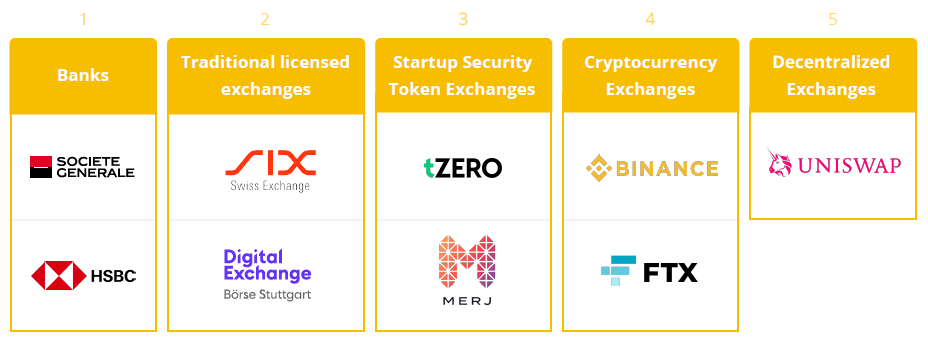
Right now there is an unspoken race being waged over who will win the world’s demand for security token trading and it isn’t possible to decide yet on a winner in this race. Although some candidates enjoy an early lead, some others are moving forward fast with advantages that can make them into winners as well.

The five main candidates include(1):

Currently, cryptocurrency exchanges and startup security token exchanges are in the lead of this race; however, decentralized exchanges are gaining traction. The status quo banks and traditional licensed exchanges are slow to move. Each category may specialize in different segments as well. Banks for example may specialize in segregated markets for a specific company’s private equity that can only be traded by a whitelist of professional investors.

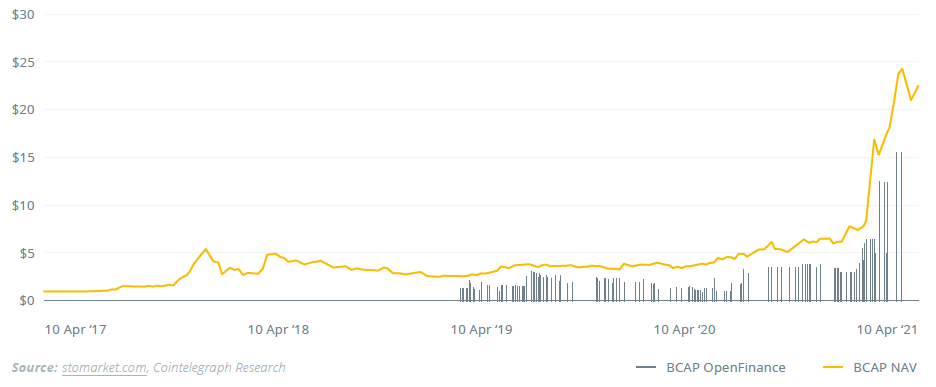
Security token issuers will be able to list their security on multiple trading venues in multiple jurisdictions, and traders will be able to arbitrage across trading venues. However, price gaps will still exist due to perceived risks associated with different venues and jurisdictions. For example, Blockchain Capital’s BCAP token has been trading significantly below its net asset value since inception.

BCAP’s Price on Secondary Markets Trades Below NAV

For some observers, trading securities tokens on centralized exchanges may seem contradictory, as decentralization is one of the key aspects of tokenization, but in practice these entities still lead. We will take a more comprehensive look at this matter in a practical report with Andy Flury from AlgoTrader next week.

1 https://blog.stomarket.com/complete-list-of-security-token-exchanges-marketplaces-1615fde71645

This article is an extract from the 90+ page Security Token Report 2021 co-published by the Crypto Research Report and Cointelegraph Consulting, written by thirteen authors and supported by Crypto Finance, Blocklabs Capital Management, HyperTrader, Ten31 Bank, Stadler Völkel Attorneys at Law, Riddle&Code, Coinfinity, Bitpanda Pro, Tokeny Solutions, AlgoTrader, and Elevated Returns.

What is a DAM (Digital Asset Marketplace)?

0

The first types of DAMs (Digital Asset Marketplaces) to emerge were centralized cryptocurrency exchanges. Binance, Coinbase, and Kraken are examples of these. They now mostly concentrate on the development of their audiences, having already successfully delivered easy-to-use and optimized web platforms for buyers and sellers of crypto tokens.

Practitioner Perspective with Ivor Colson of Tokeny Sarl in Luxembourg

Decentralized exchanges offering cryptocurrencies also began to emerge in 2020, manifesting in platforms such as Uniswap, Pancake Swap, and Sushi Swap. DeFi protocols such as Aave and Compound can also be considered decentralized marketplaces.

These types of venues are now beginning to emerge within the security token industry, driven by investors who want:

  • Lower trading and custody fees
  • Ability to earn interest from lending digital assets to other traders, such as shorters
  • Transparency with number of shares outstanding, fees, and orderbook liquidity in order to reduce manipulation such as naked short selling
  • Ability to use digital assets as collateral for margin trading accounts or loans
  • Faster settlement
  • Diversified liquidity from traders around the world
  • 24/7 trading

Why are DAMs emerging?

Naturally, the security token market will always innovate at a slower pace than the purely retail markets due to the heavy regulation requirements. In that light, it was not a surprise that we firstly saw the rise of unregulated cryptocurrency-based DAMs. However, interest in DAMs for privately issued security tokens is currently on the rise. We see three reasons why they have accelerated recently:

1. Private markets are currently dysfunctional. This is an extremely fragmented industry that is still reliant on paper-based processes. Old technology such as fax machines are still being used and Excel is the norm. As a consequence, investors have to deal with long lock up periods or pay premiums to liquidate their portfolios. Investors are now seeing DAMs as venues whereby they can find and transfer their assets to others, P2P, and for a few Euros/Dollars per transfer.

2. The regulation for security tokens has moved quickly recently, especially in Europe. Tokenized securities now fall under the same rules and regulations as traditional financial instruments in many other European countries including France, Germany, Italy, the Netherlands, Romania, Spain and the UK. This has given market actors the confidence to start experimenting and implementing blockchain technology operationally.

3. Blockchain technology has officially gone mainstream this year. The foundations were laid in 2020 with many users utilising smart contracts and custody solutions. At the break of 2021, FinTechs such as Paypal and Square adopted Bitcoin for their millions of users, institutions such as Microstrategy and Ruffer have announced over nearly $2bn in combined Bitcoin purchases. Financial institutions have also joined. The FT asked whether Bitcoin has gone mainstream on its front cover. As one of the world’s most respected financial publishers, the FT actually answered its own question by asking it. Blockchain technology is now normalised and accepted.

Benefits for Stakeholders

There would be no emergence of DAMs if there were not any benefits and improvements to the current state of affairs. So, what are these benefits?

Issuer

Issuers of financial securities seek investors by offering them shares in their asset. For this they need to describe their value proposition, detail the financial perspectives and legal structure of their project, distribute this information to eligible investors and provide the mechanisms for the transfer of funds in exchange for shares.

A DAM realizes two key benefits for issuers:

A. Digital administration of shares

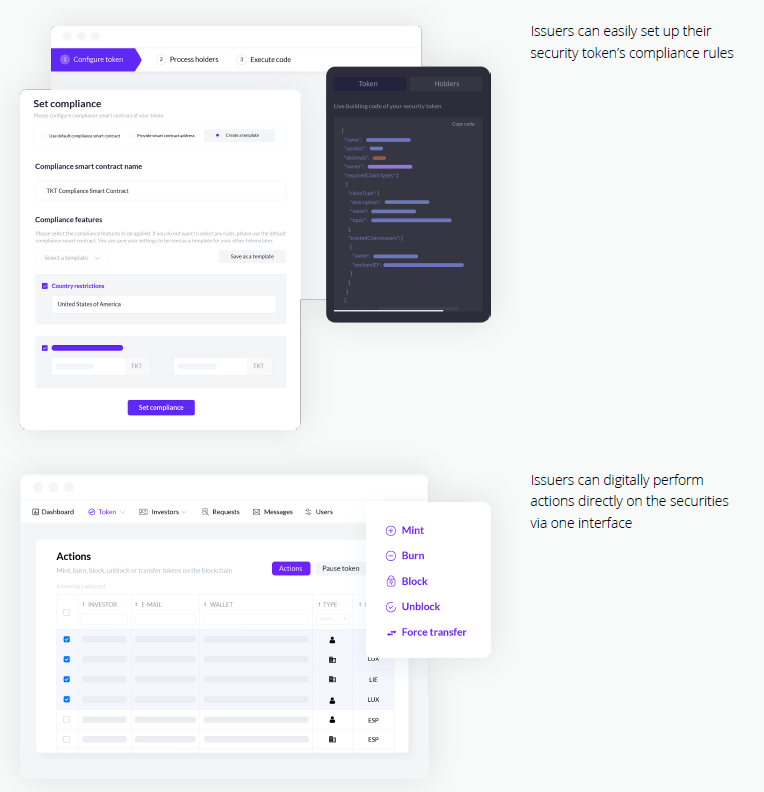
Issuers can quickly issue and allocate shares to investors via a self-service and user-friendly interface. The compliance is coded into the security tokens and all investors need to satisfy the legal obligations of the offering. These checks are performed in seconds in conjunction with KYC/AML checks. Once administered, cap tables are automatically updated, and issuers benefit from efficiency gains with the digital administration of shares.

B. Access new segments of investors

Due to a digital-first issuance and allocation of shares, issuers can easily, and cost efficiently target investors around the world. New types of investors can also be opened up, as efficiency gains translate into better opportunities to fractionalize and reduce the investment ticket size, allowing issuers to potentially target retail investors. The prospect of a more liquid secondary market also opens up a greater band of investors.

Investor

On the buy-side, investors are concerned about whether they can free themselves from an investment easily, and the types of investment opportunities available on the DAM. For this, they need to have an interface where they can access the documents that satisfy their due diligence requirements. After this, they need the mechanisms to easily subscribe and then transfer/free themselves from that investment should they wish.

A DAM offers two key benefits for investors:

A. Greater access to opportunities

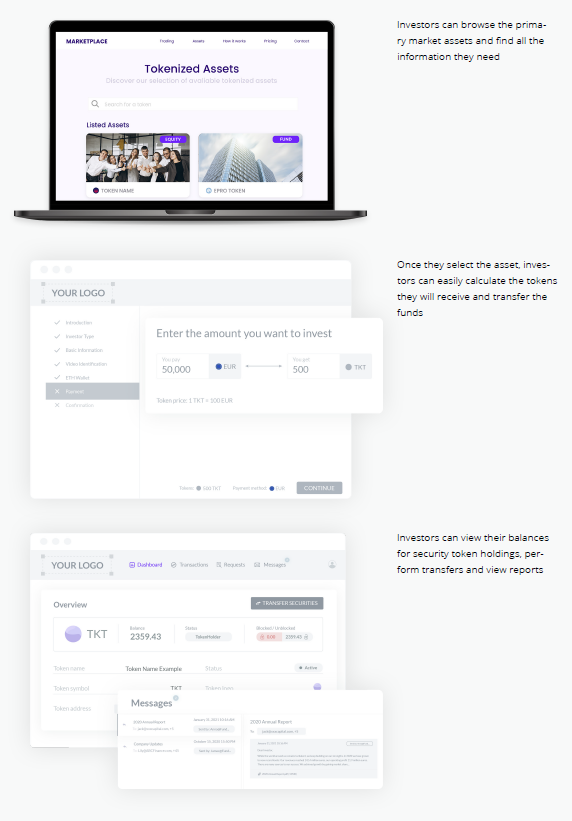
Investors can also discover more opportunities via one marketplace across both the primary and secondary markets. All the necessary documentation is available on demand and investors can log in to a marketplace and filter opportunities based on their investment mandates. Issuer contact information is accessible for further information.

B. Increase in liquidity

Investors that hold a share in a company can also utilize the DAM to discover other investors to interact with. They can act as a ‘maker’ or ‘taker’, i.e., selling or buying respectively. They can firstly discover other investors on the DAM and interact by connecting with and making buying and selling offers. The transfer is then made P2P. By offering a venue and the needed functionality, investors are more likely to meet each other and free themselves from their positions when they want to, offering a significant benefit to how current private markets operate.

DAM Operator

The DAM operator provides these digital and compliant services to enable issuers and investors to meet with the least amount of friction possible. They provide clearly defined rules and responsibilities that apply to the marketplace. They will conduct its due diligence on the projects listed on the platform. Not only that, but they need to prove they are trustworthy for both investors and issuers. The core benefits are:

A. Monetize customer base

By migrating their issuers and investors over to a DAM, they will be in a better position to monetize their audience at scale. For the issuers, they can monetize the setup of their offerings, onboarding of investors and management services that are needed for asset owners. On the buy-side, they can monetize investors via a SaaS model and/or a transaction based model.

B. Automate and digitize operations

Many operations today are manual, and a DAM operating on top of a blockchain has the ability to automate many tiresome operations. Faxes will be a thing of the past, so will manual cap table updates, duplicated KYC checks and long investor onboarding times. DAMs can utilise automation across all of these currently laborious processes and realise a highly automated and efficient operation. They can offer a seamless experience for their clients, one that is truly digital from the ground up.

Services Available on a DAM

In order for the DAM to be used, there are some essential services it needs to offer. These services can be broken down into the primary market, and those required for both issuers and investors and the secondary market, which is a venue for investors.

А. Primary market

The primary market is where the company releases shares from its entity to investors, so it is from the company to the investors. The company needs to go through various steps to issue its shares to eligible investors.

For the issuer

Issuers need a platform that allows them to create, deploy and issue compliant security tokens to its investors. To satisfy the compliance obligations, issuers need to be able to create/upload smart contracts and integrate KYC/AML services in order for them to approve or reject participating investors. Once the issuer has whitelisted its investors, it can go ahead and allocate the tokens in return for funds from investors.

After the issuer has allocated shares to their investors they need to be able to report and perform post-issuance actions on the securities. Actions like capital calls, buybacks and share splits are functions issuers or their agents need to perform. They can do this directly through the platform. Issuers also need to keep control of their assets by being able to block and unlock tokens, mint and burn, along with forcing transfers between investors. Cap tables are automatically updated when share transfers are executed as the blockchain is used as the source of truth. Reporting functionality is also required, and issuers can easily schedule the delivery of position and transaction reports.

For the investor

On the buy side, investors need an easy-to-use service to firstly view offerings and their documentation
in the primary market. Secondly, when they want to invest they need an easy-to-use service that allows
them to enter their personal information and upload their documentation to prove their claims and finally
execute the investment by transferring funds from their wallet.

B. Secondary market

The secondary market is where security token investors can meet, interact and exchange their shares with one another. For security tokens, this is normally a P2P (peer-to-peer) marketplace in practice.

Right now there is an unspoken race being waged over who will win the world’s demand for security token trading. Who are the participants of this race? That is a question that we will answer next week in another article.

This article is an extract from the 90+ page Security Token Report 2021 co-published by the Crypto Research Report and Cointelegraph Consulting, written by thirteen authors and supported by Crypto Finance, Blocklabs Capital Management, HyperTrader, Ten31 Bank, Stadler Völkel Attorneys at Law, Riddle&Code, Coinfinity, Bitpanda Pro, Tokeny Solutions, AlgoTrader, and Elevated Returns.

Is tokenization going mainstream in the 20s?

0

The benefits of tokenization are inevitable. Efficiency gains, automation, transparency, fractional ownership, increased liquidity, and direct access to investors are some but a few examples of why this emerging blockchain and DLT-enabled wave of innovation is increasingly gaining global traction. Will the 2020s be defining years in blockchain history where tokenization finally goes mainstream?

Practitioner Perspective with Marius Smith of Finoa

Tokenization promises to fundamentally disrupt financial markets as we know them today and is a topic that Finoa has covered and researched extensively since its inception in 2018. 1,2

Despite its promises, however, mainstream tokenization or “the tokenization of everything” is still in its early days, and the anticipated boom and wide-spread adoption are yet to be seen. With positive developments globally, the market volume is still expected to grow significantly in the coming years, with innovative use cases emerging everywhere and positive regulatory developments forming on both national and international levels.

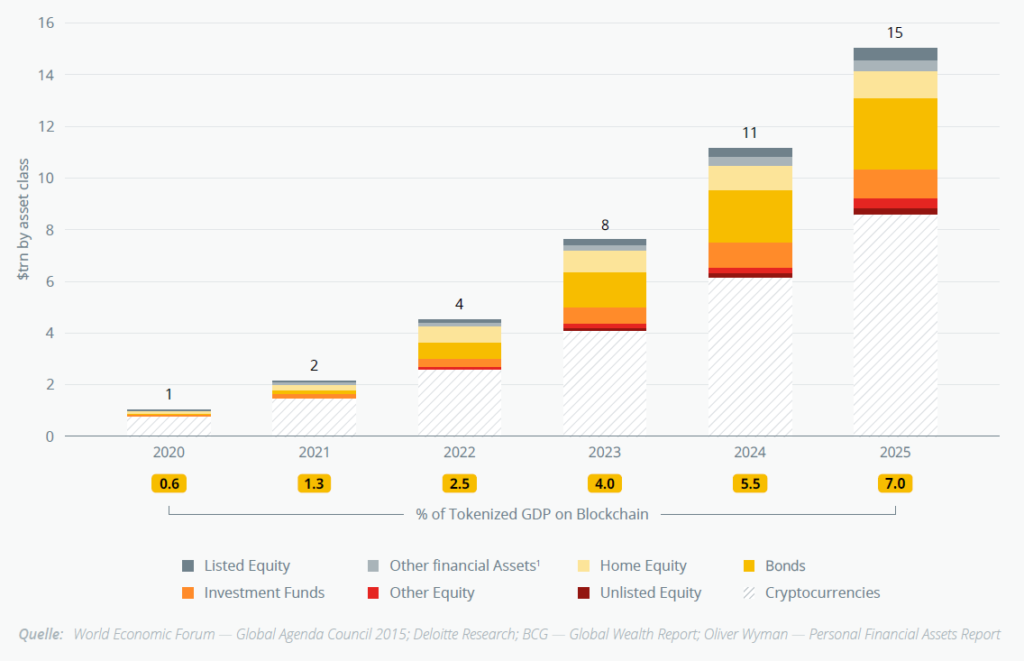
Taking into consideration the developments over the past two years, we have revised our initial tokenization forecast and outlined below findings from an extensive overhaul of our initial computations and models that projects that the tokenized asset market will constitute a $14.7-trillion opportunity by 2025.

Projected Tokenized Market Volume until 2025

With a $1-trillion market capitalization of blockchain-based assets, and this being predominantly attributed to cryptocurrencies, in 2020 (accounting for approximately 0.6% of the global GDP), we expect a significant increase in projected market volume over the coming years. Overall, we project that the tokenized market volume will reach $2 trillion, or 1.3% of global GDP in 2021, and $4 trillion (2.5% of the global GDP) in 2022. This year, we anticipate an acceleration in mainstream adoption of blockchain technologies, leading to an additional 0.7% of GDP to be stored on the blockchain. Overall, this will trigger a market growth from $4.4 trillion in 2022 to $14.7 trillion in only 3 years (2025) — an average of an additional $3.4 billion per year.

Current developments in more detail

Despite 2020 marking a pivotal year for cryptocurrency growth and adoption, leading up to total market capitalization exceeding 2018 highs, we still observe a lower-than-anticipated growth traction for tokenization. With positive developments in both the fintech and startup ecosystems and also increasing interest from traditional financial institutions, regulatory uncertainty still poses as one of the main obstacles hindering asset take-up and, combined with an ongoing pandemic, has put a spoke in the wheel on the otherwise bullish developments anticipated globally.

We have witnessed many attempts and examples of blueprints and tokenization of different asset classes, with bonds emerging as the most common product thus far. We find this mainly to be correlated with the legal foundations being most developed and fitting for this asset class compared to equities, for instance, and evidently, the case in countries such as Germany. If we consider the wider developments in regulating tokenization going forward, we expect to see positive advancements for other asset classes in the coming years; however, expect some to take a longer time to form and develop. Consequently, we expect that bonds will continue to accelerate and will be preferred over equities initially, as existing legal frameworks will seek to accommodate these first and by 2025, will be the leading tokenized financial asset class (disregarding cryptocurrencies) constituting 18% of the total tokenized financial asset market on the blockchain. We find recent examples of that both in Germany, where the “Gesetz über elektronische Wertpapiere (eWpG)” — the electronic securities act — was recently passed to provide legal certainty around the issuance of securities, as well as the European Commission’s introduction of Market in Crypto Asset (MiCA), both marking important steps for innovation in the capital markets on a national and European level.

While positive developments for tokenization are anticipated in the coming years, we still expect that cryptocurrencies will be the main driving force of growth for tokenized assets. Institutional adoption is on the rise, and we have seen many examples of large corporations and investors recently entering this space to get exposure to, diversify and seek out alpha from emerging asset classes and crypto projects. The interest from large investors, such as Mass Mutual and Tudor Group and platforms like PayPal, are just a few examples of this new wave of institutional adoption that will have a fundamental impact on the future of market development and growth expectations. Combined with a continuous acceleration of innovation in base-layer protocols and layer-two applications as well as ingenious use cases such as decentralized finance, we are particularly bullish on the growth trajectory for cryptocurrencies and conservatively estimate that they will have constituted 57% of the total tokenized financial assets by 2025. We do believe that these developments will have positive spillovers to some of the other asset classes we considered, and thus remain very positive for the years ahead for tokenization generally.

We delimited ourselves to look at a five-year horizon — an exercise that, with the current level of innovation and uncertainty, is already inherently difficult. We are still in the very early days of tokenization, as well as wider blockchain adoption and application. Extending the forecasted horizon to five, 10, or even 20 years, is, therefore, nearly impossible. What we can say with certainty, however, especially with the very positive developments we are currently seeing on a global level, is that the technology has an immense potential to disrupt, and we have seen only a fraction of its full application yet. We are confident that use cases for tokenization will continue to unfold and are strong advocates of its full realization — an evolution that is not only incredibly exciting but also one that we are very proud to take part in and support. We are just getting started.

Methodology: Projection of tokenized assets 2020 – 2025

As our initial methodology proved to be a very accurate reflection of the market developments, we decided to sophisticate it further by differentiating between different asset classes and including more recent sources.

Research and surveys from institutions, such as the World Economic Forum (WEF), Deloitte and McKinsey (see table of sources for more detail), project that up to 10% of the global gross domestic product will be stored and transacted with the help of blockchain technology by 2025 – 27. With this in mind, we triangulated and ran a market simulation to determine (a conservative) potential market size of a global tokenized market.

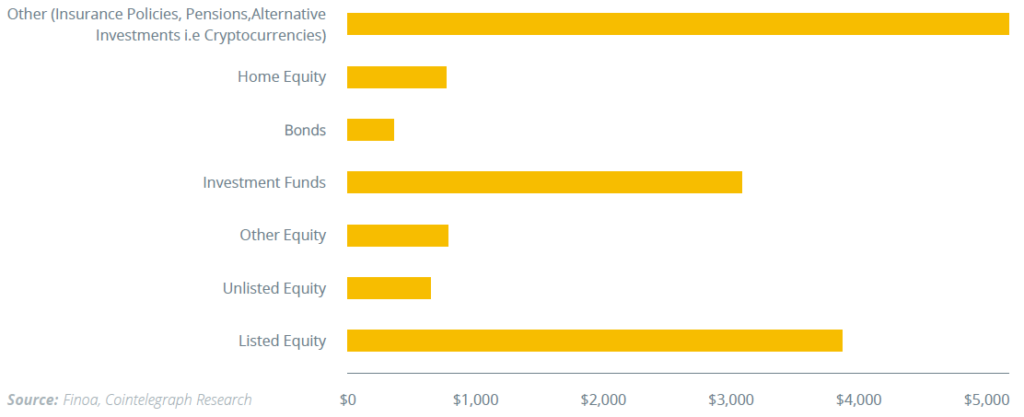
We delimited ourselves to financial assets as well as real assets clustered into: listed equity, unlisted equity, other equity, investment funds, bonds, other financial assets (i.e., insurance policies, pensions and alternative investments), home equity and cryptocurrencies. Currencies and deposits were excluded, and our study thus does not consider potential central bank digital currencies.

Based on factors such as the past performance and future growth expectations per asset class, we projected the market size of the individual assets using a bottom-up methodology. In subsequent steps, we applied different assumptions of the individual rate of tokenization per asset class and finally matched our bottom-up results with the top-down research from the WEF.

Following this methodology, we project a tokenized asset market of $14.7 trillion of financial assets by 2025. This does not include currently unmeasured (or nonexistent) asset classes or unidentified tokenization use cases of intangible assets — e.g., patents, usage rights — where we expect significant innovation and growth.

1 The Era of Tokenization — market outlook on a $24trn business opportunity
2 Cost disruption in the issuance market: The case for tokenization

This article is an extract from the 90+ page Security Token Report 2021 co-published by the Crypto Research Report and Cointelegraph Consulting, written by thirteen authors and supported by Crypto Finance, Blocklabs Capital Management, HyperTrader, Ten31 Bank, Stadler Völkel Attorneys at Law, Riddle&Code, Coinfinity, Bitpanda Pro, Tokeny Solutions, AlgoTrader, and Elevated Returns.
How Big Will the Security Token Market Become?

0

Raiffeisen Bank International’s Blockchain Hub team including Head of Strategic Partnerships & Ecosystems Christian Wolf, Senior Partnerships & Ecosystem Manager at RBI Gernot Prettenthaler, and Digital Banking Analyst Vid Hribar joined us for an exclusive interview about security tokens and to answer the question if they see demand for security tokens from their clients.

Various estimates of the security token market exist. KPMG and WEF project that the market will grow to $8 trillion by 2025.1 Benjamin Schaub and Stefan Schmitt of the Frankfurt School Blockchain Center (FSBC) predict the European market will account for $1.5 trillion by 2024.2 This chapter discusses a new estimate by Finoa, a German digital asset platform for institutional investors. Their calculations estimate that the tokenized asset market will have $14.7 trillion in assets under management by 2025; however, their estimate does include cryptocurrencies such as Bitcoin in addition to security tokens. The not cryptocurrency part of their tokenized asset market estimate is $9.5 trillion by 2025.

Finoa Estimate of Global Tokenized Security Market by 2025, $ trillions

With €176 million total assets, 17.4 million customers, and presence in 25 countries3, RBI’s forward thinking corporate culture has a huge impact. In the beginning of our interview with one of Europe’s largest banks, we established that RBI is seeing increased demand for cryptocurrencies from both retail and professional clients. RBI’s client demand for digital assets ranges from high in politically unstable regions to none in Russia where cryptocurrencies are prohibited. They noted there are regional differences in interest. Slovakia and the Czech Republic are willing to invest more in cryptocurrencies whereas Austria is more conservative when holding variables such as household income constant.

Christian Wolf stated that although clients are not directly asking for security tokens, they are asking for a better trading experience when handling traditional securities like stocks and bonds. Clients want cheaper, faster, and more transparent security trading. Wolf said, “the way we currently trade securities will be gone within 10 years.”

However, compliance with the new Anti-Money Laundering Directive (AMLD5) that came into effect on January 10th, 2020, may have made working with cryptocurrencies more difficult for the bank, although, AMLD5 also brought regulatory clarity which is a positive development. AMLD5 says that any business that exchanges fiat currency for a crypto asset (brokers, exchanges) or stores crypto assets on the behalf of customers (custodians, wallets) is required to register with financial market authorities where they are doing business and implement money laundering policies such as collecting and safely storing the identification data of users, monitoring user transactions, and reporting suspicious activity.

The trio mentioned that RBI is rethinking their compliance’s approach to digital assets. RBI is currently very cautious, but demand from clients, regulators, and the technology are all maturing, which gives them the impetus to progress as well.
Luckily, AMLD5 is most likely not applicable to security tokens, because they do not constitute a means of exchange. However, this is not the case in all countries. For example, the UK expanded the scope of its regulation by referring to crypto assets instead of virtual currencies and the new term can be interpreted to encompass security tokens. France is following a similar approach.

RBI is emerging from an experimental phase to market ready phase. They are working on a host of white-labeled products and digital asset custody for institutional and professional investors. One of their most exciting products is their tokenization of fund shares.

Gernot Prettenthaler mentioned that RBI has experimented with the tokenization of fund shares, debt, equity, and the euro with their REST (Raiffeisen Euro-backed stable token). “We now understand the technology, we just need to see what is possible from a legal perspective in Austria.”

Looking ahead, the next decade will be critical to the success of tokenized securities. That is why next week we will take an in-depth look at whether the 2020s will be the pivotal years in blockchain history when tokenization finally goes mainstream.

1 https://blockstate.com/global-sto-study-en/
2 https://dailyhodl.com/2020/03/05/tokenization-in-europe-market-size-to-reach-1-5-trillion-in-2024/
3 https://www.rbinternational.com/en/who-we-are/facts-figures.html

This article is an extract from the 90+ page Security Token Report 2021 co-published by the Crypto Research Report and Cointelegraph Consulting, written by thirteen authors and supported by Crypto Finance, Blocklabs Capital Management, HyperTrader, Ten31 Bank, Stadler Völkel Attorneys at Law, Riddle&Code, Coinfinity, Bitpanda Pro, Tokeny Solutions, AlgoTrader, and Elevated Returns.