Home Blog Page 42

Best App To Sell Bitcoin In Nigeria and Ghana — Prestmit

0

Bitcoin has been the most popular and expensive cryptocurrency among over 10,000 coins in the crypto space. Its value has attracted a huge number of investors who want to leverage its market price to make fortunes for themselves.

Also, its potential in disrupting the stock market while retaining a decentralized nature across borders and territories has made many companies and few countries adopt Bitcoin use. Bitcoin trading is increasingly growing amongst cryptocurrency traders, with other financial institutions mulling on the bandwagon to have an encompassing stream of customers that trade in both Bitcoin and fiat currencies.

In Nigeria and Ghana, Bitcoin trading is a major way of becoming a millionaire within the twinkle of an eye as the exploits of cryptocurrency are already taking over the world. Its potential is massive as it does bullish prices that have in recent times reached an all-time high price.

However, because the markets are open every hour of the day and night, you must always be ready to buy when a good deal arises or to sell when a loss is too great.

So are you looking for how to sell Bitcoin? Do you need a trusted Bitcoin exchange that can boost your courage and finance in the crypto trading world? Prestmit is here for you!

Prestmit is a web and mobile-based Bitcoin exchange that is extolled for its simple user access and reliability in the world of Bitcoin trading. Launched in 2017, Prestmit has curated a niche for itself as one of the best apps to sell Bitcoin in Nigeria and Ghana.

Using the Prestmit app, new and existing users can easily sell gift cards for Bitcoin or convert BTC to either naira or cedi, which is enabled by a series of automated transaction processes. 

Furthermore, the Prestmit App is available on Google Play Store and the Apple Play Store for the most convenient and secure crypto-transactions yet to come.

Great Features Of Selling Bitcoin On The Prestmit App

1. Easy To Use

To create a positive user experience with a Bitcoin app, it must be simple to use. The Prestmit app, like the web platform, is simple with a user-friendly interface.

2. Instant Payment

Getting payment after selling your Bitcoin on the Prestmit app is considerably fast. Prestmit boasts of having the fastest payment time, which is between 5-10 minutes.

3. Security

A centralized security system and two-factor authentication (2FA) are just two of the many security features built into the Prestmit app to keep your account safe at all times.

4. Prompt Customer Support

Across the time, 24/7, the support team is available to assist new and existing Prestmit customers to resolve any issues related to their account management.

Bitcoin Products Available On The Prestmit App

  • Bitcoin to Naira
  • Bitcoin to Cedis
  • Gift Cards to Bitcoin

How To Sell Bitcoin On Prestmit App

1. Create An Account

Registering to create an account on the Prestmit app takes nothing less than one minute. 

2. Generate Address

This is having a Prestmit wallet address that would enable you to send and receive Bitcoin at will. This can be achieved by clicking on “Generate BTC wallet” on the Bitcoin wallet page.

3. Send Bitcoin

You can now send Bitcoin to your Prestmit wallet which will be converted to either naira or cedis. This process is in respect to the current exchange rate, which can be accessed using the rate calculator on your wallet page.

4. Get paid

After you have gotten three successive confirmations, cash will be transferred into your local bank account.

Frequently Asked Questions

1. Can I send Bitcoin from any country?

Yes! Sending BTC is possible from any country, from any wallet, and even from any Bitcoin ATM!

2. What is the limit?

There is neither a maximum nor minimum limit.

Conclusion 

To keep up with the ever-changing nature of the Bitcoin market, Prestmit is constantly updating its mobile app to provide the best customer service possible to its users. Selling Bitcoin on the Prestmit apps assures a seamless transaction process.

Ethereum at full capacity since May 2021

0

For many, Ethereum 2 can’t come soon enough, as Ethereum blocks have been consistently full for many months.

DeFi and Ethereum are almost synonymous. Ethereum smart contracts enable the trustless transactions that make up decentralized finance, and most projects developed on top of the “world computer.”

This research focuses on the fundamentals of real-world use and gives an overview of Ethereum’s scalability — or lack thereof. Finally, we will explore Ethereum’s astounding dominance in both NFT sales and value locked in DeFi.

Vitalik Buterin co-founded Ethereum in 2013. Due to legal challenges with Ethereum’s initial crowd sale, it took almost two years to launch the network on July 30, 2015. Buterin wanted to expand Bitcoin’s programmability radically. He saw blockchain-native programs as a powerful catalyst for usage and adoption.

His ideas were met with intense pushback by the Bitcoin developer community, so he started to pour his efforts into a project of his own, which he called Ethereum. After receiving a $100,000 grant from the Peter Thiel Foundation in 2014, he began assembling a core team of contributors.

Some of today’s most prominent figures in crypto were among early Ethereum developers, such as Charles Hoskinson, founder of Cardano; Gavin Wood, founder of Polkadot; Joseph Lubin, founder of ConsenSys; and Anthony Di Iorio from TMX. These heavy hitters embarked on a rocky journey, which saw them facing intense infighting among the team, massive delays caused by regulatory uncertainty and near bankruptcy. 

Ethereum finally launched and proved that programmability was incredibly powerful and equally dangerous. The initial coin offering (ICO) hype of 2017, DeFi summer and the NFT boom in 2020 did more for crypto adoption than anything else, while the DAO heist(1) nearly ended Ethereum’s existence in 2017.

Figure: The Ethereum network has been at full capacity since May 2021

Ethereum hit the ceiling of its transaction capability this year. Most of the time, blocks are at capacity, but transaction fees have skyrocketed to peaks of $10,000 during coveted NFT launches.

The situation has become untenable and frequently priced out participants with lower net worth. Other blockchains picked up the slack, and Ethereum now faces innovative competition from Solana, Avalanche and Fantom. 

Will Ethereum remain the predominant ecosystem and continue to be at the forefront of innovation and adoption? Or will it fall behind and get overtaken by blockchains with better performance and faster development?

1 See “The DAO: Chronology of a daring heist and its resolution”, Deloitte Blockchain Institute, September, 2016

This article is an extract from the 80+ page Scaling Report: Does the Future of Decentralized Finance Still Belong to Ethereum? co-published by the Crypto Research Report and Cointelegraph Consulting, written by ten authors and supported by Arcana, Brave, ANote Music, Radix, Fuse, Cryptix, Casper Labs, Coinfinity, Ambire, BitPanda and CakeDEFI.

Anticipated +60K Otherside land giveaway announced by Crypto Thots

0

Crypto Thots, the NFT marketplace with Ethereum on Opensea that helps you become a P.I.M.P in the NFT Space, is thrilled to announce its highly anticipated minting date. Starting from the 8th of June 2022, it’ll offer its holders access to account creation and edition, NFTs, timed auctions, royalties, messenger, personalized activity feed, and much more. 

By being a part of their 30,000 and growing Discord users community, Crypto Thots NFTs holders can flex the Bored Ape Yacht Club and enjoy any airdrops that BAYC is making. Holders get guaranteed access to constant giveaways – such as the 13ETH giveaway in Decentraland – and have access to exclusive content created by their OnlyFans models. Therefore, users won’t have to worry about their needs being neglected at any step of the roadmap

“Crypto Thots set out to help its users achieve their passive income goals. To do so, until minting day, we’re giving away daily prizes for 5 random active users in the Crypto Thots community after they fulfill the invitation and level requirements. One week after minting day, on the 15th of June, we’ll be introducing the first +60K Otherside land-related massive giveaway happening.” – sajja.eth, Founder at Crypto Thots.

To cater to their holders’ financial needs, they are planning to: 

  • Give 20% of revenue back to each holder;
  • Give 10% of revenue back to a charity cause chosen by their holders;
  • Reveal information about the P.I.M.P coin — and how holders can use it to advance on the P.I.M.P path;
  • Introduce the PPI (PASSIVE P.I.M.P) concept, to provide its holders with free money in no time; 
  • Enable networking opportunities for pimps while partying with 3D thots at Crypto Thots’ club in Decentraland. 

“Our purpose is for our community to always be winning. That’s why all Crypto Thots NFT owners will be eligible for random airdrops and giveaways as long as their NFT is not listed for sale. By the way, the second land giveaway will take place one week after the first land giveaway – if the public sale sells out.” – sajja.eth, Founder at Crypto Thots 

About Crypto Thots 

Crypto Thots is the ultimate NFT marketplace flow with Ethereum on Opensea that bridges the gap between NFTs and online content providers. As it’s aiming to help you become a P.I.M.P in the NFT Space and get rewarded for it, it gives you access to 3,333 thots that have found their way to the blockchain and a community of 30,000 and growing Discord users. Rewards include the latest developments, the best information, and the ultimate thottery. 

Learn more about Crypto Thots here

DeFi on Bitcoin

0

Bitcoin’s design has unique characteristics that make it impossible to perform certain actions, and this has led developers and users to seek greener pastures in the Ethereum ecosystem. However, the same drawbacks conversely make Bitcoin more secure and stable.

In the article about Bitcoin’s Script protocol language, we discussed that many applications are not possible on Bitcoin due to its limited instruction set.

That’s why there will never be Bitcoin-native DeFi applications because the underlying smart contracts (a fancy name for tiny programs that self-execute and run natively on a blockchain) need a complete instruction set.

Script allows the creation of something called Atomic Swaps, however. You might have noticed that Bitcoin developers are almost as creative as Apple’s marketing department in finding awe-inspiring names for their products. Avoiding undue technicality here, Atomic Swaps allow Bitcoin to be exchanged with coins of other blockchains such as Litecoin or Ethereum in one transaction and without intermediaries. The exact mechanism involves Hash Time Locked Contracts and is beyond the scope of this research.

Only two projects offer decentralized financial services on top of Bitcoin — DeFiChain and Portal.finance.

DeFiChain

DeFiChain uses an intelligent way to secure transactions on its own chain by storing cryptographic representation to the Bitcoin blockchain every 30 minutes. DeFiChain’s own network is fast and tailored to decentralized finance by expanding Bitcoin’s Script language just enough to allow building, lending, staking and tokenizing functionality without becoming Turing complete and compromising on security.

DeFiChain went live in 2020 and introduced the ability to create digital tokens from stocks in November 2021. Users can currently get up to 400% APR when providing liquidity with Tesla, Google and other stocks in pairs with stablecoins.

The download of a proprietary wallet is necessary to participate. Thanks to rapid innovation and its clever security mechanics, DeFiChain has attracted more than $1.8 billion of assets to its applications.

Total value locked in DeFi on Bitcoin

Portal.finance has not been released to the public yet. Investors can start a whitelisting process to participate in the creation, and Portal announced $650 million of funds pledged to its development. 

DeFiChain is the only running layer-two decentralized exchange on Bitcoin, and the total value locked (TVL) on Bitcoin is the same — $1.8 billion. Watching out for Portal’s start and traction is recommended for anyone interested in this unique space.

Summary

Seen in a more poetic way, Bitcoin seems like the wise grandfather of modern cryptocurrencies. And while it may be considered old-fashioned, its stringent adherence to core values makes it inherently trustworthy and commands great authority.

DeFi has arrived on top of Bitcoin. While Ethereum allows native financial decentralized applications (DApp), transaction fees for providing liquidity to exchange pools have frequently exceeded $100 and occasionally topped $1,000. Layer-two solutions on top of Ethereum are all the rave now, so there’s no reason to think of layer-two DeFi as “less real” than layer one.

Bitcoin is still a valid synonym for crypto as a whole, and Taproot, Lightning Network, and layer-two DeFi mean it is more than just the first cryptocurrency, it is still a formidable competitor for the blockchain foundation of the global decentralized finance market.

This article is an extract from the 80+ page Scaling Report: Does the Future of Decentralized Finance Still Belong to Ethereum? co-published by the Crypto Research Report and Cointelegraph Consulting, written by ten authors and supported by Arcana, Brave, ANote Music, Radix, Fuse, Cryptix, Casper Labs, Coinfinity, Ambire, BitPanda and CakeDEFI.

TCG World partners with Shark Tank backed Jigsaw Puzzle International Convention (JPiC) to co-host The Metaverse Expo 2022, Las Vegas

0

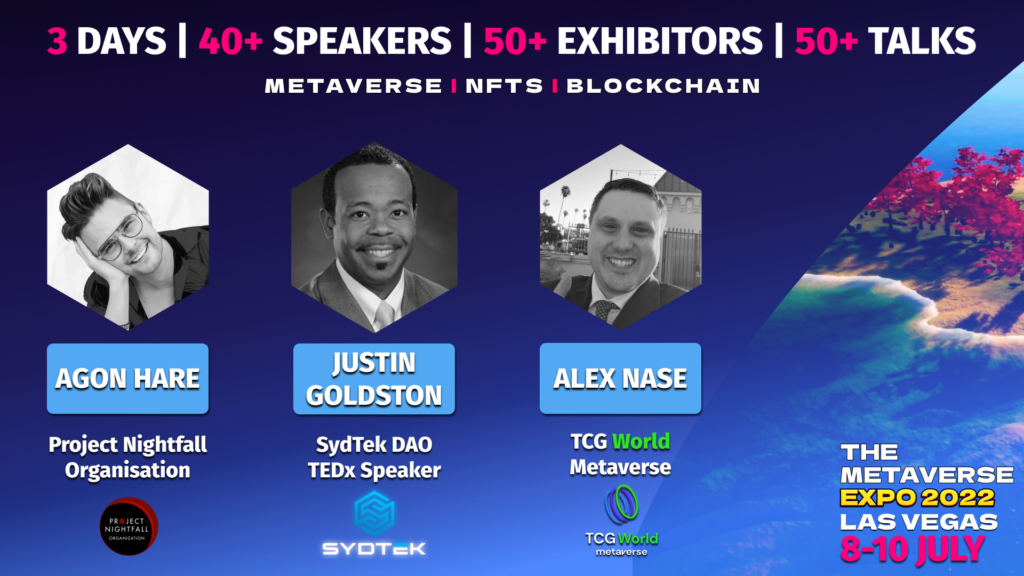
The Metaverse Expo 2022 is a 3 day event held at the Las Vegas Convention Center on 8th – 10th July 2022 that will bring together entrepreneurs, industry experts and crypto enthusiasts in the Metaverse, Gaming and NFT Space.

Showcasing a wide range of exhibitors, The Metaverse Expo 2022 features a host of key speakers & panelists including motivational speaker Agon Hare, from Project Nightfall Organization and Academia Professor & TEDx speaker Justin Goldston, PHD. The Metaverse Expo will cover topics within Metaverse, NFTs and blockchain. These include:

• Introduction to Blockchain • Introduction to Cryptocurrencies and Digital Assets • Artificial Intelligence • Introduction to the Metaverse • Metaverse Architecture • Digital Fashion and Technology • Business and Web3 Economics • Metaverse Entrepreneurship • Decentralized Finance • eSports and Blockchain Gaming • Understanding the power of the Metaverse • Reinventing Education in the Metaverse • Metaverse applications powered by blockchain

The event is taking place over three days in the renowned Las Vegas Convention Center and also includes on stage panel discussions, live performances, virtual land and NFT giveaways as well as the opportunity to network with a range of high value industry professionals.

Exhibitors can choose from three different sized booth packages, Diamond (30’x30’), Platinum (20’x20’) and Gold (10×10) which also includes 20 free tickets for the team and a speaking slot at the event. You can register for a booth at The Metaverse Expo 2022 through their website.

TCG World, is one of the largest open world metaverse projects currently in development on Binance Smart Chain and has recently started to roll out Alpha access to some of their users. Everything inside TCG World is owned as an NFT – virtual land, cars, pets and even player avatars.

Co-hosts JPiC is a company dedicated to the organization of the first ever Jigsaw Puzzle International Convention and will run alongside The Metaverse Expo 22 as well as offering free entry to individuals who purchase a Metaverse Expo 22 ticket. JPiC recently appeared on Shark Tank, Malta and secured a record breaking investment of €200,000 from Alexander Fenech, a Shark Tank investor, for a 15% stake in their Jigsaw Puzzle Convention business.

The 3 day event will bring over 6000 visitors from around the world.Tickets for The Metaverse Expo 22 and Jigsaw Puzzle International Convention can be found on their official website.

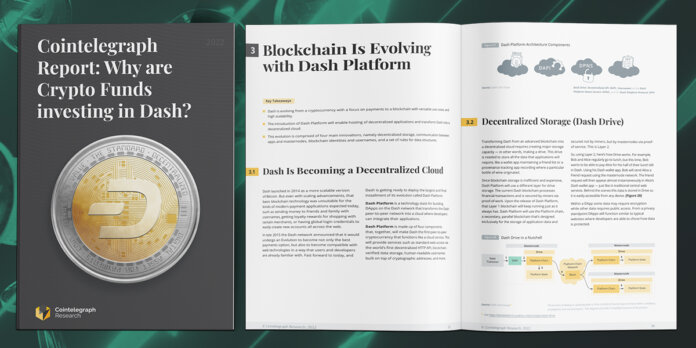
Cointelegraph Research Report: Why Crypto Funds Are Investing in Dash

0

A new crypto fund report published by Cointelegraph Research investigates how the Dash protocol’s innovative design provides security benefits to its users, as well as a thorough examination of the tokenomics and value proposition. The report highlights how investors can participate in Dash, and what future possibilities for users and developers will emerge from Dash’s upcoming developments.

Cointelegraph Research presents facts and figures on all aspects of Dash in collaboration with multiple research partners including Allnodes, Staking Rewards, CryptoRefills, CoinRoutes, intotheblock, Bitwise, Santiment, and Rekt Capital. Dash’s unique features as a payment solution including its role as an asset for investments are examined. The report is intended for investors who want to learn more about the cryptocurrency.

Dash’s evolution will achieve a major milestone in 2022. With the launch of the Dash Platform on mainnet, developers and users will be able to take full advantage of a complete ecosystem for decentralized applications and data storage.

Link to Download the full report here, complete with charts and infographics

Cointelegraph’s Crypto Fund Survey Research

An original survey of over 2,000 crypto funds was conducted in 2021 to gain a better understanding of how investors feel about Dash. This 80+ page report, written by five authors from around the world, shows which funds currently hold Dash as well as the number of funds that plan to invest in Dash over the next year.

The 200 funds that participated in the survey manage an estimated total of $1.2 billion in cryptocurrency and blockchain investments. The survey revealed that:

  • 20 funds already have Dash exposure in their investment portfolio.
  • An additional 40 funds indicated their intention to invest in Dash within the next 12 months.
  • 70% of the survey respondents requested to receive the results of this crypto fund report.

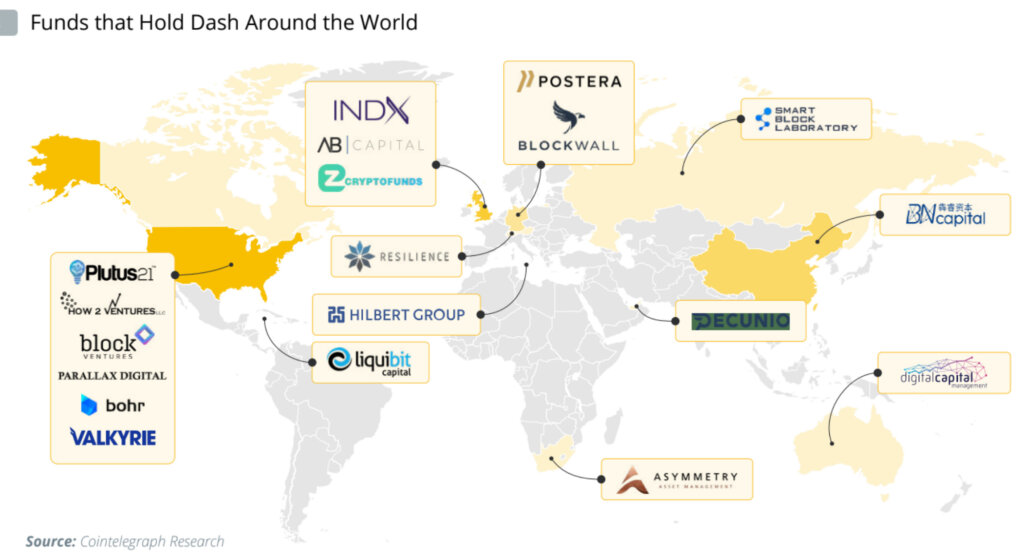
The study revealed these 20 asset allocators reported that they already have exposure to Dash in their investment portfolio including Digital Capital Management, Liquibit Limited, BN Capital, Postera Capital, Blockwall Capital, Hilbert Capital, Smart Block Laboratory, Asymmetry Asset Management, Resilience AG, Pecun.io, All Blue Capital, INDX Capital, EZCAMG, Plutus21 Capital, How2Ventures, Block Ventures, Parallax Digital, Bohr Arbitrage Crypto Fund, and Valkyrie.

Dash has distinguished itself from Bitcoin and other blockchains by emerging as one of the most prominent digital currencies focused on payments, i.e., becoming digital cash. The report not only explains how Dash’s masternode solution has helped to improve network scalability, but also elaborates on the regulatory environment for Dash and other cryptocurrencies in the world’s largest jurisdictions.

“As far as I know, there’s no other project that comes close to what we’re trying to build which is the ability to efficiently query information directly from the system database to users. We’ve seen a lot of DApps that store information on other blockchains, but they all require the use of oracles for their system to work. Dash Platform is going to be much more decentralized. Users on their mobile devices will be querying DAPI directly. There’s no oracle between them, users can query the blockchain directly with decentralized cryptographic proofs that the information is valid. You don’t have to trust any server. In my opinion, it will be a new paradigm of how decentralized systems can work.”

Sam Westrich, CTO at Dash Core Group

Aside from Dash’s vision and general features, the report delves into tokenomics, price performance, future development roadmap, and regulation. This report also outlines how Dash remains an innovative cryptocurrency that has evolved from a scalable payment solution to a Web3 ecosystem.

“Dash is a well-known, respected name in the payments space in many areas of the world, and has an engaged, loyal following. One of our goals at Valkyrie is to enable those underserved by traditional financial firms to have access to financial services, and expanding investment into the Dash ecosystem is part of that mission.”

Leah Wald, CEO at Valkyrie Investments

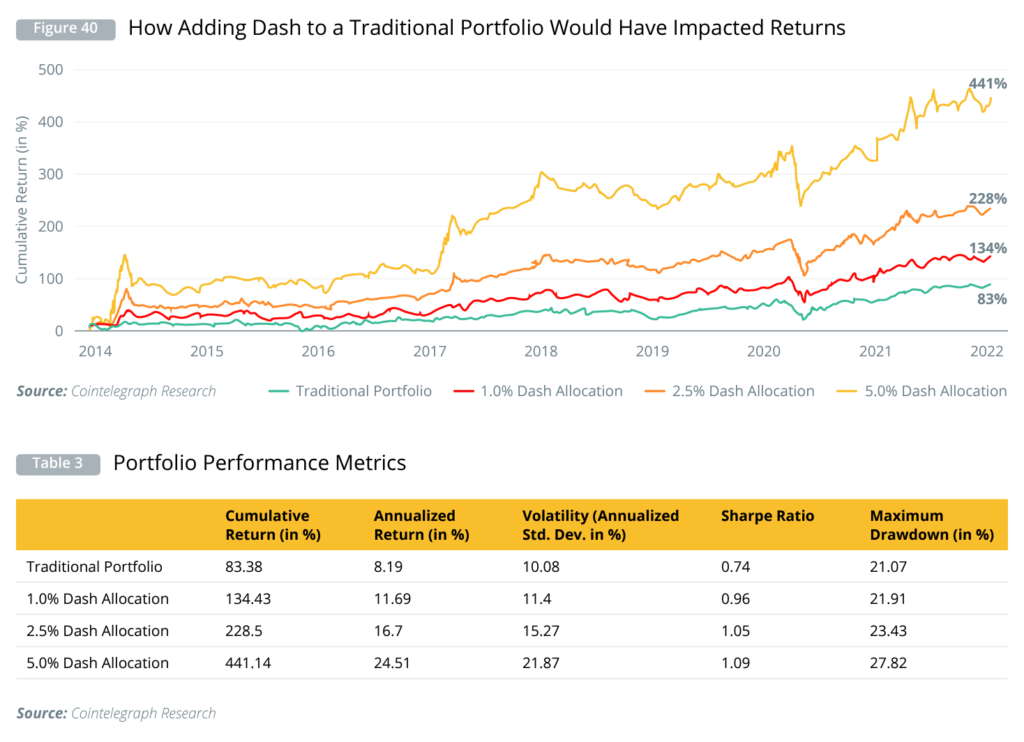
According to Cointelegraph Research, any amount of Dash can improve a traditional equity and bond portfolio by strengthening not only the cumulative return but also the sharpe ratio. Dash’s low correlation to traditional asset classes like equities and gold can also help investors manage their risk.

Link to Download the full report here, complete with charts and infographics

Layer-two solutions to Bitcoin’s scalability

0

Six confirmations for a bitcoin payment means about 60 minutes of waiting time and even just one confirmation of 10 minutes would still be a long wait for a coffee, luckily there are approaches to solve this problem!

Since Nakamoto wanted to design an electronic cash system, his successors had to think about possible solutions to Bitcoin’s scalability problem. If BTC intends to be used for payments, multi-dollar transaction fees and hours-long wait times could not be tolerated.

After Bitcoin miners rejected a proposal to increase Bitcoin’s block size to 2 megabytes in May 2017, Bitcoin Cash was created as a hard fork of Bitcoin Core. In a hard fork, every holder of coins on the parent chain also holds coins of the offspring, but the blockchains diverge after that. Sometimes, most miners decide to ditch the older chain, and it fades into oblivion. But that was not the case with Bitcoin Cash, whose acceptance remains far below Bitcoin to this day. Bitcoin Cash can achieve 350 TPS, which is a welcomed improvement but still a far cry from real-world demands. The Visa network processes up to 56,000 TPS on busy shopping days. 

Thankfully, a few clever developers found a solution and introduced the Lightning Network(1) in 2016, officially launching it in 2018.

The Lightning Network

The Lightning Network white paper was released on Jan. 14, 2016, and written by Joseph Poon and Thaddeus Dryja. Since then, Lightning Labs’ team has made steady progress under CEO Elizabeth Stark. 

Lightning specifies a peer-to-peer payment system on top of Bitcoin using payment channels. The mechanism is simple and elegant:

  1. Alice tops up her Lightning payment channel to Bob with BTC (first on-chain transaction).
  2. Alice sends Bob a transaction.
  3. Alice can send Bob as many other transactions as she wants until her funds are depleted.
  4. Alice and Bob agree on the total paid and close the payment channel (second on-chain transaction).

The fee for sending a Lightning transaction is zero if a direct connection exists between the parties. Lightning can also route a payment through many hops. The transaction propagates like, well, Lightning in the sky until it reaches its desired recipient. Hops charge minuscule fees, often fractions of 1 Satoshi, for their services in providing the necessary liquidity.

The Lightning Network is like a social network for payments. Since each hop can only facilitate less than what they topped up, network capacity can become an issue for large transactions. Mercifully, 2021 saw exponential network capacity growth, exceeding 3,000 BTC (~$150 million) in October 2021.

Figure: Visualisation of the Lightning Network

Source: Acinq

In December 2021, there were more than 17,100 Lightning nodes worldwide, most of which in the United States and the European Union. These nodes have more than 77,000 open payment channels. Lightning wallets for iOS and Android have matured enough to be usable by regular users. And in Venezuela, savvy residents shop with BTC.

It has never been easier to buy a coffee with Bitcoin. This is something that has come just in time, especially for the inhabitants of the Latin American country of El Salvador!

1 See “What is the Lightning Network in Bitcoin and how does it work?”, Cointelegraph

This article is an extract from the 80+ page Scaling Report: Does the Future of Decentralized Finance Still Belong to Ethereum? co-published by the Crypto Research Report and Cointelegraph Consulting, written by ten authors and supported by Arcana, Brave, ANote Music, Radix, Fuse, Cryptix, Casper Labs, Coinfinity, Ambire, BitPanda and CakeDEFI.

Bitrefill’s New Bill Payments Make Living on Crypto in the United States a Reality

0

Living on cryptocurrency in the United States has become a reality thanks to Bitrefill’s crypto bill payments.

Through Bitrefill’s new Bill Payments service, US citizens can now pay any bill in the US with Bitcoin, Ethereum, Dash, Dogecoin, Litecoin, and USDT on Ethereum & Tron, as well as 50 other altcoins and stablecoins.

The service works for taxes, credit card bills, utilities, auto loans, healthcare, mortgage, social security, and 20,000 other forms of expenses.

Bill payments are a game changer for people who make money with cryptocurrency by trading, working from home, or selling their goods and services to others in exchange for cryptocurrency. You may now pay for almost everything with crypto without ever touching a government-issued national currency.

“They say there are only two certain things in life – death and taxes. now you can pay both your tax and funeral costs with crypto.”

Sergej Kotliar, CEO of Bitrefill

Bitrefill requires users to have an ID-verified account with a US residency to use this service. Bitrefill is rolling out bill payments with a waiting list, which is first come, first served. In the blog post announcement, Bitrefill stated they are working around the clock to make their new service available to every Bitrefill customer in the United States, but it’ll take some time.

Bitrefill will apply a 2% convenience fee on the total bill paid to cover the costs of paying and processing each bill payment.

The new service will also be available in Bitrefill’s iOS and Android apps.

Pledged Capital and DeepSquare join forces to deploy AI for the next generation of fundraising

0

DeepSquare and Pledged Capital, two blockchain projects, each pioneer in their own field, announced a partnership aiming to boost fundraising idle funds with artificial intelligence. Milestone based investments is something that Pledged Capital has been working on since the beginning. This approach introduces a trustless third party that holds the funds. Blockchain and more specifically the DeFi space offers many innovative ways to generate interesting yields on those funds such as yield farming, staking, lending/borrowing. There are hundreds of smart contract protocols that allow this like Curve, BENQI or yield aggregators namely Yield Yak on Avalanche. Due to this diversity, finding the best strategy to maximise yield while guaranteeing a certain level of risk is a very time consuming and tedious task. Bringing artificial intelligence in the loop is the next step. AI algorithms will learn the best low risk strategy to maximise the return on the idle fund. This is exactly where DeepSquare HPC and AI features fit in, to use onchain data to train algorithms to optimise the desired requirements of yield vs risk level. The ultimate goal is to create an environment in which both investors and new projects will feel secure and collaborate on the milestone basis in order to grow and achieve goals while taking advantage of DeFi’s wonders. 

The Power Behind Web 3.0, Metaverse and HPC

DeepSquare is a distributed compute cloud, and the community response to big tech giant cloud providers. The open and interoperable grid that DeepSquare is building will allow real competition to take place and allow cloud providers, that are part of the grid, to sell their spare compute resources at their desired prices. On the other hand, in this ecosystem, end users choose where they want to run their computing workloads with a clear and transparent pricing. This inclusive ecosystem also addresses security concerns as users can choose to use providers/ services within desired jurisdictions. DeepSquare is poised to disrupt the cloud-industry and challenge the status quo by turning everything on its head. While hyperscalers rely on closed, centralised systems, DeepSquare promotes transparency and operates in a decentralized and open network centred around a blockchain compute protocol. This is the engine behind HPC, Metaverse and Web3.

Partnering with Pledged Capital comes natural as both projects come from the decentralised state of mind, and we are in fact quite compatible projects. Bringing our AI expertise and cloud computing technology to meet the vision of decentralised crowdfunding is something we are excited about.” – Diarmuid Daltún, Co-founder and Head of Business Development

Join The Future of The Web With DeepSquare: https://linktr.ee/deepsquare

Decentralized (crowd)funding platform

Pledged Capital is a decentralized trust fund that combines traditional crowdfunding with Blockchain technology with white label services to allow safe and controlled investment. Powered by DAO, Pledged Capital delivers a solution that understands how investments are used. Start-up projects seeking funding can lay out roadmap milestones and timelines according to their actual capacity and contingent upon realistic performance targets, establishing measurable criteria for delivering payments upon only fulfillable promises. It is about taking responsibility. Pledged Capital’s incremental funding system allows for ICO funding to be managed post-raise with milestone-based micropayments and unprecedented investor oversight. Investors will have the opportunity to provide feedback, and vote on the evolution of the project using a smart governance system, based on users behaviour.

“After many years as a crypto-passionate, GEM hunter, and specialist developers in cybersecurity, we understood the importance of using all the tools available in WEB3 to make our investment more reassuring, more secure, and more interactive. The creation of this protocol, combining DeFI, DAO, NFT and social experience, was obvious to us. Associated these uses with AI, in order to find the best return, or to predict the behavior of users, is a very interesting vision, to provide quality investor projects, and for investors, advice, and superior returns. Finding quality partners is not always easy, however, since our meeting with DeepSquare, our possibilities seem limitless. – Guillaume Provent, CEO & CTO

Join The Future of CrowdFunding With Pledged Capital: pledged-capital.app

Pros and Cons of a Passive Buy and Hold Strategy

0

The buy and hold strategy represents a passive investment where an investor buys stocks and keeps them for the long run regardless of market fluctuations.

Passive investing is based on assuming that a market functions efficiently and that buying and keeping investments produces long-term returns

But sometimes, that’s not the case; there’s more than meets the eye. Stay tuned to learn the pros and cons of a passive buy and hold strategy!

The Difference Between Active and Passive Investing

Copyright: Unsplash  I Credits: https://unsplash.com/photos/fiXLQXAhCfk 

Because investors tend to favor one method, any conversation regarding active or passive investing can soon turn into an argument. 

While passive investment is more prevalent among investors, active investing also has its own set of advantages.

  • Active investing represents an investment strategy that involves ongoing buying and selling. The aim is to purchase and sell stocks to profit from short-term price fluctuations. 
  • Passive investing is buying stocks or other securities and keeping them for a lengthy period. Unlike active investments, passive investors do not attempt to profit from short-term price fluctuations.

Even though both methods have benefits, passive investments have attracted more capital. Simply put, passive investments have outperformed active ones in terms of returns. However, active investments have become more prevalent in the last few years, particularly during market upheavals.

If you plan to step into the crypto world and do passive investing, crypto DCA is a good thing to start with. 

Buy and Hold Strategy vs Active Investing

Copyright: Unsplash  I Credits: https://unsplash.com/photos/HASoyURgPMY 

The buy and hold strategy has certain benefits over active investing. As we mentioned, it represents a long-term, passive strategy in which investors keep a constant portfolio over time despite short-term fluctuations.

Buy and hold investing has been proven to be very successful. As proof, it has been the favorite investing approach of business titans such as Warren Buffet.

A passive strategy is suitable for investors who do not have much time to investigate financial trends. But if you plan on doing active investing, you will be obligated to check the data constantly.

The biggest downside of the buy and hold approach is that it requires a significant amount of investments which might not be suitable for people or even brands on the budget

Crypto Wallet vs Crypto Exchange

Copyright: Unsplash  I Credits: https://unsplash.com/photos/9opiHRPIvR0 

Crypto wallets and crypto exchange are the crypto terms you are likely to hear a lot once you enter the world of digital currencies.

  • A crypto wallet is an app, software, service, or physical device that allows cryptocurrency owners to access and manage their digital assets.
  • Crypto exchange is a platform where customers can buy, sell, and exchange cryptocurrencies or digital currencies for other assets. They can also track the cryptocurrency market changes, monitor prices, and convert fiat money into digital and reverse.

If you decide to invest in your financial independence, sign up to MyWallSt for free, and start your investment today. 

The Pros and Cons of a Passive Buy and Hold Strategy 

Copyright: Unsplash  I Credits:  https://unsplash.com/photos/sM4r-swmcoY 

The key to successful investing is maintaining a well-diversified portfolio, and passive investing via indexing is an excellent way to achieve this goal. 

Before we can move on to the pros and cons of the buy and hold strategy, we need to understand what’s index found and how it works.

What’s Index Found and How It Works?

An index fund represents an exchange-traded or mutual fund. It is designed to follow certain rules to track a specified basket of underlying investments.

Index funds track a target benchmark or index rather than trying to pick winners, thus avoiding the need to continuously buy and sell stocks. 

It provides an easy way to invest in a chosen market since it tends to track an index. The users won’t need to select and monitor individual managers or choose between investment themes.

However, a passive buy-and-hold strategy largely depends on the total market risk. Therefore, it withdraws certain things.

  • Index funds track the market; thus, when the stock market falls, index funds fall with it. 
  • The index found lacks flexibility. Even if the management believes share prices will fall, defensive actions such as lowering a stake in shares are forbidden for index fund managers.

They are limited in terms of performance since they are meant to closely match their benchmark index rather than beat it. Due to financial running expenses, they generally return significantly less due to seldom outperforming the index.

Since the market is constantly changing, and we can never predict how much something will be worth, you can look up crypto and gold price forecast in 2022 and rely on their predictions!

Now that we explained what’s index found, we can move on to the advantages and disadvantages of passive investments. Let’s check them!

Copyright: Unsplash  I Credits: https://unsplash.com/photos/N__BnvQ_w18 

Pros of passive buy and hold strategy:

  • Extremely low fees – Because no one picks stocks, oversight is significantly less costly. Therefore, passive investments and their funds follow the index as their benchmark.
  • Simplicity – Having an index is far simpler to implement and understand than a dynamic strategy that requires ongoing research and adapting.
  • Tax efficiency – The buy-and-hold strategy does not result in a significant capital gains tax bill for the year.
  • Transparency – You will always have a clear view of which assets are in index fund.

Cons of passive buy and hold strategy:

  • Smaller potential for profit – Passive funds will never outperform the market because their main assets are set to track the market. There will be times when a passive fund may beat the market by a little. However, until the market as whole flourishes, it will never produce the high returns that active managers want.
  • Limitations – Passive funds have minimal to no fluctuation and are confined to a certain index or fixed selection of investments. Therefore, investors are locked into those holdings no matter what happens in the market.

The Bottom Line

The passive buy-and-hold strategy is one of the most popular strategies for investing. Choose this account type when you’re looking for a hassle-free balanced investment portfolio and want to invest for the long term. 

In passive strategies, you generally buy the stock once it has bottomed out. It then recovers and retests the old high price. This is what makes passive strategies appealing to many investors.

The main difference between passive and active investment is that you keep the stock for an extended period in passive investing. This is the ultimate goal of buying inexpensive stocks and then waiting for them to rise in value over time.