Home Blog Page 43

Transaction capacity of Bitcoin without layer 2

0

Because Bitcoin is a peer-to-peer electronic cash system, users should be able to pay for the purchase of coffee or pizza with Bitcoin. We will take a closer look at the difficulties and solutions in the next few articles.

This article on transaction speed will explain why Bitcoin cannot facilitate these kinds of transactions on a large scale on its own. Transaction fees and transaction times make it impossible to pay with BTC at the local deli. Fees are auction-based. Miners include the most lucrative transactions in their version of the next block, so transaction senders need to include a large enough payment to have their transaction processed quickly — otherwise, they will have to wait. During price crashes, when everyone and their dog wants to sell BTC at once, prices are at a premium, and desperate sellers bid $100 or more for transaction fees. Recently, fees have oscillated between $1 and $3.

Figure 1: Bitcoin transaction fees rarely breached the $3 mark in Q4 2021
Source: CoinMetrics

Bitcoin transactions are still much cheaper than Ethereum’s, where simple transactions routinely cost more than $10, but the lower price is a sign of less demand, too. A $1 transaction fee is still too much for a coffee purchase. 

Theoretical transactions per second (TPS) on the Bitcoin network

Bitcoin transactions consist of information about the senders, the recipients and the amount, plus some security information. Since a Bitcoin block cannot be larger than 1 megabyte in total, it can include a maximum of 3,500 average-sized transactions. This boils down to a maximum of 5.83 TPS, as a block is mined every 10 minutes.

Some blocks contain smaller transactions, and miners now process Segregated Witness transactions, which optimize space inside a block, making up to 7 TPS possible.

Average transactions per second

Since Bitcoin transactions are slow, somewhat expensive, and faster blockchains exist, the number of actual transactions on Bitcoin rarely reaches the theoretical maximum. In October 2021, the protocol processed 3.18 TPS on average.

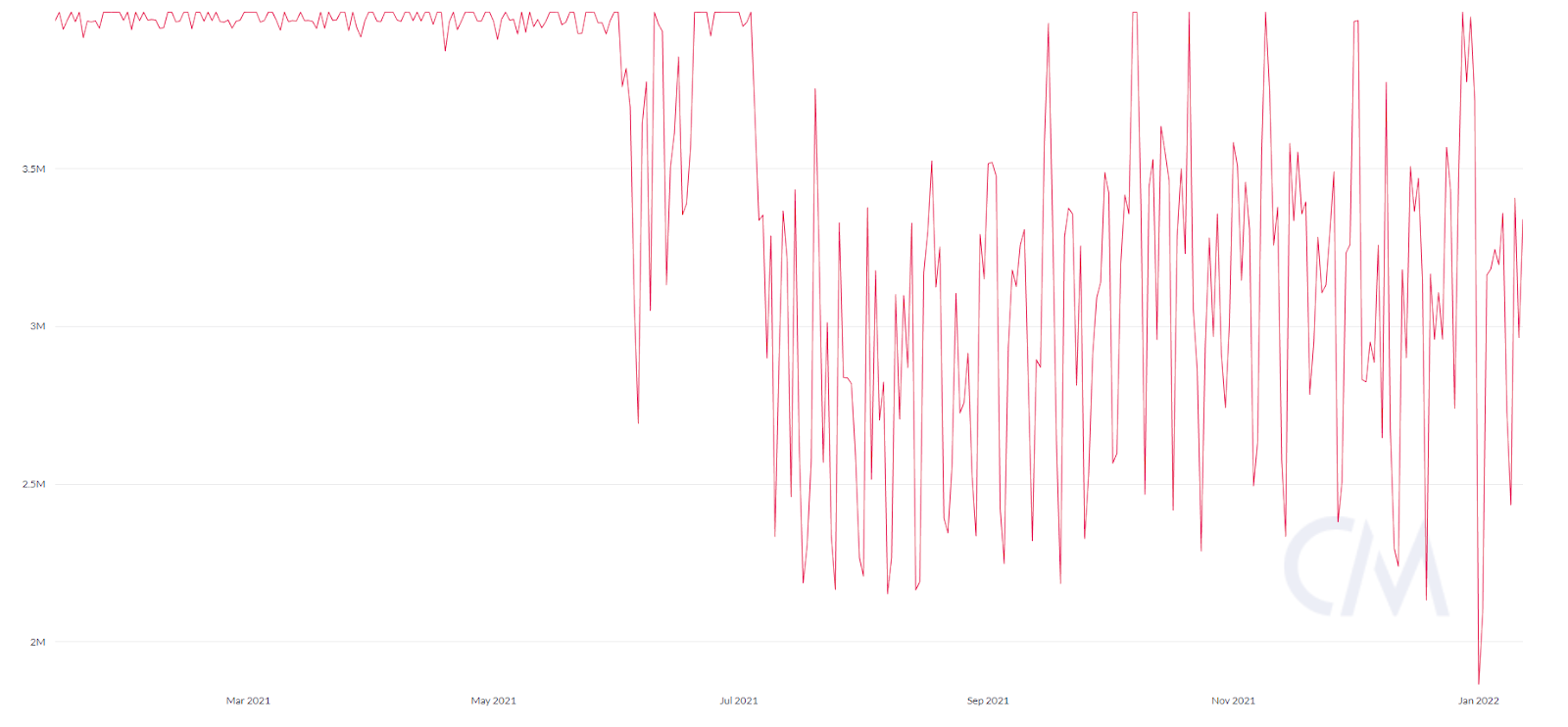
The Bitcoin protocol was a bit more active during most of 2020 with 3.85 TPS on average but saw a downturn in usage during the May 2021 crash, from which it has only partly recovered — a fact that is visible in the amount of blockspace used. Blocks are rarely more than half full in the second half of 2021.

Figure 2: Full capacity blocks until July 2021 and only half capacity later
Source:Coinmetrics

Time to finality for Bitcoin Core

Transactions are considered final after they are confirmed three to six times, depending on security requirements. The reasoning behind this is that alternatives could still overtake one block, but the effort needed to write a longer chain and catch up with more than three or six blocks is enormous. 

Six confirmations mean a minimum of 60 minutes until finality. Just two confirmations mean between 10.1 and 20 minutes of waiting time before a merchant would be wise to accept a BTC payment. That’s a long wait for a coffee.

In order to realize Nakamoto’s idea of an “electronic cash system,” his successors had to think about possible solutions to Bitcoin’s scalability problem. One of these solutions is the Lightning network, which is considered the most important layer 2 solution.

This article is an extract from the 80+ page Scaling Report: Does the Future of Decentralized Finance Still Belong to Ethereum? co-published by the Crypto Research Report and Cointelegraph Consulting, written by ten authors and supported by Arcana, Brave, ANote Music, Radix, Fuse, Cryptix, Casper Labs, Coinfinity, Ambire, BitPanda and CakeDEFI.

Phase IX: A New Era of CryptoBlades Earning

0

(9.1) Dynamic Minting Price

As of April 20, 2022, CryptoBlades character minting underwent a core update to its pricing and process called Dynamic Minting. Dynamic Minting is a new formula designed to regulate the amount of minting possible. Like the game’s Multi-Farm feature, a constant multiplier oscillates based on activity to control the outflow of minting—each costing more as activity and time go on. There is currently a floor price mechanic in place that does not let the minting price fall beneath a set amount. This amount will be updated as the price doubles from its current value, creating intense deflation over the coming weeks for CryptoBlades’ NFTs.

(9.2) CryptoBlades Genesis Event

The CBC (CryptoBlades Characters) Genesis Event will be the end of CryptoBlades generation one characters being able to be minted, meaning the current characters minted before then will be the only ones of their kind. With this, they will become 100% deflationary, increasing value over time as players continue to burn them using the character burn feature. This step is to dramatically increase generation one NFTs’ value and rewards for each individually. 

(9.3) Implementing New Fee Structure and Increasing Rewards

By playing CryptoBlades, players earn rewards after each successful combat that they can claim for a steady profit. The third step involves implementing a 25% generation one native gas fee on rewards, scaling with players’ earnings. However, this will be counteracted by increasing rewards by 25%. The purpose of this is to use a portion of gas fees to buy back SKILL and permanently fill Gold and Silver Multi-Farms. This liquidity incentive allows CryptoBlades to benefit from every smart chain they deploy to, regardless of involvement from the exchanges or smart chains themselves. It also will provide a permanent solution to multipliers on chains that lack adequate Knighthood partnerships.

(9.4) CryptoBlades Characters Second Generation

However, this is not the end for creating CryptoBlades teams. The second generation of characters will be released. One key difference will be with their own reward and minting structure. These will have similar prices to that of the NFTs currently and be affordable to many. Generation two will utilize its own Multi-Farm apart from generation one. It can be thought of as generation one earning “Gold” and generation two earning “Silver”.

(9.5) IGO Initiative for New Wallets

This will give players funds to craft weapons, spend in the shop, and create dust to power up their blades. They want players to have the most success and fun while earning!

(9.6) Increasing Reforge Bonuses

Existing and future reforge bonuses will be increased providing more incentive to burn weapons, increasing the floor price of CryptoBlades weapon NFTs. More bonuses mean more power which will bring more rewards for players!

(9.7) Multiple Smart Chain Additions

These will provide significant financial incentives for bridging monthly active users. These chains will also be provided with high-quality farm percentages to ensure they maintain the incentive requirements, with a portion of these incentives going directly into the reward pools. This allows our community to work together to achieve the active users’ benchmarks and win these rewards.

(9.8) Launch BAS and/or Avalanche Subnets
These will operate through SKILL token to add permanent utility for SKILL by offering a full suite of GameFi and DeFi services on our chains.

Social Media:

📺 YouTube 📘 Facebook 🕊️ Twitter 📰 Medium

🎮 Discord 🤖 Reddit💃🏻 TikTok

KING and SKILL are both listed at:

🐒 ApeSwap 🥞 PancakeSwap 🏦 LBank

SKILL is also listed at:

MEXC Global ✖️ XT.COM 🚪 Gate.io 👛 CoinEx

Websites:

👑 Cryptoblade Kingdoms Website

⚔️ Official Cryptoblades Website

📖 Learn How to Play Cryptoblades here

Bitcoin’s Script & Taproot

0

Using “hashcash” and other cryptographic approaches, Nakamoto found an ingenious and novel way to set financial incentives in such a way that fraud always leads to more losses than gains. But Bitcoin’s development did not end there!

Bitcoin’s Script programming language

Satoshi Nakamoto foresaw the need for programs to efficiently interact with the Bitcoin blockchain and developed the “Script” programming language.

Script has limited functionality compared to Ethereum’s Solidity or general-purpose languages, such as Rust, used by Solana. The main limitation is that Script prevents programs from looping. Loops are helpful for enumerations or working through datasets, but they can be used to empty wallets quickly in a series of smaller transactions.

Ethereum got to know what the vicious downsides of loops can entail when “The DAO heist” enabled a hacker to steal a large portion of all Ether (ETH) from a poorly designed smart contract.

This limitation makes Script “Turing Incomplete,” a fancy name for not having as many instructions as a general-purpose language. Turing incompleteness makes Bitcoin much more secure because it limits the potential for nasty bugs; however, it hinders what can be developed. There will never be native NFTs or DeFi applications on the Bitcoin network. Clever developers have had to create more complex solutions built atop Bitcoin for security but process elsewhere, so-called layer-two solutions.

Bitcoin Core developers have not been sleeping in the meantime and updated Script to Tapscript with the Taproot upgrade, which allows more complex transactions.

The Taproot update to Bitcoin Core

The “Block wars” over Bitcoin’s block size in 2017 left a deep and lasting wound on developers and stifled innovation. Bitcoin’s Taproot update is as much a healing process as it is a big step forward for the network’s technology.

Updates used to need a one-year announcement period during which miners could signify their approval. The “Speedy Trial” overlay in the Bitcoin Improvement Proposal (BIP) 8 reduced this timeframe to three months.

After the third try, 90% of miners signalled approval of BIP-340 and BIP-342, known as the Taproot update, on June 12, 2021. The update was locked in on Nov. 14 and went live without a hitch. The corresponding software updates to nodes propagated through the network in the months afterwards.

Taproot features two significant upgrades:

  1. Schnorr signatures: Replacing ECDSA signatures, Schnorr’s algorithm allows keys to sign transactions in aggregate. Bitcoin becomes more private this way because transactions signed by multiple parties are indistinguishable from single-signer transactions. They also enable Bitcoin scripts to sign transactions, expanding the possibilities of Bitcoin native programs.
  2. Tapscript: Expands the functionality of the Script programming language to facilitate more complex transaction conditions, helping the Lightning Network and other layer-two solutions become more private and efficient.

Most importantly of all, Bitcoin developers may have found a new confidence in their ability to innovate and fully support miners.

This confidence is key to keeping Bitcoin relevant with meaningful innovation in the future.

This article is an extract from the 80+ page Scaling Report: Does the Future of Decentralized Finance Still Belong to Ethereum? co-published by the Crypto Research Report and Cointelegraph Consulting, written by ten authors and supported by Arcana, Brave, ANote Music, Radix, Fuse, Cryptix, Casper Labs, Coinfinity, Ambire, BitPanda and CakeDEFI.
The Bitcoin Consensus Mechanism

0

The Bitcoin core developers have proven cautious about making changes to the foundation created by Nakamoto. Back in 2016/2017, when it took six days for transactions to settle, some users demanded a remedy in the form of larger block sizes to allow for more transactions per second.

This proposal did not meet developer support or miner acceptance. The situation became untenable for some, and Bitcoin Cash was born as a result of this confrontation. Bitcoin Cash increased the block size eightfold and can process up to 250 transactions per second (TPS).

How Bitcoin miners agree on transactions

Bitcoin uses the proof-of-work (PoW) consensus, which was first implemented in Hashcash. PoW forces miners to try quintillions of different numbers (called nonces), which get appended to the data in a block, and are then hashed using the SHA256 cryptographic function. The resulting hash is 256 bit (32 characters) long and changes radically with even the slightest alteration of the underlying data.

Hashing is a sound way to make data tamper-proof. The Bitcoin protocol only accepts hashes with a certain number of leading “0” characters. Since SHA256 is a unidirectional function, miners cannot work backwards from the desired hash to a fitting nonce but must try different numbers until one produces the desired result.

The number of leading 0s is set to such a length that all the miners in the world combined can only compute one block every 10 minutes on average. This is Bitcoin’s block time.

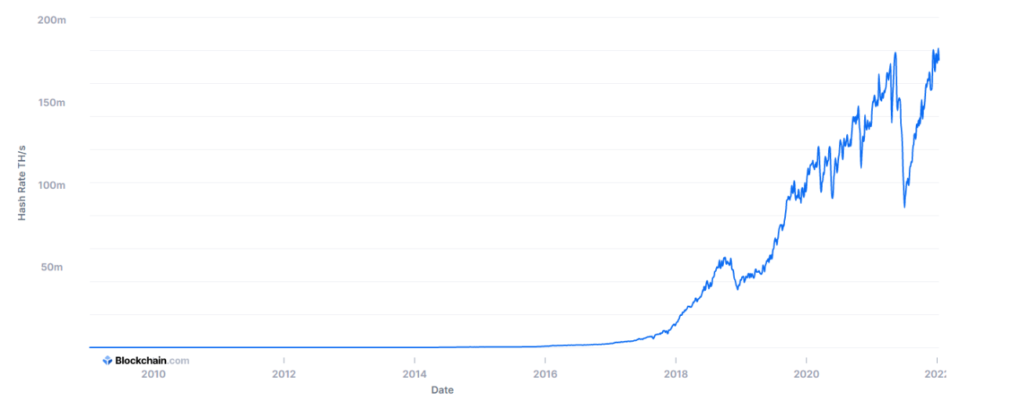
The Bitcoin hash rate is a measure of network security — currently at 185 EH/s (185*10^18)

Every block is linked to the block before, hence the moniker “blockchain.” Other miners verify a submitted block to ensure the same coins are not sent twice, or from an address a user doesn’t control. Only if they agree can a miner claim their rewards. Fraudulent activity means doing all the calculations in vain and wasted work.

Miners follow the longest possible chain of blocks. If an alternative version is proposed, it would need to recalculate all the blocks from the point of deviation onwards and overtake the main chain to write a different transaction history, known as a 51% attack, because the attacker would need the majority of the entire network’s hashing power to succeed. Hackers could use such an attack to reroute payments and empty wallets without controlling their private keys. 

Since the Bitcoin Core network currently has an astounding 185 quintillion hashes per second capacity, it is not economically possible to mount such an attack.

This article is an extract from the 80+ page Scaling Report: Does the Future of Decentralized Finance Still Belong to Ethereum? co-published by the Crypto Research Report and Cointelegraph Consulting, written by ten authors and supported by Arcana, Brave, ANote Music, Radix, Fuse, Cryptix, Casper Labs, Coinfinity, Ambire, BitPanda and CakeDEFI.
AVAX vs. Polygon: Who comes on TOP?

0

Ethereum is undoubtedly the largest blockchain ecosystem of protocols, DApps, and protocols. However, it is slow and costly. This has led to the emergence of blockchains that seek to reduce Ethereum gas fees and boost crypto transactions. This is where Avalanche and Polygon come in. The two blockchains seek to connect Ethereum intraoperative blockchains, minimize transaction costs, and increase speed.  But which one is better? 

Before we compare and contrast the two, here is brief information about each.

About Avalanche and Polygon

Avalanche is an open platform launched in September 2020. It supports the creation of DeFi and other smart contracts applications. Avalanche is often regarded as one of the “Ethereum killers” and most Avax predictions out there expect for the cryptocurrency to strengthen its position on the market during 2022.

Polygon is a layer two scaling solution for Ethereum. It is built on Ethereum and works alongside the slow and expensive blockchain. Polygon had its origin in India, but big crypto investors like Mark Cuban have invested in its ecosystem. 

The two blockchains support the creation and interoperability of chains on the Ethereum network. But how do they differ, and which is worth investing in?

Let’s find out. 

1. Chains Supported 

Avalanches comprise three blockchains with distinct functionalities. 

  • Contract Chain (C-Chain) Enables developers to easily create EVM compatible smart contracts and port applications.
  • Platform Chain (P-chain)- coordinates validators and supports the creation of subnets. 
  • Exchange chain – Supports trading of assets with AVAX as transaction fees.

On the other hand, Polygon enhances the scalability of the blockchains by supporting multi chains in the Ethereum ecosystem. It leverages validators to perform off-chain transactions before finalizing on Ethereum’s main chain. This significantly reduces strain on the mainnet, effectively boosting speed and reducing transaction costs. 

The platform has standalone and secured chains.

  • Stand-alone chain – Ethereum compatible and self-sovereign proof of stake chains 
  • Secure chains – use professional validators to boost security

2. Use Cases

Avalanches have three use cases: 

  1. Pay network fees on the avalanche blockchain. The transaction charges are based on Ethereum’s gas fee model EIP-1559. 
  2. Staking – allows users to participate in the validation and secure the blockchain.
  3.  The third use case is technical and involves using AVAX as a basic account unit for avalanche multiple subnets.

Besides these use cases, Avalanche is home to numerous dApps, gaming, and NFTs. Avalanche also supports metaverse. Avalanche is the fourth largest DeFi with some Ethereum based protocols such as Sushiswap and Aave lending protocol. The protocols have an $11 billion worth of total locked value. The main decentralized exchanges are Trader Joe, with $1.47 billion of assets locked into its liquidity pool.

Similarly, Polygon supports the creation of games, DeFi platforms, and NFTs. For instance, Polygon Studios has migrated games from Web 2.0 to 3.0. Similarly, NFT marketplaces such as Opensea enable the trading of NFTs on the Polygon network. Polygon is also emerging as one of the leading DeFi platforms with $5 billion in total locked value (TVL). 

 3. Blockchain Projects

Both blockchains have hundreds of projects running on their networks. The projects span Defi, gambling, collectible, marketplaces, social and games. Comparatively, Polygon takes the lead with over 900 projects while avalanche has over 200 projects. Despite this fact, Matic current predictions are not as optimistic as Avalanche.

The biggest project on the Polygon is ApeSwap Decentralized finance, with $5 billion total value assets. On the other hand, Teddy Cash leads on the Avalanche platform.

3. Consensus Mechanism

Avalanches use proof of stake consensus networks. Users with over 2000 nodes can run validators nodes to get AVAX rewards. Stakers with less can join forces to become a single validator. Polygon uses a proof of stake and selects transaction validators randomly.

4. Tokens

Polygon has a maximum supply of 10 billion coins, while the total AVAX supply is 395 million tokens. The Avalanche Network has a market cap of $25.7 billion and ranks 10th, followed closely by Polygons at sixteenth place. 

An AVAX coin costs $96.22 while MATIC is trading at $1.68. Polygon has a market cap of $12 billion.

5. Speed 

Polygon blockchain is way faster than Avalanche, with a processing speed of 65000 transactions per second (TPS) against Avalanche’s 45000 tps. 

6. Gas fees

Polygon’s average gas fee is currently $0.000181. In 2021, the price increased significantly after launching Sunflower Farmers play-to-earn game. Polygon’s gas fees surpassed 700 gewi. 

The Avalanche base fee varies between 0.001 to 1 avax depending on the subchain. The minimum base fee is 0.00005887 and has no upper bound. Avalanche price hit $10 last year after backers turned Ethereum critics.

Final Note 

Polygon and Avax have numerous similarities. Their growth is not far apart either. In fact, they have a correlation coefficient of 0.82.

However, their growth trajectory is not the same. Avalanche is an incredibly fast smart contract platform. It is also eco-friendly and low cost. 

On the other hand, Polygon has a flexible network that supports the creation of multiple chains. It is an easy-to-use platform for scaling and infrastructure development of Ethereum platforms. 

The avalanche is already bigger than the polygon and could continue dominating MATIC for quite some time.

Real-World Use and Adoption of Bitcoin

0

Bitcoin’s market capitalization has been above $1 trillion since February 2021, although it briefly dipped below that mark during the May 2021 downturn. But what about other metrics in regards to Bitcoins use and growth? In this article we will take a look at them!

Unique Bitcoin addresses

Bitcoin addresses are created by calculating a public and private key pair that conforms to the protocol’s specifications. The private key can then unlock the funds associated with its corresponding addresses, which is mathematically derived from the private key. 

The address only becomes publicly visible when funds have been sent. Before, it only existed as a possibility. Theoretically, another user could generate the same private key but with infinitesimally slim chances. Bitcoin’s pay-to-public-key hash address format can have a total of 1.4 * 10^48 possible addresses.

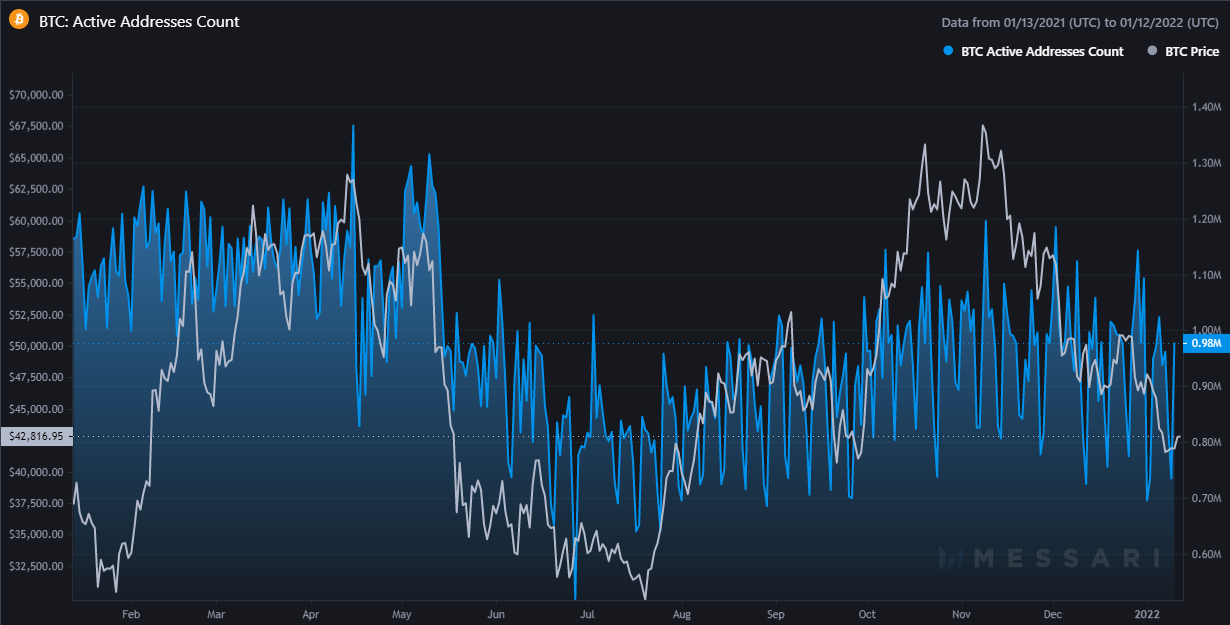
Looking at active addresses is more relevant for this comparison. Around 800,000 active Bitcoin addresses exist as of December 2021. In the last six months, the number grew 25% but is still not back to the peak of 1 million active addresses registered in January 2021.

Figure 3: Bitcoin active addresses fluctuate around 800,000

Source: Messari.io

The 100 richest Bitcoin addresses control around 15% of all BTC. Some of those haven’t moved their coins in years. Hodl (Hold On to your coins for Dear Life) culture is a strong force behind the digital asset.

Bitcoin protocol revenue and price-to-sales ratio

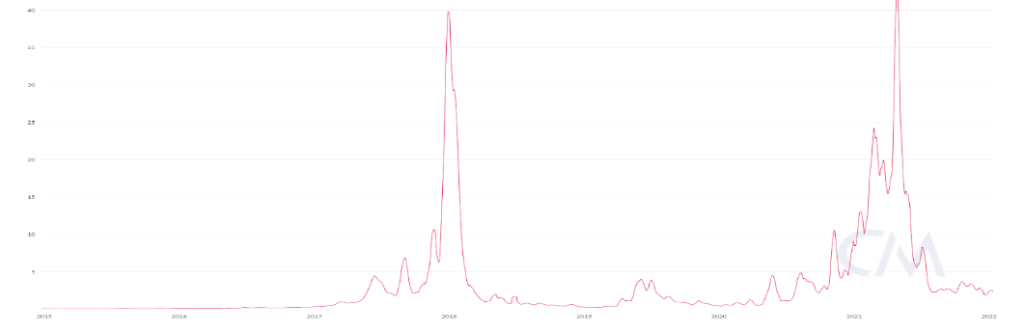
Miner revenue comes in the form of transaction fees and block rewards. Since Bitcoin’s protocol can only process seven transactions per second, fee revenue is a fraction of block rewards. Except for short bursts of intense interest, transaction fees rarely cross the 3% threshold of miner profits. 

Figure 4: Transaction fees as a percentage of block rewards. 40% spike in Jan 2018, 25% in May 2021

Source: CoinMetrics

In 2021, transaction fees were just short of $450 million. Bitcoin’s market capitalization is 2,200 times more than transaction fees, but just 70 times more than block rewards and transaction fees combined, assuming an average price of $43,000 per BTC. Solana, for comparison, has a P/S multiple of 30,909x.

Staking and lending rates for BTC

Thanks to the wonders of decentralized finance, precious Bitcoin can be put to work. Flexible staking can yield up to 6% rewards on Celsius. Locking withdrawals for 90 days can increase yields to 7.5% on Binance Earn.

Bitcoin can be bridged to the Ethereum network, controlled by a smart contract called Wrapped Bitcoin (wBTC). This wBTC can, in turn, be lent to Aave, but it currently yields less than 0.25% interest due to immense liquidity and little demand — a bullish signal representing investor faith.

DeFiChain(1), a DeFi application secured on the Bitcoin blockchain, offers up to 106% yield when providing liquidity to its exchange pools. Rewards are paid out in DFI, the project’s native coin.

Bitcoin initial coin distribution breakdown

Bitcoin has never had any initial coin distribution. Satoshi Nakamoto set up a Bitcoin node on his computer and at least one other and started mining blocks as a background process.

While the competition to mine blocks escalated rapidly and soon led to the use of dedicated mining hardware(2), the only “initial coin distribution” was the first-mover advantage that Nakamoto had. Research by the BitMEX(3) exchange attributes between 600,000 to 700,000 BTC to the mysterious founder entity. None of these coins have ever moved from their original addresses. 

Only 2.8%–3.5% of all BTC belong to the founder, and they’ve never sold a single coin — a display of strength and purity of principle.

  1. More information about Decentralized Exchanges here
  2. Learn more about Antminer here
  3. Does Satoshi have a million bitcoin? | BitMEX Blog

This article is an extract from the 80+ page Scaling Report: Does the Future of Decentralized Finance Still Belong to Ethereum? co-published by the Crypto Research Report and Cointelegraph Consulting, written by ten authors and supported by Arcana, Brave, ANote Music, Radix, Fuse, Cryptix, Casper Labs, Coinfinity, Ambire, BitPanda and CakeDEFI.

Introducing Bolstyr, The Future of Content Creation

0

With Web 3.0 buzzing throughout the crypto space and tech industry, many developers and enthusiasts are working to create and integrate the internet and modern technology into decentralized protocols. Crypto gaming, social media, and content creation are at the forefront of this wave, and with the rising popularity of crypto, it’s no surprise how quickly this movement is picking up momentum. Crypto gaming was the talk of 2021,  social media seeing glimpses of  NFTs and crypto integration earlier this year. Following in stride is an emerging content creation and subscription platform called Bolstyr. Bolstyr is a content creation platform with a system that is fully sustained through advertising sinks, trading fees, and industry-leading content creator incentives that are driven entirely by its native token, BOL, which is aimed to launch in Q2 of 2022. 

Bolstyr will be revolutionary for content creators and their fans. As businesses struggle to obtain prime rates for subscription processing via credit card, they must charge high commissions to pay intermediary parties. Combining that with the untapped potential to utilize the $2 trillion cryptocurrency market to pay content creators without using costly off-ramps, you create the perfect environment for users to subscribe to creators while allowing creators to earn every penny they deserve. The platform fees of competitors like Patreon and Onlyfans do not allow the same earning potential. For professional Filipino-American MMA fighter and Bolstyr Brand Ambassador Mark Striegl, he stated it was one of the main reasons he didn’t create on either platform and why he was so quick to jump on the opportunity to join Bolstyr. 

Overall, Bolstyr has been in development for nearly a year. Alongside their Brand Ambassadors is a strong team of employees and advisors. CEO of Riveted Games, Philip Devine, and Kevin Abdulrahman, a motivational speaker to fortune 500 companies and leading governments, are two advisors supporting the project alongside the CEO, Aaron Hutton, and his team. Bolstyr’s website and token whitelist launched on March 22, 2022, as this is the official beginning of an auspicious project. 


Website: https://bolstyr.io/

Social Media:

📘 Facebook |🕊️ Twitter |📰 Medium |🎮 Discord
🤖 Reddit |📱Telegram

Bitcoin and DeFi

0

Bitcoin’s design has specific limitations that make much of what Ethereum’s goals are impossible. However, these very limitations make Bitcoin more secure and stable. In a more poetic way, you could say that Bitcoin is the wise grandfather of modern cryptocurrencies. And although it comes across as old-fashioned, its principled nature makes it trustworthy and gives it a natural authority.

Bitcoin is the mother of all blockchains and still the largest crypto asset. Due to limited programmability, decentralized finance (DeFi) and non-fungible tokens (NFT) are only available on Bitcoin’s layer-two solutions. DeFiChain and the Lightning Network show that Bitcoin may be able to capture some of the DeFi market.

Going back to Day 1, someone or a group of persons with the pseudonym “Satoshi Nakamoto” created Bitcoin. The network went live on the Jan. 3, 2009, implementing the seminal white paper “Bitcoin: A Peer-To-Peer Electronic Cash System”(1) that was published a few months earlier in 2008.

Satoshi Nakamoto released his genius white paper in 2008

Leaning on previous research from Hashcash and others, Nakamoto found a genius and novel way to set economic incentives in such a way that fraud always leads to more loss than gain. Central authorities become unnecessary, and participants can interact with the network without knowing about other participants. Bitcoin is called “trustless” for that reason. 

The cryptocurrency sparked a revolution in thinking about financial transactions, economic incentives and collaboration that bloomed into a $2.5-trillion industry in just the next 12 years.

Completely open-source and maintained by a tiny group of core developers, who work on a pro-bono basis and are financed with donations, the Bitcoin blockchain has never suffered any global outage in its existence and now secures more than $1 trillion in assets. Its codebase, Bitcoin Core, has been cloned 105 times to create copycats and alternatives(2). Bitcoin Cash and Bitcoin Satoshi’s Vision are noteworthy; others were quick grabs for investor attention and pre-mined tokens — aka scams.

Bitcoin’s price and market capitalization

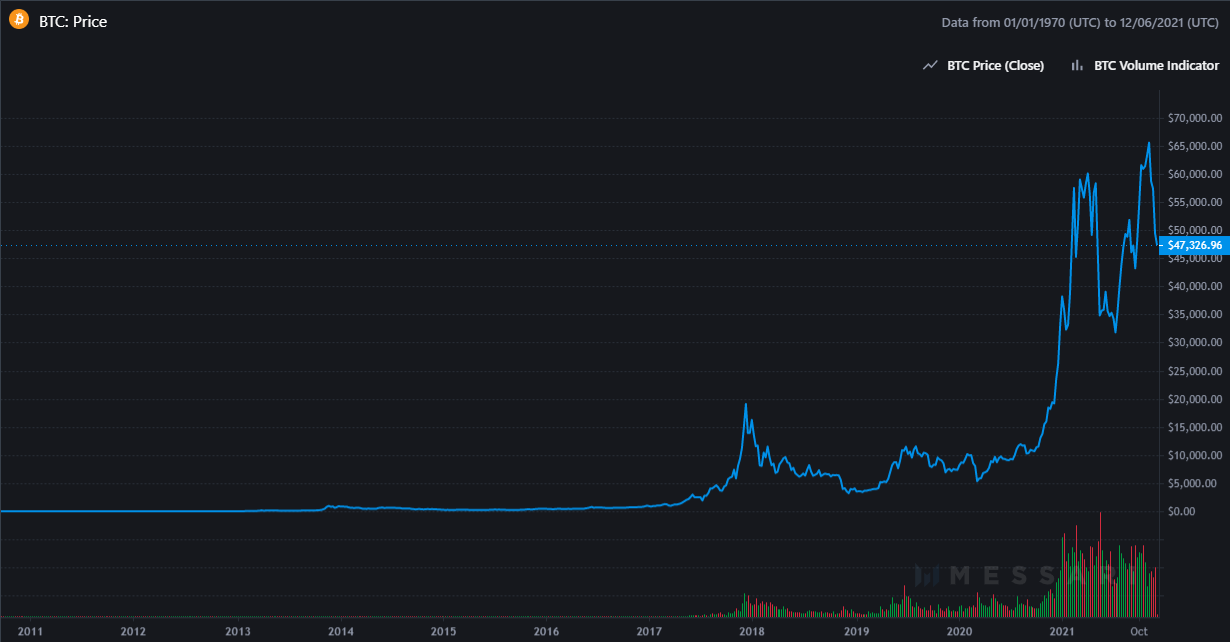
One of the best investments in the last decade was buying Bitcoin early. Initially traded for cents per BTC, the price exploded to more than $68,800 in November 2021. 

The Bitcoin community still celebrates its humble beginnings with the “Bitcoin pizza day” on May 22, the day that a young engineer named Laszlo Hanyecz paid a fellow user 10,000 BTC for two Papa John’s pizzas.

BTC’s price grew from $0.06 to $68,800 in 12 years

Bitcoin is a deflationary token, and only 21 million BTC will ever exist. New Bitcoin is created as a reward for miners finding a solution to computation-intensive cryptographical problems. The first to submit such a solution in the form of a fully formed Bitcoin block (a package of transaction data) receives a reward in the form of newly minted coins. On average, one block is discovered every 10 minutes and currently yields a 6.25-BTC reward.

Nakamoto laid out a plan to incentivize early adopters. From block 0 to block 210,000, every block received 50 BTC. The following 210,000 blocks got half of that, or 25 BTC, and so on until the most recent “Bitcoin halving” on May 11, 2020, which halved the block reward to 6.25 BTC. The next halving is in 2024, and each subsequent halving will happen every 210,000 blocks, or approximately every four years, until miners mine the last Bitcoin in 2140. Bitcoin is currently inflationary and will remain so for the next 123 years, albeit at decreasing inflation levels.

As of December 2021, 18.9 million BTC is in circulation(3), and 328,500 (~900 each day) is mined each year, an effective inflation rate of 1.7%. Bitcoin’s market capitalization has been above $1 trillion since February 2021, although it briefly dipped below that mark during the May 2021 downturn.

  1.  See “Bitcoin: A Peer-to-Peer Electronic Cash System”, Satoshi Nakamoto, Bitcoin.org
  2.  Learn more about Bitcoin Fork Count here
  3. See “How Many Bitcoins Are There Now in Circulation?”, Buy Bitcoin Worldwide

This article is an extract from the 80+ page Scaling Report: Does the Future of Decentralized Finance Still Belong to Ethereum? co-published by the Crypto Research Report and Cointelegraph Consulting, written by ten authors and supported by Arcana, Brave, ANote Music, Radix, Fuse, Cryptix, Casper Labs, Coinfinity, Ambire, BitPanda and CakeDEFI.
CryptoBlades Flips Axie Infinity in Daily Active Users After Another Month of Increased Earnings

0

Even as competitor Axie Infinity has struggled, CryptoBlades continues to increase its token and NFT rewards with multiple new features launched in 2022. CryptoBlades—the celebrated NFT, play-to-earn, blockchain game originally launched on BNB Chain last June—has been rewarding its players consistently and sustainably for the entirety of the year (and, looking forward, for many more to come). After the release of a new game feature, CryptoBlades Quests, they have significantly ramped up the game’s user acquisition numbers and heightened the experience for returning players.

CryptoBlades Quests is a feature that allows players to use their accumulated NFTs in a new and exciting play-to-earn format. After acquiring particular items (all of which can be attained through playing the game), players can exchange them for greater rewards. The rewards include stronger, more valuable NFTs and “Reputation,” experience points for quests needed to level up and unlock more challenging quests with greater rewards.

The CryptoBlades team consistently brings new content and gameplay to players. With the expansion of PvP, Character Burning, and overall rewards, it’s no wonder CryptoBlades is the number one Dapp on both HECO and OEC Chains and is showing no sign of slowing down.

To learn more about CryptoBlades or join their community, follow them on their social media accounts.

Social Media:

📺 YouTube |📘 Facebook |🕊️ Twitter |📰 Medium |🎮 Discord |🤖 Reddit |

💃🏻 TikTok

SKILL is listed at:

🐒 ApeSwap |🥞 PancakeSwap |🏦 LBank |⛰ MEXC Global |✖️ XT.COM

🚪 Gate.io |👛 CoinEx

Website:

⚔️ Official Cryptoblades Website

Telegram Channels:

📱‍🤝‍ Cryptoblades_General Chat |📱⚔️ Cryptoblades News Channel

What Is Decentralized Finance (DeFi)?

0

DeFi allows individuals to trade digital assets quickly, efficiently, and in a way that is settled because of the actions of programmed code, not because of a centralized entity. This allows for borrowing, lending, trading, collateralization, and payments, none of which requires permission from an outside authority.

One of the greatest applications of blockchain technology is in the realm of finance. As of this writing, the total value of all cryptocurrencies sits just below $2 trillion. One of the reasons for the expanse in the market capitalization of cryptocurrencies is decentralized finance or DeFi. DeFi continues to see a steady increase in users, and at the end of 2021, the total value locked (TVL) was more than $250 billion for all DeFi projects. Capital is flowing into DeFi from not only retail but also institutional investors, and worldwide adoption of cryptocurrencies is only in its infancy.

In the past, banks, investment services, insurance companies, and lenders would fall under the umbrella of finance for both the individual and businesses alike. Blockchain technology made it possible to provide the financial instruments which were offered by traditional finance (TradFi), which historically is characterized by centralized power, participation only by permission, high barriers to entry, and by “their rules.”

Decentralized Finance (DeFi) turns TradFi on its head.

DeFi is permissionless – In Defi, there is no middle man that stands between two or more people to make an agreement. This gives power back to individuals over institutions holding the power. It does not require a credit score or personal information to be exchanged. Just participants in peer-to-peer (P2P) transactions, interacting over computer code in a “trustless” manner (meaning the code ensures the transaction occurs, not just trusting another person).

DeFi is a global phenomenon – decentralized exchanges (DEXs) operate 365 days a year, 24 hours a day. There is no institution that limits hours of operation, no government regulation, and no governance needed other than that of the participants themselves. There are no state borders in DeFi. This allows for people who would never have the chance to invest in a yield-bearing financial tool in the TradFi space the ability to better their lives.

DeFi has low barriers to entry – DeFi does not require users to have entire “coins” of a particular blockchain to participate. Each cryptocurrency coin can be broken into tiny fractions of a whole, up to eight or even more decimal places! This means that anyone can start acquiring and utilizing different DeFi tools to better their position.

DeFi gives power back to the individual, allowing them to control their funds 24 hours every day of the year. People can decide to store their funds in non-custodial wallets, meaning they alone hold the private keys to unlock the use of these funds.

  1. Learn more about top-100 market capitalization coins here
  2. See “DeFi: A comprehensive guide to decentralized finance”, Cointelegraph
  3. See “3 key metrics show DeFi’s TVL on the verge of a new ATH”, Jordan Finneseth, Cointelegraph, January 5, 2022
  4. See “Grayscale sets sights on institutional DeFi fund”, Osato Avan-Nomayo, Cointelegraph, July 19, 2021
  5. See “The 2021 Global Crypto Adoption Index: Worldwide Adoption Jumps Over 880% With P2P Platforms Driving Cryptocurrency Usage in Emerging Markets”, Chainanalysis, October 14, 2021
  6. See “How to store crypto in 2022, explained”, Sarah Jensen, Cointelegraph, December 27, 2021

This article is an extract from the 80+ page Scaling Report: Does the Future of Decentralized Finance Still Belong to Ethereum? co-published by the Crypto Research Report and Cointelegraph Consulting, written by ten authors and supported by Arcana, Brave, ANote Music, Radix, Fuse, Cryptix, Casper Labs, Coinfinity, Ambire, BitPanda and CakeDEFI.