Saturday, January 17, 2026
Home Blog Page 36

AVAX vs. Polygon: Who comes on TOP?

0

Ethereum is undoubtedly the largest blockchain ecosystem of protocols, DApps, and protocols. However, it is slow and costly. This has led to the emergence of blockchains that seek to reduce Ethereum gas fees and boost crypto transactions. This is where Avalanche and Polygon come in. The two blockchains seek to connect Ethereum intraoperative blockchains, minimize transaction costs, and increase speed.  But which one is better? 

Before we compare and contrast the two, here is brief information about each.

About Avalanche and Polygon

Avalanche is an open platform launched in September 2020. It supports the creation of DeFi and other smart contracts applications. Avalanche is often regarded as one of the “Ethereum killers” and most Avax predictions out there expect for the cryptocurrency to strengthen its position on the market during 2022.

Polygon is a layer two scaling solution for Ethereum. It is built on Ethereum and works alongside the slow and expensive blockchain. Polygon had its origin in India, but big crypto investors like Mark Cuban have invested in its ecosystem. 

The two blockchains support the creation and interoperability of chains on the Ethereum network. But how do they differ, and which is worth investing in?

Let’s find out. 

1. Chains Supported 

Avalanches comprise three blockchains with distinct functionalities. 

  • Contract Chain (C-Chain) Enables developers to easily create EVM compatible smart contracts and port applications.
  • Platform Chain (P-chain)- coordinates validators and supports the creation of subnets. 
  • Exchange chain – Supports trading of assets with AVAX as transaction fees.

On the other hand, Polygon enhances the scalability of the blockchains by supporting multi chains in the Ethereum ecosystem. It leverages validators to perform off-chain transactions before finalizing on Ethereum’s main chain. This significantly reduces strain on the mainnet, effectively boosting speed and reducing transaction costs. 

The platform has standalone and secured chains.

  • Stand-alone chain – Ethereum compatible and self-sovereign proof of stake chains 
  • Secure chains – use professional validators to boost security

2. Use Cases

Avalanches have three use cases: 

  1. Pay network fees on the avalanche blockchain. The transaction charges are based on Ethereum’s gas fee model EIP-1559. 
  2. Staking – allows users to participate in the validation and secure the blockchain.
  3.  The third use case is technical and involves using AVAX as a basic account unit for avalanche multiple subnets.

Besides these use cases, Avalanche is home to numerous dApps, gaming, and NFTs. Avalanche also supports metaverse. Avalanche is the fourth largest DeFi with some Ethereum based protocols such as Sushiswap and Aave lending protocol. The protocols have an $11 billion worth of total locked value. The main decentralized exchanges are Trader Joe, with $1.47 billion of assets locked into its liquidity pool.

Similarly, Polygon supports the creation of games, DeFi platforms, and NFTs. For instance, Polygon Studios has migrated games from Web 2.0 to 3.0. Similarly, NFT marketplaces such as Opensea enable the trading of NFTs on the Polygon network. Polygon is also emerging as one of the leading DeFi platforms with $5 billion in total locked value (TVL). 

 3. Blockchain Projects

Both blockchains have hundreds of projects running on their networks. The projects span Defi, gambling, collectible, marketplaces, social and games. Comparatively, Polygon takes the lead with over 900 projects while avalanche has over 200 projects. Despite this fact, Matic current predictions are not as optimistic as Avalanche.

The biggest project on the Polygon is ApeSwap Decentralized finance, with $5 billion total value assets. On the other hand, Teddy Cash leads on the Avalanche platform.

3. Consensus Mechanism

Avalanches use proof of stake consensus networks. Users with over 2000 nodes can run validators nodes to get AVAX rewards. Stakers with less can join forces to become a single validator. Polygon uses a proof of stake and selects transaction validators randomly.

4. Tokens

Polygon has a maximum supply of 10 billion coins, while the total AVAX supply is 395 million tokens. The Avalanche Network has a market cap of $25.7 billion and ranks 10th, followed closely by Polygons at sixteenth place. 

An AVAX coin costs $96.22 while MATIC is trading at $1.68. Polygon has a market cap of $12 billion.

5. Speed 

Polygon blockchain is way faster than Avalanche, with a processing speed of 65000 transactions per second (TPS) against Avalanche’s 45000 tps. 

6. Gas fees

Polygon’s average gas fee is currently $0.000181. In 2021, the price increased significantly after launching Sunflower Farmers play-to-earn game. Polygon’s gas fees surpassed 700 gewi. 

The Avalanche base fee varies between 0.001 to 1 avax depending on the subchain. The minimum base fee is 0.00005887 and has no upper bound. Avalanche price hit $10 last year after backers turned Ethereum critics.

Final Note 

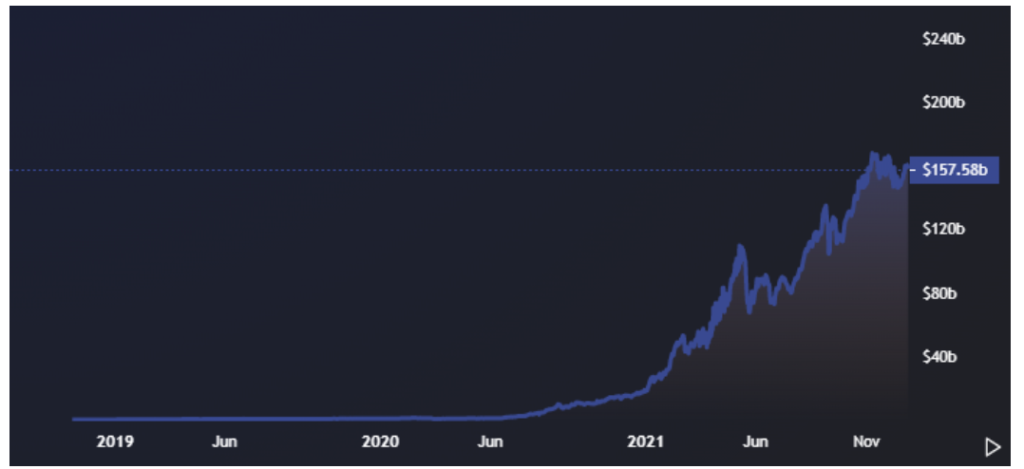
Polygon and Avax have numerous similarities. Their growth is not far apart either. In fact, they have a correlation coefficient of 0.82.

However, their growth trajectory is not the same. Avalanche is an incredibly fast smart contract platform. It is also eco-friendly and low cost. 

On the other hand, Polygon has a flexible network that supports the creation of multiple chains. It is an easy-to-use platform for scaling and infrastructure development of Ethereum platforms. 

The avalanche is already bigger than the polygon and could continue dominating MATIC for quite some time.

Real-World Use and Adoption of Bitcoin

0

Bitcoin’s market capitalization has been above $1 trillion since February 2021, although it briefly dipped below that mark during the May 2021 downturn. But what about other metrics in regards to Bitcoins use and growth? In this article we will take a look at them!

Unique Bitcoin addresses

Bitcoin addresses are created by calculating a public and private key pair that conforms to the protocol’s specifications. The private key can then unlock the funds associated with its corresponding addresses, which is mathematically derived from the private key. 

The address only becomes publicly visible when funds have been sent. Before, it only existed as a possibility. Theoretically, another user could generate the same private key but with infinitesimally slim chances. Bitcoin’s pay-to-public-key hash address format can have a total of 1.4 * 10^48 possible addresses.

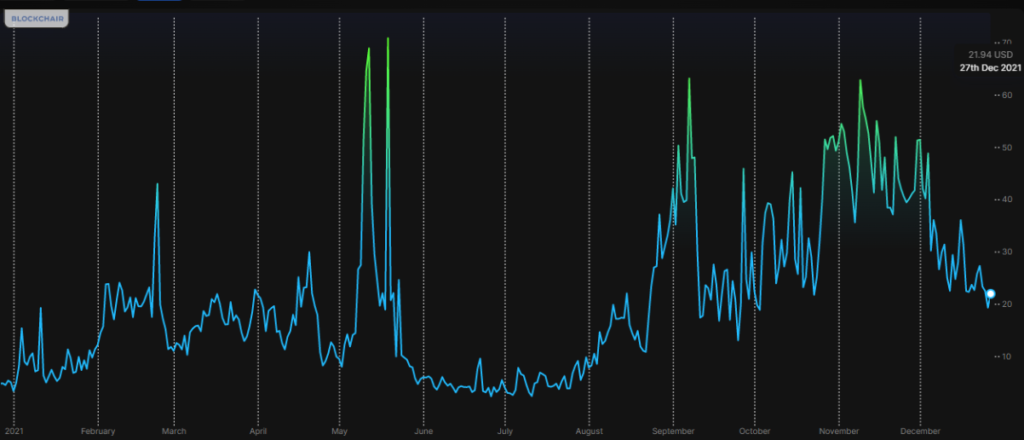
Looking at active addresses is more relevant for this comparison. Around 800,000 active Bitcoin addresses exist as of December 2021. In the last six months, the number grew 25% but is still not back to the peak of 1 million active addresses registered in January 2021.

Figure 3: Bitcoin active addresses fluctuate around 800,000

Source: Messari.io

The 100 richest Bitcoin addresses control around 15% of all BTC. Some of those haven’t moved their coins in years. Hodl (Hold On to your coins for Dear Life) culture is a strong force behind the digital asset.

Bitcoin protocol revenue and price-to-sales ratio

Miner revenue comes in the form of transaction fees and block rewards. Since Bitcoin’s protocol can only process seven transactions per second, fee revenue is a fraction of block rewards. Except for short bursts of intense interest, transaction fees rarely cross the 3% threshold of miner profits. 

Figure 4: Transaction fees as a percentage of block rewards. 40% spike in Jan 2018, 25% in May 2021

Source: CoinMetrics

In 2021, transaction fees were just short of $450 million. Bitcoin’s market capitalization is 2,200 times more than transaction fees, but just 70 times more than block rewards and transaction fees combined, assuming an average price of $43,000 per BTC. Solana, for comparison, has a P/S multiple of 30,909x.

Staking and lending rates for BTC

Thanks to the wonders of decentralized finance, precious Bitcoin can be put to work. Flexible staking can yield up to 6% rewards on Celsius. Locking withdrawals for 90 days can increase yields to 7.5% on Binance Earn.

Bitcoin can be bridged to the Ethereum network, controlled by a smart contract called Wrapped Bitcoin (wBTC). This wBTC can, in turn, be lent to Aave, but it currently yields less than 0.25% interest due to immense liquidity and little demand — a bullish signal representing investor faith.

DeFiChain(1), a DeFi application secured on the Bitcoin blockchain, offers up to 106% yield when providing liquidity to its exchange pools. Rewards are paid out in DFI, the project’s native coin.

Bitcoin initial coin distribution breakdown

Bitcoin has never had any initial coin distribution. Satoshi Nakamoto set up a Bitcoin node on his computer and at least one other and started mining blocks as a background process.

While the competition to mine blocks escalated rapidly and soon led to the use of dedicated mining hardware(2), the only “initial coin distribution” was the first-mover advantage that Nakamoto had. Research by the BitMEX(3) exchange attributes between 600,000 to 700,000 BTC to the mysterious founder entity. None of these coins have ever moved from their original addresses. 

Only 2.8%–3.5% of all BTC belong to the founder, and they’ve never sold a single coin — a display of strength and purity of principle.

  1. More information about Decentralized Exchanges here
  2. Learn more about Antminer here
  3. Does Satoshi have a million bitcoin? | BitMEX Blog

This article is an extract from the 80+ page Scaling Report: Does the Future of Decentralized Finance Still Belong to Ethereum? co-published by the Crypto Research Report and Cointelegraph Consulting, written by ten authors and supported by Arcana, Brave, ANote Music, Radix, Fuse, Cryptix, Casper Labs, Coinfinity, Ambire, BitPanda and CakeDEFI.

Introducing Bolstyr, The Future of Content Creation

0

With Web 3.0 buzzing throughout the crypto space and tech industry, many developers and enthusiasts are working to create and integrate the internet and modern technology into decentralized protocols. Crypto gaming, social media, and content creation are at the forefront of this wave, and with the rising popularity of crypto, it’s no surprise how quickly this movement is picking up momentum. Crypto gaming was the talk of 2021,  social media seeing glimpses of  NFTs and crypto integration earlier this year. Following in stride is an emerging content creation and subscription platform called Bolstyr. Bolstyr is a content creation platform with a system that is fully sustained through advertising sinks, trading fees, and industry-leading content creator incentives that are driven entirely by its native token, BOL, which is aimed to launch in Q2 of 2022. 

Bolstyr will be revolutionary for content creators and their fans. As businesses struggle to obtain prime rates for subscription processing via credit card, they must charge high commissions to pay intermediary parties. Combining that with the untapped potential to utilize the $2 trillion cryptocurrency market to pay content creators without using costly off-ramps, you create the perfect environment for users to subscribe to creators while allowing creators to earn every penny they deserve. The platform fees of competitors like Patreon and Onlyfans do not allow the same earning potential. For professional Filipino-American MMA fighter and Bolstyr Brand Ambassador Mark Striegl, he stated it was one of the main reasons he didn’t create on either platform and why he was so quick to jump on the opportunity to join Bolstyr. 

Overall, Bolstyr has been in development for nearly a year. Alongside their Brand Ambassadors is a strong team of employees and advisors. CEO of Riveted Games, Philip Devine, and Kevin Abdulrahman, a motivational speaker to fortune 500 companies and leading governments, are two advisors supporting the project alongside the CEO, Aaron Hutton, and his team. Bolstyr’s website and token whitelist launched on March 22, 2022, as this is the official beginning of an auspicious project. 


Website: https://bolstyr.io/

Social Media:

📘 Facebook |🕊️ Twitter |📰 Medium |🎮 Discord
🤖 Reddit |📱Telegram

Bitcoin and DeFi

0

Bitcoin’s design has specific limitations that make much of what Ethereum’s goals are impossible. However, these very limitations make Bitcoin more secure and stable. In a more poetic way, you could say that Bitcoin is the wise grandfather of modern cryptocurrencies. And although it comes across as old-fashioned, its principled nature makes it trustworthy and gives it a natural authority.

Bitcoin is the mother of all blockchains and still the largest crypto asset. Due to limited programmability, decentralized finance (DeFi) and non-fungible tokens (NFT) are only available on Bitcoin’s layer-two solutions. DeFiChain and the Lightning Network show that Bitcoin may be able to capture some of the DeFi market.

Going back to Day 1, someone or a group of persons with the pseudonym “Satoshi Nakamoto” created Bitcoin. The network went live on the Jan. 3, 2009, implementing the seminal white paper “Bitcoin: A Peer-To-Peer Electronic Cash System”(1) that was published a few months earlier in 2008.

Satoshi Nakamoto released his genius white paper in 2008

Leaning on previous research from Hashcash and others, Nakamoto found a genius and novel way to set economic incentives in such a way that fraud always leads to more loss than gain. Central authorities become unnecessary, and participants can interact with the network without knowing about other participants. Bitcoin is called “trustless” for that reason. 

The cryptocurrency sparked a revolution in thinking about financial transactions, economic incentives and collaboration that bloomed into a $2.5-trillion industry in just the next 12 years.

Completely open-source and maintained by a tiny group of core developers, who work on a pro-bono basis and are financed with donations, the Bitcoin blockchain has never suffered any global outage in its existence and now secures more than $1 trillion in assets. Its codebase, Bitcoin Core, has been cloned 105 times to create copycats and alternatives(2). Bitcoin Cash and Bitcoin Satoshi’s Vision are noteworthy; others were quick grabs for investor attention and pre-mined tokens — aka scams.

Bitcoin’s price and market capitalization

One of the best investments in the last decade was buying Bitcoin early. Initially traded for cents per BTC, the price exploded to more than $68,800 in November 2021. 

The Bitcoin community still celebrates its humble beginnings with the “Bitcoin pizza day” on May 22, the day that a young engineer named Laszlo Hanyecz paid a fellow user 10,000 BTC for two Papa John’s pizzas.

BTC’s price grew from $0.06 to $68,800 in 12 years

Bitcoin is a deflationary token, and only 21 million BTC will ever exist. New Bitcoin is created as a reward for miners finding a solution to computation-intensive cryptographical problems. The first to submit such a solution in the form of a fully formed Bitcoin block (a package of transaction data) receives a reward in the form of newly minted coins. On average, one block is discovered every 10 minutes and currently yields a 6.25-BTC reward.

Nakamoto laid out a plan to incentivize early adopters. From block 0 to block 210,000, every block received 50 BTC. The following 210,000 blocks got half of that, or 25 BTC, and so on until the most recent “Bitcoin halving” on May 11, 2020, which halved the block reward to 6.25 BTC. The next halving is in 2024, and each subsequent halving will happen every 210,000 blocks, or approximately every four years, until miners mine the last Bitcoin in 2140. Bitcoin is currently inflationary and will remain so for the next 123 years, albeit at decreasing inflation levels.

As of December 2021, 18.9 million BTC is in circulation(3), and 328,500 (~900 each day) is mined each year, an effective inflation rate of 1.7%. Bitcoin’s market capitalization has been above $1 trillion since February 2021, although it briefly dipped below that mark during the May 2021 downturn.

  1.  See “Bitcoin: A Peer-to-Peer Electronic Cash System”, Satoshi Nakamoto, Bitcoin.org
  2.  Learn more about Bitcoin Fork Count here
  3. See “How Many Bitcoins Are There Now in Circulation?”, Buy Bitcoin Worldwide

This article is an extract from the 80+ page Scaling Report: Does the Future of Decentralized Finance Still Belong to Ethereum? co-published by the Crypto Research Report and Cointelegraph Consulting, written by ten authors and supported by Arcana, Brave, ANote Music, Radix, Fuse, Cryptix, Casper Labs, Coinfinity, Ambire, BitPanda and CakeDEFI.

CryptoBlades Flips Axie Infinity in Daily Active Users After Another Month of Increased Earnings

0

Even as competitor Axie Infinity has struggled, CryptoBlades continues to increase its token and NFT rewards with multiple new features launched in 2022. CryptoBlades—the celebrated NFT, play-to-earn, blockchain game originally launched on BNB Chain last June—has been rewarding its players consistently and sustainably for the entirety of the year (and, looking forward, for many more to come). After the release of a new game feature, CryptoBlades Quests, they have significantly ramped up the game’s user acquisition numbers and heightened the experience for returning players.

CryptoBlades Quests is a feature that allows players to use their accumulated NFTs in a new and exciting play-to-earn format. After acquiring particular items (all of which can be attained through playing the game), players can exchange them for greater rewards. The rewards include stronger, more valuable NFTs and “Reputation,” experience points for quests needed to level up and unlock more challenging quests with greater rewards.

The CryptoBlades team consistently brings new content and gameplay to players. With the expansion of PvP, Character Burning, and overall rewards, it’s no wonder CryptoBlades is the number one Dapp on both HECO and OEC Chains and is showing no sign of slowing down.

To learn more about CryptoBlades or join their community, follow them on their social media accounts.

Social Media:

📺 YouTube |📘 Facebook |🕊️ Twitter |📰 Medium |🎮 Discord |🤖 Reddit |

💃🏻 TikTok

SKILL is listed at:

🐒 ApeSwap |🥞 PancakeSwap |🏦 LBank |⛰ MEXC Global |✖️ XT.COM

🚪 Gate.io |👛 CoinEx

Website:

⚔️ Official Cryptoblades Website

Telegram Channels:

📱‍🤝‍ Cryptoblades_General Chat |📱⚔️ Cryptoblades News Channel

What Is Decentralized Finance (DeFi)?

0

DeFi allows individuals to trade digital assets quickly, efficiently, and in a way that is settled because of the actions of programmed code, not because of a centralized entity. This allows for borrowing, lending, trading, collateralization, and payments, none of which requires permission from an outside authority.

One of the greatest applications of blockchain technology is in the realm of finance. As of this writing, the total value of all cryptocurrencies sits just below $2 trillion. One of the reasons for the expanse in the market capitalization of cryptocurrencies is decentralized finance or DeFi. DeFi continues to see a steady increase in users, and at the end of 2021, the total value locked (TVL) was more than $250 billion for all DeFi projects. Capital is flowing into DeFi from not only retail but also institutional investors, and worldwide adoption of cryptocurrencies is only in its infancy.

In the past, banks, investment services, insurance companies, and lenders would fall under the umbrella of finance for both the individual and businesses alike. Blockchain technology made it possible to provide the financial instruments which were offered by traditional finance (TradFi), which historically is characterized by centralized power, participation only by permission, high barriers to entry, and by “their rules.”

Decentralized Finance (DeFi) turns TradFi on its head.

DeFi is permissionless – In Defi, there is no middle man that stands between two or more people to make an agreement. This gives power back to individuals over institutions holding the power. It does not require a credit score or personal information to be exchanged. Just participants in peer-to-peer (P2P) transactions, interacting over computer code in a “trustless” manner (meaning the code ensures the transaction occurs, not just trusting another person).

DeFi is a global phenomenon – decentralized exchanges (DEXs) operate 365 days a year, 24 hours a day. There is no institution that limits hours of operation, no government regulation, and no governance needed other than that of the participants themselves. There are no state borders in DeFi. This allows for people who would never have the chance to invest in a yield-bearing financial tool in the TradFi space the ability to better their lives.

DeFi has low barriers to entry – DeFi does not require users to have entire “coins” of a particular blockchain to participate. Each cryptocurrency coin can be broken into tiny fractions of a whole, up to eight or even more decimal places! This means that anyone can start acquiring and utilizing different DeFi tools to better their position.

DeFi gives power back to the individual, allowing them to control their funds 24 hours every day of the year. People can decide to store their funds in non-custodial wallets, meaning they alone hold the private keys to unlock the use of these funds.

  1. Learn more about top-100 market capitalization coins here
  2. See “DeFi: A comprehensive guide to decentralized finance”, Cointelegraph
  3. See “3 key metrics show DeFi’s TVL on the verge of a new ATH”, Jordan Finneseth, Cointelegraph, January 5, 2022
  4. See “Grayscale sets sights on institutional DeFi fund”, Osato Avan-Nomayo, Cointelegraph, July 19, 2021
  5. See “The 2021 Global Crypto Adoption Index: Worldwide Adoption Jumps Over 880% With P2P Platforms Driving Cryptocurrency Usage in Emerging Markets”, Chainanalysis, October 14, 2021
  6. See “How to store crypto in 2022, explained”, Sarah Jensen, Cointelegraph, December 27, 2021

This article is an extract from the 80+ page Scaling Report: Does the Future of Decentralized Finance Still Belong to Ethereum? co-published by the Crypto Research Report and Cointelegraph Consulting, written by ten authors and supported by Arcana, Brave, ANote Music, Radix, Fuse, Cryptix, Casper Labs, Coinfinity, Ambire, BitPanda and CakeDEFI.

Tokens will do to contracts, what email did to letters

0

Nowadays, it seems normal that most business conversations are conducted via email. When it was first invented in 1971, or even when it was made available through a webmail service in 1994, hardly anyone would have expected it to be the norm for communication instead of letters.

Practitioner Perspective with Katharina Gehra of Immutable Insight, GmbH

Today, very few expect tokens to be the norm for binding agreements rather than contracts. However, we are convinced that the plethora of advantages of tokens versus contracting today, such as vastly increased security, lower cost, higher speed, easier and cheaper scalability, cross-border availability will undoubtedly lead to this paradigm shift.

Tokens will also develop into new scenarios that are not even thought of yet. Token design is open to exploit different approaches to business – in terms of services being offered, pricing models being adopted and ownership being defined. We are now seeing crypto tokens in the categories of utility, payment, and security token. There are at least four different sets of tokens that will be used in the near to mid-term future. The one that should be in the focus today are the ones that are neither crypto tokens, nor security tokens, nor tokenized existing assets such as bonds, but the ones that are hardest to describe because they are the least known and conceptualized yet. We’ll attempt to push into unchartered territory.

To start, let us have a look at what contracts mostly do today. When two or more parties want to interact reliably today, they are using elaborate contracts mostly written up by a specialized occupational group such as lawyers to define the matter, the scope, what happens if something that we can already imagine happening, happens and how we resolve a conflict if it may occur and has not been covered in this agreement yet. We also need to rely on the contractual party being the very contractual party and the signatory being able to make what the signature entails. In short, there is a lot of construction of eventualities and trying to mitigate execution risks in the process of the business itself.

What formal codified law or case law try to provide as a framework for such contracts, can be substituted by a framework for coding. Many lawyers and policymakers will disagree, some of them strongly, but while I am not saying it is there yet, I am still saying one form or the other, this will take precedence over our current system.

Why? The strongest force behind is the underlying economic logic. Today, most businesses act according to Price × Quantity = Revenue. And the quantity is directly or indirectly deduced from the number of people on the planet and the market needs they create. Tomorrow, token allow businesses where the multiplying quantity can entail not only human-related clients, but also machines and business processes that are entirely human free. If the number of potential clients is so much higher and for example by an automatization of a process the repetition of usage of a service is easier to predict for the future, even a minor fraction of price can lead to substantially more profitable new business models. It will create new types of platform business models, that make Google or Amazon’s platform scale look small.

Tokens will enable tokenization as a business logic that substitutes complex processes for the standardized version. Those new processes are by design very slim, straightforward, highly standardized, real-time actions with reliably proven identities for both the contractual parties and their respective signatories. Delivery, payment and record-keeping will all take place simultaneously and will be automated in the execution in order to decrease human involvement to the highest possible degree. This will lead to offerings so radically cheaper and more reliable, that it will outcompete the current offerings.

This change of execution reduces complexity dramatically to an extent where the cost effects and the speed of business will be so superior, that de facto the existing business modus operandi will fade out to a large extent.

And just as we still write letters under certain circumstances, so will single contracts still be produced and executed the old-fashioned way. If for now we assume that is the case in the future, the undeniable next question is: how do we get there most likely and maybe a little faster?

When Ethereum began to play a part in the blockchain universe in 2015 the whole notion of “the new internet” was introduced alongside it. It created the 2017 Initial Coin Offering (“ICO”) hype, but then this bubble burst and Ether and all tokens crashed subsequently.

After a cooling off period in 2018 and 2019, the models that were being initiated then started to show a higher level of seriousness and industrial grade application level. In 2019 security tokens (“STO”) were thought of being the new answer with some early issuances of prototypes, e.g., Bitbond in Germany. Before that model took off, in 2020 the wave of Decentralized Finance (“DeFi”) washed through the crypto scene and simply showed a stronger growth trajectory for Ethereum’s application landscape at this point in time.

However, both security tokens and DeFi center around some form of cryptocurrency or financial use case. And those are certainly good starting points. They show how to provide value-creating business models that are only possible for the fact that there is a blockchain as a platform that enables unique digital assets. Right now, most of the DeFi applications are still showing a strong resemblance to traditional finance. As soon as the Decentralized Finance model will develop and expand in somewhat unchartered territories with products and services being conceptually more advanced than traditional finance, we’ll be embarking on the journey to smarter and more competitive levels of tokens.

On the other side of the spectrum, traditional financial institutions are slowly but surely adopting security tokens. While Decentralized Finance develops products without a centralized issuer in the shape of tokens, traditional finance wraps their products in decentrally tradable security tokens. Bonds have been a very early version of it, but unfortunately those were more picture perfect, than below the surface perfect. The second round of security tokens, often originating from a real estate financing perspective, learned the lesson, but still rely on a quite traditional approach. Real estate today is defined by bigger ticket sizes, relatively little liquidity and high transaction cost. Beyond the two aspects where a token can immediately compete, i.e. potential fractionalization of ownership and easier tradability of the token itself, we also need an adoption of underlying registries. That will at this time create friction and thereby lessen the advantages of the standardized, scale approach which the tokens represent.

Rather than the real-estate or bond sectors, other areas have been discussed before and they might be easier tokenized at first. That might be rare special goods, such as fine art or old timer cars that usually are traded with low liquidity, little transparency and a strong dependency on a few reputable market makers such as specialized car dealers or art galleries. These assets are not so much hinged on existing registrar systems and are potentially also more open to the gamification aspect that tokens also can entail by design.

There might be some features of tokenization that have a stronger USP in more liquid markets. For example, in stock or commodity trading, the local time zone and opening hours of an exchange still play a significant role. Here a tokenized asset could build momentum on the fact that trading is possible 24 hours per day, 365 days per year. The higher availability can be superior to trading strategies that more and more are focusing on speed and higher turn-over, where also the transaction cost plays a role. Also, traditional patterns will be broken up – endangering some investors, enabling others at the same time.

While the former examples are still a little bit like training a horse to be faster, they all remain a horse with its innate limitations. The game changes as soon as from the mindset of “breeding a faster horse” we innovate into a “horse-power engine” that will jump start and exceed any horse-like limitations and whose speed is outcompeting any existing model.

So what is the engine going to look like? In my perspective, the tokenization will start by understanding the demand of the new client category: machines. Most of our business thinking has centered around catering human needs (aka “breeding a horse”). Our thinking needs to put the machines, servers, cars, utilities into our client focus. How machines produced cheaper and faster are serving their purpose longer and more cost effective, and how in the end are they being recycled more sustainably? How is the financing determined cheaper in light of the new cash flow projections of machines having machines as their client for a pre-determined demand? What type of real estate, logistics, supply chain implications will that have? What about legal ownership? At this point in time, we certainly have more questions than answers to these topics.

In an age of the emergence of knowledge, of the frequent interdisciplinary application of solutions – the combination of network effects, biomechanics, power efficiency, Internet of Things, blockchain and a new way of thinking about business models in combination with token design -to name only a few will create innovation faster than most people expect today. And tokens will have substituted contracts, much faster than it took email to replace letters.

Due to the numerous benefits tokenization offers, an improved regulatory environment, and strong interest from industry players, the future looks very bright for the STO market.

This article is an extract from the 90+ page Security Token Report 2021 co-published by the Crypto Research Report and Cointelegraph Consulting, written by thirteen authors and supported by Crypto Finance, Blocklabs Capital Management, HyperTrader, Ten31 Bank, Stadler Völkel Attorneys at Law, Riddle&Code, Coinfinity, Bitpanda Pro, Tokeny Solutions, AlgoTrader, and Elevated Returns.

WhiteBIT Cryptocurrency Exchange Enters the Metaverse with TCG World

0

You have probably already noticed how the metaverse is getting more and more popular every day, accelerated by Facebook’s strategic move to rebrand to Meta and develop their own metaverse. We are entering into a generational shift, people are buying virtual land for large sums of money, and big brands such as Nike & Adidas are on their way to developing virtual spaces in blockchain-based games such as The Sandbox and Decentraland.

TCG World, a metaverse project in which everything that the player owns exists on the blockchain, recently announced a partnership with WhiteBIT who will become the first cryptocurrency exchange to build their virtual office in the TCG World Metaverse.

WhiteBIT is amongst the top global exchanges on CMC and CoinGecko and supports USD, GBP, and EURO in over 190 countries with a user base in excess of 1,000,000. The metaverse will provide WhiteBit a new opportunity to connect with customers and players through the experiences developed on their virtual land. Players will be able to view charts, trade on the exchange in-game or visit their auditorium for live news feeds & streams as well as other unique experiences developed by the team.

To accompany the partnership, TCG World released a cinematic trailer of WhiteBIT’s virtual office in the Metaverse. The trailer takes you on a cinematic tour of their virtual building in the snow-covered north region of TCG World and offers players an early glimpse of the metaverse development and graphics. TCG Worlds partnered YouTuber Ryan Patrick also provides an insightful reaction video on the latest trailer release.

With the game set to go live in Q3 of 2022 for community testing, players are excited to jump into TCG World. You can join its popular Telegram or Discord communities in preparation for the release. Further information can be found on the official website, where virtual land is currently on presale.

Benefits of Real Estate Tokenization

0

Over the last few years, blockchain technology evolved a lot. Even though it is not that new, it seems that only lately have people started to see how beneficial it can be. Many businesses began integrating blockchain technology, which improved things for them.

Another process that has become quite popular among businesses is real estate tokenization. Experts keep talking about how it can positively influence a business and bring many financial and economic changes. 

So, should you consider real estate tokenization? If you were ready to implement this tool and reach out to lawyers for real estate tokenization, you will be happy to read about its benefits in this article.

  1. It Increases Transparency

With real estate tokenization, data is programmed into a digital token that is very secure. Thanks to this aspect, there will be full transparency between the seller and the investor, which makes things better for both sides. 

Not to mention that since the administrative work is reduced and there are fewer intermediaries, selling houses and buying them will be much cheaper. 

  1. Liquidity Increase

Real estate has always been an illiquid asset or a low-liquidity investment. This is because there is a significant capital requirement, there is a lot of paperwork and multiple parties involved, and the number of private players is higher. 

Luckily, real estate tokenization comes to save the day. Through it, assets will be fractionalized, and investors will have an easy entry, which makes the tokens more liquid. 

  1. Easier to Manage Properties

One of the challenges that property owners and tenants face is delayed monthly rent payments, as well as lease renewal. But this can change with real estate tokenization. 

With blockchain-based smart tokens or contracts, you will have the option to register documents into a special database. This way, you can syndicate loans, get rents from tenants on time, and even speed up the due diligence process. Overall, the process is fast and efficient for both parties.

  1. Ownership Proof

Rights and ownership have often been the reason why so many intense legal battles took place in the real estate industry. They may end up affecting the value of the brand, and may also take a lot of money, which is not something you want. 

With tokenization, data will be stored in blockchain ledgers and will not allow others to tamper with it. So, when fractional ownership or ownership is declared, you can start evaluating transactions from the past or the present. 

  1. Better Market Access

Not everyone can play the real estate investment game, mainly because only those with knowledge and possibilities can do it. 

However, with tokenization, the investor pool will increase in such a way that anyone who has a good Internet connection, and enough capital can either buy, sell or hold real estate from any place. Selling a token as a whole unit is not necessary considering the tokens are fractionalized. 

Conclusion

Real estate tokenization offers transparency, easier access to the market, and less expensive transactions, among others. You should give it a try for your business and see what benefits you can reap.

Easier Crypto Cash Out with Save Crypto Tax

0

Cryptocurrency transactions are not as anonymous as many people believe. A Bitcoin transaction is typically recorded eternally on the public ledger by design, which means that every action someone takes is permanently and publicly stored.  

Instead of anonymous, you are a pseudonymous address holder, meaning that the public has direct access to all transactions you have ever made. However, there are still ways to convert cryptocurrency into USD cash while keeping the user’s identity hidden to a better extent.  

For that, you have a plethora of options and platforms that provide this type of service. One of them is Save Crypto Tax, where cashing out anonymously and selling crypto for cash is their main priority.  

How does it work?  

Save Crypto Tax is well-known for its services that allow users to cash out anonymously with no other KYC requirements. But, if you are wondering how it works, the answer is quite simple:   

The user places an order, and it is delivered to their door. There are no additional requirements. Save Crypto Tax system works in a way in which cash buyers send cryptocurrency to the website using Bitcoin (BTC), Ethereum (ETH), or Monero (XMR) and receive 1:1 cash at his door via USPS.  

The platform was founded in the United States in 2017, and they have been providing similar services since then, with plans to expand into the United Kingdom.  

Why choose them? Because they believe that cryptocurrency is a KYC-free revolution, they intend to keep it that way, with no KYC required on their platform. And once the order is delivered and confirmed by the client, their system deletes all data associated with that trade.  

Are there still things that you should be aware of?  

There is nothing else a person should be aware of because the Save Crypto Tax has been doing this since the creation of Bitcoin, and they deal with more than 20 million per month, so the volume of a user trade will not be a problem for them. With their one-of-a-kind operation security and shipping, your money will be delivered to you in no time.  

The website’s system supports BTC, XMR, and ETH, and if you want to cash out any other cryptocurrency, open a support ticket. As soon as you have completed these steps and your order has been created, they will provide you with tracking information to know exactly when the order will arrive at your door.  

Everything said during the conversation is encrypted into the address details for end-to-end encryption, ensuring that everything remains anonymous.  

There are over 8k active traders with a $339,74k/24Hrs volume; and now is your time to make use of your crypto and become one of the Save Crypto Tax active traders.