Over the last year we have seen legislation waking up to the promises and dangers of blockchain technology and hope that they can provide clarity and guidance that enables innovation while protecting investors and consumers. The importance of this can also be seen in additional important surveys that were made about the crypto industry in the last couple of years and that we have not taken a look at in last weeks article.
The third report we want to include is the State Street Digital Assets Survey from October 2021. The report finds that:
82% of respondents are allowed to hold digital assets.
21% actually hold them, although most plan to increase their exposure.
56% expect cryptocurrencies to be common in modern portfolios within the next three years.
Asset holdings are driven by smaller funds. Sovereign wealth funds are mostly prohibited from investing.
Similar to the PwC report, funds prefer direct holdings for unleveraged long positions.
Custodial solutions are the most important building block for respondents because cybersecurity concerns are paramount blockers.
Decentralized finance (DeFi) and nonfungible tokens (NFT) are seen as the biggest drivers of disruption.
52% believe blockchains will enable real-time settlement in the financial markets at large.
Finally, the Bitwise/ETF Trends 2022 Benchmark Survey of Financial Advisor Attitudes Toward Crypto Assets report features some very promising indicators:
94% of financial advisors received questions about crypto from clients.
47% of advisors reported holding digital assets for themselves.
Client accounts with digital assets in them grew from 9% to 16%.
Crypto equities like Coinbase stock trumped the list of investments (46%), with Bitcoin (45%) and Ether (41%) not far behind.
60% reported regulatory concerns as the biggest deterrent.
53% viewed crypto as too volatile.
34% had trouble with applying valuation methodologies to digital assets.
Apart from regulation, 46% said that better custodial solutions would make them reconsider digital assets.
44% wanted a spot-based ETF to invest in.
Source: Cointelegraph Research
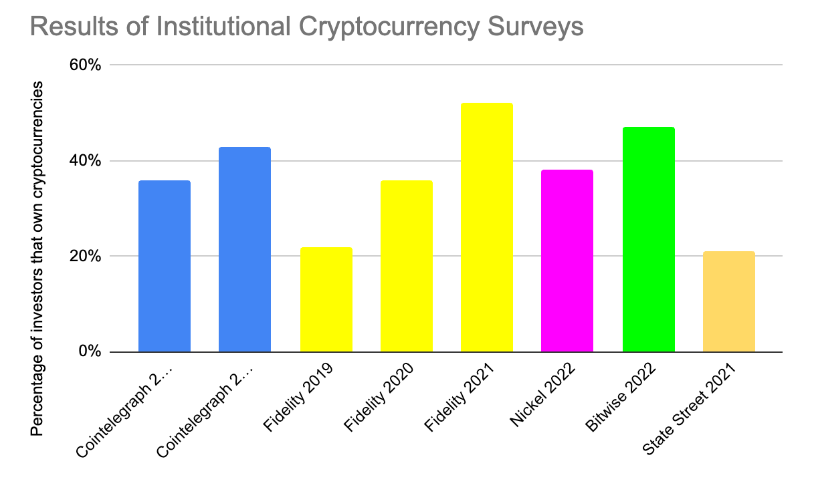
Comparing the results of the 4 surveys done in 2022 on professional investment in cryptocurrencies, 45% of institutional investors have exposure to digital assets. If there’s a common ground among these reports, it is that concise regulation and good custodial solutions would unlock investments on a massive scale. These two are clearly correlated, as custodians have some legal responsibility and are likely waiting for clarity themselves.
According to the survey by Fidelity, slightly more than half (52%) of institutions surveyed across Asia, Europe and the U.S. have already invested in cryptocurrencies. The results of Cointelegraph Research’s survey corroborate the findings of Fidelity’s 2021 survey of its professional investor clientele.
In addition to Fidelity’s survey, there have been four other surveys done of professional investment in cryptocurrencies. The 2022 Nickel Digital Institutional Investor Survey interviewed more than 100 investors representing more than $110 billion in assets under management (AUM).
Source: Nickel Digital Institutional Investor Survey
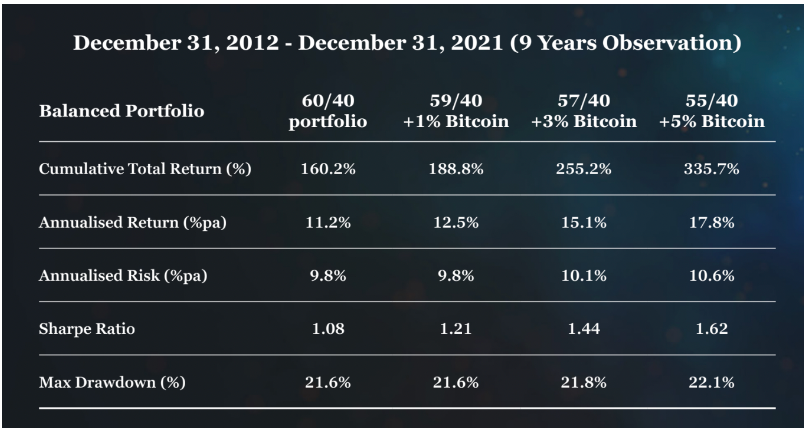
Nickel Digital Asset Management pointed out in their report, How Professional Investors Perceive Crypto in 2022 and Beyond that a single digit allocation to Bitcoin of 1% to 5% has a strong positive impact on portfolio performance. This can be seen in Figure 3 with a doubling of return by adding 5% of Bitcoin to a 55% stock and 40% bond portfolio. Similarly, Cointelegraph’s survey presented in this report found that professional investors had 3.3% of their portfolio invested in cryptocurrencies on average.
Similar to our findings, Nickel reports:
91% of professional investors believe digital assets are becoming more mainstream.
19 of the surveyed companies have invested in Bitcoin with over $60 billion worth of BTC held.
75% of the digital assets are held in North America (U.S. and Canada).
78% of the key personnel surveyed have a positive view about digital assets.
47% say improved custody is one of the key drivers of sentiment shift.
25% have more than doubled their holdings in the last year.
38% believe their funds will hold between 5%–10% of assets in crypto.
Exploiting market inefficiencies was the No. 1 alpha for 69% of investors surveyed.
79% cited security concerns for holding them back.
67% cited volatility concerns.
56% said low market capitalization meant reduced liquidity.
46% had regulatory concerns.
That security and liquidity concerns trump regulatory, and the legal risk outlook was the most surprising takeaway from this report in our view. This would mean that good custodian services with proven track records and improved derivatives offerings could be crucial to bring more institutional investors to the digital asset market.
Both of these will take time, but we have seen multiple promising offerings under development and are cautiously optimistic this space will see drastic improvements in the next 12 months.
The second survey report is the Annual Global Crypto Hedge Fund Report 2021 by PricewaterhouseCoopers. Since PwC’s report focuses on 2020–2021 investments, returns are not representative of current market conditions and have been omitted from this report. There are still a number of very interesting facts we have discovered.
In 2020, use of custodians by institutional investors decreased from 81% to 76%, indicating that institutions are more active in protocol governance, something that custodians usually do not actively support.
Digital asset funds were incorporated in the Cayman Islands (34%) and the U.S. (33%) for the most part.
Contrary to Nickel Digital’s more recent report, 82% of the participants cited regulatory concerns as one of the biggest challenges.
2020 saw a distinct reduction in quantitative digital asset investment strategies in favor of discretionary long and short holdings by hedge funds.
Investments were driven by family offices and high net-worth individuals with just 23 investors per fund (median).
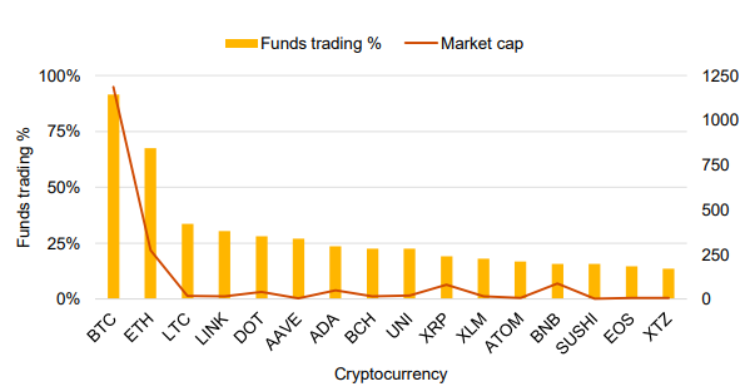
Investments were dominated by BTC and Ether (ETH) holdings, displaying the kind of power laws we’ve been seeing in other reports as well.
53% of the funds permit active shorting of digital assets.
28% have active short positions.
Only 56% of the hedge funds use derivatives as part of their investment execution.
Decentralized exchanges were used but dwarfed by their centralized counterparts, with just 16% of the participants using Uniswap and 8% using 1inch.
The average size of investment teams was 7.6 members with 2.8 years of crypto experience per team member. It seems that veterans of the initial coin offering bubble are calling the shots at hedge funds.
Lock up in digital asset funds was one year across surveyed funds, with about 30% in hard lock.
Source: PricewaterhouseCoopers
The PwC report represents a less recent survey of the current landscape. Nickel Digital’s survey portrayed a landscape where investors’ regulatory concerns have been partly addressed and investment strategies have matured. Digital asset investments are making leaps and bounds in professionalizing their operations and offerings. But there are even more reports that we want to take a look at in next weeks article!
This report presents the survey results of Cointelegraph’s second annual survey of professional investors from traditional finance (TradFi). This survey provides a comprehensive record of the cryptocurrency investments of professional investors, including changes in their attitudes toward digital assets and their future allocation plans.
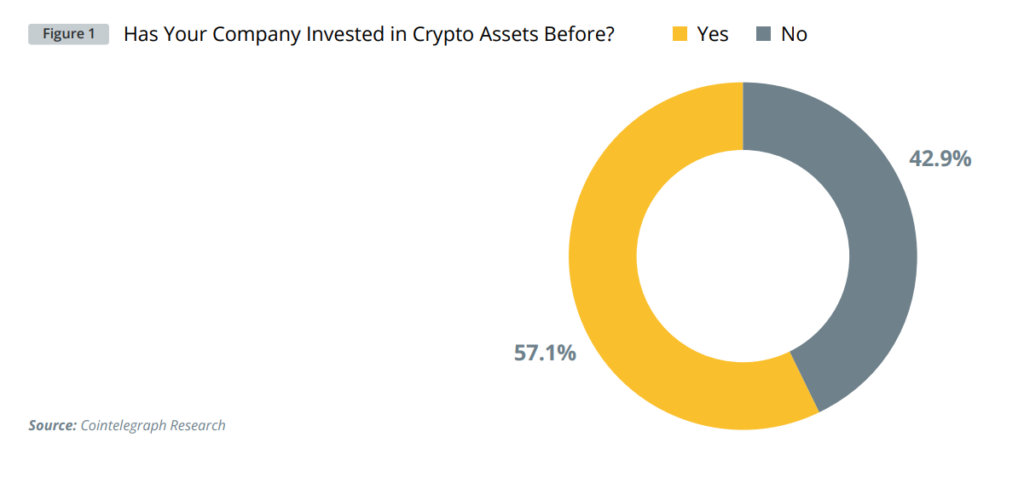
The main findings confirm the rumors that institutions are investing in cryptocurrencies. Over the last two years, the percentage of institutional investors that have bought cryptocurrencies has increased by 22%. The new survey shows that 43% of professional investors have invested in cryptocurrencies, up from 36% in 2020, and that 19% plan to buy them in the future. Out of the 48 respondents that reported they do not currently own crypto assets, 16 of them said they plan to invest in crypto assets in the future. This means that the majority (62%) of the professional investors that responded to this survey are interested in having digital assets in their portfolio.
This survey had 84 responses from professional investors across the world, with a focus on the United States, Europe and Asia. Respondents included traditional banks, asset managers and pension funds. This report focuses on buy-side, not sell-side, asset allocators. Therefore, we did not send this survey to crypto funds that are invested 100% in digital assets. The goal of this report is to gauge the demand for digital assets from traditional financial intermediaries.
The survey was delivered via email to 6,004 registered professional investors with the financial market authority in 11 countries: Japan, Singapore, the U.S., Canada, the United Kingdom, Germany, Austria, Switzerland, Liechtenstein, France and Finland. Investors were given a two-week period to respond in July 2022.
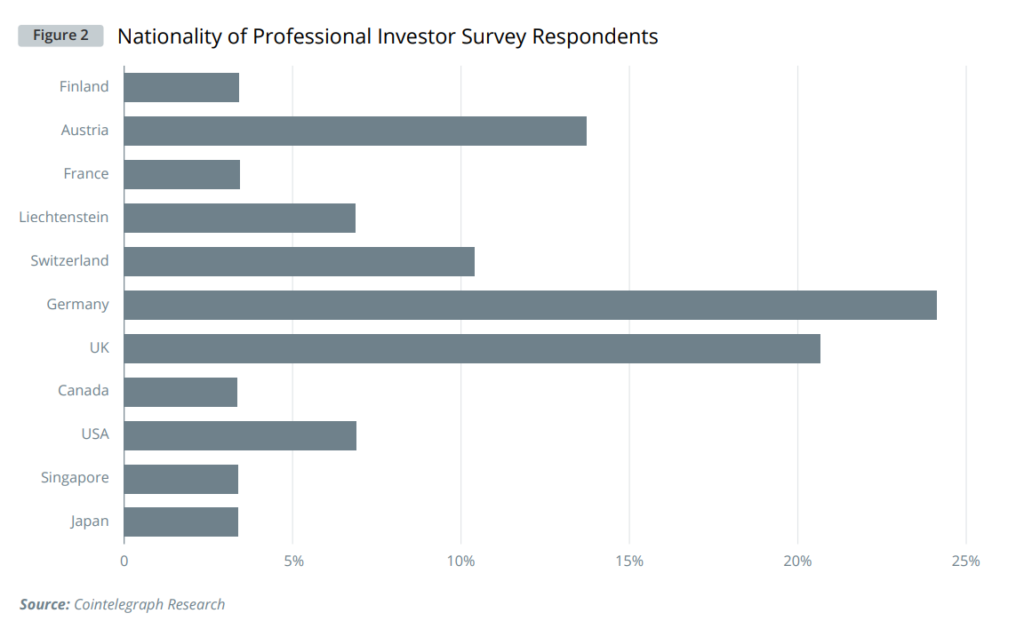
The majority of the respondents came from Germany and the U.K., followed by Austria and Switzerland. When sorting the survey results by country, the respondents from the U.K. managed the most assets. In total, the respondents manage $316 billion in assets, 3.3% of which, or approximately $10.42 billion, is invested into cryptocurrencies. Austria’s respondents worked in firms with the highest headcount. The majority (83%) of the respondents worked in firms with fewer than 50 employees. Only one woman in charge of asset allocation decisions at her company responded to the survey compared to 81 men. The median age of the respondent was 48.8 years old.
Total institutional holdings of cryptocurrency through trusts and funds was estimated to be $62.5 billion at the end of 2021, according to CoinShares. This number does not include direct Bitcoin (BTC) holdings, worth more than $10 billion, as of March 31, 2022, or venture funding volume, worth $25.1 billion in 2021.
Out of the 19.15 million BTC in circulation, an estimated 7.54% (1,444,201) are held by institutional investors ranging from publicly traded companies, such as Tesla, private companies, such as the insurance provider MassMutual, exchange-traded funds (ETFs), such as VanEck, and countries, such as El Salvador.
However, institutional interest is difficult to measure directly. Quantifying the largest traditional financial investors in cryptocurrencies is difficult because many institutional investors do not disclose their holdings of cryptocurrencies publicly. Furthermore, many institutional investors have indirect exposure to cryptocurrencies and blockchain technology via the stocks that they hold. Instead, surveys can be used to estimate the real magnitude of institutional cryptocurrency holdings.
The institutions are here, and they are buying the dip. Cointelegraph’s second annual survey found that 62% of professional investors currently hold digital assets (43%) or plan to buy them in the future (19%).
Blackrock, the largest asset manager in the world with $10 trillion in assets, just announced its second blockchain ETF, one month after the debut of its first one. Goldman Sachs took on principal risk in a crypto OTC trade for the first time with Galaxy Digital. Goldman Sachs now has a part of its website dedicated to the investment case for cryptocurrencies and the metaverse. The largest hedge fund in the world with $140 billion in assets under management, Bridgewater Associates, announced they were backing a Bitcoin fund. Fidelity is weighing a plan to allow its brokerage customers—some 34.4 million individual investors—to trade the world’s largest cryptocurrency. Citadel, Brevan Howard, Investment Bank Cowen—soon, the list of institutional investors in crypto will be longer than the list not involved. Not only will these institutions bring liquidity to the cryptocurrency space, but they also hold significant power in local politics and governments. Finance, insurance, and real estate lobbyist groups in the US spent $539 million in 2020 on influencing regulation and public policy.
As institutions join the blockchain ecosystem, the demand for institutional-grade infrastructure is growing. The largest global banks, including JPMorgan Chase, Bank of America, and DBS Bank, amongst others, have invested in educating themselves on the topic of digital assets, and many are already venturing into offering products and services.
The entire technology stack from traditional finance is integrating the necessary tools to handle cryptocurrencies. There are custodian banks, market makers, paying agents, and clearing houses that are establishing themselves as trusted intermediaries for blockchain-based assets.
However, some key questions remain. How much of the cryptocurrency market capitalization and daily trading volume is done by institutions versus retail investors? The answer to this question helps us understand if crypto is mainly a retail phenomenon or if institutions already own a considerable chunk of the market. This report investigates the direction of the capital flow. Are professional traders currently buying or selling Bitcoin? Are institutions primarily interested in Bitcoin, Ethereum, or some other method for gaining exposure to blockchain technology, such as private equity or mergers and acquisitions? Do they plan to increase their exposure to blockchain over the next 12 months?
To answer these questions, Cointelegraph Research took a data-driven approach in the second annual Institutional Demand for Cryptocurrencies Global Survey 2022 Report. To gain a deeper understanding of how professional investors feel about blockchain assets, this 60+ page research report presents 32 questions about crypto assets answered by 84 wealthy investors across Asia, the US, and Europe.
Algorand’s democratized variation on PoS, dubbed pure proof-of-stake, is essentially the secret recipe by which the network claims it achieves its holy grail of scalability, decentralization and security.
Three properties actualize this reality:
First, it democratizes access to network participation by requiring only 1 ALGO as the minimum stake to serve as either a relay or a participation node. Relay nodes are responsible for communicating across the network and ensuring messages are propagated properly, while participation nodes run and engage in the consensus algorithm. Second, it distributes validator rewards to all token holders as opposed to only validators present in the ETH model, amassing them ~4%–6% APY. Third, the aspect of randomness that guarantees a fair opportunity of participation for all eligible nodes in respect to their stake.
In that regard, Algorand’s process to block production, executable over three stages and reliant on on-chain randomness, includes a proposal, soft vote and certify phases. Proposals begin with all eligible nodes looping through the sub accounts they oversee while running a cryptographic primitive, known as a verifiable random function (VRF), to determine which ones are nominated to propose a block in the next stage of consensus based on their hashed proofs.
VRFs, in short, are pseudo-random cryptographic functions capable of providing proof that their outputs were correctly calculated by their submitter, as it is mapped to their public key. They perform similar to a weighted lottery system in that the total number of staked ALGO increases the probability of being chosen as every token acts like it is its own lottery ticket for its owner’s address.
Selected accounts then transmit their next proposed block linked up with the associated VRF output that substantiates their validity as a proposer. The next stage proceeds with the aim of reducing all block proposals to one. The VRF gets reexecuted to form the soft vote committee where participants are randomly selected to vote for the proposal with the lowest hash value, repeatedly, until a quorum is reached. Finally, the certify vote stage arrives with the formulation of a new committee to testify that the proposed block is absent of any double- or over-spending issues. The committee then votes to certify the block if a quorum is present in an analogous manner to the previous stage.
Algorand’s key component in achieving scalability without compromising on either security or decentralization is the element of randomness abstracted in the pure proof-of-stake algorithm and its reciprocal cryptographic sortition mechanism relating to the VRF.
Randomness bolsters security as the proposing or committee accounts are chosen randomly and secretly without any peer-to-peer messaging overhead. Nodes only loop through their accounts and run a personal lottery to validate if they were chosen, meaning that block-producing nodes’ identities are concealed, further protecting them against any distributed denial-of-service attacks. Even if they were identified, nodes and committees are replaced intermittently with a randomly selected group in every round of consensus; so, targeting them that late would be fruitless.
Not only does this reduce the chances for a network attack, but it also inhibits the network with its unforkable state. To put in context, miners in PoW-based systems are susceptible to solving the cryptographic puzzle at the same block height, which results in a soft fork of the chain, where the one belonging to the lower-activity chain will be eventually discarded. Within Algorand’s consensus, only one block can be confirmed as accounts are randomly chosen to propose the block and form the committee to fill this expectation at once and then replaced by its next random-weighted round of selected accounts.
Every participating node will be eligible to propose and approve a block, relatively proportional to its stake, as it is periodically and randomly chosen per round. There will never be a rigid set of validators controlling the block production process since nodes are randomly rotating, no matter how deep their pockets might be. Finally, randomness ensures scalability is maintained in that a 1,000-member committee along with a single-block proposer will always periodically and randomly rotate to lead new rounds of consensus, at 100M, 1B, and 10B users network scale.
6.4 Tokenomics
The ALGO token is the network’s native currency and the bedrock for any activity on top of the Algorand blockchain. ALGO is capped at 10 billion tokens that were minted during the token generation event, with only 25 million sold during the first public ICO on CoinList at a price of $2.4 in June 2019. The wide discrepancy between what private investors bought at versus the public price created an initial huge selling pressure, prompting the foundation to offer two buy-back programs in August 2019 and June 2020 for all retail investors who were affected by the chaotic launch, where almost all of the retail investors opted in for redemption, as it was significantly higher than ALGO’s current market price.
When it comes to its utility, ALGO is used as a medium of exchange to pay for storing data and processing transactions. The token is also used as an instrument to participate in the network’s consensus by allowing any individual with at least 1 staked ALGO to become a validating node, contribute to the block production process, and secure the network. Finally, ALGO will be also used to participate in the newly rolled out community governance, while locking the token for a predefined period enables holders to vote on the root governance matters, in addition to yielding further rewards of ~17% per quarter as a result of governance participation.
Algorand’s initial tokenomics projected that the entire supply of 10 billion should be reached by 2024, with 2.5 billion allocated for communal ALGO sales, 1.9 billion for ecosystem support, 3.1 billion for incentivizing an early relay node runners program, 500 million for the Algorand Foundation, and 2 billion will be dedicated to the software company Algorand Inc. Listening to the community’s criticism nevertheless, the token distribution has been updated with a focus on rewarding participants that can prove their commitment to the long-term growth of the projects through staking for a lengthy period — to be extended until 2030 with the revised distributions below as well as the protracted token release schedule.
6.5 Algorand ecosystem
The carbon-neutral blockchain did not really pick up steam until last year. Early 2020 saw the Algorand 2.0 network upgrade introducing some of the layer-one capabilities that make up the present foundation of the blockchain’s core functionality, such as stateless smart contracts, atomic transfers and the ASA protocol. However, it was the debut of stateful smart contracts in August 2020 that set the ball rolling for Algorand to garner attention as it became capable of servicing the exciting new wave of DeFi projects currently being developed on top of the network.
Few players understood Algorand’s potential early in the journey as initial rounds of adoption saw Algorand ink partnership with the Marshall Islands to underpin the issuance of their central bank digital currency while integrating conventional stablecoins such as USDC and USDT onto the network to cater to DeFi’s rudimentary substratum. Algorand also collaborated with SIAE, the largest Italian copywriting agency, to issue 4 million NFTs representing over 95,000 creators as ASAs. This complemented another coalition with planetwatch, an environmental monitoring service designed for capturing data to operate air-quality sensors in hopes of maintaining a global air quality ledger on Algorand’s blockchain.
To capitalize on the network’s upgraded capabilities, Algorand launched its series of accelerator programs – a 12 week initiatives focused on spurring the development of the blockchain’s ecosystem via providing funding resources (in partnership with Eterna and borderless capital) and mentorship (technological, economical, marketing) for aspiring projects hoping to build on top of the blockchain. The first iteration, Algorand’s Asia accelerator program, which ended in early January 2021, wanted to ameliorate Finance 3.0 as its focal point and saw a curated list of projects accepted into the program to build the foundational stage of financial services.
Some of the inductees included DEXTF (an asset management protocol), StakerDAO (a DAO for governing financial assets), Yieldly (the first full-suite of DeFi services on Algorand), and VeriTX (digital commerce marketplace for exchanging physical assets like medical equipment).
The second half of 2021 was the biggest growth catalyst thus far. First, Algorand’s technological stack was updated to include the AVM 1.0 upgrade, which was necessary to predicate the roll-out of more complex smart contracts. It was an equally eventful biannual for the network’s funding as borderless capital set forth a $25-million Miami-based fund for investing in projects harnessing Algorand’s technology. This was followed by Arrington capital’s $100-million advertised fund to back Algorand-focused protocols back in June. In September, SkyBridge Capital allocated another $250-million fund to fuel the growth of DApps building on top of the network.
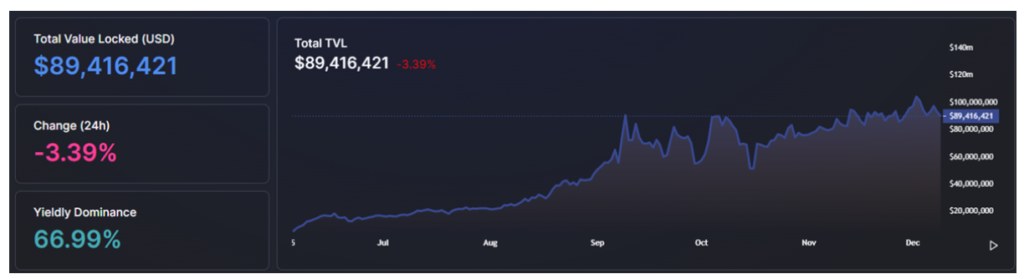
Activity truly began to forge ahead following Algorand Foundation’s decision to launch the $300-million Viridis fund in September, which is focused on growing DeFi on the emerging network, as manifested by the increase of active addresses from last September shown above. Precisely, the capital was to be deployed for bankrolling applications relating to money markets, NFT platforms and synthetics issuance — the ground-laying infrastructure for DeFi. Tinyman, an Algorand-based automated market maker, raised $2.5 million following the fund’s announcement and in hopes of securing the required liquidity at launch. The DEX went live on mainnet on Oct. 31, marking the first true passageway to DeFi on the growing blockchain. Yieldly and Tinyman are the only two DeFi applications live on Algorand’s mainnet where they attribute a sum of $85 million in total value locked.
The upgrade capabilities, combined with the inflow of capital, unequivocally stirred the development of more complex primitives, such as Algofi (a lending, borrowing market), Algodex (an order-book-based DEX), Mese (a micro-equity exchange), Algomint (a synthetics platform), and saw their deployment to testnet.
Amongst an extensive pipeline of DeFi projects coming to Algorand, Prismatic, a treasury management protocol for crypto organizations, is launching in Q2/22. The protocol puts a special emphasis on security and transparency through building multi-sig tooling, enabling crypto organizations to manage digital assets in a time and cost-efficient manner fit for enterprise-grade crypto treasury management. Using Prismatic, organizations can integrate digital assets into their payroll, treasury and financial operations with a high level of security. By building upon Algorand, Prismatic takes advantage of low transaction costs, high speed, strong security and a proven track-record – allowing organizations to securely handle digital assets.
Looking into the future of Algorand, the infant blockchain is expected to undergo a performance boost that will witness the block finalization time reduced to 2.5 seconds from 4.5, while the capacity for processing transactions per second will grow to reach 25,000. The improved latency will surmise as a result of adopting an encoding mechanism that utilizes hex transactions (32 bits) over protracted names (with relation to how transactions are specified and called), while the enhanced transaction throughput will be enabled through the truthful block pipelining mechanism. This is a conceptually similar approach to sharding where a block is proposed without waiting on the finalization of its preceding block.
Considering the influx of VC funding and the blockchain’s elevated capabilities, Algorand should be in for a fruitful journey ahead assuming applications gather significant adoption in the coming year. Once the DeFi stack of protocols reaches a relatively mature level and becomes more entrenched, the Algorand Foundation’s next move will potentially be launching its own liquidity mining program.
6.6 Valuing Algorand
Due to Algorand’s fledgling state of development, the network’s ecosystem hasn’t reached a level of fruition that would make it sensible to conduct an analysis into either its revenue for deducing a P/R Ratio or inferring the network’s value based upon its generated fees. Even though a good number of protocols are being built on the network’s mainnet, it will still be a while before Algorand’s ecosystem matures and enough data can be extracted out of it. Algorand is still in its infancy when compared to other functioning smart contracts-based platforms and layer-one blockchains. This juxtaposition corroborates that ALGO has a long way to go before catching up with a corresponding market sizing similar to its competitors — representing only 2% of Ether’s current market value.
6.7 Risks
Compared to most Layer-one blockchains, apart from Ethereum, Algorand’s mainnet went live just shy of two years ago. In this period, activity had only recently begun ramping up due to the network’s new capabilities that accommodate the plethora of complex smart contracts and long tail of Web3 applications. However, with only two DApps live on the mainnet, it shows that Algorand’s technology is even less battle-tested than other relatively functioning blockchains, such as Solana and Avalanche, which have hundreds of deployed apps and still have their fair share of issues that are in the process of being addressed. Seeing the big picture nevertheless depicts how early Algorand is to the layer-one blockchain wars.
Seeing how Algorand’s operating system AVM now supports creating DApps with five different programming languages, caution should be exercised, as two out of the five (Clarity and Reach) are quite experimental languages that don’t have a provable record of stability yet, notwithstanding their prospects.
An issue that originally plagued the blockchain was the degree of centralization present in who ran the introductory round of relay nodes. Even though there are around 100 relay nodes distributed geographically around the world, they’re all vetted and appointed through the Algorand Foundation so that that they satisfy the necessary performance requirements and avoid clogging the blockchain. However, this is being addressed with Algorand’s community relay pilot program, launched on Nov. 2, 2021, where it began accepting and onboarding more users to increase the diversity of relay nodes, eventually leading to more decentralization.
Finally, due to the network’s approach of increasing the block size while reducing block time, the full ledger size of the Algorand blockchain was estimated at 647GB back in May. For context, this figure is aggregated over two years in contrast to Bitcoin’s 360GB aggregated over 11 years. So, considering it has exceeded 1 trillion GB by this stage, average users will soon be quoted out of participating as relay nodes due to the unfeasible hardware requirements. Possible workarounds could include introducing zero-knowledge proofs to compress transaction history, or adopting decentralized data storage solutions, such as Arweave.
Blockchains diverting away from EVM compatibility risk sacrificing on the network effect accrued from Ethereum’s ecosystem of developers and users accustomed to the workings of the architecture. Algorand has decided to take a longer path by rebuilding from scratch and bootstrapping its own operating system. Thus, adopting Algorand as the go-to platform for underpinning complex smart contracts is predicated on developers appropriating the new developmental environment to create competing DApps to those found on the more familiar EVM-compatible chains.
Another emerging issue, despite its irrelevance at the moment, comes down to instituting a reliable incentivizing mechanism to remunerate early backers of relay nodes after 2024, as their advertised allocation (25% of ALGO’s total supply) will have run out by then. There currently isn’t a rewarding mechanism for new entities hoping to join the relay node force.
Summary
Algorand uses a zero-knowledge proof algorithm to solve the blockchain trilemma. Its new consensus mechanism enables the system to be efficient and secure while being sufficiently decentralized. In theory, Algorand’s blocks can reach their final state in seconds, and the transaction throughput of the entire blockchain network will be comparable to that of large financial networks. Given the current adoption metrics, it is hard to imagine that Algorand is a threat to Ethereum; however, if the Algorand public chain is fully realized, the project and the entire blockchain industry will benefit greatly.
No matter which dimension is analyzed, the project will not lack market attention. With the likes of crypto companies such as Circle developing solutions on the Algorand chain and the government of El Salvador choosing Algorand as the backbone of the nation’s blockchain infrastructure, the longer-term picture looks constructive.
Algorand was founded in late 2017 as the brainchild of the renowned Italian Massachusetts Institute of Technology professor Silvio Micali. The 2012 Turing Award winner, celebrated for his contributions to cryptography through instituting zero-knowledge proofs, contrived the idea behind the network in hopes of addressing the blockchain trilemma of security, decentralization and scalability proposed by Ethereum co-founder Vitalik Buterin.
Although the network’s mainnet had launched in June 2019, the inventive protocol didn’t pick up steam until 2020, which featured the network’s major upgrade, Algorand 2.0. The network’s uphaul unlocked vital capabilities needed to underpin the creation of sophisticated use cases, such as DeFi services, consistent with the thriving ecosystems on comparable smart contract-based blockchains.
Algorand is administered by the nonprofit Singapore-based Algorand Foundation, which concurrently commissions the for-profit Boston-based software company Algorand Inc. to nourish the development of the network. Algorand’s native token, ALGO, has been lagging behind the rest of the large-cap crypto assets over the current extended bull market due to its disputable tokenomics and its what-was-once-restrained base layer — two aspects that were addressed over the course of 2021.
Algorand’s ability in offering high transaction throughput (1,000 TPS) combined with almost-instant transaction finality (~4.2 seconds) is bolstered by two network designs that help achieve this reality.
The first is the blockchain’s unique dual-tier architecture that separates the computationally demanding processes by locating it on the network’s off-chain layer (layer two) while designating the on-chain layer (layer one) to host relatively simpler smart contracts-based transactions. The network’s two-layer architecture serves to forestall any bottlenecks from materializing. The second is the scalable and randomness-predicated iteration on the PoS consensus mechanism known as pure proof-of-stake.
Architecture
Algorand enables a two-layer architecture. Algorand’s on-chain layer one is where the core activity takes place. Baked into the base layer is a set of features that equip the blockchain with the qualities necessary for fortifying its very own DeFi ecosystem and intricate real-world use cases. Among some of these components are Algorand Standard Assets (ASA), Algorand’s Virtual Machine (AVM), Rekeying functionality and atomic transfers
ASA is the network’s solution to bringing about the creation of four different types of standardized tokens that benefit from the ease, compatibility and shared security of the underlying network, as they are embedded into the blockchain layer itself, rather than being presented through add-on smart contracts. The proposed system is seen as Ethereum’s ERC match, designed to normalize the token creation process, allowing the creation of: Fungible in-game points, system credits, loyalty points; nonfungible identity, in-game items; restricted fungible securities, government issued fiat currency; restricted nonfungible tokens (real estate, regulatory certifications). To create one these, developers are only expected to fill out a form supplying its basic details, including asset and unit name and its total supply for it to be deployed, rather than compiling code. This approach enables fending off certain poor token designs that could jeopardize the asset’s security as witnessed by the billions lost in 2021 due to exploitative hacks in Ethereum’s DeFi ecosystem.
In addition to homogenizing the tokenization process, ASAs correspondingly capacitate transacting individuals with asset spam protections (ASP) while empowering token issuers with what’s known as role-based asset control (RBAC). ASP protects users from receiving assets burdened with reputational or legal risk unless explicit consent to accepting the token is provided by users — an ensuing reality in places such as the United States where citizens are excluded from participating in airdrops due to the U.S. Securities and Exchange Commission’s interpretation that they might be violating securities laws. On the other hand, RBAC entrusts token managers with the ability to quarantine certain accounts under investigation or introduce a whitelisting model where only a discrete group of users are warranted to transact, closely resembling schemes to that of the controlled financial environments ubiquitous in traditional finance.
Prior to the release of the AVM, Algorand was initially limited to supporting the creation of stateless smart contracts (ASC1) through its non-Turing complete language transaction execution approval language (TEAL), which restricted introducing complex logic into the applications, as TEAL programs were primarily focused on running basic operations like returning true and false while being used to approve and analyze transactions. Following its upgrade, Algorand’s operating system is now capable of hosting DApps built with higher-level languages, such as Python, Reach (simplified JavaScript-like), Clarity and GO, facilitating the implementation of more sophisticated use cases and simplifying the ecosystem’s maturity.
Atomic transfers strongly position Algorand’s main layer as a reliable financial ledger because they enable the frictionless exchange of assets between untrusting parties, almost instantaneously. Due to Algorand’s almost-instant finality, transactions are combined together and get either fully executed altogether or rejected with funds reverting to their original users. This functionality opens the door for facilitating expeditious interlacing multi-party and multi-asset transactions that can extend beyond the realm of Algorand’s ecosystem.
Rekeying functionality is Algorand’s final attempt at fortifying the blockchain as a user-oriented network tailored for seamless use. The feature preserves a public address while interchanging the private key without imposing any structural changes to the account overseeing them both, which in return means that reassigning a contract’s ownership is now as seamless as sending a transaction.
Even though computation and settlement can be run on both layers, as evidenced by the feature-packed layer-one smart contract capabilities, computationally intensive DApps are discharged to Algorand’s off-chain layer (layer two) to prevent bottlenecks from materializing. Contracts that handle private stock placement, for instance, and need to refer to external databases of certified investors are better kept off-chain, as it is costly to hold sizable data on-chain. Other contracts employing privacy-oriented libraries, such as zk-SNARK, which requires considerable computing power, are also redirected toward the off-chain layer.
The mechanism by which Algorand ties the off-chain layer to the main network’s security is through randomly selecting a committee of nodes already partaking in block validation and calling on them when the time comes to execute more complex contracts. That way, scalability would be subsumed into the blockchain’s core functionality.
It took Wood over three years to carefully design and develop the Polkadot ecosystem without compromising the blockchain trilemma. While in theory, Polkadot checks most boxes to emerge as the No. 1 competitor to Ethereum, but the technology is still new and unproven. However, the wheels have been set in motion, and with such strong fundamentals, the developer community has been flocking to the ecosystem.
Shared security: Polkadot explains its security model by describing it as pooled security. In other words, each parachain brings additional security to the network, increasing security as it grows. The way Polkadot’s shared security works is by allocating the task of validating to the Relay Chain. This makes it nearly impossible for malicious actors to attack a parachain because its protected by the economic security of the large Relay Chain. As activity and economic incentives on Polkadot grows, the number of validators increases, resulting in more DOT tokens staked thereby increasing the security for the ecosystem.
Forkless Upgrades: One of the most contentious aspects of blockchains is the question of how to upgrade them. Ethereum is community-centric in the extreme, so upgrades are accomplished by forking and creating an entirely new chain. Polkadot’s Relay Chain features onchain governance that votes on upgrades. If an upgrade is voted on and passed, it’s immediately deployed to the Relay Chain without contentious forking. This way, Polkadot is anything the community wants it to be without resorting to epic hash power fights.
Speed: Ethereum 2.0 is a proof-of-stake network that requires 32 ETH to stake for each validator instance. Validators run a primary Beacon Chain node and multiple validator clients — one for each 32 ETH. These validators get assigned to “committees,” which are randomly selected groups to validate shards in the network. Ethereum 2.0 relies on having a large validator set to provide availability and validity guarantees. They need at least 111 validators per shard to run the network and 256 validators per shard to finalize all shards within one epoch. With 64 shards, that’s 16,384 validators (given 256 validators per shard).
Polkadot can provide strong finality and availability guarantees with much fewer validators. Polkadot uses nominated proof-of-stake to select validators from a smaller set, letting smaller holders nominate validators to run infrastructure while still claiming the rewards of the system without running a node of their own. Polkadot plans to have 1,000 validators by the end of its first year of operation and needs about 10 validators for each parachain in the network.
Polkadot’s greatest strength is Substrate. Substrate is a development framework for creating Polkadot-compatible blockchains, offering different levels of abstraction depending on developer needs. Polkadot was built with Substrate. It dramatically reduces the time, energy and money required to create a new blockchain.
Substrate provides a much larger canvas for developers to experiment on, as compared to smart contract platforms like Ethereum. It allows for full control of the underlying storage, consensus, economics and state transition rules of the blockchain — things you generally cannot modify on a standard smart contract platform.
The design of Polkadot, which allows for shared security within its network, is another strength. Shared security has two key benefits.
First, it reduces the burden on parachain builders by providing security-as-a-service from the Relay Chain. This shared security simplification lowers friction for builders and simplifies the process of launching a new parachain.
Second, shared security provides a framework for parachains to communicate with one another, which ultimately allows parachains to specialize.
Ethereum has a dominant position and the largest developer community of any developer-oriented platform. Furthermore, there are a lot of new platforms coming to market that are looking to compete with Ethereum and gain developer mindshare. At present, there are only so many developers to go around. We are in a situation where there are more developer platforms than there are developers to support and build on them. The real challenge for Polkadot is getting enough traction and building enough of an ecosystem and developer community for the network effects of its architecture to start to kick in.
GitHub shows Polkadot having the second-most average daily development activity in the past 30 days. It is now a matter of when not if Polkadot will emerge as the top three blockchain ecosystems.
To date, Polkadot has raised roughly $200 million from investors from two sales of its DOT cryptocurrency, making it one of the most well-funded blockchain projects in history.
In October 2017, Polkadot raised a staggering $144 million in its token sale, which was one of the largest on record at the time. But Polkadot also had the misfortune of being one of the many victims of a hacking incident that was using Ethereum wallets at the time, resulting in some of Polkadot’s funds being inaccessible — an issue the Foundation fortunately managed to resolve.
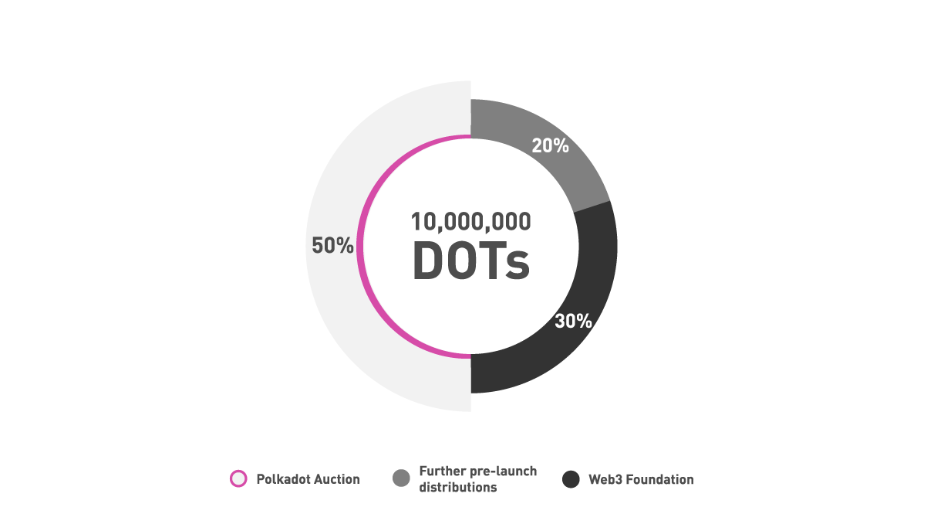
The total token supply of Polkadot was 10 million, which is far smaller than other digital currencies (Bitcoin has a rather small supply of 21 million tokens in total). Polkadot had its first crowdsale from Oct. 14 to Oct. 27, 2017, during which it sold 50% (5 million DOT) of the total supply through what was called a Spend-All Second-Price Dutch Auction.
Polkadot was redenominated on Aug. 21, 2020, after the Polkadot community approved a redenomination proposal. The redenomination did not affect the actual supply of DOT but changed the number of Plancks (the smallest unit of DOT, analogous to Satoshis in BTC) that constitute 1 DOT. Before the change, 1 DOT was 1e12 Plancks, while it is now 1e10 Plancks after the change.
Source: Polkadot Network, auction
The average transaction fee currently on the Polkadot networks is 0.1 DOT or $3.8. Polkadot uses a weight-based fee model as opposed to a gas-metering model. As such, fees are charged prior to transaction execution; once the fee is paid, nodes will execute the transaction. Fees on the Polkadot Relay Chain are calculated based on three parameters:
A per-byte fee (also known as the “length fee”).
A weight fee.
A tip (optional).
The length fee is the product of a constant per-byte fee and the size of the transaction in bytes. Weights are a fixed number designed to manage the time it takes to validate a block. Each transaction has a base weight that accounts for the overhead of inclusion — e.g., signature verification — as well as a dispatch weight that accounts for the time to execute the transaction. The total weight is multiplied by a per-weight fee to calculate the transaction’s weight fee. Tips are an optional transaction fee that users can add to give a transaction higher priority.
Together, these three fees constitute the inclusion fee. This fee is deducted from the sender’s account prior to transaction execution. A portion of the fee will go to the block producer, and the remainder will go to the Treasury. At Polkadot’s genesis, this was set to 20% and 80%, respectively.
So does Polkadot have an advantage over Ethereum and its other competitors? Next week we will present you a summary article on Polkadot before we are moving on to Algorand, the last Ethereum competitor that we will analyse in depth!
It took Wood over three years to carefully design and develop the Polkadot ecosystem without compromising the blockchain trilemma. While in theory, Polkadot checks most boxes to emerge as the No. 1 competitor to Ethereum, but the technology is still new and unproven. Polkadot’s native utility token, DOT, is used for multiple purposes, including bonding, governance and staking.
Bonding: To earn a parachain slot, projects must raise and bond DOT tokens. While some projects will have private venture capital funds to acquire DOT tokens, others will source them publicly via crowdloans. Polkadot crowdloans are a crowdfunding model for borrowing DOT tokens from the public. In exchange for bonding your DOT tokens during a crowdloan, the project in question gives an amount of its native token. An interesting aspect of DOT bonding is that your tokens are always yours. When you lease them to projects raising DOT for parachain auctions, the tokens never actually leave your wallet. Instead, they’re delegated from your wallet and are unlocked at the end of the lease.
Governance: DOT tokens are used for voting in governance matters called referenda. Voting on Polkadot referenda is always a yes or no binary — there is no in-between — keeping votes simple. This being Polkadot, there’s a twist on governance that gives you more or less voting power. Using voluntary locking, you can lock your DOT tokens to increase voting power the longer the lock duration.
Staking: Polkadot is a proof-of-stake network secured by validators staking DOT tokens on the Relay Chain. Staked DOT tokens act as collateral ensuring validators act honestly. If they don’t, their DOT tokens are slashed. About 58.9% of the DOT liquid supply is staked, with the average staking reward rate currently standing at ~12% on exchanges, such as Kraken and in the Polkadot.js wallet.
With a current price of $7 and a circulating supply of just under 1 billion, DOT has a market capitalization of ~$7 billion, putting it in the No. 13 spot among the top 20 cryptocurrencies ranked by market cap. P/S Ratio, calculated by dividing the fully diluted market cap by the annualized protocol revenue is 25,136.43x. The cumulative protocol revenue (share of fees that goes to the protocol’s treasury or directly to its token holders through e.g. a burn mechanism) for Polkadot $30700 (30-day), while the annualized revenue totals $373000. The burn mechanism is similar to a stock buyback because it decreases the amount of tokens in circulation. There are a total of 808,000 addresses that hold DOT, with 27,130 addresses being active.
The wheels have been set in motion, and with such strong fundamentals, the developer community has been flocking to the ecosystem. GitHub shows Polkadot having the second-most average daily development activity in the past 30 days. It is now a matter of when not if Polkadot will emerge as the top three blockchain ecosystems.
When evaluating the technology of a Blockchain it is always important to look at the Consensus Mechanism that this Blockchain uses. When it comes to newer chains, like Polkadot, it is also a good idea to compare them to their more established competitors like Ethereum.
Ethereum 1.0 uses a single blockchain to process all transactions, run all apps, and validate the network with mining. It does all this while using a slow PoW consensus algorithm that seriously restricts throughput. That’s why network congestion is so frequent during high-traffic days.
Polkadot eschews the single-chain design for a fully interoperable multichain ecosystem. Instead of using one chain to do everything, the Polkadot philosophy lets different chains specialize and share resources
Both Ethereum 2.0 and Polkadot use hybrid consensus models where block production and finality each have their own protocol. The finality protocols of Ethereum 2.0 and Polkadot both finalize batches of blocks in one round.
For block production, both protocols use slot-based protocols that randomly assign validators to a slot and provide a fork choice rule for unfinalized blocks. There are two main differences between Ethereum 2.0 and Polkadot consensus algorithms:
Ethereum 2.0 finalizes batches of blocks according to periods of time called “epochs.” The current plan is to have 32 blocks per epoch and finalize them all in one round. With a predicted block time of 12 seconds, this means the expected time to finality is six minutes (12 minutes maximum). Polkadot’s finality protocol finalizes batches of blocks based on availability and validity checks that happen as the proposed chain grows. The time to finality varies with the number of checks that need to be performed (and invalidity reports cause the protocol to require extra checks). The expected time to finality is 12–60 seconds.
Ethereum 2.0 requires a large number of validators per shard to provide strong validity guarantees. Polkadot can provide stronger guarantees with fewer validators per shard. Polkadot achieves this by making validators distribute an erasure coding to all validators in the system so that anyone — not only the shard’s validators — can reconstruct a parachain’s block and test its validity. The random parachain–validator assignments and secondary checks performed by randomly selected validators make it impossible for the small set of validators on each parachain to collude.
Another important factor of the Polkadot ecosystem is the DOT Token. What role does it play for the functioning of the Polkadot Blockchain as a whole?