Friday, January 16, 2026
Home Blog Page 51

Smart Contracts

0
Smart Contracts

“A smart contract is a computer program that directly controls some kind of digital asset… The smart contract approach says instead of a legal contract, immediately transfer the digital asset into a program, the program automatically will run code, validate a condition, and determine whether the asset should go to one person or back to the other person, or whether it should be immediately refunded to the person who sent it or some combination thereof.”

Vitalik Buterin, Founder of Ethereum

Smart contracts are dynamic, complex, and incredibly powerful. This technology has the potential to change how business is done because governments and companies can decrease costs, automate contract enforcement, and provide an auditable trail of control. While their long-term potential is unimaginable, they are already disrupting industries such as crowdfunding, law, and insurance. However, smart contracts are made by humans, and therefore, they are not perfect. Over $2.4 billion USD have already been lost due to faulty smart contracts. The future success of utility tokens depends on the ability of developers to build more secure applications that users can trust. 

Smart Contracts, Decentralized Applications, and Decentralized Autonomous Organizations

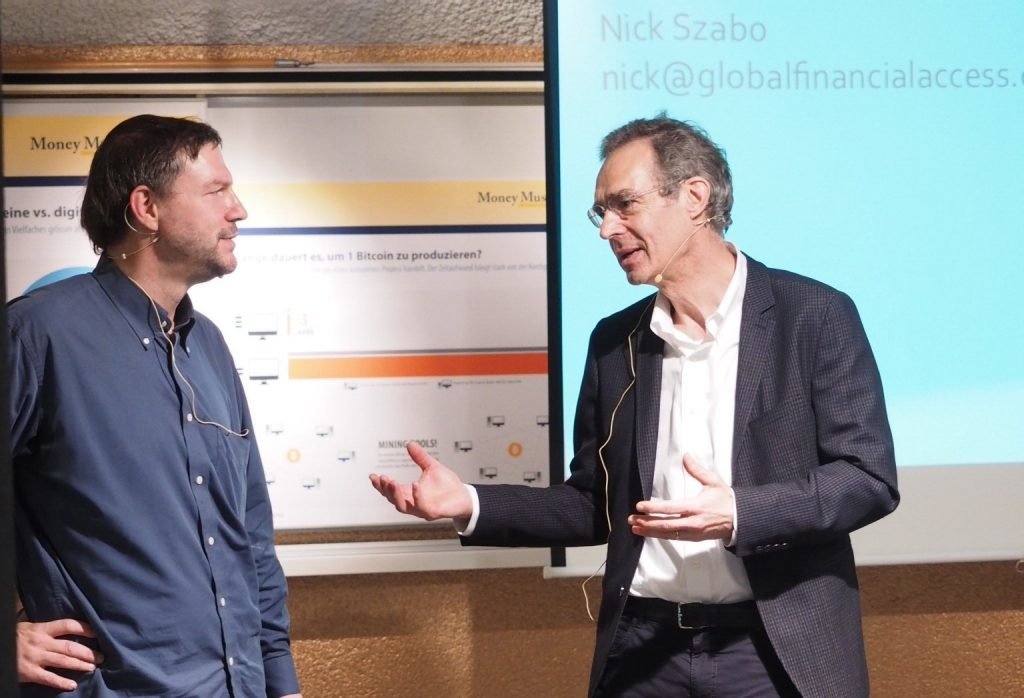
With the rise of cryptocurrencies and blockchains, smart contracts, Decentralized Applications (DApps), and Decentralized Autonomous Organizations (DAOs) are becoming increasingly important technologies that investors should understand. This all began when Nick Szabo coined the term “smart contract” in 1994. To define the term, a smart contract is a piece of software that represents a set of rules that are automatically executed under pre-determined circumstances. In other words, a smart contract is an “if-then” statement that is executed on a distributed peer-to-peer network.

Since each contract is stored on several computers all around the world, smart contracts do not have a single point of failure. Similar to BitTorrent, not having a single point of failure means that if one computer fails, the whole network does not fail. Nobody has the power to change the smart contract – even the person who made the smart contract. That applies to hackers and governments too!

Smart contracts have the same privileges as cryptocurrency wallets, except they are not controlled by private keys or users. Instead, a smart contract is controlled by the code contained within the smart contract. They can send and receive cryptocurrency, and they can store a balance or have a balance of zero. They can interact with other smart contracts, but users have to pay a small fee to the blockchain network to interact with the contract because every change needs to be approved and recorded by every computer that maintains the network. This is similar to mining in Bitcoin.

A DApp is a collection of many smart contracts that are working together to create a product for users. To be a DApp, four criteria must be met. First, the application must be open-source, which means that anyone can download it and look at the underlying code. Second, the application must run on a blockchain or distributed ledger technology, such as a directed acyclic graph. Third, the application must have a token associated with it. This token can be native to the application, such as Augur, or the application can use another cryptocurrency, such as Bitcoin or Ethereum. Finally, the application must use a cryptographic algorithm for confirming changes to the smart contracts that control the DApp.

A DAO is a type of DApp that allows owners to make business decisions by voting electronically and to automate management using smart contracts. DAOs use smart contracts to facilitate digital voting, and to facilitate the voting outcomes. The goal of a DAO is to reduce managerial overhead and to circumvent regulations particular to geographic regions.

 Essential, a DAO is a company structure for a globally dispersed group of owners. The cryptography and blockchain enables a group of strangers to invest capital together and make financial decisions. Smart contracts enable the company to be run autonomously because they hold the rules of the company and serve as a basis for operation decisions instead of a human. For example, a smart contract could be programmed to distribute dividends to investors once a certain condition is met. If profits are above a certain threshold, the smart contract could automatically send a transaction to shareholder wallets.

Smart Contract Theory Applied In Practice

The most popular cryptocurrency that incorporates smart contracts is Ethereum. The founder of Ethereum, Vitalik Buterin, proposed Ethereum in 2013 as a blockchain specifically designed for smart contracts. Ethereum is a worldwide network of computers which enforce, execute, and validate smart contracts. As covered in the previous Crypto Research Report, validation is achieved by a decentralized network of thousands of Ethereum nodes around the world. The centralized nature of the network enables decentralized applications (DApps) to run without downtime, censorship, or third-party interference, which makes the applications immutable or tamper-proof.

In practice, Ethereum can be used to create a decentralized crowdfunding website without intermediaries, such as Kickstarter. Ethereum users can invest in a business idea by sending money to an Ethereum wallet address of a smart contract. If the entrepreneur is unable to raise a certain amount of funding within a certain timeframe, the smart contract can automatically send all of the investors their money back. Instead of paying 10 % to Kickstarter, they only have to pay a 5-cent fee to the Ethereum network to process the transaction to the smart contract. Middleman removed. If company raises $10 million with Ethereum instead of Kickstarter, they save $1 million in fees.

The decentralized nature of Ethereum also allows investors to circumvent regulations that limit how much investors can invest in crowdfunding projects. For example, in the US, non-accredited investors with an annual income or net worth less than $107,000, are limited to invest a maximum of 5 % of their assets. For those with an annual income or net worth greater than $107,000, he/she is limited to investing 10 % of the lesser of the two amounts. These rules do not apply to Ethereum and other smart contract platforms such as NEO and EOS.

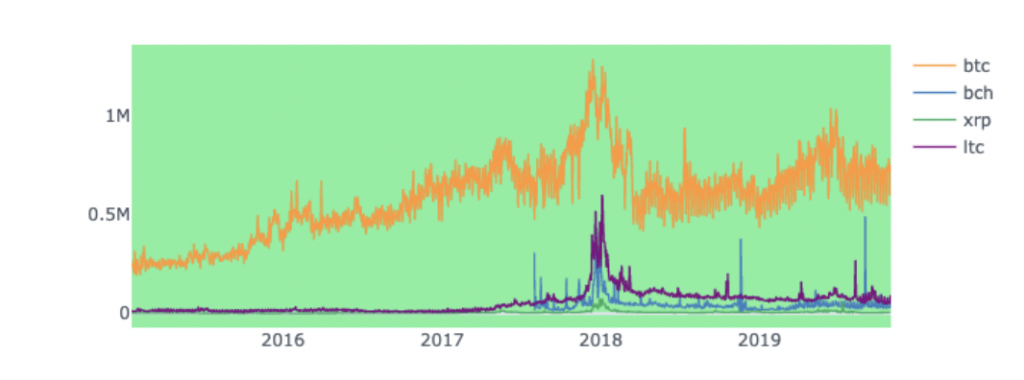
Blockchains that facilitate smart contracts are often referred to as utility blockchains, and the assets that are associated with them are referred to as utility crypto assets or utility tokens. Table 1 compares the relative return of utility crypto assets to payment crypto assets such as Bitcoin, Monero, and Litecoin. Although a portfolio comprised entirely of payment crypto assets had a higher cumulative return of 227 %, the portfolios are highly correlated with a 0.81 correlation coefficient. Cryptocurrency investors that bought the top five payment cryptocurrencies in June and sold in January realized a six-month profit of over 1,200 %.

Crypto Asset Companies That Use Smart Contracts, DApps, and DAOs.

There are already many projects that seek to implement smart contracts via blockchains into the real world. Ethereum is one of the most prominent examples, but a variety of other companies are also harnessing the power of automatic digital contracts, including Cosmos, Dfinity, Etherisc, Polkadot, and ShareRing.

A controversial example is the decentralized prediction market named Augur. In late July, CNN reported on Augur users gambling on whether President Trump would be assassinated by the end of this year. Since Augur is a DApp, no one can stop users from gambling on the probability of criminal and unethical behavior. Even the creators of Augur are unable to stop Augur from existing because the project is open-source. Not only are the legality of prediction markets questionable, now lives of people will be directly attached to financial gains. If this prediction market does lead to heinous acts be committed, Augur’s price will most likely be volatile and downward.

Although Augur is enabling people to vote on the probability that Trump, John McCain, or Warren Buffett will survive past the end of this year, most of Augur’s prediction markets are based on sports. For example, during the FIFA World Cup, users could vote on the outcome of specific games and earn Ethereum if they voted correctly.

When Smart Contracts Are Dumb

Since 2011, a combined $2.4 billion has been destroyed, frozen, stolen or otherwise compromised in the crypto asset space due to attacks. The two biggest crypto assets in terms of market capitalized have seen losses of around 1.7 million BTC and 4.54 million ETH over the past seven years. The three biggest mistakes that have occurred in the Ethereum space include the DAO hack, the Parity wallet hack, and the Parity wallet suicides.

DAO Hack

The Decentralized Autonomous Organization (DAO) was one of crypto’s most highly anticipated projects of all time and a pioneer in the application of the revolutionary capabilities of smart contracts. Some of Ethereum’s developers created a spin-off company called Slock.it and created the first DAO using the Ethereum blockchain in April 2016.[1] The DAO application worked like an investment fund, although without the usual investment fund management. Investors could participate by transferring the Ethereum cryptocurrency, ether, to the fund, which entitled them to voting rights. The investment decisions were supposed to be taken through a joint effort, where every participant could vote on investment proposals. Anyone with a venture project could pitch their idea to the DAO community in hopes of potentially receiving funding from a pool of ether which was controlled by the DAO.[2] Once a project was chosen, token holders would receive rewards – much like dividends or interest payments – if the projects turned out to be profitable.

The DAO was launched as a smart contract on the Ethereum network in May 2016. At the time, it raised $162 million worth of ether, making it the biggest crowdfund ever.

Nevertheless, on June 17th, 2016, a hacker perpetrated the DAO network by exploiting a loophole in its software, allowing him to drain funds from the pool of Ethereum tokens owned by the DAO network. 3.6 million ETH tokens were stolen in the first couple of hours of the attack, amounting to an equivalent value of $70 million at the time ($1.2 billion in today’s terms). Strangely enough, the hacker stopped draining the DAO for unknown reasons, even though he could have continued to do so.

The team and community behind Ethereum were quick in noticing the breach and very soon responded to the situation by presenting multiple proposals on how to deal with the attack. Due to the architecture of the DAO, the drained funds in the form of ether were locked up in a child DAO, another smart contract, which required a 28-day holding period before the attacker could fully withdraw the funds and launder them into circulation. This gave the Ethereum team sufficient time to decide on their course of action.

Vitalik Buterin, the creator of Ethereum, realized the severity of this breach and issued a statement soon afterwards assuring all investor that their funds were safe for the moment. The Ethereum community then decided to render any transaction originating from the attackers account with code hash:

0x7278d050619a624f84f51987149ddb439cdaadfba5966f7cfaea7ad44340a4ba

as invalid, thereby preventing the attacker from withdrawing funds even after the completion of the 28-day holding period.

The hacker later published an open letter to the Ethereum community claiming rightful ownership of the acquired funds. You can see the original letter here. Refunding the investors’ ether would have not been possible under the rules of the Ethereum network at that time, posing an existential threat to the network as a whole.

The solution that the Ethereum foundation came up with was highly controversial.[3] They implemented a “hard fork” by releasing a new version of the Ethereum software client that did not include the hacked transactions. They re-winded the Ethereum blockchain in order to remove the hacker’s transactions. The release also included a fix to the bug that the hacker exploited. Not all of the members of the network agreed with the decision of hard forking the chain. Some dissidents left Ethereum entirely and others just continued to use the original Ethereum blockchain, which included the hacker’s transaction. This chain became called Ethereum Classic with ticker symbol ETC.

As with all of the mishappenings described in this article, none of them has arisen due to the fundamental design of the Ethereum network. Instead, the hacks occurred because of design problems in applications that were built on top of Ethereum. The type of attack that destroyed the DAO is known as a reentrancy attack.[4] In this attack, the attacker first donated ether to the smart contract (DAO) and then was able to “ask” for the ether back multiple times before the smart contract could update its balance. When the contract fails to update its state (a user’s balance) prior to sending funds, the attacker can continuously call the withdraw function to drain that contract’s funds.[5] The code written for the DAO had multiple flaws including the recursive call exploit as well as the fact that the smart contracts sent ETH funds before updating the internal token balance.

Parity Wallet Hack

Parity Technologies builds platforms and applications, and it powers large parts of the infrastructure of the public Ethereum network.[6] On the July 19th, 2017, an unknown hacker attacked a critical vulnerability in the Parity multisignature wallet on the Ethereum network, looting three massive wallets containing a combined $31 million worth of ETH in a matter of minutes.[7] A group of heroic white-hat hackers from the Ethereum community responded by quickly alerting Ethereum users on social media and hacking the remaining wallets before the attacker could. This form of hacking is called white-hat hacking because they hacked for the good cause. If the white hackers had not responded so quickly, the hacker could have hacked over $180,000,000 worth of Ethereum from vulnerable wallets. Of course, the funds that were stolen by the white-hats were securely redistributed to their respective account holders in the end.

The hacker found a programmer-induced bug in the code that let him re-initialize the Parity multisignature wallet, almost like restoring your iPhone to factory settings. Once having done that, he was free to set himself as the new owner and walk out with everything.

Due to the programming model of Ethereum, there is an incentive for programmers to optimize code in order to minimize transaction costs. Every time code is executed on Ethereum, a smart contract, which constitutes a transaction on the network and thus comes with a computation fee, needs to be deployed. An efficient way to reduce costs from the computation fees is to use shared libraries which have already been deployed to the network.

The default settings for the multisignature wallet in Parity had a configuration which did exactly that. It referenced a shared external library, which contained a wallet initialization logic, namely initWallet(), which if called could reinitialize the contract the wallet was built upon. It effectively made whoever exploited this flaw the new owner of the wallet. From there, the hacker could simply transfer the funds to any address of his or her choice.

However, why did they not just roll back this hack, like they did with the DAO hack? Unfortunately, that was not even an option any more. When the attacker drained the DAO into a child DAO the hacked funds were frozen for a 28-day period before they could be released to the attacker. This prevented any of the stolen funds from going into circulation, which in turn gave the Ethereum community plenty of time to consult the community about how to deal with the attack. In the Parity wallet attack, however, the attacker directly withdrew the funds and could start spending them. Once the stolen ETH was in circulation, it was almost impossible to recover them, much like with a huge sum of counterfeit bills circulating in the economy.

Parity Wallet Suicides

On November 6th, 2017, the Parity multisignature wallet fell prey to yet another attack,[8] only this time to one of a much more severe magnitude. A Github user named devops199 wrote a post titled “anyone can kill your contract”. Devops199’s post seemed to have good intentions.[9] He wanted to make the Parity team aware of a vulnerability in the smart contract that powered its multisignature wallets. The security vulnerability allowed any hacker to make him- or herself the “owner” of that contract, thus giving him or her permission to do with the wallet as he or she pleases. Up to this point in time, it still remains unclear what his original intent was, but his following actions were largely met with skepticism: He “accidentally” triggered the “kill switch” of the contract, rendering all Parity multisignature wallets impossible to access. Just minutes after the library was wiped out, devops199 raised another issue following up his “anyone can kill your contract” post on Parity’s Github titled “I accidentally killed it.”

The scale of this Parity hack compromised a total of 514 k Ethereum tokens, which
at the time were valued roughly around $155 million or 1 % of Ethereum’s total
valuation. As a consequence of the hack, no funds can ever be moved out of all
Parity multisignature wallets that were deployed after July 20th, 2017 again.

A hard-fork could technically “bail-out” the multisignature wallets that are frozen
but that would compromise the foundation of Ethereum’s decentralized,
distributed, immutable, and tamper-proof ledger. Calls for a hard-fork have largely
remained ineffective.

Smart Contracts Represent a Distinctly Different Exposure for Investors Than Bitcoin

Smart contracts have the potential to disrupt industries by cutting out middlemen and bringing together the parties of the contracts directly. They can ensure trust and cut transaction costs. Despite the benefits, The Economist criticizes the concept of smart contracts by pointing out the immature state of the industry.[10] They further argue that smart contracts are not flexible enough for an economy that needs to respond to ever changing conditions.

At Incrementum, we think that smart contracts are here to stay. From a financial perspective, utility blockchains, such as Ethereum, NEO, and EOS, offer a distinctly different risk-return profile compared to payment blockchains, such as Bitcoin, Dash, and Monero. Due to the complex nature of smart contracts, utility blockchains are inherently more prone to technology risk. In contrast, since utility tokens do not threaten to disrupt the current monetary system, risk of being outlawed for competing with sovereign currencies is lower when compared to public payment blockchains. However, many regulators are saying that initial coin offerings and utility tokens are violating security law. Diversifying into both crypto asset classes is prudent for investors that are willing to make the extra effort.

[1] See “Decentralized Autonomous Organization to Automate Governance. Final Draft – Under Review” [white paper], Christoph Jentzsch, 2016.

[2] See “The Story of the DAO–Its History and Consequences,” Samuel Falkon, The Startup, December 24, 2017.

[3] See “To fork or not to fork,” Jeffrey Wilcke, Etherum Blog, July 15, 2016.

[4] See “Smart Contract Attacks [Part 1] – 3 Attacks We Should All Learn From The DAO,” Pete Humiston, Hackernoon, July 5, 2018.

[5] You can find a more technical walkthrough here.

[6] Learn more about Parity here

[7] See “A hacker stole $31M of Ether – how it happened and what it means for Ethereum,” Haseeb Qureshi, Medium, July 20, 2017.

[8] See “Security Alert,” Parity, November 8, 2017.

[9] See “Yes, this kid really just deleted $300 MILLION by messing around with Ethereum’s smart contracts,” Thijs Maas, Hackernoon, November 8, 2017.

[10] See “Not-so-clever contracts,” Schumpeter, The Economist, July 28, 2016.

ETH, NEO, ADA, & EOS

0
ETH, NEO, ADA, & EOS

“2019’s Trillion Dollar Question: How to merge Blockchains?

Yanislav Malahov, Aeternity

Smart Contract Platforms: Who’s the
Smartest in Town?

Grandmother Bitcoin has birthed powerful ecosystems – first and foremost, the
Ethereum empire. From July to August in 2014, the Ethereum Foundation
launched an Initial Coin Offering to promote its concept to Bitcoin owners. As we
already mentioned in our Crypto Concept chapter, the masterminds behind
Ethereum were Vitalik Buterin and Mihai Alisie. They realized that a Turincomplete
blockchain could enable decentralized applications. Vitalik developed the
solidity scripting language to compliment a Turin-complete blockchain. With the
technology built, he founded a new crypto asset and after the code had been
programmed and $18 million worth of Bitcoin had been collected in an initial coin
offering to advance the project, the first Ethereum block was created on July 30th,
2015.

Wrong Dichotomy

Like Bitcoin, Ethereum attracted a network of users – especially a larger spectrum of software developers. Due to the increasing interest, the Ether price also shot through the ceiling and the rivalry between the two camps increased. Some Bitcoin supporters – perhaps a little unsettled by the upturn in Ether prices – saw this new crypto asset as a cheap copy of Bitcoin, which was hardly faithful to true crypto values. On the Ethereum side, some exponents were already saying that the programmable blockchain was far superior to Bitcoin and that the former would make the latter obsolete sooner rather than later. To this day, the two camps are fighting each other on internet forums, on Twitter, and at conferences. While Ethereum maximalists are called heretics, Bitcoin maximalists are seen as the fundamentalists of the crypto world.

This circus around the title “Only True Blockchain” is ultimately nothing but a clownish pseudo battle. Bitcoin and Ethereum are not direct opponents, since they pursue different goals after all. As an independent store of value, the Bitcoin blockchain must offer the greatest possible security. This implies that Bitcoin must necessarily be based on a more rudimentary scripting language that limits susceptibility to bugs. The purpose of Ethereum is to resolve this trade-off in exactly the opposite way. Because of the greater experimentation and flexibility in programming capability, greater susceptibility to errors is also accepted at the source code level. Events mentioned in the Crypto Concept chapter in this edition of the Crypto Research Report, such as the DAO hack and the parity bug are due to programming errors because of solidity’s complexity. Because the Ethereum approach allows much more in terms of programming, its use case appears much broader, which leads many Ethereum enthusiasts to conclude that Ethereum is the more lucrative project in the long run.

Today, Ethereum is held responsible for the ICO hype during the end of 2017. Quite often the tone is somewhat reproachful: Not only have investors lost a lot of money in this speculative boom, but they have also been led astray by a number of ICO fraudsters and crypto charlatans. But thanks to Ethereum, anyone can launch their token at low cost without having to worry about setting up a blockchain infrastructure. Ethereum has thus taken crowdfunding to a whole new, global level. Financing can suddenly be carried out efficiently, quickly and independently via the Internet.

So, while Bitcoin is disrupting the creation of money by central entities such as central banks and commercial banks, Ethereum’s revolutionary power lies in providing a real alternative to the centrally organized capital market. Investment banks have always acted as intermediaries between asset managers and companies or states wishing to issue bonds or shares through an IPO. Before Ethereum, there was no technical way around them. Today there is. The venture capitalist business is currently being turned upside down, which is why it is no longer unusual to find venture capital companies such as Andreessen Horowitz or Union Square Ventures on pre-ICO investor lists. The figureheads of venture capitalists have already had to react to the “Etherealization” of investing – a fate that is likely to hit Wall Street as well.

A Non-centralized World Computer

Like Bitcoin, Ethereum is also based on a public blockchain and is therefore ultimately nothing more than a network of tens of thousands of geographically distributed computers, all communicating via the Ethereum protocol. Since Ethereum, in contrast to Bitcoin, can be used to program applications on top of it, the analogy of a world computer applies even better. The Ethereum blockchain functions like a computer. Like a hard disk of a computer, the blockchain stores everything that happens on the Ethereum world computer.

On a programmable blockchain like Ethereum’s, developers can program anything they can program on a local computer. However, the Ethereum world computer differs from an ordinary computer in that it must run according to its programming code and, due to its non central structure, can only be manipulated at extreme costs. At the same time, such a world computer provides immensely high robustness. Since the Ethereum blockchain runs on tens of thousands of individual computers, there is redundancy. The Ethereum “hard disk” does not only exist once and in one place only but is distributed all over the world. The downtime risk is therefore diminishingly small.

Why a Programmable Blockchain?

In the context of Ethereum, the term smart contract is frequently used. It was the Ethereum blockchain that first recognized the potential of these “intelligent contracts” and thus popularized the idea. The Bitcoin blockchain already knows a primitive form of smart contracts. In the case of Bitcoin, these are limited to the simple transmission of Bitcoin units. Since Ethereum is a programmable blockchain, the smart contract functions can be extended almost arbitrarily in theory. In addition to the processing of transactions of digital value units, other assets or securities such as bonds, shares, and even physical assets can also be transferred by means of a smart contract. Ultimately, the most diverse contracts that make up our social life today can be converted into computer code, stored in the form of smart contracts on the blockchain and executed by the Ethereum network in a non-centralized manner. This is the vision that is becoming established more and more in the minds of people as Ethereum grows more popular.

The elegance of a smart contract lies in the fact that it is a digital contract that executes itself according to predefined parameters. In other words, if the contract conditions are fulfilled, the contract is executed according to its content. A comparison with a vending machine helps here. One feeds the vending machine with money and receives the selected goods in return. There is no need for a third party to deliver the goods. The theory behind a smart contract works in a similar way: When you pay a smart contract, you receive the corresponding goods, a transfer certificate, a driver’s license or something else. In addition, the smart contract not only defines the rules and sanctions relating to the agreement, it also enforces them itself.

Gas – an Essential Component Of Ethereum

Ethereum clients are the individual computers that make up the Ethereum network, and execute the programming code defined in a smart contract. Since Ethereum is Turing-complete – a term from computer science – the computers of the Ethereum network are capable of executing code of any complexity. At the same time, Turing-completeness also means that a smart contract or its programming code would be executed endlessly by the Ethereum clients. Such an endless loop would render the Ethereum blockchain non functional, since the execution of a single smart contract would consume the resources of all the computers participating in the Ethereum network.

As a solution, Vitalik Buterin integrated a mechanism into Ethereum that enables the Ethereum clients to determine the execution length of each smart contract in order to prevent endless loops. The keyword here: Gas. Each execution of a smart contract costs a certain amount of gas. But this is just a form of expression. Behind every gas price that has to be paid for the execution of a smart contract is a certain amount of ether, the cryptocurrency of the Ethereum blockchain. How much ether it costs, or in other words, how high the respective gas price is, depends on the current utilization of the Ethereum network. Not all smart contracts cost the same gas price. Depending on the complexity, the amount of ether to be paid is smaller or larger.

In principle, the gas from Ethereum can be compared to the gasoline of a vehicle. Just as petrol makes a vehicle run, gas ensures that a smart contract is executed. Just as a car comes to a standstill when the fuel tank is empty, the Ethereum gas also defines an upper limit for the execution of smart contracts and thus prevents endless loops.

The recipients of ether paid via the gas price are the Ethereum clients who are responsible for the execution of smart contracts. Each smart contract costs a minimum execution price. However, if a higher price is offered, the chances of processing and execution are greater, as Ethereum clients are usually controlled by  miners who earn wages by chasing the most lucrative offers.

Can Ethereum Hold Steady?

Whoever buys Ether invests in the first decentralized world computer. As such, Ethereum aims to become the backbone of a future decentralized internet. Should the Ethereum network ever reach this important position, Ether will be the “crypto-fuel” to power the entire Ethereum machinery. Just as the oil age made the Rockefeller family and others rich, Ether owners could one day become the new “oil barons” due to the crypto revolution.

Ethereum is now (only) three years old. Since the first Ethereum block was created on July 30th, 2015, the blockchain has become the second largest crypto asset in terms of market capitalization and already has over 250,000 developers today. To date, approximately 1,800 DApps have been registered. Ethereum is also undoubtedly the most successful blockchain-based crowdfunding platform. Of the top 100 tokens by market capitalization, 94 % were originally built on Ethereum – $13 billion in capital was generated through Ethereum in this way. Of the top 700 tokens by market capitalization, 87 % are Ethereum tokens. This corresponds to $15 billion of the $19 billion collected through the Ethereum platform.

This growth and the resulting dominance have led to the emergence of other smart contract platform projects. Although Ethereum has experienced a meteoric rise, to handle decentralized services and applications on scale that make it a viable alternative to traditional centralized solutions, effective scalability is required. The Ethereum community has recognized this and is working on it – but it has not yet made a significant
breakthrough.

This is where many alternative smart-contract platforms see their chance to outsmart Ethereum. If they succeed in scaling sooner and better, not only the old world but also the new world should be able to build its applications on one of these alternative smart contract platforms.

Academia Goes Blockchain

Most smart contract projects try to outpace Ethereum with speed. Such as Cardano, a project that is also described as the “Japanese Ethereum” in the crypto community because it was launched in Japan and is said to have had around 95 % of all ICO investors coming from the land of the rising sun.

Cardano does not focus on speed. On the contrary, the focus is on accuracy and correctness. Cardano was founded by Charles Hoskinson, who worked for Ethereum and BitShares. The fact that Hoskinson is a mathematician clearly mirrors Cardano’s path forward. No other smart contract project is more academically influenced and geared towards mathematical correctness. For the developers behind Cardano, the technical evaluation of the code is the most important thing. It is their intention to subject Cardano protocols to a peer review system and, if possible, to validate any program code with formal verification. A program code can be seen as formally verified once it is mathematically proven that it is correct for all inputs. Although formal verification does not (yet) prove that a code does what it is supposed to do, it does prove that certain errors can be excluded for sure. This kind of formal verification is a new area, and although other projects are increasingly oriented towards it, Cardano wants to be the leader when it comes to formal verification.

Although Cardano already runs on its own main net, many of the features and characteristics of this smart contract platform are still under development. For an outsider, there is little secure information available at the moment. Already today it seems to be clear though: While with many other projects the accounting of value transactions and the execution of smart contract commands are one and the same, with Cardano, these processes are separated into two different “layers”. There is the “settlement layer” for value transfer and the “computational layer” for the application of smart contracts. Cardano hopes that this split will enable it to better reconcile key aspects such as scalability, privacy, regulatory issues, and compliance. The two different layers are also based on two different programming languages. One language is specific and limited but less prone to bugs and other unforeseen programming errors, while the other is more flexible. Depending on the application, one or the other programming language can be used, which is why Cardano offers a certain choice here.

Only time can tell whether this careful way of peer reviewing and formal verification will lead to success in the incredibly fast-moving crypto world. After all Cardano’s peer reviewing appraisal method also has its exquisite critics. Their argument: Academic peer review processes do not always provide certainty and are therefore often not worth the effort. Nevertheless, at Cardano, people just want to
do philosophically, mathematically, and technically clean work. Consequently,
their project could provide the crypto world with some interesting approaches
regarding smart contract platforms going forward.

China Takes on Ethereum

Another project, which wants to establish a platform for a future internet comes out of China. Formerly known as Antshares, the project changed its name to NEO in June 2017 and immediately caused a sensation among crypto investors. But soon the question arose among them: Can a blockchain project from China even be successful when the Chinese government took a firm stand against Bitcoin and ICOs in 2017?

With China and its iron measures, it is always complicated. If you look closely, you will see that China has not generally opposed blockchain technology; after all, in its five-year plan, China’s central bank has taken a stance for exploring the possibilities of blockchain technology. It is just that the Chinese government is solely interested in blockchain projects that are predictable and thus controllable. And this is exactly where NEO seems to be entering the picture, probably for good reason and quite intentionally.

It is the declared goal of those responsible behind NEO to focus on speed and regulatory compliance. With NEO, blockchain technology can be used to digitalize assets of all kinds and to automate administration and trade in order to create structures for a smart economy. A digital identity solution seems to be indispensable for this, which is why the NEO Council – the body for the promotion of the NEO ecosystem – already supports a GDPR-compliant digital identity solution with PikcioChain. If a blockchain platform is based on pseudo or even anonymity, it is of little interest for a government – especially one like China – as well as for companies, since regulatory requirements can hardly be fulfilled this way.

At the same time, NEO is also focusing on solutions for the development of privacy and data protection. Through its partnership with OnChain, a company that promotes blockchain projects, NEO wants to enable companies to protect personal data. Founded by Da HongFei and Erik Zhang, who have also created NEO, OnChain is working with governments and corporations to create public and private blockchains that will eventually connect to the NEO ecosystem through OnChain’s decentralized network architecture (DNA).

Like Ethereum and other smart contract projects, NEO already has an open source community for developers and programmers called City of Zion. NEO also has an ICO platform that will allow payment solutions, distributed trading exchanges, and more.

The consensus mechanism of NEO is called Delegated Byzantine Fault Tolerance or dBTF. Behind this term lies a governance model known to us from the traditional world: that of a representative democracy. The NEO token holders appoint delegates, so-called accountants, who ensure consensus and thus maintain the network. There are a total of seven accountants. Compared to Ethereum, the number of nodes validating the network is much smaller. In addition, the NEO accountants still have digital identities and real names – so they are visible to everyone, while the network nodes at Ethereum are anonymous. The fact that the accountants at NEO are known certainly makes sense with regard to the goals of this project. In order to meet the regulatory requirements, the blockchain project must have this degree of transparency.

The delegated accountant model can prevent transactions from having to be validated by all nodes in the network. This way, NEO can handle a higher number of transactions than Ethereum. In addition, NEO transactions are final. This means: Forks, i.e. splitting the blockchain into several chains, are impossible. If the accountants reach a consensus of
66 %, the transaction is not only included in the blockchain but is final and cannot be made obsolete by a fork. One more difference between Ethereum and NEO concerns the programming languages for the development of smart contracts. Ethereum requires Solidity – a programming language specially developed for Ethereum. NEO, on the other hand, supports many of the most popular programming languages. Therein, NEO sees the advantage of enabling traditional developers to program on the NEO blockchain without having to learn a new programming language.

Differences Are Evident

Of particular interest is the fact that NEO, like Ethereum, knows gas. While Ethereum also uses the ether token as gas, NEO has a separate gas token in addition to the NEO token.

The NEO token makes it possible to be a “shareholder” in the NEO platform. As already mentioned, NEO token holders are entitled to appoint the accountants. The share-character of the NEO token is strengthened by the fact that the token is not divisible.

The GAS token, on the other hand, is used to pay for all operations such as transactions in the NEO network and thus functions as a sort of crypto fuel. Payment in the form of GAS tokens is made to accountants, but also to all NEO token holders. A personal NEO wallet is required to collect the GAS tokens.

This decoupling of NEO and GAS is particularly interesting because accounts do have the tendency to keep transaction fees low. The reason is the following: High transaction fees, which only benefit accountants, prevent operations from being carried out on the NEO blockchain. The fewer operations, the less reward NEO token holders receive. This leads them to vote for accountants, who in turn keep transaction fees low.

These are the features that make NEO an interesting smart contract platform. From a macro point of view, however, this platform differs from Ethereum in one fundamental aspect: NEO has apparently placed itself in the service of the Chinese government. Consequently, NEO is by its very nature a planned and top-down orchestrated undertaking, which seems to have been driven primarily by the NEO Council in the interest of the Chinese officials. From NEO’s point of view, this strategy has an intact chance of success. Anyone who manages to get popular in China itself and serves a market of 1.4 billion people can already book his project as a success.

And even if one or more smart contract platforms were to establish themselves in the West, this would not mean the end of NEO. Tech giants from the USA such as Facebook or Amazon provide a good example: Although their dominance in the world outside of East Asia is growing, they have virtually no chance against the domestic platforms in China. Why should this be any different in the area of smart contract platforms?

Ethereum might also experience some influence by interest groups such as Consensys or the Ethereum Enterprise Alliance, its ecosystem nevertheless tries to generally uphold the philosophy of organic growth. In this sense, Ethereum is more of a platform emerging out of a spontaneous order. Because of these different intentions, the two projects are difficult to compare. While NEO strives for an advanced future that is adapted to the existing actors and circumstances, Ethereum is working on a new future to which the current companies and states will have to orient themselves someday.

EOS – Ethereum’s Biggest Competitor?

In doing justice to the drama of the crypto world, some of these smart contract counterparty platforms bear the name “Ethereum-killer”. Probably the most prominent of these projects is EOS, also called “Ethereum on Steroids” by some. While Ethereum is an established blockchain project with a fully functional platform, EOS is still in its infancy. Following the largest ICO ever carried out on Ethereum, which raised a record $4 billion, EOS held its Mainnet launch in June this year, switching from an ERC-20 token based on Ethereum to its own blockchain, the EOS blockchain.

Although EOS ultimately also enables the programming of smart contracts, there are some important differences. For example, Ethereum smart contracts are developed using JavaScript/Solidity. Smart contracts on the EOS blockchain, on the other hand, must be written in C++. Since this programming language is not as common and user-friendly, some programmers see this as an entry threshold that could put EOS at a disadvantage compared with other smart contract platforms. At the same time, EOS is supposed to feature the implementation of C/C++ libraries in the future, which would considerably expand the possibilities for developers.

Unlike Ethereum, EOS’s consensus mechanism is based on the so-called Delegated Proof of Stake or DPoS for short. This type of consensus finding was invented by EOS founder Dan Larimer. As with NEO, DPoS entitles every EOS token holder to choose validators in a voting process. Analogous to the motto “one person, one vote” the voting process follows: one token, one vote.This also means that those who have more EOS tokens have a greater influence on the voting result.

The validators are called EOS block producers because they produce the EOS blocks in mutual agreement and check their correctness in order to maintain the functionality of the blockchain. In total, EOS token holders will have to elect 21 block producers who are effectively capable of managing the blockchain and keeping the network secure and functional. They are rewarded for their work with new EOS tokens. If a block producer does not do its job well and, for example, validates invalid transactions, his status as a block producer can be revoked. The reconciliations are carried out approximately every two minutes. In principle, it is therefore possible to change validators every few minutes. In addition to the 21 active block producers, there are about one hundred other block producers in standby mode. If a block producer is deselected for whatever reason, one is being elected out of the reserve.

The idea of the EOS founders behind this structure is as follows: Because the task of actually processing and validating the transactions is delegated to only 21 block producers, the basic protocol and, thus, the actual blockchain itself should be able to be scaled to enable millions of transactions per second. In reality, the EOS project has so far completed a maximum of 3,097 transactions per second successfully. In an objective comparison, EOS has performed significantly better than Ethereum, even though the actual goal of millions of transactions has hardly been achieved. But EOS is not only capable of processing a larger number of transactions per second – the transaction speed is also higher. After just one second, the blockchain reaches finality via a newly added block.

Inflation as a Reward

Interestingly, no transaction fees are envisaged to make EOS work as they are regarded to be more of an obstacle by the EOS founders. In this context, they often refer to an example concerning Facebook: Facebook servers process over 50,000 likes per second and ultimately each of these likes represents a transaction. If one had to pay a transaction fee each time on a blockchain-based social media platform, this would be detrimental to the customer experience. While at Ethereum, the miners who validate transactions and add them to the blockchain are paid for this service through transaction fees, the validators within the EOS system are not remunerated with transaction fees for their verification work. To be fair, it has to be said: Ethereum is also working on second- or third-layer scaling solutions to mitigate the problems described above.

But how are the EOS block producers remunerated instead? They receive newly created EOS tokens through the EOS protocol. Each year, five percent more EOS tokens are produced. In concrete terms, this means that the EOS token stock is inflated by five percent a year. Of these five percent, the block producers each receive one percent as a reward for validating the transactions. The remaining four percent will be placed in a separate pool, from which proposals for improving and further developing the EOS blockchain will be financed. EOS also aims to ensure that block producers cannot share their earnings with those from whom they receive their votes. This way, “buying of votes” should be prevented.

From a cryptoeconomic point of view, transaction fees not only serve to provide incentives but also prevent malicious players from spamming the blockchain network with an unnecessarily large number of transactions. EOS, on the other hand, prevents such spam attacks by making blockchain bandwidth usage dependent on the number of EOS tokens. Anyone who owns one percent of all tokens is entitled to one percent of the entire bandwidth of the network. In order to increase the chances of a targeted network overload, the attacker must increase his possession of EOS tokens, which causes ever-increasing costs. Spam attacks are therefore not ruled out, but they are economically expensive.

Anyone who wants to develop a DApp (decentralized application) on Ethereum will, as it were, make use of the computing power of the Ethereum miners and pay for it with ether gas. EOS, on the other hand, is based on an ownership model: If you hold one-thousandth of the EOS network, you also have one-thousandth of the computing power combined on EOS Blockchain. This ownership model enables DApp developers to realistically estimate their hosting costs at any time.

Attacking Ethereum

EOS is also committed to revolutionizing the concept of crowdfunding once again. Today, the Ethereum platform can be used to collect funds directly via an ICO – also known as a token sale. One issues a token and in return receives Ether, Bitcoin, or other cryptocurrencies. It is inevitable that fraudsters, swindlers, and charlatans will also receive financial resources this way. It is the hope of EOS sympathizers that crypto projects will migrate away from Ethereum in the longer term and switch to EOS for crowdfunding. This was the case, for example, with Everipedia, a for-profit competitor of Wikipedia.

The EOS ecosystem knows no ICOs or Token Sales, only the Airdrop. If a project wants to finance itself via the EOS blockchain, its EOS-based tokens are passed on to the EOS community free of charge via Airdrop. After the tokens of the project have been distributed via Airdrop, the market determines the value of the tokens according to the law of supply and demand. The team behind the project can then sell a percentage of its own tokens to raise money for the project. However, it seems somewhat unclear how a token distributed over an Airdrop without capital can gain value in the first place and thus be accepted by the market.

At best, the venture capital fund created within the EOS ecosystem should come into play here. Behind this fund is the company Block.one, which conducted the ICO for the EOS token in 2017. The venture capital fund is intended to make strategic investments in various projects based on the EOS Blockchain. It is only natural that this venture capital fund should be used to invest in promising projects that also want to carry out an Airdrop via the EOS blockchain. Of course, the question then arises as to how strongly Block.one influences crowdfunding on EOS. After all, a certain pre-selection takes place through the venture capital fund, which is not the case with Ethereum. The tradeoff is between allowing fraud on Ethereum or censoring innovation on EOS.

What About Decentralization?

The decisive question crypto investors are asking themselves today: Who will prevail in the long term? Ethereum or EOS? Are there any clues? Investors, for example, are focusing on the most prominent people behind the two projects: The battle between Ethereum and EOS has thus also turned into a battle between Vitalik Buterin and Dan Larimer. Some Ethereum supporters refer to Buterin’s allegedly astronomically high intelligence quotient, which would make him an even greater genius than Larimer. The opposite side meanwhile refers to the crypto projects BitShares and Steemit, which both originated from Larimer and would lead him to triumph. In the end, these comparisons are interesting, but they have little relevance for the future of the two smart contract projects.

More revealing are project-specific debates that were initiated by Vitalik Buterin and Dan Larimer, among others. In the theoretical debate, the question of decentralization ranks at the top of the list. In the case of the EOS blockchain, it is ultimately a comparatively small number of nodes that maintain the network. In a world like that of crypto, which is committed to the decentralization of social structures, a blockchain concept with only 21 block producers naturally arouses suspicion. Is EOS decentralized enough or do the 21 block producers not rather remind us of a cartel or an oligarchy? Many honest crypto experts still consider it technically impossible to escape the blockchain trilemma, according to which there are inherent trade-offs between security, scalability, and decentralization, at the level of the basic protocol.

On the EOS side, there are some exponents for whom decentralization is not an absolute value. Since decentralization is always associated with mathematical and economic costs, compromises must be made in this respect in order to achieve the goal of mass scaling DApps. In their view, EOS is just as decentralized as the scaling intention requires. The fact that there are just 21 block producers can be traced back to Larimer’s previous experience with his other DPoS systems BitShares and Steemit. This number is therefore not engraved in stone or better written in code. In the light of new findings, it could also be changed, according to their arguments.

Other advocates of EOS do not consider the EOS blockchain to be less decentralized than Ethereum at all. They point out, for example, that at Ethereum three parties account for more than 50 % of total hashing power. If these three actors were to play together, the Ethereum blockchain could be successfully attacked and transactions could be spent twice. They also argue that Larimer’s earlier projects BitShares and Steemit have shown that DPoS systems are more decentralized than than proof of work used by Ethereum and Bitcoin because proof of work has an inherent tendency towards centralization due to economies of scale. Interestingly, it seems as if the EOS community generally consists more of people who prefer a certain amount of leeway to exert influence instead of a total inability to supervise. One can read the argument again and again that it can be considered sensible for “democratically” elected block producers to be able to intervene in the interest of the EOS community during emergencies such as a hack or bug.

A Fight That Is None?

Ethereum, EOS or another smart contract platform? The discussions about who will win the race are likely to continue for some time. Ethereum has by far the most developers, has many influential companies thanks to the Enterprise Ethereum Alliance, and is still by far the most widely used crowdfunding platform. EOS has become accustomed to its own blockchain by now and unites three of the most renowned crypto investors behind it, Mike Novogratz, Peter Thiel and Jihan Wu.

However, this fight is based on the assumption that only one smart contract platform is optimal. Most likely there is enough room for more than one winner because different applications require different blockchain infrastructures. The battle for supremacy among these platforms is reminiscent of the tug-of-war between the various operating systems in the early years of the computer and internet age. Just as several operating systems exist today with Mac, Windows, and Linux, no single winner is likely to emerge this time either. DApps can even run on multiple smart contract platforms simultaneously. Bancor, a blockchain protocol for the creation of smart tokens, for example, has already announced that it will use EOS as a foundation alongside Ethereum.

Advisory Board Meeting Q4

0

step0001 (1)
wieler_sw
171e7b3

Mark Valek:

Welcome to our Advisory Board Crypto Research Report of the fourth quarter. A lot has been going on and we are very happy to have all of you here again to talk about some of the developments. Pricewise, cryptocurrency markets are generally still on the weaker side, we have been experiencing a bear market basically throughout the year, correlations remain high and only very few tokens experienced an uptrend. Most of them are down since the peak which occurred at the beginning of the year. So we find a minus of 60, 70 or 80 percent pretty common across all kinds of different tokens.

We talked about that already last time, I think Max brought up the fact that during bear markets typically a lot of technical advancements happen which are in turn often overseen by the markets, so I would like to start with Max.

How do you see current developments, perhaps starting off with Bitcoin’s lightning network? We have been covering this, but I think it is worth to follow the latest developments, because it is a very important feature of Bitcoin once it actually starts being implemented and starts working well. Max what are your thoughts on the development?

Max Tertinegg: 

First of all, I read the statement “Bear markets are the perfect environment for true technical innovation” already in your last report, which I quite agree on and thus I´m very positively inclined towards our current situation. On the lightning side, there is still one big problem holding back the adoption process which is the consumer user interface. Since our last talk there are no decent lightning enabled wallets enabling anyone to use it on a daily basis, for example on a smartphone. I tried to install a lightning wallet myself on my iPhone and even though being a technical guy, I struggled doing so. I don´t think about going out to the street and telling someone to install a lightning wallet, because we are just not there yet. So that is the big problem holding us back at the moment, but the backend developments are looking good: node counts still going up, transaction volumes are going up, the total balance of Bitcoin locked up in the lightning network is going up, so this all looks very good to me.

Mark Valek:

Ok great. Do you have sources where one can look this up? This is certainly very interesting material to keep track of. 

Max Tertinegg: 

Sure, there are some websites, where you can just look out for these indicators here.

Mark Valek: 

Perfect, I am sure that will be of interest to many people. Thanks, I have another question for you Max on Ethereum. Ethereum is underperforming; utility coins are generally underperforming Bitcoin this year. I think this is in part because of ICO activity drastically going down. How do you see this playing out relative to Bitcoin?

Max Tertinegg: 

As you might have already found out, I am sort of a Bitcoin maximalist, I see Bitcoin currently as the only real valuable decentralized coin out there. I think that more and more people are starting to realize that many of these tokens and coins which are decentralized or digital assets won’t end up being that valuable in the future. This certainly is one aspect explaining underperformance. The other thing is of course the more or less implosion of the whole ICO business. One of the big reasons for Ethereum`s success last year was the explosion of the number in ICOS and this went down drastically this year, going hand in hand with a significant drop in the value of Ethereum. I am not saying that I oppose Ethereum’s value proposition, it is an interesting platform for many decentralized applications, but from an investor’s perspective who wants to store value over mid-to-long term, I think that Bitcoin will definitely be the winner and we see this by Bitcoin’s dominance index going up. I think we are currently around 55%, which is a very strong sign.

Mark Valek: 

Ok thanks, I share your view and think this consolidation made investors more and more aware of where to put their money into. That leads me to my next question, which will be directed to you, Oliver. What is your stance on current ICO projects, I think you are active in consulting ICOs as well, what is your experience on that side?

Oliver Völkel: 

I can confirm what Max said before, the market has sort of imploded. Although it is interesting to know that in absolute figures the market is still huge, yet somehow more concentrated. On the other hand, we see many people with brilliant ideas, which are by no means fraudulent, trying to raise funds through an ICO but not getting funded. That is how I see it from an economic perspective. From a legal perspective, I see that regulators have used the time wisely in the last couple of months. The Austrian regulator for example has issued new guidance a couple of days ago which was drafted in a very thorough manner and issued new guidance as to how to remain compliant with all local legislation. I think this was certainly a step in the right direction for Austria. If we look overseas to the US, we see that the SEC is going after token sales quite heavily now. Everything that has been done in 2016 and 2017 is being scrutinized a lot at the moment. I think this could also be the part of the reason why the ICO market is not performing so well, because of the scrutiny of regulators.

Demelza Hays: 

Ok, that is very helpful Oliver to discuss the latest updates in Austrian regulation. Another question that I have for you is have you seen any criminal court cases actually arise related to the blockchain technology yet?

Oliver Völkel:

I have indeed seen a couple of criminal investigations and some of them were concerning compliance with capital market regulations which is also a criminal offence in Europe and in most legislations around the world. The Austrian regulators seems to forward criminal charges to the prosecutor who is then taking over the cases and interestingly enough, as far as I know none of these cases have gone to trial yet. I think the reason for that is that also the prosecutor isn’t really confident what to do about these cases and has decided that even they cannot tell whether this is a criminal case or not so they can’t really press charges. This was one aspect. Another interesting development is in connection to how prosecutors try to get a hold of cryptocurrencies in the case of suspected money laundering with an ICO. I have talked to the guy responsible for that at the Austrian Bundeskriminalamt and it is quite a challenging but interesting question: How do you take Bitcoin from a money launderer into custody? What they have done in the past is simply take all the computers they could find and store their hard drives in the hope that nobody else has the private key over the cryptos. Another thing they are going to do is transferring crypto to wallets which only the government has the private keys to. This is also interesting in terms of criminal law.

Demelza Hays: 

So, no concrete court cases yet. The reasons why I am asking this is because I am curious to see a court case where a Coin promises to pay out dividends or some type of interest payment to investors and then fail to do so. I am wondering if an investor goes to court and says that this company engaged in fraudulent or negligent behavior. Will the courts actually take action, can investors even take companies to court, not for criminal, but for civil cases? Right now investors are circumventing the entire regulated financial market. My question is, are the courts still responsible for judicating this type of cases?

Oliver Völkel:

Sure they are. I can only speak for the European side; in the US it is a whole different issue. In Europe and Austria in particular, if a company were to issue coins with a fraudulent attempt then you could press criminal charges against it. In terms of civil liability, you would have to make a distinction: have you participated in a private token sale or just purchased coins on the secondary market. If you are somebody who has purchased coins on the secondary market, most likely if they are not labeled as securities (security tokens) you can’t really do much in terms of action against the company that has issued them in the first place. Perhaps you could file a claim against the person you have purchased the coins from if you know that person. But if it was a primary investment, if you have purchased coins or tokens from the issuing company directly, then you could under European law file a suit based on the consumer rights protection act. The most promising approach in terms of ICO that I have seen, is to argue, if that is the case, that you have not been informed properly about the risks associated with the purchase and that the sale of the coins has violated these information obligations. If you are lucky then you could have a right of withdrawal from your contract for 1 year and 14 days, which is a relatively long period of time to decide to withdraw from the investment. This is the most promising approach at the moment in my view.

Demelza Hays: 

Ok, so the bottom line is we all need to know a good lawyer. One last question from my side, do you know of any successful tokens that have received a license to be a security?

Oliver Völkel:

That is an interesting question. In Liechtenstein there was a capital market prospectus published for security tokens which is as far as I know the first in Europe. Unfortunately, it is not going to be us, but here in Austria I expect by the end of this month that we will also have the first registered security token offering to start or at least have the prospectus approved by the Austrian regulator. So this is also moving forward now.

Demelza Hays: 

Thanks, Oliver. To open it up to Stefan and Max about their general view points, do you see a future for tokens that are also securities?

 Max Tertinegg:

Yes, I see a future for this one, but the main development has to be on the regulatory side, not on the technical side, but definitely, I see a future. I think it will take a couple of years until they have this ready, so one or two year from my perspective.

Oliver Völkel:

If I may add something there, the thing is not only that you need issuers who use the blockchain to issue their securities, but you also need exchanges where you could trade these securities and I do not know of any crypto exchange that is licensed to trade real securities. The infrastructure for that is still a missing ingredient as well.

Mark Valek: 

Thank you, switching gears: Stefan, in terms of performance, gold obviously has outperformed crypto this year, not too much on the upside yet I would say but on a relative basis gold was a much better play this year. My question is, do you see gold investors opening up to cryptos, I guess the market climbing isn’t super in favor as I said, but what is your feeling in terms of gold and crypto overlap from the investor´s perspective, has anything changed in this aspect?

Stefan Wieler:

Sure, allow me to add to the securitization of crypto tokens first. There have been some interesting developments in the Swiss market over the past couple of months. There is one company called the Swiss Crypto Exchange and they are actively looking to be a fully licensed exchange and exactly servicing that market. There has been another interesting development also in Switzerland, called Siba Crypto AG and they raised 100 Million Swiss francs to build a bank that offers cryptocurrency services to companies and investors as well as banking the entire industry. People are actually unaware of this but behind these companies are kind of the usual suspects, pretty much all of them come from the banking industry. I mean obviously they have tech guys in it, but the driving force behind this development are typically bankers. I find it interesting and I totally agree with what was previously said, it is a regulatory issue and it will take time to do that.

So, going back to your question on the interplay of gold and crypto from the investor side. We see some of that, because we are offering both and that said we still haven’t gone live with BlockVault. I hope by the time the transcript of this call goes out, we will actually be live, but we do offer cold storage for some cryptocurrencies already. Most of our clients own gold and other precious metals and they also go into the crypto side. The turnover is relatively large; I would say there is a relatively limited amount of our customers that are actively engaging in the crypto market at this point. Obviously, it is hard to see this from the data, but we have long-term customers that are convinced in gold and they might not be interested in cryptocurrencies and it is rather recent customers which are generally younger that are more interested on the crypto side. We have not done a detailed analysis of these trends yet. You don’t see people that are selling all their gold and just going into cryptocurrency. Usually they have both, their common threat is more that they distrust the fiat currency system and they distrust the banking system and so that naturally opens them up to be receptive to the concept of cryptocurrencies and these people actually do like our services. We don’t have people that just come to us to buy cryptocurrencies in masses at the moment. Maybe once BlockVault is live, we are going to see that, but it is too early to tell.

Demelza Hays: 

Fascinating Stefan, to learn about what Gold Money and BlockVault are doing. One question I am curious about: Since Gold Money offers services to US clients, will BlockVault also offer custodian services to US clients? It seems like there is no company in the US or prime broker dealer that has been licensed by the SEC yet. That is really a bottleneck problem for large institutional investors in the US.

Stefan Wieler:

Yes, the plan is that this is open to everyone. The storage itself is not necessary in the US, so for instance, there will be a BlockVault AG which is a Swiss company and stores assets in Switzerland in one of our vaults which we already use for precious metal storage. What these companies are offering is simply storage of a physical object and that is open to everybody. I think the trick is that you are getting a trusted third-party auditor and a trusted third party insurance company to audit the insured goods. We already have a ton of US customers both from the public and institutional side in the US. It is a very large market of ours and we already do store all kind of stuff for them, mostly metals but we also hold money for them.

Mark Valek: 

Ok, Interesting. I just wanted to shortly introduce our team member Friederich who is also curiously listening in from NY and has got a question for you, Stefan, as well.

Friederich Zapke: 

Stefan interesting. I wanted to ask you one thing: I was wondering, as we see more and more systems moving  away from proof of work to proof of stake the following question arises for investors: You have tokens, you store them, but you can actually generate income within those proof of stake systems. I attended at a talk of Coinfund recently here in NY and they are saying that one of their major strategies right now is staking their coins, as opposed to merely sitting on them. They are looking for a solution of custodians that hold the coins, but also take those coins and stake them for transaction confirmation purposes and then actually generate income on these funds. Is GoldMoney looking into that direction as well?

Stefan Wieler:

The first thing when we will go live is simply going to be pure storage. That is going to be the offering. Our unique selling proposition is that we are insured and audited by KPMG. That enables a lot of institutional investors which simply so far had no way to invest for mostly legal reasons. Obviously, once the system is in place, the way it is set up, it is very flexible, so you could do a lot of things. Certainly, it should be able to at some point have the same functionality for cryptocurrencies that we have for precious metals. For example, GoldMoney owns a share of a company called LBT, lending borrowing trust, and LBT is a really cool company, that allows you to use your Gold as collateral to borrow fiat currencies. So let´s say you want to borrow $10 Million and you have $15 Million in gold, you can do that through Lending Borrowing Trust, by using the $15 Million dollars of gold as a collateral. It is basically a market place where you have lenders and borrowers, bringing them together and using the metal as collateral.
This generates extremely good conditions for the borrower and the lender has extremely liquid collateral. There is nothing holding us back from applying the same principle to the cryptocurrency side. Again, I cannot spill the secrets, what we are doing but once we are out, it will be quite clear, that it is a quite flexible system and you can do a lot with it. We do introduce something that has been taken away out of the cryptocurrencies, namely we are not decentralized, so you deal with one party which is us. Even though we centralize the risk for our customers, we actually don’t own anything, but there is an auditor and insurance company still going through us.

Stefan Wieler:

The way our partners are handling storage of cryptocurrencies is exactly the same way they handle metal. We can do anything you can do in the metal world. That said obviously given the volatility of cryptocurrencies, borrowing against any cryptocurrency becomes a little bit trickier than it is in metal world.

Mark Valek: 

Summing that up Stefan, GoldMoney has already branched out into quite a few areas of supply chain or value chain with regard to gold and crypto, right? So you got GoldMoney, BlockVault coming up, you have got Menē and LBT, are these all subsidiaries of GoldMoney?

Stefan Wieler:

With exception of LBT, which was founded by people that were closely affiliated with GoldMoney, among others James Turk the founder of the original GoldMoney, but it has always been a separate business. It was always meant to be a platform that serves GoldMoney’s clients. GoldMoney has over the past couple of months increased its share in the company several times, but we still hold the minority stake at this point. The other companies that you mentioned, BlockVault we own 100% and Menē we own I think at this point 40%.

Mark Valek: 

Great, thanks for that insight.

Demelza Hays: 

Fascinating! Just to open this backup to the whole group of advisors, one thing that I have seen lately is the emergence of stable coins or explosion of stable coins. Definitely some stable coins are being backed by gold. I actually think that the DAO project that imploded in 2016 is relaunching as a gold-backed coin and they are working with vaults in Asia from my understanding. In general Max, Oliver and Stefan do you see a future for stable coins? I mean because for example as a Bitcoin maximalist Max, I guess a stable coin would compete with Bitcoin wouldn’t it?

Max Tertinegg:

Sure, I have 2 answers: First one is, I don’t think that stable coins can function on the long run, because there is just too much risk. You have to hold assets to be represented by other assets, so I don’t think that it works from a technical perspective. The other thing I want to say is that we already have a stable coin and it is called Bitcoin, but the other currencies just do not know about this yet. I think that in 10 years everything will be referring to Bitcoin as the stable anchor of value. I think Bitcoin will be the stable coin. In the meantime, there might be some projects trying to stabilize their coin somehow, but I think most of them won’t work properly because of technical reasons.

Demelza Hays: 

Oliver any outlook from legal perspective or general opinion?

Oliver Völkel:

Actually, I would say that Max is correct. I see it the same way he does.

Demelza Hays: 

Wow that is a pretty strong opinion. This first security token that was approved by regulators in Liechtenstein, from my understanding will be a stable coin that is going to be offered by Union Bank, so it seems like there is a lot of investment in that area, but both of you are bearish on stable coins. Stefan do you have any thoughts?

Stefan Wieler:

Generally, I agree with my co-advisory board members. I am not sure why we need this; the whole idea of cryptocurrency independent from the blockchain was that you create something which has value on its own. So naturally, I am skeptical about this.

Demelza Hays: 

Max, what is Coinfinity doing, are there any new projects or any updates from your side?

Max Tertinegg:

We partnered up with the Austrian state printing company, which produces our ID cards and Passports, and we are doing a wallet (debit) card with them which we will launch in 2 or 3 weeks. It is a very secure way to store Bitcoin offline and, in the future, we expect to add further cryptocurrencies. Basically, it is a paper wallet, but a very sophisticated paper wallet, printed in the Austrian state printing house. They say they have the most secure room in Austria. I am not sure about this, but it is a highly secured room. State printing house guarantees that no one has ever seen the private key to a Bitcoin address; even them and they can approve it to the customer. The good thing is that you can take this Card Wallet and even use it for offline transactions of Bitcoin. So if you can trust that nobody else, than the owner of the card wallet has the private key, can you can put for example 1 BTC on the card and use it for offline payments, so you just hand over the card to another person and both of them know that there is no copy of the private key and the Bitcoin changed hands without having to touch the blockchain.

Stefan Wieler:

This is in a way similar to what we are going to do, too. You basically transact the wallet, the title of the wallet goes from one person to the other, but it actually never moves from one wallet to the other, unless you take physical possession in our case. So, if the customer comes to us and says he wants to have physical possession, obviously we don’t send him the piece of metal, there is a onetime transaction that goes into your wallet instead. It is the same thing, you are taking a little bit away of the idea of what a cryptocurrency is with decentralization but make it infinitely scalable on fast to trade with.

Max Tertinegg:

Exactly, in the best of worlds where everything is decentralized, you always have the problem of having to keep your private key secure. That is the basic problem and this is just one way to overcome this. I am not saying that it is a perfect way for every use case, but for many people who don’t know how to store their passwords or how to keep their computer secure it provides a great solution. Just just let the card wallet handle it for you, put it into your safe and 10 years later you pull it out again have the private key and that’s it.

Stefan Wieler:

How does the physical product get to the client?

Max Tertinegg:

That is the best part, it gets sent out directly by the Austrian state printing house.

Stefan Wieler:

So there is a robot that passes it?

Max Tertinegg:

Exactly and you get it in an envelope like you would get your ID or your driving license.

Stefan Wieler:

So what you are basically producing is an empty wallet and you are getting a physical thing that has a private key and a public key in it.

Max Tertinegg:

Exactly, the basis of the product is just empty wallets, just a credit card size card. First we are going to sell these without any Bitcoin, because then it is easy to sell it worldwide. If it would be preloaded with Bitcoin, we would have problems with different regulatory environments. Of course it would have been very interesting to do this, but we will sell preloaded cards only in Austria for the beginning.

Demelza Hays: 

That is just fascinating Max, and just to confirm, what did you call this card?

Max Tertinegg:

Card Wallets.

Demelza Hays: 

Is there a website where we could order this in 2 weeks from now?

Max Tertinegg:

Hopefully so, if you enter cardwallet.com, you would be redirected to our Coinfinity website and I hope we would have our preordering set up by then.

Demelza Hays: 

Ok that is terrific, thank you very much Max for the update. That is a product that I have been looking for a very long time. I think that is all that we have planned for today’s meeting and we want to thank all the advisors for coming on today. If there are any concluding statements, we open up the table for any remarks.

Demelza Hays: 

Ok, well going forward, we would like to invite all of you to join us for our very first blockchain breakfast, which is going to be a meeting specifically for professional investors in Liechtenstein, at our office is in Schaan and the meeting will be on November 21 from 8:30 am until 10:00 am and we are going to be discussing our fund and how we make investment decisions at Incrementum for cryptocurrency assets.


Download transcript

Legal Aspects and Regulatory Issues of Cryptocurrencies – EU Perspective

0
Legal Aspects and Regulatory Issues of Cryptocurrencies – EU Perspective

In a presentation at the Federal Reserve Bank of Cleveland, Demelza Hays talked about the legal aspects and regulatory issues of cryptocurrencies in Europe.

Read the complete presentation here:


Download Presentation

Consensus Mechanisms

1
Consensus Mechanisms

In cryptography, there is a theory that states that anything that can be done with a central party, can also be done without a central party. This refers to voting, auctions, banking, etc. For example, OpenBazaar is a decentralized version of eBay, Bisq is a decentralized version of Coinbase, and Bitcoin itself is a decentralized version of fiat currency. In a decentral network there is no ruler to make sure that everyone follows the rules. Instead, decentral networks rely on consensus mechanisms.

A consensus mechanism is the way that a group of people make a decision. For example, Bitcoin users need to constantly update their history of transactions in order to reflect new transactions and wallet balances. Consensus mechanisms enable strangers to come to an agreement by giving financial rewards or financial punishments. A major goal of consensus mechanisms is to stop users from double-spending the same coin. If a user could send the same Bitcoin to two different wallets, then the supply of Bitcoin could be inflated infinitely, which would result in a decrease in the purchasing power of the currency. In order to stop double-spends, every computer that maintains the Bitcoin blockchain needs to have the same information about which wallets hold what amounts of value.

Table 1: Consensus Mechanisms of the Top 100 Cryptocurrencies

As shown in Table 1, around 17 different consensus mechanisms exist; however, none of them are perfect. So far, the most secure consensus mechanism is still the original one used by Bitcoin: proof of work. However, proof of work relies on miners, which can lead to centralization. Developers are constantly trying to beat proof of work because a coin that removes miners and their electricity consumption would splash big waves in the ICO market.

Figure 1: Consensus Mechanisms of the Top 100 Cryptocurrencies

Companies such as Visa and PayPal do not need to employ a consensus mechanism because they control the entire network. If someone uses their Visa credit card, the information is sent to a centralized database that is maintained by Visa. We trust these companies to protect our sensitive information and settle our transactions. Since Visa controls the network, they can reverse and censor transactions. In the 1970s, computer specialists began to explore other ways to solve this problem because they realized that even a central authority can be hacked by an adversary or corrupted from within. The two most popular methods for taking decentralized decisions in a cryptocurrency network are known as “proof of work” and “proof of stake”. However, dozens of consensus mechanisms exist including proof of authority, proof of space, proof of importance. All of these different methods are proposed solutions to the Byzantine Generals’ Problem.

Byzantine Generals’ Problem

Imagine there is a king in a castle defended by 300 soldiers. The castle is surrounded by five armies of 100 men each. Each army has its own camp in the surrounding hills and its own general. The generals need to communicate with each other in order to agree on an attack strategy. However, the generals cannot easily trust each other because they suspect that some of the generals are traitors. If they send a message on horseback from one camp to another with the time of the attack and strategy, then the disloyal generals could easily change this message and relay false information to the next camp. Sending a simple message is not secure because written text is easy to change. Misinformation could result in the traitors winning the battle because the different camps will attack at the wrong time or not attack at all.[1]

Nowadays, a conference call could replace the messenger on horseback, but the problem still persists. How can you be sure that the message is authentic and not tampered with? Authenticity refers to the problem that adversaries can fake phone calls or emails by pretending to be someone else. Tampering refers to the content of the message being changed, deleted, or read by an adversary.

To solve the Byzantine generals’ problem, consensus algorithms rely on two concepts. First, each of the generals would need to invest resources into the network, i.e. they need to have “skin in the game.” For example, imagine two businessmen decided to co-found a venture, and one refused to invest any time or capital into the venture. The invested partner would feel suspicious of his partner’s loyalty to the project. The same idea holds in a decentralized network. The second concept is that there must be a ledger of all previous communication that is “tamper-proof”. Tamper-proof refers to the ability of the computers to immediately detect when the history of communication has been changed or deleted. The digital version of the ledger is a blockchain that tracks each user’s transactions and links them using hash functions that ensure the data’s authenticity.[2]

To go back to the Byzantine Generals’ problem, one way they could ensure the loyalty of their comrades is to make each general invest a large sum of money in an escrow account that is impenetrable. Before a general sends a message, he must sign his name with a cryptographically secure signature that proves his identity. If any of the generals misbehave, the army will look at the message book and see the traitor’s signature. The traitor can still misbehave, but now he will suffer financially because the army will not give him back his deposit. This method of coming to a decentralized consensus is referred to as “proof of stake” because each general, or computer user in modern times, has a stake invested in the success of the network. Another option would be for the network to force each general to solve an extremely complex math problem before they can successfully sign and send a message. To solve the math problem quickly, the general would need to invest large sums of money in expensive mathematicians. This consensus method is called “proof of work” because the general proved that he invested scarce resources such as time and capital into solving the math problem.

Overview of Consensus Mechanisms

As shown in Figure 2, consensus mechanisms exist along two main axes, degree of centralization and degree of external anchor. The vertical axis ranges from centralized, where you need to trust a person or an organization to settle transactions correctly, to decentralized, where strangers settle transactions. For example, Bitcoin’s proof of work consensus mechanism is an example of a permissionless and public blockchain because an untrusted stranger can become a transaction validator and their identity does not need to be disclosed. Another example is Monero.

Figure 2: Centralization and Externality of Consensus Mechanisms

The horizontal axis refers to what kind of investment a user needs to pledge in order to gain power within the system. For example, Bitcoin requires users to pledge scarce resources in the real world in order to make decisions in the Bitcoin network. This is referred to as an external anchor. In contrast, consensus mechanisms that fall into the upper right quadrant, such as proof of stake, do not require external resources in order to make decisions within the network. This quadrant includes coins such as NXT and Peercoin. Ethereum is planning to switch from the upper left quadrant to the upper right quadrant over the next year.

On the other side of the spectrum in the bottom right quadrant are permissioned and private consensus mechanisms such as byzantine fault tolerance. IBM’s Hyperledger is an example of a data structure that allows the creator to specify who will settle transactions. A company that uses Hyperledger or Microsoft’s Blockchain as a service will know the identities of the people that they select to control the network, and the users of the network will need to trust these people. These systems are centralized, and they do not have external anchors. In the bottom left quadrant are coins like IOTA, Byteball, and Hashgraph. These coins have witnesses and coordinators that centralize the system; however, they still require the validators to pledge external resources in order to gain power within the network. The most common consensus mechanism is the directed acyclic graph structure combined with proof of work to prevent Sybil attacks.[3]

Proof of Work (PoW)

In the case of Bitcoin, you can think of the Byzantine Generals as different Bitcoin wallets. Computers that run the Bitcoin software use the proof of work consensus algorithm to come to an agreement on which payments are valid.

According to Hristian Hristov at the BlackSeaChain Conference, proof of work is

“a piece of data which is difficult (costly, time-consuming) to produce but easy for others to verify and which satisfies certain requirements. Producing a proof of work can be a random process with a low probability so that a lot of trial and error is required on average before a valid proof of work is generated.”

If Mark wants to send 5 Bitcoins to Demelza, the entire network must ensure that Mark has the 5 Bitcoins and that the transaction is being signed with Mark’s digital signature. Bitcoin nodes come to an agreement every ten minutes about which transactions are valid in a process known as “mining”. Before confirming a new block of transactions, the miners compute hashes until they find a desirable number that is less than a specific number set by the software protocol called the difficulty target. In the Bitcoin protocol for example, miners must find the right “nonce”, or arbitrary number, that produces a hash lower than the difficulty target set by the software. This is called a hash-puzzle because the miner must add the nonce to the hash of the previous block in the blockchain. The computational output is a number which basically falls into a target space which is comparatively small in relation to the large output space of the entire hash function.[4] This number becomes that block’s identification number, which is used as an input in the next block’s hash puzzle.

Figure 3: Proof of Work Computation

Proof of work uses two main types of financial rewards to incentivize users to maintain the network: rewards and transaction fees. The first miner to find a hash that is lower than the given difficulty target will be entitled to “print” new Bitcoins and receive the transaction fees that the senders paid to the network when they broadcasted their payments. The first transaction of every block is a “coin-creation transaction”. The coin-creation transaction allows the miner of the block to mint new Bitcoin and to send these new Bitcoin to his or her wallet. In 2016, the value of the block reward was about 25 Bitcoins.[5] However, this rate drops roughly every four years and is currently 12.5 Bitcoins. The block reward incentivizes honest behavior because the coin-creation transaction will only be valuable if it is accepted by the other users maintaining the network. The second reward is the transaction fee. When users send Bitcoin transaction they attach a fee. The higher the fee, the more likely a miner will include the transaction in their candidate block, which means the confirmation time of the transaction will be faster.

Figure 4: Bitcoin Minig and Transaction Revenues

However, Bitcoin’s proof-of-work algorithm has disadvantages. First, there are several attack vectors that adversaries can exploit including:

Second, the network uses large quantities of energy and hardware equipment, which have been estimated to cost approximately $400 million per year. Since more and more entrepreneurs are joining the mining industry, the difficulty of finding a Bitcoin block continuously increases. Consequently, the electricity a miner must buy to find a block is constantly increasing. This is why mining has naturally become centralized in countries where electricity is cheap. Table 2 shows the cost of electricity in several counties.

Like gold, Bitcoin uses electricity and capital equipment to mine new coins. The probability of randomly being chosen to create a block and receive a reward is equal to each miner’s amount of mining power divided by the total amount of mining power on the network. The more power the mining hardware consumes, the higher the hash rate. This results in a higher profit from mining. The parameters used to calculate include: difficulty factor, hash rate (TH/s), BTC/USD Exchange rate, pool fees in %, hardware cost (USD), power (watts), power cost (USD/kWh).[1]

[1] See “Is Bitcoin Mining Profitable in 2018,” Ofir Beigel, 99Bitcoins, 2018.

Table 2: Cost of Electricity by Country in 2018

Proof of Stake (PoS)

Unlike Bitcoin or gold, proof of stake allows the users with the largest holdings to create coins out of thin air. In a proof-of-stake system, the probability of receiving a reward is equal to the fraction of coins held by the user divided by the total number of coins in circulation. Several varieties of proof of stake exist including leased proof of stake and delegated proof of stake.

Both systems achieve similar outcomes; however, proof of work incurs a negative externality on the environment. Then why are people still using proof of work? The highest market capitalization coins all rely on proof of work but proof of stake is gaining popularity: Ethereum, the second largest market capitalization coin, is expected to switch from proof of work to delegated proof of stake during the next year.

In addition to attack vectors, proof of stake has not been well tested on the market. Although many supporters of proof of stake claim that it is less centralized than proof of work, this is not necessarily true. Since investors receive interest on their long positions, proof of stake encourages hoarding more than proof of work. As Andreas Antonopoulos explained during the Wisma BeeOn Group in Kuala Lumpur, Malaysia, proof of stake allows the rich to get richer. This has a centralizing impact on the holders of the cryptocurrency. In contrast, proof of work miners are forced to release a certain number of coins to the market in order to invest in new mining hardware and to pay electricity bills. This allows a relatively constant amount of newly minted Bitcoins to hit the market every day.

Conclusion

The main trade-off that cryptocurrencies face is between centralization and efficiency. The more centralized the decision-making process is, the faster the decision can be taken and the more scalable the network is. On the other hand, the less centralized a network is, the longer it takes to come to a consensus. This is not unlike the dichotomy between dictatorships and direct democracies. When the hierarchy between shareholders is flat, unanimous decision making is difficult to achieve. Although the introduction of counterparties may not be a problem in every case, the original goal of the blockchain technology was to create consensus without intermediaries. Miners, oracles, witnesses, delegates, or stakers all centralize the system to some degree.

A consensus mechanism that could remove proof of work’s electricity use without introducing a directed acyclic graph coordinator would make huge headlines in the cryptospace. MIT cryptographer, Silvio Micali, reports that his consensus mechanism, Algorand, achieves decentralization and security simultaneously. We plan to keep this algorithm and coins that employ it on our radar. Also, coins such as Tezos and Dfinity promise to embed governance at the protocol level, which may enable decentralized shareholders to come to a consensus faster. While we are optimistic about the ability of developers to overcome the scaling problem in the long run, we recognize that proof of work’s proven track record of at least ten years makes it the undefeated champion of consensus mechanisms. However, governments may crack down on the use of electricity to mine cryptocurrencies, therefore, we recommend holding a range of cryptoassets with different consensus mechanisms.

[1] See “Bitcoin and the Byzantine Generals Problem“, Patricia Estevao, We Use Coins, July 13, 2015.

[2] IOTA and Byteball use a directed acyclic graph instead of a blockchain to record transactions.

[3] Witnesses & coordinators are meant as a temporary measure until the network reaches scale according to developers; however, the path to decentralization is not clearly defined.

[4] Narayanan, A., Bonneau, J., Felten, E., Miller, A., & Goldfeder, S. (2016). Bitcoin and Cryptocurrency Technologies. New Jersey: Princeton University Press.

[5] Ibid.

Blockchain 3.0 The Future of DLT?

0
Blockchain 3.0 The Future of DLT?

“I do think Bitcoin is the first encrypted money that has the potential to do something like change the world.”

Peter Thiel

The Bitcoin blockchain is generally regarded as the original blockchain, since it is the first implementation of a new technology that is commonly described today as distributed ledger technology (DLT). The birth of the Bitcoin blockchain 1.0 was followed by the programmable Ethereum version as the blockchain 2.0 and soon the third generation, the blockchain 3.0 in form of IOTA, Nano, or Hashgraph. Splitting the development into these individual stages is a simplification, because the latest generation of the blockchain technology is not even properly characterized as being a blockchain. Rather, the keyword here is DAG or directed acyclic graph. Projects based on this technology aren’t really blockchains. Instead, IOTA, Nano, and Byteball are described as post-blockchain concepts. But why are investors and blockchain users to replace the original blockchain technology with a new “DLT variant”?

The Apparent Weakness of Current Blockchains

In theory, first- and second-generation blockchain technology has already turned the world upside down. There seem to be hardly any fields that could not be fundamentally changed by the blockchain. In practice, however, the situation has been somewhat different.

Currently blockchains such as those of Bitcoin and Ethereum are subject to an unresolved restriction: to date, they have not yet achieved substantial scaling success. This means that all these blockchain protocols are limited in terms of transaction throughput and speed. While legacy systems such as PayPal can process about 200 transactions per second (tps) and Visa even 56,000 tps, Ethereum currently only manages a maximum of 20 tps, while Bitcoin only reaches a capacity of 7 transactions per second. This is why Bitcoin and Co. are currently no match for the incumbent payment systems of our time.[1]

But why does this technical limitation exist at all? The answer is simple: The blockchain protocols are not slow because of some inherent scalability barrier. The restriction is rather the result of a “conscious” decision – to build a decentralized blockchain network.[2] One of the core elements of public blockchains like Bitcoin and Ethereum is to give everyone the possibility to operate a network node. Each node processes every single transaction and therefore has to store the entire transaction history of the blockchain on his computer. Public blockchains are only as strong as their weakest link. Scalability and therefore transaction throughput and speed depend on the capacity of the weakest node. Of course, weak nodes could be discarded, but then the crucial property of censorship resistance would be damaged, as certain network members would be deliberately excluded.[3] Therefore, it is this trilemma between decentralization, security, and scalability that prevents blockchains from achieving the transaction speed and throughput of traditional systems such as Visa or PayPal.

The Blockchain Solution That is Not a Blockchain

Research in the Bitcoin and Ethereum communities is continuously revolving. In each ecosystem, scaling solutions are being developed. On the Bitcoin side, the Lightning Network[4] and RootStock[5] are two of the best-known approaches. In Ethereum, solutions such as Sharding[6], Plasma[7], or Caspar[8] are at the top of the list. Attempts such as the Lightning Network or Sharding suggest that the answer to the scaling question is that not all participants – or network nodes – need to know all the information at all times to keep the network in sync. This approach is something the DAG or directed acyclic graph is based on as well.

A DAG works according to a “horizontal” scheme, while a blockchain is based on a “vertical” architecture. With the blockchain, miners create new blocks that are added to the blockchain. The “horizontal” structure of DAGs, on the other hand, enables transactions to be linked directly to other transactions without putting them in a block first. This way there is no need to wait for a confirmation of the next block. At the same time, not all network participants have to confirm the block update. Since the DAG concept has neither blocks nor miners, there is no chain of blocks full of transactions and therefore no “blockchain”. The structure of a DAG is much more like a “mazy” network of numerous transactions. This is why it is often referred to as a Tangle – a term that appears again and again, especially in connection with the IOTA project. At its core, however, the Tangle has the same properties as a blockchain: it is still a distributed database based on a peer-to-peer network. Thus, the Tangle is also a validation mechanism for distributed decision making.

How Does the Tangle Work?

The Tangle is created by linking individual transactions in the network. The linking is a consequence of the fact that each unconfirmed new transaction must confirm one or two additional transactions before the unconfirmed transaction can be processed and confirmed itself. In contrast to the blockchain of Bitcoin or Ethereum, it is not only the miners who are responsible for the confirmation of transactions. In the case of the Tangle, this task of processing and approving new transactions is the responsibility of all active Tangle or network participants. This way not only newly added transactions are confirmed, but the entire transaction history is also indirectly confirmed with it. The “transaction issuer” does not pay a direct fee for processing its own transactions – he/she only indirectly pays (with computer hashing power) by confirming other transactions.

Transactions in the network that have not yet been confirmed are commonly referred to as “tips”. In order to obtain confirmation, these “tips” themselves have to confirm other transactions. An algorithm called Markov chain Monte Carlo[9] ensures that network participants do not just confirm their own transactions.

The reason why transactions have to be confirmed is obvious: the problem of double-spending must be avoided. As with a regular blockchain, the cryptocurrency units – in the case of IOTA the IOTA token – must be stopped from double-spend attempts. For example, if Alice sends ten IOTA tokens to Bob, Charlie checks Alice’s IOTA token balance before this transaction. If Alice only had five IOTA tokens, then her balance would be too low for the transaction to be valid. Charlie will not want to confirm this transaction because he has an interest in having his own transaction confirmed and this will most likely only happen if he himself does not validate any invalid transactions.[10]

As the name suggests, the Tangle ultimately is a Tangle of transactions. The Tangle has a concept called “confirmation confidence”[11] so that no two separate branches form in this “mazy” cluster of transactions in which Alice has issued the same IOTA token twice. Because this is the level of trust and acceptance that the rest of the Tangle gives to a transaction. Each transaction therefore has a certain percentage, depending on the number of tips (unconfirmed transactions) accepting it. This is intended to ensure that only one branch prevails, namely the one with the larger confirmation confidence.

It is this concept that should enable a better scaling of any DAG project. What causes a traffic jam in a blockchain and slows down the network should make a Tangle even safer and faster: The more participants in the network and the more transactions are processed, the better the processing of outstanding transactions – that is what the theory says. As of yet, the IOTA network is still rather small, which is why the claim cannot be validated for sure. However, the largest Tangle projects, IOTA and Nano, indicate that they can currently process ~1,000 and 7,000 tps respectively.[12]

IOTA – The Backbone for an Internet of Things?

The IOTA project emerged from a hardware startup working on a new trinary microprocessor called “Jinn”[13]. In the future, this hardware component should make it possible for every vehicle, every microwave, and every refrigerator to communicate via the IOTA network without functioning as a normal computer.[14] Since the beginning of its development, the IOTA project, due to its inherent scalability, has seen itself as the predestined solution for the obvious problem of efficient transaction processing in a future machine economy.

Experts today hardly seem to question the fact that our world will develop into one big Internet of Things.[15]  Estimates claim that by 2025, there should be over 100 billion interconnected devices and machines worldwide, all of which will have a dozen or more sensors. Already today our smartphone produces huge amounts of data. Imagine how much greater the amounts of data will be when our car becomes a smartcar, our house a smarthome and our city a smartcity. In our times, where data is the digital oil and thus a new treasure, the revenues generated by the data business will be enormous. Of course, these values should not simply be reaped by large tech companies. As a universal agnostic protocol, IOTA could function as a public, decentralized and self-regulating “machine-to-machine network” via which the respective machines can communicate independently without an intermediary and thus transfer values.

A futuristic but often mentioned example is that of a smart car. This intelligent vehicle could have an identity and an “e-wallet” one day. With this equipment, the smart car would be able to pay for various services such as fuel (in the future probably electricity instead of petrol), insurance, washing or road tolls. Even the payment of a parking ticket should be possible, especially because the IOTA network does not have any actual transaction fees and therefore seems to be predestined for “micro-payments”, i.e. very small payments.

The vehicle of the future should therefore not only be a self-driving car – it should also be autonomously paying for services used and also be able to offer its own services. The concept of “mobility as a service” could become more attractive in such a machine economy driven by the IOTA network. Whenever one of the vehicle owners does not need his vehicle, his/her car could offer its driving services to paying passengers. By giving customers a ride and collecting the fee through the e-wallet, the car generates a kind of passive income for the owner instead of simply sitting in a parking lot. As an autonomous economic agent, the possibilities for such a vehicle of the future seem to be limitless. Ultimately, we humans benefit because our time can be optimized in more efficient ways. For example, if a passenger is in an extreme hurry, he/she could also instruct the vehicle to make other vehicles that are in less of a hurry go out of its way – obviously, a fee would be

paid directly to other vehicles via the IOTA network using IOTA tokens for clearing the way.[16]

The founders of the IOTA network are pretty confident: While mankind is already creating the Internet of Things by digitizing things and equipping them with sensors, IOTA should have the potential to make a further step possible: An economy of things in which data and IoT devices are able to share their digital assets autonomously via marketplaces in the new machine economy.

With regard to IOTA, one of the most impressive facts is that the project has succeeded in setting up a foundation in Germany. This is astonishing because Germany is regarded as one of the most difficult countries to establish a foundation. In addition, the IOTA foundation has influential advisors on the board of their foundation. For example, the “Chief Digital Officer” Johann Jungwirth of Volkswagen is a member of the Board of Trustees. Robert Bosch Ventures is also a member of the advisory board and its fund has already made substantial investments in IOTA.[17]

In mid-April, the world’s first charging station for electric vehicles was launched in the Netherlands, where charging and payment can be carried out with IOTA. The charger was installed by ElaadNL, a research institute for innovation.[18] For the IOTA team, this is one of the first steps towards real-world adoption.

Recently, the IOTA team unveiled the long-awaited secret about the so-called Project Q. With Qubic, the IOTA protocol will not only support smart contracts[19] and oracles[20], but also a form of distributed computing. This makes the IOTA Tangle programmable. At the same time, the free micro-transactions should ensure that external and distributed computing power can be used for the IOTA Tangle. Qubic is intended to make unused computing power available for the IOTA Tangle on a global scale in order to further enhance the performance of the IOTA network. According to the founders of IOTA, the Qubic project is one of the most important milestones of the IOTA project.[21]

Hashgraph – The Latest Excitement Among DLTs

In addition to the Tangle, the term “Hashgraph” is also causing quite a stir on the market. This newly developed technology also falls into the category of distributed ledger technologies (DLT). The idea for Hashgraph was developed by Leemon Baird in mid-2016 and was originally intended for the private corporate sector. The intellectual property in Hashgraph is held by Swirlds, a company founded by Baird.[22] Swirlds distributes a software development program that allows anyone to experiment with the “Hashgraph Consensus Library”. With CULedger, a consortium of 6,000 cooperative banks in North America, Hashgraph has already found a potent customer who uses their private Hashgraph software and has even preferred it to other alternatives such as Hyperledger.[23]

Due to this success in the corporate sector, Swirlds has now launched the “Hedera Hashgraph Platform” with aims to drive forward Swirlds’ patented Hashgraph technology for the development of a public Hashgraph network.[24] While the source code of the Hedera Hashgraph is publicly available and anyone can become part of the Hedera Hashgraph ecosystem as a network node, the project will still have a governance model similar to that of Visa. This means that there will be 39 organizations that will form a kind of leadership council. The exact terms are currently being finalized and the 39 members will be announced.[25] Due to this structure with a management body, splitting the source code to create an alternative project using a hard-fork will not be possible.

How Does the Hashgraph Work?

As with the Tangle, the Hashgraph concept is no longer based on blocks that are chronologically put together to form a chain. Instead so-called events, which are hashed to each other – hence the name “Hashgraph”. The following information is contained in these “events”: a timestamp, two different parent hashes and one or more transactions.

While in a blockchain the winning node has the possibility to add the new block with transactions to the existing chain, in the Hashgraph all nodes within the entire network inform each other about the latest status and “exchange” their information with each other. Similar to a Tangle, a connection diagram of “events” or transactions is created, and transactions are arranged according to a chronological time sequence. This transaction history allows a consensus on the sequence of individual transactions.

With the Hashgraph concept, the necessary information within the network is also transferred via the so-called Gossip protocol, a communication protocol. To disseminate information within a network, the Gossip protocol is considered the fastest and most efficient method of communicating between different computers. Each computer passes the received information to a randomly selected computer. This leads to an exponential dissemination of information throughout the network.

However, the mere dissemination of information within the network is not sufficient to achieve a consensus on the shared information. For this purpose, each network participant must know the exact transaction history and thus the exact sequence of individual transactions, which is ensured by the timestamps already mentioned. Therefore, the Hashgraph consensus algorithm makes use of the “Gossip-about-Gossip” approach. Every computer within the network shares all its knowledge about which network accounts spoke to what, to whom and when. Or more technically speaking: Each computer shares all its knowledge about the Hashgraph, which is the exact order of all transactions ever occurring on the network. Because each network participant always has the current Hashgraph, each computer knows the entire transaction history. All participants know that every other participant within the network has all the relevant information about transactions and their order. This circumstance enables what is called “virtual voting” because all nodes in the network have a copy of the transaction history and information about who received the information at which point in time, each participant can calculate how each other network participant will behave. Therefore, each node knows the decision of the other, without an effective decision, i.e. a “vote”, having been made. On the basis of this “voting without voting”, there is thus a consensus among the network participants, although they do not have to carry out a resource-intensive coordination procedure among themselves.

Interestingly, the voting algorithms used for Hashgraph are already over 35 years old and are used in a slightly modified form. These are so useful because they have a mathematically proven level of security that, to this point in time, cannot be outsmarted. The experts behind Hashgraph therefore claim – and refer to mathematical evidence – that Hashgraph is the only DLT technology to be A-BFT (asynchronous Byzantine fault tolerance). According to them, this means: As long as less than 1/3 of network participants have no intention to defraud the network, a consensus can always be found among the computers about the state of the network and the transaction history.

The Future Vision for Hashgraph

As a form of DLT technology, the Hashgraph is also intended to radically change the structure and organization of today’s Internet and with it the world. It is becoming increasingly obvious that the Internet in its current form has serious shortcomings, some of which are due to original birth defects. Today, large centralized server facilities are the cornerstones of our global Internet. Due to these neuralgic points of attack, things like hacks, spam, BotNet or DDoS attacks[26] are part of everyday online life. Again and again we are reminded of this fact in reality.

Hashgraph sees itself as a potential solution for these problems. With Hashgraph, it should be possible to create an “Internet of Shared Worlds” that minimizes numerous security risks that exist today and at the same time eliminates isolation. Moreover, this new Internet powered by Hashgraph should in the future enable everyone to create their own world, their own community.In addition to inadequate security, the Internet also suffers from isolation. What this means is that the Internet as a whole consists of mass isolated systems that are not connected to each other by default, which makes smooth communication between these separated silos tedious and complex. Although the Internet appears to be a perfectly interlinked network on the surface, it still consists of countless separate worlds whose bridging is very resource-intensive.

The hash graph protocol, which in contrast to conventional blockchain protocols already allows scaling on its basic protocol, is designed to fundamentally change the model of Internet data storage also. According to experts, data storage is to be vastly distributed across and within networks. For the provision of their data storage capacity, corresponding network participants would be remunerated on the spot by means of micropayments. The financing of large centralized server units for data storage would no longer be necessary, say advocates believing in the vision of Hashgraph. At the heart of this new Internet would be DLT technologies such as the hash graph, which transparently capture all important information about the community. If Internet applications were based on Hashgraph technology, participants could be sure that the rules defined by the protocol would be enforced in a fair way for all, as they are secured and enforced by cryptography and mathematics. In this way, the individual communities could communicate smoothly with each other via DLT technologies and reach a consensus in this new world of digitally shared worlds.

Hashgraph connoisseurs also insist on another important point: This technology can also make the Internet faster. Today’s leadership-based Internet, which is based on central servers that have to route all data traffic through the entire system, appears to us to be fast. However, if the Internet were based on a DLT technology such as the Hashgraph, even higher speeds would be possible. With its private Hashgraph network, Swirlds has achieved a higher transaction speed in test attempts than the Visa network currently has. Here too, the visionaries of Hashgraph see another reason why their protocol could possibly improve the existing Internet.

Tangle & Hashgraph – Can They Keep Their Promises?

As described at the beginning of this chapter, innovative approaches such as the Tangle or Hashgraph are seen as the next generation in the still young history of DLT technology. Free market competition is further fueling innovative. The speed with which innovation progresses is astonishing – but the mutual rivalry between the projects often turns into real animosity. The debates degenerate into childish mud battles, which do little to advance the crypto, blockchain and DLT world as a whole. It is difficult for investors to keep track of all the cheap, emotionally charged and often personal accusations and criticisms and to arrive at a reasonable assessment of each cryptocurrency’s potential capital gains.

Nevertheless, one of the more meaningful objections should be briefly described: In the case of a DAG, there is no global network state, since a DAG (Tangle and Hashgraph) has no blocks and is based to some extent on the principle of regional consensus. This means that network participants no longer store all transactions, but only “local” data of their “neighbors” and rely on “other regions” to do the same carefully. The ultimate question here is whether this concept of regionalism can actually prevent double-spend-attacks. To be fair, it has to be said that the same question arises in Ethereum’s scaling companies that want to take advantage of the sharding solution.

There are also fears that the Tangle and Hashgraph will assume a huge data size due to their scalability and that this will lead to centralization among those network nodes who keep the network running. IOTA and Hedera Hashgraph seem to have a solution for this problem: they announced to regularly shorten the Tangle or Hashgraph. Of course, this would mean though that the networks would potentially introduce certain neural centralized points of attack again. Those responsible for either project argue that the coordinators of the Tangle and the leadership council of the Hashgraph only have a supporting function. Once the two projects had reached a certain size and relevance, these “support wheels” would no longer be needed, on which the IOTA coordinators and the Hashgraph Leadership Council would lose influence. By then the problem of too big data pools might have been solved as well. Until then, however, a lot has to happen, and the projects must first achieve the promised scaling. Although both the Tangle and Hashgraph appear promising, they have yet to provide the final and practical proof for what the claim.

[1] See “Why blockchains don’t scale,” Piers Ridyard, Radix, Febrary 8, 2018.

[2] Here the term “non-centricity is deliberately used. The frequently mentioned concept of de-centrality implies that there is a central entity, albeit a weak one. However, this does not apply to Bitcoin and some other blockchain projects, which is why “non-central” seems to be better suited.

[3] See “Hate Bitcoin? This May Change Your Mind,” Peter Shin, Medium, March 10, 2018.

[4] See Crypto Research Report II

[5] See RSK.

[6] See “How to Scale Ethereum: Sharding Explained,” Raul Jordan, Medium, January 20, 2018.

[7] See “Ethereum Plasma Explained,” Lukas Schor of Argon Group, Medium, May 28, 2018.

[8] See “What is Ethereum Casper Protocol?,” Blockgeeks, December, 2018.

[9] See “A Primer on IOTA (with presentation),” Dominik Schiener, IOTA Blog, May 21, 2017.

[10] See “The Tangle: an Illustrated Introduction,”Alon Gal, IOTA Blog, January 31, 2018.

[11] See “The Tangle: an Illustrated Introduction,”Alon Gal, IOTA Blog, January 31, 2018.

[12] See “What it means to have 7,000tps!,” Reddit, January, 2018.

[13] See “Jinn,” CoinMarketCap, 2018.

[14] See “IOTA: The hardware part,” Chris Mueller, Medium, January 6, 2018.

[15] Watch “Jeremy Rifkin on the Fall of Capitalism and the Internet of Things,” Big Think, April 22, 2018.

[16] Watch “IOTA – 100 Billion Reasons Why,” The bIOTAsphere, April 11, 2018.

[17] See “Blockchains vs DAG: Behind the Battle for the Backbone of the Internet of Things And the Future of Cryptocurrency – A History,” Wasim Of Nazareth, Medium, February 16, 2018.

[18] See “World’s first IOTA Smart Charging Station,” Harm van den Brink, ITA Blog, April 19, 2018.

[19] See “Smart Contracts: The Blockchain Technology That Will Replace Lawyers,” Blockgeeks, 2016.

[20] See “Types of oracles,” BlockchainHub, 2018.

[21] See “IOTA and Qubic – The Start of New Era (And The Fulfillment Of A Long Time Dream),” IOTA News, June 42018.

[22] See Swirlds’ website for more information.

[23] See “Swirlds and CULedger Collaborate to Deliver High Performance, Secure, Distributed Applications to Credt Unions,” Swirlds, October 27, 2017.

[24] See “The Future Of Distributed Ledger Technology: Hashgraph Launches Hedera Platform,” Jorn van Zwanenburg, Invest in Blockchain, March 26, 2018.

[25] See “The Next-Generation Internet: Mance Harmon and Hedera Hashgraph,” Bitsonline, May 3, 2018.

[26] See “What is a DDOS Attack?,” Digital Attack Map, 2018.

Advisory Board Meeting Q2

0


step0001 (1)


Oliver Völkel

Stefan Wieler

Max Tertinegg

Topics

  • Market Overview
  • Lightning Network
  • Regulation
  • Custody and Institutions
  • Final thoughts
  • The Bitcoin Standard (video)

Mark Valek: 

Welcome to our second advisory board meeting of the Crypto Research Report. Thank you so much for joining us again this quarter. Max Tertinegg co-founder & CEO of Coinfinity, Oliver Völkel, Partner at Stadler Völkel Attorneys and Stefan Wieler, who is Vice President & Corporate Sales at Goldmoney. In the line with me are our two new analysts, Andres and Friederich, who are also eager to learn more about your views.

I would like to open this advisory board meeting with some general thoughts on the markets: We have been seeing quite a prolonged bear market now in Bitcoin and generally in cryptocurrencies. On the one hand, this doesn’t come as a huge surprise after quite a big exaggeration in the markets during the turn of the year. The media hype was accompanied by a lot of retail money flooding the market. In my view, things are slowly cooling down somewhat.  

Moving on to the technical charts of Bitcoin/USD, the benchmark cryptocurrency. What we are seeing is that the RSI on a monthly and weekly basis, is cooling down substantially with levels of 44 and 40 respectively. In my view, there is a good probability that the bear market has not bottomed out yet.  

Just to give us a brief overview on each of your views we will make the round, starting off perhaps with Max.

Max Tertinegg: 

I´m very much in favor of this bear market and hope that it will continue in the upcoming months. Historically, these were the times when people interested in the technology enter the stage, while people hoping to make a quick buck are leaving it.

From a long-term perspective that is a good phase to be in for an ecosystem. So, we see much development going on currently on the technological front like for example the Lightning network. 

Nevertheless, I am not able to pinpoint a date when the market finally turns, nor am I a big fan of chart analysis. But there will be a turn-around, that’s for sure.  

Mark Valek:

Interesting thoughts from your side, I also listened to Julian Hosp. He just recently brought out a note, where he reminded people that during the last bear market, Ether came up, which was a technology breakthrough and, in the end, helped the market to turn around. So perhaps we are looking for something in that respect.

I’d like to talk a little bit more about the Lightning Network a little bit later though. Just to give the voice to the other board members, let’s move to Oliver: Do you have any specific ideas regarding the markets? 

Oliver Völkel:

I´m part of the legal profession, so I don´t regularly make estimates about future developments. From my point of view, the only important aspect is the technology. Meaning, I don´t really care about price fluctuations, since for me the central point is the technology as a facilitator of e.g. payments. If people can make money off of holding cryptos, that´s fine with me, but I´m primarily concerned with the use case and actually I think, in this regard, I would concur with what Max said: If you look at how transaction fees have developed over the last few years and the fact that they were becoming more and more of a problem in late 2017, the current phase is definitely beneficial to the technology.

Mark Valek:

Thanks Oliver. Over to you Stefan.  

Stefan Wieler:

Yeah, I mean I think last time we talked, we were already in a bear market and since then we sold off more but not that much. It´s an exciting time, because there are really two things going on: On one side you have the whole infrastructure around cryptocurrencies that is progressing rapidly, you see a lot of new players getting in even though the price is declining. A lot of people that were trading in other fields like FX or Commodities are moving to the crypto space.

On the other side we have the price levels. I mean, it´s really hard to pin down where it will bottom out and declining prices do not seem to have much to do with people losing interest in the technology itself. If anything, maybe part of it is that the US dollar, which is the strongest competitor in the currency world has been getting stronger for the past couple of months quite dramatically.

So, if you look at the USD trade weighted chart, it has been in decline since the end of 2016, while interest in cryptocurrencies has gone up. Conversely, since the end of 2017 the dollar has gotten stronger, while cryptocurrencies were in decline. Thus, we see some real implications to the narrative of bitcoin as an alternative store of value.

That said, I´m in the same camp as everyone here in the call. I can´t say exactly where it is going from here, but I´m also happy we had a consolidation and in the meantime the technology frontier is progressing. What we need in the whole space is a broader adoption and that is obviously easier with lower prices.  

Mark Valek:

Perfect, thank you. Just another follow-up regarding the current topic market and price action. So perhaps back to Max and his idea of volumes: What is happening on the volume side? It is looking quite supportive in your business, but can you generally grasp how far volumes have come down or stabilized? 

Max Tertinegg:

Yes, as I mentioned before it´s all a matter of reference point. If you look at the heights in mid-December 2017, then we are operating at 30% of the volume right now. But if you compare it with the same month year to date then we are slightly above last years’ levels. There is always a supportive basic volume, which won´t go away. We might have another hype coming and volumes potentially becoming unsustainable again, but this base volume of users that have been into bitcoin for several years already is here to stay.  

That´s as far as my view goes. 

Mark Valek:

Ok, thanks. To follow up on the Lightning Network from your side, Max. A lot of things are developing here. It has been discussed frequently, what implications this could have for the whole ecosystem and in particular to Bitcoin.  

Max Tertinegg:

I´m convinced the Lightning Network will be adopted on a very broad basis. So, technically you can do Bitcoin transactions directly peer to peer without the need to put the transaction on the Bitcoin blockchain, which solves the scalability issue. In some regard it also solves the anonymity problem, because in a sense, Bitcoin transactions are not anonymous but as a matter of fact very transparent.

Also, it solves the problem Bitcoin has with not being a sustainable platform for microtransactions. If we look at the developments. The number of lightning nodes that were in operation back in Q1 were in the one hundreds, right now we have around three thousand nodes. The more nodes are active the better it is for every participant. Once we have a Lightning Network that is also consumable, meaning that the consumer facing side is also existent, then the whole aspect of Bitcoin as a payment network will become interesting again.

We are still only at the stage where work on the protocol is done, but there are only very few practical Bitcoin wallets that can talk to the Lightning Network. Especially during the last bull run in December, Bitcoin was only used as a speculative investment tool and maybe even as a store of value, which is fine, but the payment application was completely disregarded. I would suspect that we will have a practical Lightning Network around the beginning of next year and then we´ll have an enormous growth in applications on the payment network. This will make Bitcoin more valuable and in turn drive its price upwards.  

Mark Valek:

Do you think the Lightning Network could be the topic that turns the market?  

Max Tertinegg:

Sure, it could be, but currently we have a negative correlation between positive news and the market behavior because right now there is basically only good news on a technical level, a lot of problems were fixed, Bitcoin cash forked out, yet the prices are falling. 

So, of course the Lightning Network could be the spark igniting a new bull run, but given how many other things are going on, I can´t make such a strong statement here. 

Mark Valek:

Ok, great. Switching gears. On the regulation side. One of the topics for institutional investors, to which we also have been talking increasingly recently, is uncertainty regarding regulation. FINMA has categorized three types of tokens in February, being payment, asset & utility tokens. Oliver, what´s your view regarding this classification generally and specifically the potential conflict of interest inherent to these types of tokens, thinking of problems with ICOs of utility tokens, camouflaged security tokens, etc.? 

Oliver Völkel:

Yes, sure. I would first like to add something to the discussion on the Lightning Network because it’s an interesting topic from a regulatory perspective as well. The thing is, it´s difficult to keep track of all the developments. It´s not just the Bitcoin network, but other networks as well, but we have seen a couple of things: In the US we have seen that the SEC has classified almost all new tokens that are issued and from which you could expect a likely increase in value as security tokens. European Security law is quite different to the one in the US, but it´s something to definitely keep in mind.

With regards to the Lightning Network, the point I wanted to make is the following. As far as I understand it, in a Lightning Network you only have two parties that open a channel between one another. That raises legal questions as to how to classify these networks. You can no longer discern a particular transaction at a given point in time on the Blockchain as you are effectively only updating balances of parties. This will pose really difficult regulatory questions, since we are beginning to move towards what could become an actual payment network which is, from a regulatory perspective, quite different from what the Blockchain is today.

It´s not just the emergence of the Lightning Network, but also for example the rise of the proof of stake consensus mechanism, where you have people staking funds and master nodes which serve different purposes than regular miners. This makes it difficult from a regulatory perspective because you might fall into a regime where you don´t want to end up. Of course, developers are not really considering this, but it could become problematic. 

Regarding ICOs, what the swiss authority did was use their current model and adapt it to different sorts of instruments that are being issued. We could do the same in Austria, I´m not sure, however, we really need to call different tokens the same way: asset, payment & security tokens. There are already laws in place that are quite similar. If you want to issue a token that can be adopted by a broad range of people that would accept these tokens as a medium of exchange there is EU legislation on payment instruments for example and then you could fall under this regulation.

The same is true if you have utility tokens that are being used for accessing a network or software that you are developing. It makes sense to structure tokens a certain way. I´m not sure we can simply say: Okay, there is a token, we call it an asset token and if it fulfills five requirements then we know you are on the safe side when issuing this token. It’s a little bit more complicated than that, there are many laws that interplay with one another. Small differences in the design can have a big impact on the legal classification. In the end you have to look at every single token in detail to figure out what it actually does. 

Disguising a security token as a utility token for example is an issue we haven´t quite solved yet. The legal consequences around security tokens are severe when you are not complying with the legislation. 

Mark Valek:

Ok, very interesting. Thanks for that. Perhaps, while we are on the topic you want to give us an idea of the experience you´ve had regarding a recent case, which, if I’m informed correctly, was the first case of a regulated security token within the EU. Is this correct? Who did you advise?

Oliver Völkel:

The case goes as follows: Europe wanted legislation in place that controls capital market offerings, and if you are selling instruments with a ticket size of over 100.000 Euros, this makes it a little easier, because this means you don´t have to get a capital market prospectus approved by one of the member states regulators. I´m sure people have used some sort of blockchain technology before to issue securities and most likely they have simply used one of the exemption.

One of our clients is trying to have a capital market prospectus approved by the Austrian regulator for issuing a security token. The idea is to issue profit participation rights on the Blockchain. So, basically what this means is that you collect money or in this case Ethereum or other cryptocurrencies, use it for your business and the return that you make in your company is then distributed proportionally to the token holders. What they are doing is cutting out the banking system because they don´t need a payment agent or anybody who would distribute the funds back to the investors. This would all be done in the Ethereum blockchain and they would issue a token, which would represent the actual security they are offering. As far as I know, if we get an approval by the Austrian regulator, then this would be the first European capital markets prospectus that has been approved by a regulator for a capital market´s issuing of security tokens on the Blockchain.  

It was quite challenging because we had to draft completely new concepts for everything. In a prospectus, you have to describe to investors how the blockchain technology works, how profit distribution works, how the subscription process works. In its basic form, it is quite the same as if you were to issue paper bonds, for example. It’s an interesting field of law currently.

Stefan Wieler:

May I ask something here? How do you handle that with international investors if they exclude certain markets and then it says in the prospectus that they cannot invest?

Oliver Völkel:

For the European markets we can passport the prospectus to other jurisdictions, the only thing that you need to do is have a summary in your prospectus in a language that is accepted by the country you are passporting to and show the taxation issues that investors from these countries have to know. If you do that for every member state of the EU you can pass port your prospectus into every member state of the EU. This is not done in this case, by the way, it’s only 7 or 8 major markets where investors ought to be addressed.

With regards to other markets outside the EU, this client has also done an offer in the US, which was checked by US legal counsel. With respect to other markets outside of the EU or US, we would advise to not make an offer in these markets unless you have checked the local laws. 

Stefan Wieler:

So, you cannot accept a Swedish person that comes to you with a prospectus that is not translated into Swedish and the Swedish person finds out that you cannot take it. Or is this just for outside the EU markets?

Oliver Völkel:

No, it’s more complicated than that. At least for the EU, as a rule of thumb, you always must comply with the national regulation that you are trying to make business in. With respect to the EU, it’s not that you are not allowed to sell security tokens to a Swedish person, but rather that you are not allowed to make a public offering of securities in Sweden unless you are relying on one of the exemptions or if you have a capital market prospectus that has been approved. The devil is in the details. But generally speaking, this is the rule of thumb.

Stefan Wieler:

Once the ICO is through, you are no longer in control of who is selling to whom. I assume that the company is no longer liable for anything when an imposter sells to a Swedish person, for example? 

Oliver Völkel:

Yeah, this not only relates to European law. If you are preparing a secondary market transaction and you could regard this as a public offering, then the person who would sell in the secondary market would also be under the requirements of having a capital market prospectus published. The idea behind this is to avoid issuing securities to one person, who then puts it on an exchange and then the actual selling process is done over the exchange. This leads to a whole bunch of really difficult questions such as: What constitutes a public offering and what does not?

The other problem is that, for an exchange to list a security token it needs to be a security exchange, they need to have a license for that and I have heard that there are actually exchanges in process of obtaining these licenses, but if an exchange doesn’t have such a license then they would usually refuse to list your token. We have seen this in the past regarding other tokens that have been issued. Exchanges effectively requested a legal opinion that this token was not a security, because they would, of course, then have to get a license. It’s not easy to get such a license.  

The more closely you look at it, the more legal problems you see. But it’s a matter of time until these problems are sorted out. The first ones, who will get a license for a securities exchange on the crypto-market will dominate the future.

I always try to make people aware of these legal obstacles but at the same time tell them what possibilities there are at the moment, because if you start now, you are the one most likely to dominate the market in the future. It’s just as simple as that. 

Mark Valek:

Great so that seems very exciting. Thanks Oliver for these insights. Perhaps we should go to our next block of topics “Custody and institutions”. We were talking about the potential influx of institutional investors during our last call and the same topic is often named as a potentially source for the next bull market for cryptocurrencies. Obviously, custody is one thing which is important for cryptocurrencies and even more for institutions.

Stefan, you told us last time that the company you are associated with, Block Vault, is working on custodian solutions for institutional investors. What are the newest developments in custody or related to institutional investors in your view and specifically with Block Vault as far as you can tell us? 

Stefan Wieler:

To summarize what we do with Block Vault: It’s currently 100% owned by Goldmoney. We will offer a third party audited, fully insured product custody product for cryptocurrencies.  We already have had a soft launch and we already acquired a client that is using our service. The company is called Malbex Resources, it´s a Canadian company with the ticker COIN CN on Bloomberg and they are a cryptocurrency merchant bank. The company owns a portfolio of cryptocurrencies and they have chosen us as their exclusive custodian.

Similar to what we offer in the precious metals space, Block Vault will offer third party audit and third-party insurance. We should have a full launch in the next couple of weeks. We just had our investor call for the year end results where our CEO gave the timeline for that, which is 4 to 6 weeks, when we go live with this. There is a lot of pent up demand for this as I said during the last call.

The reason why we are launching this is because we have been asked by some of our clients in the precious metals business. Josh Crumb, our Chief Strategy Officer, is leading this part of the company. He has done a lot of marketing and demand is coming mainly from Wall Street and there’s a lot of interest for the product and we are quite excited about that.  

The way we are doing this right now is, there will be two different products. First, everybody that holds cryptocurrencies with Goldmoney will, once it’s live, be moved on to Block Vault. So, we give all our clients that stored cryptocurrencies with us third party audit and insurance.

Second, we will offer a custody solution for any third-party company. The way we use the vaults of Brinks to store precious metals of our customers, other entities can use Block Vault as the vaulting solution for cryptocurrencies for their underlying business. For example, a future exchange can use Block Vault to store customer margins. Such entities will likely require a storage solution that satisfies regulatory requirement, and Block Vault can offer that. 

We firmly believe that our offering will be an important building block to broaden adoption of cryptocurrencies. I can’t say whether this should be the trigger for the next boom, I guess no one knows what is going to be the trigger for the next boom but we should hear soon about that.  

Mark Valek:

You mentioned Hedge Funds using you as a custody. What about regulated funds, could you also act as an outsourced custody solution for custodian banks, for instance? 

Stefan Wieler:

Yes, we are open to everybody. The custody business is meant for institutional investors in any form. Pension funds could use our custodian solutions as well as insurance companies. If cryptocurrencies are ever adopted for global trade, we could be there and serve as the custodian for exchanges. Or for example, you are already on a platform and you hold your cryptocurrency there but then we could have an agreement with this platform to be their custody solution, to offer their clients auditing and insurance.
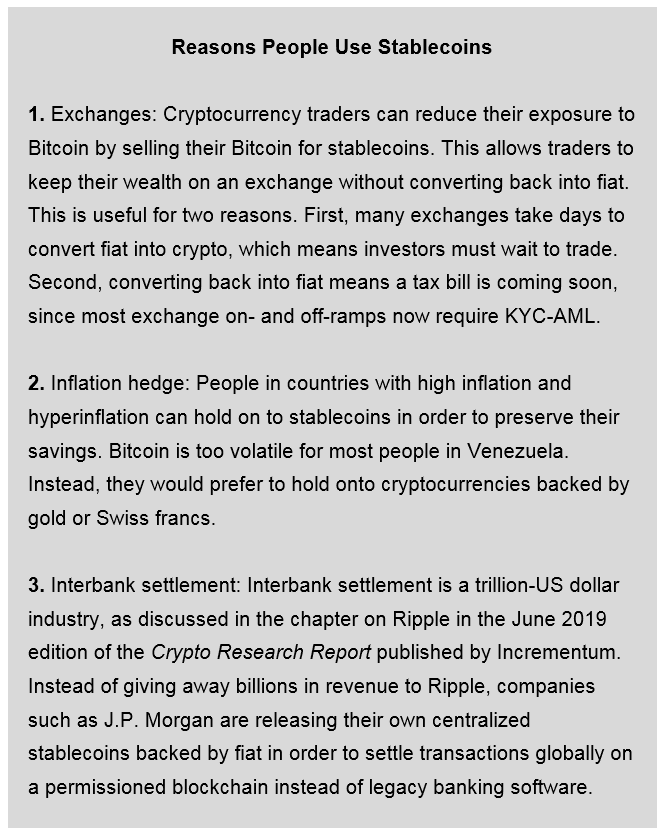
For now, if you just want to use this product, then open a Goldmoney account and you can use it. It’s very simple, the same way you used it so far, in the future everything is going to be within Block Vault.  

Mark Valek:

Very good, in terms of currencies I would be curious what kind of currencies are you able to store or take custody of? 

Stefan Wieler:

Well, generally we can do anything that is a token. When we launch, we are going to have Bitcoin and Ethereum, but we are working on bringing other currencies as long as we have demand for it.

Mark Valek:

Perfect.

Max Tertinegg: 

May I ask you a question here, out of interest? I think I already asked this last time but I’m not sure. You said this Vault solution will be full third-party insured, so I was just wondering how this would be possible from a technical perspective, because how can it be determined, who had access to a private key or if there isn’t a copy of the private key so in case of theft.  

Stefan Wieler:

Yes, we have a solution for this. Yours is a very good question and it took us a lot of time to figure it out, but that was the problem our customers came to us with. For example: A hedge fund came to us saying, “I want to invest [in cryptocurrencies], but I need the same kind of insurance as I have for precious metals”. First, to give you full disclosure, I don´t have a technical background, but simply speaking, the way this works is that we fill wallets with a fixed amount of, let’s say Bitcoin, and then store part of the private key in a physical form (on a bar) in one of our vaults. So, we store those physical bars the same way we store precious metals, so it can be handled by the vault operators the same way they handle a silver bar or a gold bar.

The important part is, we needed to have our auditor and our insurance company to be comfortable with the process.

Max Tertinegg: 

Are they comfortable with the process? 

Stefan Wieler:

We have been working with them very closely from the beginning and so far, it looks very good. The insurance company needs to have the thing audited otherwise they cannot insure it. What the insurance company relies on is that the auditor is doing a good job and the insurance company has to be happy with the process.

So, auditor must be able to go into the vault, the same way that they come and make regular and unannounced visits and the same way they do for precious metals and then they count the bars. The person doing the audit can see that the bars are there physically.

We had to put this all together and it seems that everybody is on board and the vault operators need to be on board as well because this is completely new for them, too. Nobody has ever seen something like this. We launched the beta and it works.

Max Tertinegg: 

I just registered for the beta launch. I really can’t emphasize this enough so if you found the solution to be profitable and if the insurance companies are happy with the process, then it is a breakthrough because this opens up the door. 

Stefan Wieler:

We haven’t launched yet but so far from our side it looks pretty good. From what we know there will be a lot of demand for this from day 1 because it’s something nobody has been able to offer so far and it’s really important for certain type of asset managers that can actually invest right now. 

Max Tertinegg: 

Can I add one last question to this? What actually is insured? Let’s say I put 100 Bitcoin into your vault, so the insurance goes for the 100 Bitcoin or for the euro equivalent at the time I put it in the vault or at the time of a potential theft?  

Stefan Wieler:

I give you the information I can give, some I might not be allowed to tell you. That’s a very good question. You have to understand: The insurance companies we are talking about are the same insurance companies that insure our precious metals. The way this works in the precious metals sector is that the company that owns the vault, they insure everything that is in the vault through an insurance company, they just pass on the costs.

For gold bars it’s easy, and, what is insured is the weight of metal, so it changes every day right? So, let’s say I have a ton of gold in there and it’s currently worth, I don’t know, 40 million US dollars and then the gold price doubles and then you need to have an insurance for 80 million dollars. The idea is that we have the exact same thing for cryptocurrencies.

Now you are using Block Vault through your Goldmoney account and you come to us and say, “I want to buy 100 Bitcoins through Goldmoney”. What we do is: there will be different types of bars, there will be, let’s say a 10-coin bar, a 50-coin bar and a 100-coin bar, so if you buy exactly 100 coins, then you can own the entire 100-coin bar. We can also break down bars, the same way we break down gold bars, and assign the title of each fraction to a different customer.

Basically, there will be a fixed amount of Bitcoin per wallet / bar and that will be insured as Bitcoin and not as dollars. The insurance companies have been doing this, for the valuables that are already insured in those vaults, and there’s surely much more complicated stuff in there than something that has a market price, because there’s all kinds of valuable stored in those vaults.

Max Tertinegg: 

Thanks a lot, very fascinating. 

Stefan Wieler:

I’ll keep you guys posted, once we go live, I can send out an email to everybody. The launch should be very soon. 

Mark Valek:

Lovely! Congratulations in advance and good luck for the official launch. Well, I think we covered quite a bit, I don’t want to make this too long, but I would still give everybody the opportunity to add some final thoughts, if you have some, I’m sure you have some, but if you have some relevant thoughts, please let us know now, anything related to crypto, did we leave out something crucial in your view Max?  

Max Tertinegg: 

No, I think I’m fine, but I want to add, what I told you in the beginning, so, I would recommend having a look at the Bitcoin Standard, the book from Saifedean Ammous, which is very interesting regarding Bitcoin being potentially a long term digital store value for the whole world. There is also a video because Saifedean Ammous was in Vienna at the Bitcoin Austria meetup and there is also a Youtube video, which I think is 50 minutes where he basically covers the essential points. Just have a look at this. That is my recommendation. 

(Video at the end of the transcript)

Mark Valek:

Thank you, great, we will post the video in the transcript. Oliver anything to add from your side perhaps? 

Oliver Völkel:

Just perhaps as a general remark, the cryptocurrency industry is still very young and faces a lot of challenges also in legal terms, I see this on a daily basis, I just would encourage people not to give up, I mean this is here to stay, and also perhaps if some of the regulators hear this or read the transcript, keep up the good work, I mean it is important that also the regulators get involved in this and figure out how this stuff works and from what I’ve seen in the past this has been done very well. I think if we work together, then in the next meet up we will have again substantial new developments to talk about. 

Mark Valek:

Perfect, thank you. Stefan any final thoughts from your side? 

Stefan Wieler:

No, I think sums it up quite nicely. I think the more I see interest in the space from people that don’t necessarily have a technical background, the stronger this becomes and the less likely this ever disappears. 

Mark Valek:

Perfect, then with this I want to thank you very much again for attending. I think we have some interesting thoughts, which we want to keep and spread. Thank you for that, have a great day and a great week.


Download transcript

Competing Currencies and Digital Money: How Hayekian Are Cryptocurrencies?

0
Competing Currencies and Digital Money: How Hayekian Are Cryptocurrencies?

The Government Monopoly on Money – For a Long Time Unquestioned

“I do not think that it is an exaggeration to say that history is largely a history of inflation, and usually of inflations engineered by governments and for the gain of governments.”

Friedrich August von Hayek

It is a truism that monopolies are detrimental to economies. They are inefficient with respect to quality and cost, their price fixing generates welfare losses, and beyond this, they occasionally waste substantial resources merely on erecting barriers to entry for competitors.[1] In an efficient economic order, monopolies are therefore either prohibited or are at least subject to curbs.

Natural monopolies[2] and government monopolies represent special cases. The latter are based on the notion that the state is able to fulfill certain tasks either more efficiently or in a more “social” manner than private suppliers are. These tasks include security (the monopoly on the legitimate use of physical force), state-run health insurance schemes, and the provision of transport infrastructure.

The monopoly on money is a very powerful tool at the state’s disposal,[3] and it’s a monopoly that has been abused for about as long as it has existed.[4] Already in antiquity the funding of wars was accomplished by systematically diluting the precious metal content of coins, which over time pushed the value of their precious metal content ever further below their nominal value.[5] Rulers across history have succumbed to the temptation of increasing their seigniorage income or of generating indirect tax revenues by means of inflation. Such behavior was eventually institutionalized in the form of the two-tiered banking system we know today — with money creation through the interplay between central banks (issuance of central bank money) and commercial banks (deposit money creation through lending of circulation credit) also known as fractional-reserve banking – which drapes a veil over the collection of seigniorage profits.[6] Latter-day efforts to stabilize the financial system and save the euro in response to the financial crisis are blending seamlessly into this history of abuse.

Thus, it is hardly surprising that criticism of the monetary and financial system has a long tradition as well. However, even intellectuals who placed individual liberty at the center of their deliberations hardly ever questioned and question the state monopoly on money as such – despite all the criticism leveled at the monetary system.[7]

Hayek’s Proposal of Introducing Competing Private Currencies

“Everything comes down to the question: Which forms of order promote liberty?”

Walter Eucken

When Richard Nixon suspended the US dollar’s convertibility to gold in 1971, it became obvious that the attempt to establish a monetary system based on a gold-exchange standard had failed due to over issuance of uncovered money substitutes. Upon this event Friedrich August von Hayek felt compelled to reexamine the question of what constituted an expedient monetary order.[8] In Hayek’s opinion, not only the abolition of the tie between the US dollar and gold but also the proliferation of Keynesian economic thinking at the time worsened the prospect of a stable, noninflationary money ever emerging under a government-run currency monopoly.[9] In 1975 Hayek eventually gave a lecture entitled “Choice of Currency”[10], in which he articulated for the first time the provocative demand that the state monopoly on money should be repealed. The publication of the monographs Free Choice in Currency and The Denationalization of Money followed a year later, in which he expanded in greater detail on his ideas on competition between private money issuers.

Hayek’s core thesis was that the entrenched abuse of the state monopoly on money for the purposes of enriching selected private groups, making good on fiscal deficits, or financing wars illustrates that concentrating the power of money issuance in the hands of the state (or any other centralized entity) does not work. Hence government has to be deprived of its monopoly on money creation, which should be replaced by a market-based monetary order that constitutes a system of power-sharing among competing entities.

What shape would an order reflecting these power-sharing principles take, and how could it emerge? Hayek argues that such an order would take shape if the following liberties were granted:

  • Private money producers would be free to issue money and enter into currency competition.
  • Citizens would be free to choose which currencies they want to use.

Banks would, for instance, issue their own currencies – in any amount they wished. While Hayek regarded money backed by gold or commodities as ideal, he explicitly allowed for the possibility of banks engaging in excessive creation of uncovered deposit money. However, he believed that this practice would fail to survive in a competitive market. In an unhampered market, banks would find that the incentive to boost their asset base over and above the amount of savings deposited with them would be curtailed. The preference of money users for an easy to use money with stable purchasing power would force banks to fulfill these expectations in the best possible way. Money suppliers issuing uncovered money substitutes would eventually face an exit of customers and disappear from the market.

Competition would – analogous to competition in nonmonetary goods and services – exert discipline. The structure of incentives would be optimal, as general welfare would increase as a result of numerous competing actors pursuing their own interests.[11] Hayek famously concluded:

“Money is the one thing competition would not make cheap, because its attractiveness rests on it preserving its ‘dearness’.”[12]

What role would a central bank play in such a competitive order? It would become obsolete. This prospect is welcomed by Hayek, as government-run monetary policy is precisely what he regards as the major source of economic instability. According to Hayek, historical economic crises were time and again attributable to the distorting effects of monetary policy implemented by governments, rather than to so-called market failures:

“The past instability of the market economy is the consequence of the exclusion of the most important regulator of the market mechanism, money, from itself being regulated by the market process.”[13]

However, the central bank would not necessarily have to stop operating right away. It could continue to issue (government) currency. However, it would be in competition with commercial banks and other private money producers and would therefore have a strong incentive to supply citizens with a stable currency.

Cryptocurrencies – Free Currency Competition in Practice?

“Cryptocurrencies are a use case of competing private currencies as envisaged by Friedrich August von Hayek.”[14]

Norbert F. Tofall

Initially the debate over the idea of competing private currencies was purely theoretical, as the government monopoly on money had been so deeply rooted for such a long time that the public at large never thought of seriously questioning it. When Hayek published his proposal, the voluntary abolition of the money monopoly would have been required to adopt it, which was tantamount to governments relinquishing a great deal of their power – a highly unrealistic prospect.[15]

Since then, conditions have fundamentally changed, though, as a result of the pervasive spread of the Internet. After the near-collapse of the monetary and financial system in the 2008 financial crisis and the erosion of confidence in government currencies and central banks in its wake, the first private digital currency in the form of Bitcoin made its entrance in the realm of Web 2.0. Since then more than 1,500 cryptocurrencies (in their entirety better described as crypto assets) with a market capitalization totaling roughly USD400bn have entered the market. As cryptocurrencies are largely outside of government control – at least until now –, a kind of laboratory for private currency competition could be established. In fact, the ECB suspects (rightly) that Hayek’s theoretical work was the spiritus rector of today’s cryptocurrencies.[16]

Decentralization: The Cryptocurrency Killer App

What makes cryptocurrencies so interesting is that they are so contrary to the mental image many people have of money.[17] The most famous cryptocurrency, Bitcoin, functions as a payment system based on monetary units that consist of themselves and are not redeemable for gold or any other commodity. Bitcoin is accepted as currency, though in line with the definition of Ludwig von Mises it has to be considered as pure fiat money [18], that is not run by the state and is not tied to a commodity. Many monetary theorists were convinced that such a currency could not possibly emerge in a free market. Hayek himself believed that currencies tied to commodities would prevail in a system of free competition. What is the reason, then, for the growing acceptance of cryptocurrencies?

The secret of their success that is at the core of an accepted currency is a result of their decentralized nature. Cryptocurrencies such as Bitcoin, Monero, and Litecoin are not issued by a single private institution; they are based on a source code protocol and maintained through a decentralized network of widely dispersed market participants. Unlike a currency issued by a private money producer, whose paper money represents a promise to pay, Bitcoin is a fiat money that is no one’s liability. In this respect, a cryptocurrency like Bitcoin is similar to gold.

An interesting aspect of the currency competition launched by the emergence of cryptocurrencies is also that it differs from Hayek’s proposal in one decisive respect. The situation as envisaged by Hayek would always carry the latent risk that a – centralized – money-issuing entity could fail.

In the case of a cryptocurrency such as Bitcoin, no such central entity exists. The smooth operation of a cryptocurrency is safeguarded by geographically dispersed interest groups such as developers, miners, traders, users, and others working within the ecosystem. Trust and risk are distributed across a network of numerous parties pursuing their own interests.[19] Those purchasing a cryptocurrency ultimately place their trust in mathematical and encryption protocols that maintain a system of incentives, which in turn provides all participating entities or groups with a motive to ensure the currency’s integrity. Hence the slogan “In Code We Trust”[20]. To this day this system of incentives has worked splendidly, and not one of the numerous attempts to destroy it has been successful.

The Quest for Stability

A problem plaguing many cryptocurrencies – and, as a proxy for them, Bitcoin – is their excessive price volatility. Bitcoin’s inelastic supply, coupled with a demand shock triggered by the rapid diffusion of “crypto-ideology” and the associated speculative hype,[21] has temporarily led to an enormous increase in the purchasing power. Leaving aside the recent correction, the history of Bitcoin is a history of hyper-deflation[22] – and in a time of strong deflation it makes more sense to hoard a currency than to use it as a means of payment. As a result Bitcoin and other new cryptocurrencies are barely fulfilling the function of media of exchange at the moment.[23]

The same feature that underpins the currency’s store of value function hampers its use as a unit of account. As the supply of Bitcoin and other cryptocurrencies is as a rule limited, with no central entity able to balance excess demand by boosting supply, cryptocurrencies are occasionally highly volatile.[24] Contrary to Mises’ belief that an inelastic supply would go hand in hand with comparatively small fluctuations in demand and price, cryptocurrencies have not proved suitable for fulfilling unit of account functions such as drawing up corporate balance sheets – at least so far.[25]

In line with Hayek, one could counter that a cryptocurrency that is undergoing a process of monetization has to be regarded as an object of speculation in the early stages of the process, which will inevitably involve volatility. It seems logical that speculative demand and reservation demand will be strong at an early stage. However, the importance of speculative demand should diminish over time, as ownership of the cryptocurrency in question broadens. If they are successful, emerging cryptocurrencies should eventually manage the transition from speculative assets to currencies that function reliably as media of exchange.[26]

A number of cryptocurrency enthusiasts who don’t want to simply wait and see whether this will happen are working on creating cryptocurrencies with stable values, so-called “stablecoins”.[27] These currencies have a flexible supply, which is adjusted to fluctuations in demand with the aim of achieving purchasing power stability. But – and here is the problem – how is it possible to guarantee “price stability” without being forced to restrict or abandon the decentralized and therefore intervention-resistant structure of a cryptocurrency? Simply decreeing an “inflation target” from on high is precisely what central banks are doing and is contradictory to the spirit of cryptocurrencies.[28]

The solution to this problem may be DAO, which stands for “decentralized autonomous organization”. Members of such a DAO organize independently. With respect to managing a stable-coin, members of a DAO would be tasked with ensuring the stability of its purchasing power. Stability would be promoted through a structure of incentives embedded in the coin’s programming code. The recently launched Maker DAO project[29] appears to hold promise in this regard. Maker’s stablecoin, called Dai, is still very young, but has already become popular with many users.[30]

Conclusion

“Humanity’s progress always involved a small minority deviating from the ideas and customs of the majority, until its example finally persuaded others to adopt its innovations as well.”

Ludwig von Mises

In our opinion Hayek has bequeathed us a vital body of preliminary theoretical work for a future, more crisis-resistant monetary order. In order to create full freedom of choice for money producers and users, the money monopoly of the state has to be repealed and replaced by an environment in which private currencies can be developed and can compete in a decentralized discovery procedure. As money users would punish producers of unsound (i.e., inflationary) money by abandoning it, both government and private currency suppliers would be motivated to keep their seigniorage income low and to issue sound money.

As governments would no longer be able to mitigate their debt burdens through inflation, such a monetary order would be highly effective in enforcing fiscal discipline. The chronic debt-crisis of our times, namely the overindebtedness of governments, could never emerge in such a system – thus currency competition would be the most powerful debt brake imaginable.[31]

For a long time, such competing currencies were unthinkable, as governments have not been inclined to voluntarily abandon their monopoly on money. With cryptocurrencies, which could emerge only due to the spread of the internet and which cannot be effectively suppressed or prohibited due to their decentralized structure, currency competition in the spirit of Hayek has become possible even in the absence of self-limitation by governments.

[1] A special case is temporary monopolies, which generate so-called “pioneer profits”. Companies can, for instance, obtain patents for innovations, which protect them for a limited time from imitations of their products made by competitors. The idea is that the state temporarily restricts competition for a time via the patent system in order to promote competition over the long term, since many companies won’t regard the required R&D spending as economically viable if there is no prospect of making temporary monopoly profits. See “Theory of Economic Development”, Joseph Schumpeter, 1911.

[2] Natural monopolies are the result of a cost structure (in most cases involving high fixed and low marginal costs) in which competitors are held to raise the total cost of supplying a good. Examples for this are railways, which have high fixed costs in the form of rail networks, and power and water utilities, which require electrical grids or piping systems for distribution.

[3] We are going to refer to the “state (or government) monopoly on money” in this section, even though it is nowadays usually not the central bank itself that produces new money. (Exceptions are QE, repos, and coupon passes, which affect the money supply directly and indirectly over a wide range of time frames.) Most money production results from inflationary lending by fractionally reserved private commercial banks (with central bank support), i.e., it is so to speak the result of a private-public partnership. Regardless, the government ultimately decides what may be used as legal tender.

[4] See “Monetary Regimes and Inflation. History, Economic and Political Relationships”, Peter Bernholz, Cheltenham, 2003.

[5] See “The Monetary Aspect of the Fall of Rome”In Gold We Trust report 2016, pp. 98-103, or “The Frogs”, Aristophanes, pp. 719-737.

[6] See The Zero Interest Rate Trap: Sustainable Wealth Accumulation in a Non-Sustainable Monetary System, Ronald-Peter Stöferle and Mark J. Valek, 2018 (to be published shortly).

[7] Hayek noted that the economic literature offered no answer to the question of why a government monopoly for the provision of money was deemed indispensable, nor was there any academic discussion examining the abolition of this monopoly (The Denationalization of Money, Friedrich A. von Hayek, 1976, pp. 26 ff). He attributed the notion that governments had a quasi-natural prerogative to be the exclusive suppliers of money to the historical fact that they had usurped the right to mint coins a very long time ago and then simply retained it as if this were a perfectly natural state of affairs (The Denationalization of Money, Friedrich A. von Hayek, p. 28).

[8] What makes this very interesting is the fact that Hayek previously espoused quite contrary views: “[A] really rational monetary policy could be carried out only by an international monetary authority […] [S]o long as an effective international monetary authority remains an Utopian dream, any mechanical principle (such as the gold standard) … is far preferable to numerous independent and independently regulated national currencies” (Monetary Nationalism and International Stability, Friedrich A. von Hayek, 1937, pp.93ff). Later Hayek wrote that a free currency market was “not only politically impracticable today but would probably be undesirable if it were possible” (The Constitution of Liberty, Friedrich A. von Hayek, 1960, pp.324ff). Nevertheless, what unites the different positions Hayek has taken over time is his desire to create a noninflationary monetary order. Moreover, the evolution of his position illustrates his growing skepticism with respect to the state.

[9] See “Toward a Free Market Monetary System”, Friedrich A. von Hayek, p.2.

[10] See “Choice of Currency: A Way to Stop Inflation“, Friedrich A. von Hayek, The Institute of Economic Affairs, 1976.

[11] See The Denationalization of Money, An Analysis of the Theory and Practice of Concurrent Currencies, Friedrich A. von Hayek, 1977, p. 57.

[12] See The Denationalization of Money, An Analysis of the Theory and Practice of Concurrent Currencies, Friedrich A. von Hayek, 1977, p. 94.

[13] See The Denationalization of Money, An Analysis of the Theory and Practice of Concurrent Currencies, Friedrich A. von Hayek, 1977, p. 102.

[14] See “Währungsverfassungsfragen sind Freiheitsfragen: Mit Kryptowährungen zu einer marktwirtschaftlichen Geldordnung?,“ Norbert F. Tofall, Flossbach von Storch Research Institute, 2018, p. 4 (Currency questions are questions of liberty: Toward a market-based monetary order with cryptocurrencies?).

[15] See “A praxeological analysis reveals that currency competition is simply not in the state’s interest.” Thorsten Polleit: “Hayek’s ‘Denationalization of Money’ – a Praxeological Reassessment”, Journal of Prices and Markets, p. 79.

[16] See “ECB: ‘Roots Of Bitcoin Can Be Found In The Austrian School Of Economics,“ Jon Matonis, Forbes, 2012.

[17] The success of cryptocurrencies does not only irritate a number of laypersons. For instance, the well-versed monetary theoretician (and Austrian School representative) Guido Hülsmann stated in 2007 that a money “that is defined entirely in terms of bits and bytes is unlikely ever to be produced spontaneously on a free market.” (“The Ethics of Money Production”, Ludwig von Mises Institute, 2008, p. 33).

[18] See The Theory of Money and Credit, Ludwig von Mises, Yale University Press, 1953.

[19] See “Trustless is a Misnomer”, Nick Tomaino, Medium, July 21, 2016.

[20] See “The Bitcoin Boom: In Code We Trust”, Tim Wu, The New York Times, December 18, 2017. (Coincidentally a play on words on the title of this report, which was first published well before Bitcoin was born.)

[21] Thus, many people believe that cryptocurrencies, which are still at the beginning of more widespread adoption, will continue to gain in value in coming years and are buying them as speculative buy-and-hold investments.

[22] See “Bubble or Hyperdeflation“, Incrementum AG, Crypto Research Report.

[23] Several people in the crypto community argue that Bitcoin is not at all predestined to become a widely adopted medium of exchange for day-to-day use. Rather, they say, Bitcoin represents a decentralized and therefore intervention-resistant store of value. The original source code of Bitcoin, which can be altered only if the extremely disparate Bitcoin community arrives at a consensus, provides the best possible conditions for the currency’s store-of-value function: The total amount of Bitcoin that can be mined is restricted to 21 million units (some of which have already been lost forever – e.g. a famous hard disk drive containing 70,000 BTC is known to be peacefully collecting rust in a UK landfill). It takes around 10 minutes for a new bitcoin to be created. Since the emergence of Bitcoin in 2008, the quantity of newly created bitcoins has been declining by half every four years. According to estimates, by 2140 all bitcoins that will ever exist will have been mined. This continually strengthening deflationary tendency strongly underpins the store-of-value function of BTC.

[24] Cryptocurrencies are affected to a greater extent by this volatility than, for example, gold, as gold is subject to countercyclical buffers through jewellery and fabrication demand (declining demand when prices rise and vice versa) as well as through fluctuations in the gold supply (growth in mine supply and rising sales from existing stocks when prices increase and vice versa).

[25] See Human Action: A Treatise in Economics, Ludwig von Mises, Auburn, Alabama: Ludwig von Mises Institute, 1998, pp. 225ff.

[26] As discussed in this section, relatively supply-inelastic gold is not immune against periodic high speculative demand, either: If in the course of an emerging currency competition currencies backed by gold were to turn out to be preferred by most users, surging demand for gold would rapidly boost its price – and presumably also its volatility – which would at least temporarily suspend suitability of the precious metal as a means of payment and unit of account. (See The Denationalization of Money, An Analysis of the Theory and Practice of Concurrent Currencies, Friedrich A. von Hayek, 1977, pp. 102/127.).

[27] See the chapter Crypto: Friend or Foe?

[28] See “The Search for a Stable Cryptocurrency”, Vitalik Buterin, Ethereum Blog, November 11, 2014.

[29]: See “Maker for Dummies: A Plain English Explanation of the Dai Stablecoin“, Gregory DiPrisco, Medium, November 20, 2017.

[30]: See “Stablecoins: A Holy Grail in Digital Currency“, Nick Tomaino, The Control, April 3, 2017.

[31]: See “Währungsverfassungsfragen sind Freiheitsfragen: Mit Kryptowährungen zu einer marktwirtschaftlichen Geldordnung?“, Norbert F. Tofall, Flossbach von Storch Research Institute, 2018, p. 5 (“Currency questions are questions of liberty: Toward a market-based monetary order with cryptocurrencies?”).

Quarterly Review Q2 2018: Wall Street Is Getting Ready

0
Wall Street Is Getting Ready

“The total market cap of cryptocurrencies was around USD 400bn, around a quarter of that of gold as store of wealth (gold bars, coins and physical gold ETFs all together amount to USD 1.5tn). And monthly trading volumes of the three largest cryptocurrencies by market capitalization (Bitcoin, Ethereum and Ripple) have increased sharply in recent months, from around USD 5bn in early 2017 to USD 550bn in December. This represents around half of the monthly trading volume of gold futures of USD 1.1tn, as of January 18 aggregate volumes were higher, reaching around USD 680bn.”

J.P. Morgan Perspectives 2018

The Bitcoin price is plummeting and looking for a floor. Meanwhile big players on Wall Street are working on their grand entrance. At the forefront of this: Goldman Sachs.

What to do if you are stationed in the middle of nowhere surrounded by super computers? Exactly, you mine cryptocurrencies. This happened in a Russian government research center in Sarov, a secluded city 400km east of Moscow, the seat of the Russian nuclear program. The first Soviet atomic bomb was built here in 1949. And now researchers have been caught using the strongest computers the Russian state has to offer to mine cryptocurrencies.

This came to light through a press statement by the authorities in February of this year. Apparently, this is becoming a common occurrence in companies with good IT infrastructure. However, maybe the researchers just took a statement from Vladimir Putin during his visit to Sarov in 2014 a bit more literal than expected. At said meeting with young scientists, President Vladimir Putin praised the Russians’ spirit of resourcefulness, saying, “When life sets us certain challenges, we are forced to tackle them one way or another and we do.” As a side note, the Russian authorities neither informed us which coins had been mined nor did they shed any light on what had happened to them in the meantime. [1] It is however not only Russian civil servants or the population of inflation-riddled countries such as Venezuela, who have discovered cryptocurrencies and are using them for their own gain. Recently military investigators uncovered a drug ring at the US-Navy academy in Annapolis, Maryland. Ten officers in training had been supplying their comrades with cocaine, LSD and ketamine. They had apparently bought the drugs on the Dark Net and paid for them with Bitcoin. The management of the academy ordered a spontaneous drug test for all 4500 recruits, the results of which were never made public. [2]

The Bitcoin Price is Plummeting

In our first report in 2018, we predicted a spell of crypto winter. Our technical analysis of the crash in January 2018 goes to show that a hard plummet right down to USD 2,500 is very possible. Other (especially pessimistic) analysis corresponds with this evaluation. Many are looking at the charts of the crash after 2013 for some sense of direction in which Bitcoin could go now. Especially bleak outlooks have been published since analysts saw a “Death Cross” in the charts in mid-March.[3] Others, such as the crypto hedge fund “Pantera Capital Management” assume that we have already reached the rock bottom price of Bitcoin at USD 6,500, and we will therefore soon witness an upwards trend again.[4] While we are finishing this report, prices are dropping again, then shooting up because of good news, then dropping again. Where do we go next? That is the age-old question – in hindsight we are always smarter. The markets are unpredictable and the crypto market is especially volatile.

A study by the Warwick Business School showed that trades on the crypto market are made on a purely emotional basis instead of being based on fundamental analysis.[5] The survey covered trade data from April 2016 up to September 2017, and the results do make sense.

 The crypto market is still dominated by small investors who don’t have the knowledge or data for a technical or fundamental analysis. On top of this, Bitcoin and Co. are still so relatively new that there is a real lack of accepted official data for an unbiased assessment. It is however noticeable that over the past few months more and more central bankers have had a closer look at Bitcoin – and in the process, have confirmed Bitcoin’s role as a currency[6] as well as the fact that Bitcoin does indeed have value. One central bank economist sees the fundamental price (based on mining costs) at USD 1,800.[7]

The debate is however still ongoing. The author of the Warwick survey, Daniele Bianchi, has a similar view. “It’s not like with normal currencies, in which the productivity of a country influences the price. Instead, they have similarities to investments in shares of a high-tech company.” This phenomenon can be seen time and time again and economists are now discovering the new field of crypto economics. The puppet masters behind the various tokens try and create different incentive systems to pull in more investors. These tokens therefore almost turn into shares of the company or project at hand. At least they are traded like shares. An important factor in the price drop over the past few months has been the so-called Tokyo Whale. This is the nickname for the bankruptcy trustee of the now extinct exchange Mt. Gox. The hack and subsequent collapse of which lead to the bear market of 2014 and onwards.[8] It is the Tokyo Whale’s job to sell the rest of Mt Gox’ Bitcoins as profitably as possible. In total, he will unleash 200,000 Bitcoins to the market.[9] This will obviously not happen in one go, but according to media reports the trustee Nobuaki Kobayashi has trickled Bitcoins into the market worth USD 400 million since September 2017.

By the beginning of February, he must have sold roughly 40,000 Bitcoins. What followed was a temporary recovery until Kobayashi moved 16,000 Bitcoins onto an exchange ready for the presumable subsequent sale. The community follows his wallets closely, as the game only ends when all 200,000 Bitcoins from Mt. Gox have been turned into “real” money.[10]

Which Altcoins Will Survive?

All these elements together make for an extremely volatile market. The least volatile cryptocurrency, measured by standard deviation of returns, in this market is Bitcoin. However, altcoins such as Ethereum and Ripple are also becoming increasingly popular on the market. Market sentiment in June 2018 first showed signs of desperation, maybe even despair – in social media as well as in various forums. We are sure we will only start a new bull market once the weak hands have been swept out of the market. Investors which only joined the game during the ICO Boom of 2017 should be aware that although Bitcoin has survived such a “crypto winter” before, the majority of Altcoins however have not been put through the same test of time.

The analysts from Goldman Sachs categorically warn against holding on to Altcoins in a bear market. In a report dating back to February of this year, Goldman analyst Steve Strongin, suggests that a large percentage of existing Altcoins could completely disappear and could be replaced by a small number of robust cryptocurrencies which lead the way to a new upward turn. “The high correlation between the different cryptocurrencies worries me”, Strongin said. “Because of the lack of intrinsic value, the currencies that don’t survive will most likely trade to zero.”[11]

Like others before him, Strongin draws parallels between the Blockchain market and the Dot Com Bubble. Only a few of the hottest stocks from the late 1990s have survived. Those that did however, became huge. “Will the cryptocurrencies of today turn into the Amazons or Googles of tomorrow or will they end like the many now non-existent search engines? Just because we are in a speculative bubble doesn’t mean the price for the few surviving ones can’t rise again. At the same time this means that many won’t ever reach their all-time highs ever again.”

It is true that such gloomy prophecies regarding Bitcoin have turned out to be wrong time and time again.[12] But then again, we have been in good company when we have warned against the ICO Mania. This is why we must say the Goldman analyst could be right. A handful of projects could survive in the long-term, but many are facing the end before we leave this valley of death. The Godfather of cryptocurrencies Bitcoin has proven its stability before. While small investors are at home licking their wounds from the market downturn, the big boys are finally here to step into the ring. This is probably the most important trend of 2018, and we call it the “Goldman-Effect”. The second trend comes as a direct result of the first: the regulators are finding themselves under more and more pressure because institutional investors need legal security before they can enter the market.

The Goldman-Effect

The boss of Goldman Sachs, Lloyd Blankfein, earned lots of criticism in 2009, when he was quoted saying his bank was doing “God’s work” in an interview with London Times. He added that his bank had a social role: “We help companies grow. Growing companies create standards and jobs. We have a social responsibility.”[13]

Early Bitcoin adopters and purists may note like to hear this, but Goldman is doing a lot for the legitimization and growth of the crypto sector. The investment bank, which has always thought of itself better than the competition, wants to be the first to get in on the new opportunity. The analyst from Goldman took a closer look at Bitcoin back in the summer of 2017. And now this. At the beginning of May, in a carefully choreographed article in the New York Times, it was made public news that “Goldman Sachs will be entering the trading floor of Bitcoin”.[14]

The new trading desk will initially be part of the department for foreign currency. It will be led by the 38-year-old Justin Schmidt. In 2017, he had only left the hedge fund Seven Eight Capital to trade Bitcoin and other crypto assets by himself. The reasoning behind the decision, which are described in the New York Times article, paint a very interesting picture of the growing popularity of Bitcoin on Wall Street. “It resonates with us when a client says, ‘I want to hold Bitcoin or Bitcoin futures because I think it is an alternate store of value”, says Rana Yared, a senior of Schmidt’s at Goldman. “Bitcoin is not a scam”, she goes on “But it is also not a currency. Clients want to hold cryptocurrency as a sort of precious natural resource, similar to gold.”

It was possible for Goldman to get in on the action through the implementation of futures and other derivates. However, the Goldman bankers aren’t the only ones buying up Bitcoin-Futures. The daily trading volume of the CME Futures in Chicago have risen by 250% since the initiation in December 2017.[15] There is still room to grow. According to Reuters one fifth of the big banks want to enter the Bitcoin trade by the end of 2018.[16] As of now, it is still prohibited for institutional investors to buy Bitcoin outside of regulated fund vehicles, trackers, futures, and trusts. They are however getting prepared for when the day comes that this will be possible, and they are putting real thought into how one can directly buy Bitcoin and store them securely for clients.

Et tu, J.P. Morgan?

One of them could be J.P. Morgan. This is highly interesting as J.P. Morgan’s CEO Jamie Dimon is a known Bitcoin skeptic. He has after all called Bitcoin a scam.[17] He went as far as to say he would fire any employee who touches the stuff. The comments didn’t age well. In May, just a mere few months after Dimon’s last outburst, the U-turn was made official: J.P. Morgan is working on its own crypto strategy.[18]

They created a new position for exactly this purpose and found the 29-year-old Oliver Harris to fill it. Up until then he was responsible for J.P. Morgans Fintech-Program. J.P. Morgan seems to be still be a few steps behind the competition as direct trading with cryptocurrencies or even derivatives are as of yet, not on the horizon.[19]

Daniel Pinto, co-president of J.P. Morgan, separately told CNBC on Wednesday that the Wall Street giant was now “looking into that space”. “Cryptocurrencies are real, but not in the current form,” he said.[20] We are left wanting further explanations by Dimon’s potential successor. But when Dimon revised his statement regarding Bitcoin and even noted that there was a viable future for the Blockchain technology, one could have known the bank was about to announce their official move towards the sector.

Dimon is not the only one to change his mind when it comes to Bitcoin. The currency speculator George Soros had claimed just six months ago at the economics forum in Davos that Bitcoin was only interesting for a dictator wanting to keep some money safe on the side. A very lopsided view of things given that the technology actually allows the small man on the street to keep money away from a dictators as it is happening in Venezuela. Soros has changed his mind anyway. In April he gave the green light to his fund, which has USD 26 billion in assets under management to invest in Bitcoin.[21]

Rock and Coins

And yet another big name from the finance world has arrived: Venrock, the Venture Capital arm of the Rockefeller family (Ven stands for Venture, Rock for Rockefeller). Two of the most successful early investments of the company include Intel and Apple. Now they are heading into the crypto sector. In stark contrast to George Soros, Partner of Venrock David Packman doesn’t hold back his enthusiasm regarding the new industry. More specifically, Venrock has a partnership agreement with CoinFund, a company based in Brooklyn.[22]

CoinFund supports Start-ups which base their business model on the Blockchain technology. Both companies have invested in YouNow, an app for live video streaming which had planned an ICO last year. Yet another client of CoinFund is the Canadian Chat-app Kik, which already completed its ICO.[23] David Packman from Venrock commented on his company’s entrance onto the crypto scene, that they are in it for the long haul: “There are many cryptocurrency traders. There are many cryptocurrency hedge funds. This is different. For us it looks more like Venture Capital.”[24]

Venrock is not alone in its mission to infiltrate the market. Despite the consistent popularity of ICOs more and more, Venture Capital firms are looking for a way into the game. In just the first three months of this year Blockchain companies have been able to pull in a combined investment of USD 400 million.[25] It is doubtful though that many of these are actual long-term investments like Venrock’s are meant to be. It seems to be the norm that investors buy in the Pre-Sale-Phase of an ICO since the value of their equity already rises through the ICO itself.[26]

The ICO-Bubble Continues

As a comparison: Blockchain companies have had an influx of over USD 3 Billion via ICOs just this year. It comes at little surprise that many of the investors, no matter if they bought in the Pre-Sale-Phase or during the actual ICO, get rid of their shares quite quickly. Roughly half of all ICO funded projects have already failed.[27] Many of these companies only exist on paper – the so called White Paper.

This investment boom is compared time and time again with the Dot Com Bubble. Many big players within the scene, like Ethereum founder Vitalik Buterin, have called out for caution in regard to an ICO Bubble. In our past reports, we have not only given the subject much room but have also warned against a too flippant approach when investing via ICOs. Especially, since regulation bodies are also highly alarmed. The question if a coin which is financed via ICO is in fact a security, and should be regulated as such, puts this process very much in the legal grey zone. The US authorities have already convened on this subject, more specifically looking at the sector’s giants Ethereum and Ripple.

A story which broke in the Wall Street Journal claiming there had been a meeting of regulatory authorities back in April caused for confusion and panic on the market.[28] It is unclear to this day if said meeting actually ever happened. What we however did find out in the course of the coverage of this story is that Ethereum and similar products have gained a huge fan base in the Tech-sector. Defenders of the crypto world are organizing themselves in Silicon Valley – once again driven mainly by Venture-Capital-investors. This new lobby wants to persuade the regulatory bodies to at least not classify already existing and successful projects such as Ethereum as mere securities. Initially founded via ICO, Ethereum’s structure is now completely decentralized, they argue. And their voice seems to be heard. In a speech on June 15, the SECs point man on crypto, William Hinman, stated, that Bitcoin and Ethereum are in fact not to be treated as securities. However, he did not comment on Ripple.[29]

A Scam is a Scam – Even on the Blockchain

The US regulatory board SEC has also started to act based on the existing rules.[30] A scam is a scam – even on the Blockchain. The founders of the cryptocurrency Centra were arrested in April. The charge: Their ICO had criminal intent and they relieved their investors of USD 32 million. Centra was supposed to be a crypto credit card and work together with Visa and Mastercard – at least that was what was advertised.

According to SEC, the company Centra never had a business agreement with either of the credit card providers. One of the two apparent imposters was caught just before leaving the country. “We allege that Centra sold investors on the promise of new digital technologies by using a sophisticated marketing campaign to spin a web of lies about their supposed partnerships with legitimate businesses”, Stephanie Avakian, co-director of the SEC’s Division of Enforcement, said in a statement Monday. “As the complaint alleges, these and other claims were simply false.”[31]

Centra was not the first case to be looked into by the SEC. The AriseBank case, who’s ICO was also stopped, involved more than USD 500 million. The Centra case is so juicy marketing wise because the famous boxer Floyd Mayweather had publicly endorsed the ICO.

To educate investors, the SEC went as far as to create its own fake ICO as a honeytrap. They even wrote a White Paper full of the specific Blockchain language for the fake project “Howeycoins”.[32] “Howeycoins” set out to disrupt the global tourist industry. The website looked like many others of which ICO investors have seen plenty, it even included the famous count down timer to indicate when the bonus phase of the ICO was to kick off.

Whoever clicked on “invest” ended up on the website of the US regulatory authority. This site also included a list of “red flags” to look out for and avoid. For example, ICOs with celebrity endorsements should rather be avoided instead of gravitated towards. This whole ploy was largely more successful than any official warning the SEC had issued up until then and shows that even regulators have a sense of humour.

Authorities are also looking into potential price manipulation. The US Department of Justice has opened a new investigation in regard to illegal practices.[33] This includes spoofing or strategically placed buy and sell orders used to manipulate the market, which are deleted before being activated. Also, the act of “wash trading”, the manipulation of prices through a participant who completes his own orders. The Billionaires Mike Novogratz and Cameron Winklevoss have both whole heartedly supported the supervisory authorities’ attempts in the field of cryptocurrencies. “Weeding out the bad actors is a good thing, not a bad thing for the health of the market,” Novogratz, said in a telephone interview. “Plenty of exchanges have these inflated volume numbers to create some sense of excitement around coins,” he said, citing his own experience trying to trade.[34]

One thing is for sure: the big players want in on the action. But only in areas where the rules are clear and above board can they actually also play. This has led to a behind-the-scenes race of the big names. It is not about investing now, it is about being the best prepared player when the time has come, the dust has settled and the rules are clear. This creates more pressure on the authorities to come up with rules which give investors and consumers legal security, but also don’t jeopardize this new sector.

For this report, we have especially highlighted the role of the US authorities as they have been extremely proactive here. It should be noted that almost all countries are currently asking the same question: How can we regulate without strangling the Bitcoin sector? This means there is not only a race to regulate between states, but also between national governments and the international organizations. At the moment one can say the governments are leading the way.

In some EU countries, such as Austria and Germany, there will be obligatory rules regarding ICOs soon. An overall EU law is currently not on the agenda.[35] Although, the fifth know-your-customer and anti-money laundering directive is expected to include specific provisions for cryptocurrencies. As predicted in the last report, the attempts of the G20 have also been without results so far. However, even the managing director of the IMF, Christine Lagarde, has said that something is needed. Regulating the sector is unavoidable, she said, but a balanced approach would be commendable.[36]

You Can Buy an Exchange

Other participants are also preparing for the days with more transparent rules in the land of Bitcoin. The Intercontinental Exchange (ICE), the mother company of the New York stock exchange, publicly announced to be working on a Bitcoin trading tool at the same time the New York Times article about Goldman Sachs broke. The technology exchange Nasdaq also seems to be well underway in this direction. Nasdaq CEO Adena Friedman is quoted saying just in April of this year “There is no doubt that Nasdaq will consider becoming an exchange for digital cryptocurrencies.” That same day, Nasdaq announced a cooperation with the American Bitcoin exchange Gemini. According to some sources, the second largest exchange of the US could start trading Bitcoin as early as October 2018.[37]

These plans correspond perfectly with Goldmans and others plans. The big institutional players obviously need big, regulated exchanges in order to start trading. Goldman can’t just open a Binance account.

However, there is another way. You can simply buy an exchange. The investment bank itself didn’t do so, but the start-up Circle which is supported financially by Goldman did. At the end of February, Circle acquired the popular crypto exchange Poloniex.[38] The “NYT” journalist Nathaniel Popper got his hands on internal presentations which explain the motivation behind this takeover: Circle wants to keep Poloniex as an independent exchange, however they are looking to work very closely with the SEC. The goal: Circle wants to make Poloniex the first regulated crypto exchange in the USA.[39]

The slides read as follows: “By becoming the first regulated Crypto Exchange will enable Circle to list and provide a platform for all forms of emerging crypto tokens, including tokens that would be deemed securities. We believe the market for security-like tokens will continue to expand, creating demand for this market infrastructure. Circle (and evidently Goldman) are obviously preparing for a world in which regulated securities can be traded on the Blockchain as a token. The plan goes on: Circle wants to introduce a cryptocurrency which is bound to the Dollar. A Crypto-Dollar by a company which is covered by Goldman Sachs would be a complete and utter game changer. The issue of regulation is completely open in this aspect as well.

We assume that the race for the Bitcoin infrastructure has only just begun. That every step is a step into a legal grey zone still discourages many institutional players. Some, such as the huge investment manager Vanguard, are steering clear of the sector all together. In May, CEO Tim Buckley went as far as saying: “You will never see a Bitcoin fund from us. We stay away from assets which don’t have a sound basic economic value and don’t generate income or cash flow.”[40]

Conflict of Generations

Similar to Warren Buffett, who misses no opportunity to hate on Bitcoin, companies such as Vanguard have no interest in making Bitcoin sound too interesting as an investment. They want their clients to continue to put their money in traditional investment opportunities. There is more behind this all than the mere discussion and discourse about the Blockchain technology. It is a generation conflict. Millennials, people aged between 18 and 39, are deeply influenced by the last financial crisis. This coincides with the fact that this is the generation which grew up with internet access. A whole row of studies show that Millennials are the most likely to be interested in crypto assets.[41]

The combination of technological trust and wariness towards the financial system is a dangerous one for providers of legacy investment products. It is to be expected that established players such as Buffet and Vanguard will be become more and more outspoken against Bitcoin. Others such as Goldman have already decided to go a more proactive route and be first in line when it comes to institutions embracing the new sector. And others like J.P. Morgan have proven that they can and must change their thinking.

Without a doubt, the economic success of the partially dubious crypto exchanges must have drawn the attention of the big players to the sector itself. The top 10 exchanges generate roughly USD 3 million in fees per day. Just the top two, Binance and OKEx, have a daily trading volume of approximately USD 1.7 billion. “The exchanges and transaction processors are the biggest winners in the space because they’re allowing people to transact and participate in this burgeoning sector,” said Gil Luria, an equity analyst at D.A. Davidson & Co, who reviewed the methodology for the revenue estimates. “There’s a big business there and it would not surprise me if they’re making hundreds of millions of dollars in revenue and possibly even billions a year.”[42]

Of course, at the moment it is still unclear if the crypto exchanges of today will even be around tomorrow. The current market leader Binance is just over a year old. If established players such as Nasdaq really set their sights on these markets, they will subsequently also be able to pull in a lot of investors. This is however in the distant future. There are still a few battles to be fought – also in the generational conflict of the exchanges.
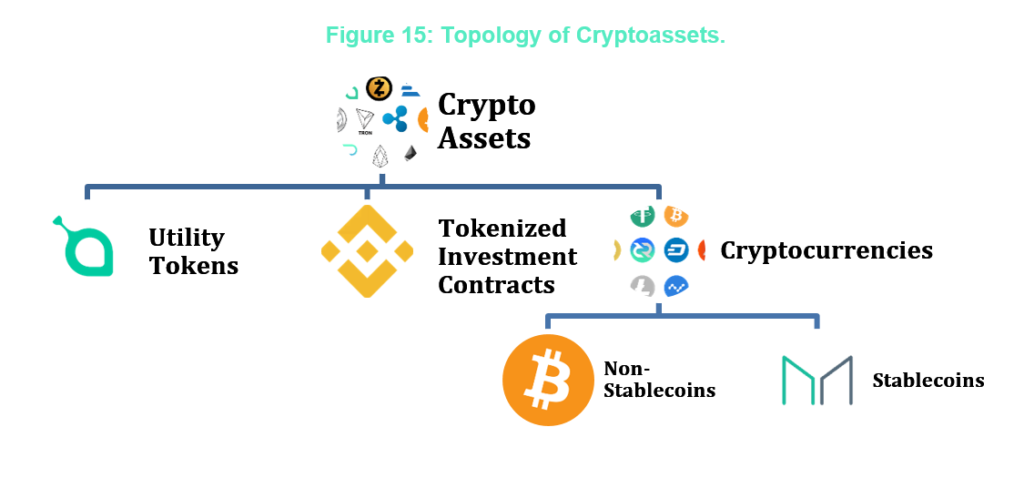
One player deserves special attention: Coinbase. Subject of many chats within crypto forums is the speculation of which coin will next be released on the Coinbase platform. The “standard” app for Bitcoin newbies has more than 20 million clients – more than the traditional US investment management firm Charles Schwab. The US company is currently expanding in many directions simultaneously. The Coinbase app is available in 32 different countries and has additionally initiated a crypto fund. The fund is currently only available for US investors and only if they decide to invest at least half a million USD. The name of the new venture speaks volumes of where this ride will take us: Coinbase Asset Management.[43]

Coinbase has its own exchange, Gdax, which will soon be relaunched as “Coinbase Pro”. Additionally, Coinbase recently purchased Paradex. This “decentralized” exchange not only takes care of the storage of tokens of their customers, but also allows users to directly trade with each other. Speculators say the purchase of Paradex is paving the way for Ethereum based ERC20 tokens to be launched on the Coinbase exchange. Currently the app only offers four cryptocurrencies: Bitcoin, Ethereum, Litecoin and Bitcoin Cash.[44] Ethereum Classic could also be added soon.

Last but not least, Coinbase has also entered the Venture Capital sector and has initiated their own incubator fund for start-ups in the crypto sector. “It could be possible that we start investing in companies that look a lot like competition for Coinbase. We have a long-term perspective and believe that different approaches are healthy and viable”, Coinbase stated on their blog.

Bitcoin Has Become Mainstream

Predictions are always tricky. But the abundance of activity within the Bitcoin sector since the crash of January 2018 goes to show that cryptocurrencies are far from dead. It is however still most probable that only a few of the Boom phase projects will survive in the long run. The overall dominance of Bitcoin is not in danger at the moment.

The infrastructure side of things promises to be very active in the coming months. We will stay tuned. New players such as Binance are attacking companies like Coinbase. In addition, there is a continuously growing list of newcomers: from Goldman all the way to start-ups like Revolut or exchanges such as Nasdaq. Within the crypto market itself, there are of course also many promising projects. While the market is still recovering from the ICO Bubble, new coins which aren’t based on the classic Blockchain are gaining traction. One example is the Iota project which is already pretty popular in Europe, and is investigated in length in next chapter of this report.

Bitcoin and the crypto sector have become mainstream. We won’t find out what this all really means until we have finally come out the other side of this valley of doom. As with most things in life, in hindsight we will be wiser as to where the real bottom of the Bitcoin price in 2018 was and if we have already seen it or not.

[1] See “Russia Busts Crypto Miners at Secret Nuclear Weapons Lab,” Stepan Kravchenko, Bloomberg, February 9, 2018.

[2] See “Naval Academy Rocked by Drug Scandal; Ring Bought Cocaine With Bitcoin,” Tyler Durden, Zero Hedge, February.

[3] See “Bitcoin’s ‘Death Cross’ Looms as Strategist Eyes $2,800 Level,” Todd White and Eddie van der Walt, Bloomberg, March 16, 2018.

[4] See “Crypto Hedge Fund Says Bitcoin Has Bottomed Out,” Camila Russo, Bloomberg, April 12, 2018.

[5] See “The Fundamentals Driving Crypto Trading? There Aren’t Any,” Julie Segal, Institutional Investor, May 24, 2018.

[6] See “A Short Introduction to the World of Cryptocurrencies,” Aleksander Berentsen and Fabian Schär, Federal Reserve Bank of St. Louis Review, 2018, 100(1), pp. 1-16.

[7] See “Making Sense of Bitcoin Price Levels,” Joost van der Burgt, Federal Reserve Bank of San Francisco, April 2018.

[8] See “Inside The Bizarre Upside-Down Bankruptcy of Mt. Gox,” Adrianne Jeffries, The Verge, March 22, 2018.

[9] See “Mt. Gox Trustee Sold Half a Billion Dollars Worth of Bitcoin and Bitcoin Cash,” Trustnodes, March 7, 2018.

[10] See “Bitcoin’s Tokyo Whale Sold $400 Million and He’s Not Done Yet,” Go Onomitsu, Bloomberg, March 7, 2018.

[11] See “Get Ready to See Most Cryptocurrencies Hit Zero, Goldman Says,” Kana Nishizawa, Bloomberg, February 7, 2018.

[12] See “Bitcoin Obituaries,” 99Bitcoins, 2018.

[13] See “Blankfein Says He’s Just Doing ‘God’s Work’,” Dealbook, The New York Times, November 9, 2009.

[14] See “Goldman Sachs to Open a Bitcoin Trading Operation,” Nathanial Popper, The New York Times, May 2, 2018.

[15] See “The CME recorded an all time record volume of its 5-lot BTC futures yesterday,” Jon Najarian, Investitute, April 26, 2018.

[16] See “One in five financial institutions consider cryptocurrency trading, says survey,” Reuters, April 24, 2018.

[17] See “Jamie Dimon Slams Bitcoin as a ‘Fraud’,” Hugh Son, Hannah Levitt and Brian Louis, Bloomberg, September 12, 2017.

[18] See “JPMorgan launches crypto strategy months after Dimon ‘fraud’ warning,” Paul Clarke, Financial News London, May 17, 2018.

[19] See “JPMorgan has asked 29-year-old highflier to draw up a cryptocurrency strategy,” Oscar Williams-Grut, Business Insider Deutschland, May 17, 2018.

[20] See “JPMorgan’s Wall Street chief talk China, bitcoin, Amazon, and is preparing for an inevitable big downturn in stocks,” Hugh Son, CNBC, May 16, 2018.

[21] See “George Soros Prepares to Trade Cryptocurrencies,” Alastair Marsh, Saijel Kishan and Katherine Burton, Bloomberg, April 6, 2018.

[22] See “It Started With the Rockefellers: Now it’s Takin on Crypto,” Robert Hackett, Fortune, April 6, 2018.

[23] See “VC Firm With Rockefeller Roots Turns to Crypto Startup,” Olga Kharif, Bloomberg, April 25, 2018.

[24] See “Rockefeller’s VC Arm Venrock Partners With Coinfund, Exec Highlights Focus On Long Term,” Molly J. Zuckerman, CoinTelegraph, April 8, 2018.

[25] See “Blochain-Startups haben dieses Jahr bereits mehr Investment bekommen als 2017,” Jakob Steinschaden, Fortune, April 6, 2018.

[26] See “Venture Capital Surges Into Crypto Startups,” Olga Kharif and Camila Russo, Bloomberg, March 26, 2018.

[27] See “46% of Last Year’s ICOs Have Failed Already,” Kai Sedgwick, Bitcoin.com, February 23, 2018.

[28] See “World’s Second Most Valuable Cryptocurrency Under Regulatory Scrutiny,” Dave Michaels and Paul Vigna, The Wall Street Journal, March 1, 2018.

[29] See “Bitcoin and ether are not securities, but some initial coin offerings may be, SEC official says. “ Bob Pisani, CNBC, June 18, 2018.

[30] See “The SEC Is Finally Cracking Down On ICOS,” Tyler Durden, Zero Hedge, March 1, 2018.

[31] See “Founders of cryptocurrency backed by Floyd Mayweather charged with fraud by SEC,” Arjun Kharpal, CNBC, April 3, 2018.

[32] See “ICO Howeycoins,” Investor.gov, 2018.

[33] See “U.S. Launches Criminal Probe into Bitcoin Price Manipulation,” Matt Robinson and Tom Schoenberg, Bloomberg, May 24, 2018.

[34] See “Probe into Bitcoin Price Manipulation Probably ‘A Good Thing’, Novogratz Says,” Camila Russo, Bloomberg, May 24, 2018.

[35] See “ICOs: EU-Kommission plant in naher Zukunft keine einheitliche Regulierung,” Bastian Kellhofer, Trending Topics, March 9, 2018.

[36] See “An Even-handed Approach to Crypto-Assets,” Christine Lagarde, IMF Blog, April 16, 2018.

[37] See “Nasdaq May Launch Bitcoin Trading in October 2018,” Marko Vidrih, Medium, April 27, 2018.

[38] See “Circle Acquire Poloniex,” Sean Neville and Jeremy Allaire, Circle, February 26, 2018.

[39] See tweet by Nathanial Popper on Twitter, February 26, 2018.

[40] See “Vanguard chief: You will never see a bitcoin fund from us,” Thomas Franck, CNBC, January 22, 2018.

[41] See “A bitcoin bubble made in millennial heaven,” Financial Times, 2018.

[42] See “Crypto Exchanges Are Raking in Billions of Dollars,” Camila Russo, Bloomberg, March 5, 2018.

[43] See “The SPY of Crypto? Coinbase Launches Cryptocurrency Index Fund,” Tyler Durden, Zero Hedge, March 6, 2018.

[44] See “Coinbase acquires cryptocurrency trading platform Paradex,” Anna Irrera, CNBC, May 23, 2018.

Bubble or Hyperdeflation?

0
Bubble or Hyperdeflation

Since December, Bitcoin’s price dropped 69 % from a high of $19,224 to a low of $5,920 in early February.[1] The last time Bitcoin’s price plummeted this much was after the 2013 rally when it reached $1,000 per coin for the first time. During a 411-day correction, Bitcoin’s price dropped 87% from $1,163 on November 30, 2013 to $152 on January 14, 2015. The general narrative in the media is that the current downward spiral is the bursting of the bubble; however, the fundamentals of the technology have not changed since December. This article explains what a bubble is, why some senior market analysts believe that Bitcoin is a bubble, and why they may be right if Bitcoin does not become widely adopted as a store of value or medium of exchange.

What is a Financial Bubble?

Prior to the 20th century, bubbles were few and far between. The Dutch tulip mania in the 1630s, the British South Sea Bubble of the 1710s, and the French Mississippi Company of the 1710s are the most commonly cited examples of early bubbles. In recent times, the term “bubble” has been applied to collapses of several financial asset classes, including the 1930s stock market crash, the 1980s Japanese real estate market deflation, the 1990s Asian financial market collapse, the Internet stock bubble, and the 2000s housing crisis, amongst others. The commonly used definition of a bubble is “a surge in asset prices unwarranted by the fundamentals of the asset” and an “eventually burst, causing prices to precipitously decline before stabilizing at more reasonable levels”.[2] For a familiar reference point, large tech-company stocks shrank up to 86 %, while other companies went out of business entirely during the “Internet bubble”.[3]

Two Explanations for Bubbles

1. The greater fool theory follows from Keynes’ beauty contest interpretation of stock markets.

Overly optimistic investors by overvalued assets hoping to sell them to even more overly optimistic investors in order to generate profit. The party comes to an end, when the greatest fool is left with no one to sell the overvalued asset to. The greatest fool takes the greatest loss as the financialcvalue of the asset contracts.

2. The herd mentality follows from the investment wisdom that the best predictor of tomorrow’s price is today’s price.

If cryptocurrencies are following an uptrend, and have for several years, why should the trend reverse tomorrow? However, as all financial market participants eventually learn, what goes up must go down. When enough investors begin to believe that the fundamentals of the asset do not justify the price, the bubble deflates and investors who bought in at the top, burden the loss.

A burgeoning body of academic literature has developed around the topic of causes, impacts, and indicators of bubbles. Sociologists and behavioral economists have proposed several explanations for bubbles, including the greater fool theory and herd mentality. Economic theory holds that bubbles are a recurrent and damaging feature of our financial system[4]; however, a quantitative test for determining if an asset’s price is a bubble does not exist. According to economist Dr. Jean-Paul Rodrigue, a bubble has four phases beginning with an increase in the value of an asset. Smart investors who understand the value of the technology begin building positions.

In the second phase, institutional money enters the market, and the smart money investors reinforce their positions. In the third phase, the media gets involved, and everyone starts to say that the latest guests to the party are “unsophisticated”. At this point, the smart investors and institutional investors cash out and realize their gains. The final phase is marked by a collapse in the asset’s price because investors lose confidence in the fundamentals of the asset.[5] Rodrigue’s theory is similar to the Dow theory which is the basis of technical analysis. Even though this description is strongly simplified, it may serve as a guideline for the evolution of a typical financial bubble.

18

Phases of the Typical Bubble

Institutional money has not moved into cryptocurrencies yet. Therefore, one could argue the
cryptocurrency market is either still in the smart investor phase or the cryptocurrency market
skipped the institutional investor phase and is the second bull trap. Source: Dr. Jean-Paul
Rodrigue.

The Top 5 Reasons Analysts Call Bitcoin a Bubble

Increasingly used as synonym for tulips and the tulip mania of the 1630s, Bitcoin’s long-term sustainability is garnering serious doubts. The CEO of J.P. Morgan Chase, Jamie Dimon, called Bitcoin a fraud when Bitcoin reached $4,000 in September of last year.[6] Recently, Paul Krugman claimed that Bitcoin is a larger bubble than the 2008 housing crisis.[7] The 100,000 percent increase in Bitcoin’s value over the past five years is considered to be unwarranted exuberance because of five main reasons.

1.) Chart Looks Like a Bubble

In 2017, Bitcoin’s price rose from approximately $1,000 to $20,000. However, Bitcoin’s performance over the past three months looks like a deflating bubble. Economists Eng-Tuck Cheah and John Fry analyzed empirical data on Bitcoin’s price fluctuations and found that a bubble could explain 48.7% of Bitcoin’s price movement.[8] Similar results were found by MacDonell (2014) and Garcia et al. (2014). The following chart shows the most recent price collapse that has revitalized the bubble argument on social media.

19

Bitcoin’s Recent Run-up and Correction

2.) Bitcoin Has No Use Cases

Bitcoin’s original purpose was to be a medium of exchange unbacked by government. However, critics claim that a new monetary system cannot be created out of thin air by a few cryptographers in Palo Alto. This argument consists of two main parts: first, Bitcoin does not have any use case outside of being a medium of exchange; second, Bitcoin is not a tangible commodity.

The proponents of the first argument claim that fiat currencies such as the U.S. dollar and the euro have value because the government backs them and because you can pay your taxes in them. Similarly, gold has value because it can be used in industrial applications. Following this logic, Bitcoin has no value because it cannot be used to pay taxes in most jurisdictions and it has no physical applications. The second argument follows from Austrian Economics and Ludwig von Mises’ regression theorem. The regression theorem states that the purchasing power of fiat today can be traced back to purchasing power of fiat yesterday which can eventually be traced back to when fiat was convertible for gold and other commodities.[9]

The theory holds that the purchasing power of money can be regressed to a time when money was not used as money but as a commodity. Gold’s original purchasing power was established on the free market through the forces of supply and demand because gold could be directly used as jewelry. Since Bitcoin is digital, some analysts argue that Bitcoin’s purchasing power is backed by nothing. Instead, speculation is the main reason the price keeps going up. According to this logic, the price will plummet when speculators stop speculating because Bitcoin is not legal tender, and it has no industrial demand to support its price on
the market.

3.) Bitcoin Has the Highest Volatility of Any Asset Class

Bitcoin’s original purpose was to be an electronic cash system. Critics claim that Bitcoin is too volatile to be a store of value or a unit of account, and therefore, Bitcoin is a bubble. Volatility is generally measured by calculating the standard deviation of the asset’s return. The Bitcoin Volatility Index tracks Bitcoin’s price fluctuations. As shown in the next chart, Bitcoin’s rolling 30-day volatility has been over 6 % during the past month. At the same time gold and the S&P 500’s rolling 30-day volatility was 1 %. More volatility means more risk. According to this statistic, Bitcoin is a significantly riskier asset than gold or the S&P 500. Bitcoin has a 30 % correction every quarter, while the S&P 500 has had 12 corrections of 30 % or higher since its inception in 1929.[10] The main point is that Bitcoin’s volatility makes it poor money, and if it is poor money, then why does it have value?

20

30-Day Rolling Volatility of Bitcoin, Gold, and the S&P 500 from 2013–2018

4.) The Supply is Unlimited

Another prominent reason why Bitcoin is called a bubble is because the supply of cryptocurrencies is unlimited. The open-source and digital nature of Bitcoin enables thousands of new cryptocurrencies to be created for free. As the Crypto Concepts chapter on software forks explains, 19 hard forks of Bitcoin were created, and some of them had an impact on Bitcoin’s price. In addition to hard forks, new tokens can be created on the Ethereum blockchain with only 66 lines of code, and all 66 lines of code can be copy-pasted from online sources. There are even YouTube tutorials on how to create new cryptocurrencies in under six minutes. In 2017, over 472 new cryptocurrencies were launched. According to this argument, the demand for cryptocurrencies is larger than the supply. However, since the demand is finite, and the supply is theoretically infinite, the bubble will eventually collapse, and investors will lose billions of dollars.

5.) An Even Better Technology Will Replace Bitcoin

Bitcoin has only been around since 2009, and the technology has evolved from being a free and fast payment system to an expensive and slow payment system. Critics of Bitcoin claim that if it does not implode because of other factors, Bitcoin will be replaced by a cryptocurrency with superior technological features. Specifically, Bitcoin will be replaced by a cryptocurrency that does not require billions of dollars in electricity and mining hardware per year.[11] Also, post-blockchain technologies such as Hashgraph and IOTA are the talk of all blockchain conferences and meet-ups because they promise to solve the Bitcoin scaling problem. The smartest minds in the world are working on better blockchains because the reward for creating a cryptocurrency better than Bitcoin is astronomical. As fast cars replaced slow horse buggies and sleek iPhones replaced Nokia bricks, the adage goes that Bitcoin is a bubble because it will not be around forever.

The Asset Bubble Checklist

The asset’s price skyrockets.

Bitcoin’s price rose by 1,900% in 2017. Over the past five years, Bitcoin had a 100,000% return on investment.

Everyone is talking about the asset.

Even the American singer Katy Perry sported cryptocurrency logos on her nails to show enthusiasm for what some investors call a new asset class.

When people quit their day jobs to become investors in the asset.

Thousands of young people are quitting their job in hopes of becoming #CryptoRich. The South Korean 23-year-old Eoh Kyong-hoon left math for Bitcoin, “I no longer want to become a math teacher… I’ve studied this industry [cryptocurrencies] for more than ten hours a day over months, and I became pretty sure that this is my future.”

Investors are taking on debt to purchase the asset.

“We’ve seen mortgages being taken out to buy bitcoin. … People do credit cards, equity lines.” – Joseph Borg, President of the North American Securities Administrators Association.

The Root Cause of Financial Bubbles

In the past 20 years, we have experienced the dot-com bubble, the housing bubble, and now stock and bond markets are close to their all-time highs. Some skeptics are calling the current economy the “Everything Bubble” because every asset class is hitting an all-time high. Around the world, markets have entered unchartered territory. In the U.S, the Dow Jones Industrial Average reached 26,000 for the first time in history. The Case-Shiller Real Estate Index is back at its 2006 high. In Europe, trillions of euros have been poured into corporate and government bonds that have negative yields, and the UBS Swiss Real Estate Bubble Index is the highest it has been since the 1989 real estate downturn.

However, the increase in price of real estate, stocks, bonds (and cryptocurrencies) cannot be explained by a fundamental improvement in the economy. Former FED Chairman, Alan Greenspan, referred to the Dow’s 44 % increase since Trump’s election and the bond market as financial bubbles. Other critical analysts like Peter Schiff regularly point out that industrial nations do not have real productivity growth. While financial markets are roaring, the economy still seems to have severe problems.

The increase in asset prices does not match a complimentary increase in economic activity; however, another variable is highly correlated: namely, the money supply. Throughout history, excess money has been present before every single bubble.

What is Money and Why Is Excess Money a Bad Thing?

Several economists have observed that excess money is the catalyst of unsustainable financial bubbles; however, economists do not even agree on the definition of “money”. Mainstream monetary theory suggests that money is a medium of exchange, a unit of account, and a store of value. In contrast, the Austrian school of economics holds that money’s main purpose is being a medium of exchange, while unit of account and store of value are secondary.[12]

Definition of Money

We asked two economists for their definitions of money: Associate Professor of Economics at WU Vienna, Dr. Guido Schäfer, and Research Assistant Professor with the Free Market Institute at Texas Tech University, Dr. Robert Murphy.

Schäfer: To serve as money, an object must fulfil the functions of a medium of exchange, a store of value, a unit of account and of legal tender. As of now, bitcoin fulfils these functions only to such limited degrees that I do not think it can be considered as money.

Murphy: Mises argued that a money was a medium of exchange that was generally accepted within the community. This is a fuzzier criterion; the dividing line between money and non-money is not very sharp. So, I think the fair test for bitcoin and other cryptocurrencies is something like this: If we ever get to the point where the people in a community with at least 1,000 people could manage to get by only using the cryptocurrency to make purchases (like paying rent, buying groceries, paying the utility company, etc.), then it would clearly be a money.”

To reconcile the two branches of economics, one possibility is that money’s value comes can be from each of money’s functions. For example, some people demand money because they want a medium of exchange; others demand money because they want a store of value. The purpose of a medium of exchange is to exchange between two real assets; however, a medium of exchange does not necessarily need to be a store of value and vice versa. In Principals of Economics, Carl Menger argued that certain goods such as livestock, tea, and slaves functioned as a medium of

exchange, while precious metals, jewels, and pearls were used as a store of value In early agrarian societies, cattle were primarily used as a medium of exchange while wealth was accumulated in salt. In Austrian School for Investors, Taghizadegan, et al. (2014), explain how African tribal chiefs hoarded ivory before European merchants began using it as a medium of exchange.[13] Since the 1600s, gold has been kept in clearing houses and depositories as a store of value while paper certificates of deposit became the most marketable medium of exchange.

In the current financial system, the supply of money is increased via credit expansion triggered by artificially low interest rates. Due to the architecture of fiat money systems, central banks are authorized to create money out of thin air.[14] A large portion of the newly created money is channeled directly into financial assets, which raises the prices of those assets. Meanwhile, a small amount goes to entrepreneurs and small business owners who want to expand operations.[15]

In addition to indirectly raising the demand for financial assets by pumping newly printed money into financial markets, printing money debases the currency. Each newly printed dollar decreases the purchasing power of the other dollars circulating in the economy. When central banks create new money, they do not create new goods or services. Therefore, the new money can only be spent on the existing supply of goods and services. Since the demand for goods and services goes up and the supply is fixed, price inflation ensures. Due to the inflationary bias of the fiat money system the currencies are no good long-term store of value. Gold still is seen as a store of value. If one denominates paper-currencies in Gold one might get a different perspective of the long-termstability of fiat money.

21

Fiat Currencies in Terms of Gold (Logarithmic Scale)

Under fiat monetary systems, average Joes and Janes can no longer store their money under the mattress for safekeeping. If they do, price inflation will eat away the purchasing power of their savings by 2 % to 7 % per year based on official and unofficial calculations, respectively. Permanent money debasement discourages saving and encourages consumption spending on cars, clothing, and vacations. People who are determined to save money are forced to take on additional risk to preserve the purchasing power of their savings over time. Instead of saving their money in bank accounts, savers are forced to look for other long term stores of values like stocks, bonds, and real estate.

The main problem is that printing money is only a short-term strategy. If the purchasing power of a currency depreciates too quickly, demand for that currency decreases. In hyperinflations, demand for holding currency tends toward zero. Subsequently, the currency becomes worthless. However, increases in the money supply happen all the time. Harvard professors Kenneth Rogoff and Carmen Reinhart analyzed the past 800 years of our global financial history and found that governments always increase the money supply and that frequently governments print so much money that confidence in the money collapses.[16]

The following table shows 21 governments inflated their currency in Europe, Oceania, and North America between 1800 through 2008.

22

Severe Inflation in Europe, North America and Oceania from 1800 – 2008

In summary, newly created money from low interest rate policies and limited ways to save money have led to excess cash in the economy. The excess cash must go somewhere. Currently, the excess cash has found its way into stocks, bonds, real estate, collectables, and cryptocurrencies. Like all of the bubbles before, removing the excess cash will remove the bubble. If central banks raise interest rates too much, the nominal growth of financial markets will slow down or even decline.

Why Bitcoin May Not Be a Bubble

It is true that low interest policy and demand for a secure way to save are fueling part of Bitcoin’s rise in price. If central banks stop debasing the purchasing power of fiat currencies and people can return to the good old days of saving cash in their bank accounts, a large portion of Bitcoin’s appeal will vanish. In contrast, Bitcoin’s price will go much higher if fiat currencies continue to be a poor vehicle for saving. The number one reason Bitcoin may not be a bubble stems from Bitcoin’s technological qualities that make it a superior way of saving value. The upward price trend and speculation around Bitcoin stems from Bitcoin’s potential to be a global and permissionless system of managing wealth that cannot be confiscated. Like with Gold, one also gets a different perspective denominating the USD in Bitcoin. We would not expect the steep decline of the USD to continue, however the deflationary nature of Bitcoin would imply that it has more value relative to an ever inflating USD (or any other FIAT money).

23

USD in Terms of Bitcoin (Logarithmic Scale)

Also, the five reasons why analysts call Bitcoin a bubble can be countered. First, it is true that Bitcoin’s price fluctuates heavily; however, this does not mean that Bitcoin is not a good investment. To avoid buying at all-time highs, several investors invest a small amount of money in cryptocurrencies every month to gain exposure at an average price. This strategy is commonly referred to as cost averaging. Highly volatile assets have the advantage, that a small position of a portfolio has a reasonable impact on the overall performance. If sized correctly a saver/investor may be able to handle the volatility much better. The second argument that Bitcoin has no value because it has no use cases collapses upon closer inspection as well. The 19th century economist Carl Menger observed that value is subjective. Each individual values Bitcoin for a different reason. The market price is a surrogate of information concerning the individual preferences of consumers in society. If one Bitcoin costs $10,000, this means that a lot of people around the world value Bitcoin even though it is not a physical commodity.

The third argument that Bitcoin is the most volatile asset class is also not evidence that investors should avoid Bitcoin. Many investors specifically target volatile asset classes with active trading strategies. Fourth, any analyst or economist that says the supply of cryptocurrencies is infinite does not fully understand the technology. Creating cryptocurrencies by copying and pasting code is free and can be used to increase the supply of cryptocurrencies. However, creating a new cryptocurrency does not mean it will have a network of users. Creating a network of users requires scarce resources such as capital and labor. Although the supply of cryptocurrencies is technically unlimited, the supply of global cryptocurrency networks is limited. The final point regarding Bitcoin being replaced by a better technology is probably the strongest argument against Bitcoin. However, Bitcoin is open-source, and many developers say that Bitcoin code change the underlying code to reflect consumer preferences. If another coin, such as Bitcoin Cash, begins to overtake Bitcoin, the original Bitcoin can adopt Bitcoin Cash’s features if necessary.

Three Potential Outcomes

Bitcoin was designed to fulfill three functions of money: store of value, medium of exchange, and unit of account. Bitcoin’s inherent scarcity removes the problem of excess money and currency debasement from the financial system. The total number of units is capped at 21 million and its inflation rate is more predictable than fiat or gold. Similar to Gold, Bitcoin allows Joes and Janes to save without having their savings diluted slowly by ever increasing money supply (or quickly in the case of hyperinflation). In both cases there may well be phases, where a saver has to be willing to lose nominal purchasing power for a longer period of time. However, Bitcoin does not only enable secure saving, this technology also allows people to directly send their savings to other people without converting into fiat or any other asset. The Bitcoin network does not depend on intermediaries. Stocks, bonds, real estate, and fine art, all depend on government stability and efficient courts that uphold legal contracts. Even owning gold was outlawed in the U.S. from 1933–1974. Today, it is only possible to move $10K worth of gold out of the U.S. at once.

Given Bitcoin’s qualitative features, there are three possible outcomes for Bitcoin.

1.) Bitcoin Becomes A Store of Value

Bitcoin’s qualities of durability, portability, fungibility, divisibility, scarcity, and non-confiscatability are attracting an injection of trust from users. The nominal and real price of Bitcoin in terms of the good and services that it can purchase is increasing because more and more people are demanding it. Since the quantity is fixed, all of the fluctuations in demand directly impact the price of Bitcoin. In contrast, investors are withdrawing trust from fiat currencies. In the U.S., quantitative easing 1,2, and 3 have resulted in over $12 trillion newly printed dollars. In January, the dollar index hit its lowest point since 1987 and its lowest exchange rate with the yuan since 1994.[17]

Velocity, or how often a currency is spent, is one way to estimate a currency’s value. Gresham’s law says that overvalued money flows into circulation while undervalued money is hoarded. Named after the 16th century financier Thomas Gresham, the law states that people hold on to money that is expected to retain its value and spend money that is expected to lose its value. Thus, inflationary money changes faster than deflationary money. The next chart compares the velocity of the dollar and Bitcoin. In this graph, velocity of the dollar is the ratio of nominal GDP to the M1 money supply, velocity of Bitcoin is calculated as the ratio of Bitcoin’s transaction volume in USD to Bitcoin’s market capitalization in USD.

24

Historical Velocity of Bitcoin and the U.S. Dollar

When the media has negative reports concerning Bitcoin, such as China is outlawing ICOs or the electricity use is unsustainable, the perception that Bitcoin can become a global store of value is weakened, and the price drops. A crisis of confidence leads to investors pulling out their investments. Similarly, investors inject trust when there is good news about Bitcoin’s adoption such as the Lightning Network or CFTC Chairman Christopher Giancarlo’s positive comments about Bitcoin at the hearing on blockchain on February 6 of this year.

If Bitcoin is adapted as store of value in the long term, the current period of volatility may be referred to as Bitcoin’s “hyperdeflation” phase, and this is the first time in history we are experiencing this type of economic phenomena. Investors are speculating whether or not Bitcoin will become digital gold, and rightly so. Due to the inflationary design of fiat money, Bitcoin exhibits interesting properties relative to fiat money as store of value. If Bitcoin achieves this goal, the price may level out and volatility could fall drastically.

2.) Bitcoin Becomes A Store of Value and a Medium of Exchange

The original Bitcoin white paper written by Satoshi Nakamoto states that Bitcoin was intended to be an electronic cash system; however, many people believe that Bitcoin can never become global and permission less money. According to Dr. Schäfer (and several other experts), the authorities will crack down on the technology if people really started to use it. In addition to legal uncertainty, Bitcoin’s high transaction fees and network latency make it cumbersome to use as a medium of exchange. If one mistake in the receiver’s address is made, the Bitcoin are gone forever. If the Bitcoin are sent to an Ethereum address by accident, the Bitcoin are gone forever. If a coffee is bought with Bitcoin, the merchant has to wait at least ten minutes before they know if the payment was valid.

If a transaction is sent in the wrong amount, there is no way to do a chargeback or file a dispute. Given the technological problems, the majority of Bitcoin users do not use it as a medium of exchange. Our current payment system is easier to use. We already have credit cards, banks, and PayPal to facilitate our payments to merchants around the world. On the other hand, technologies such as the Lightning Network and SegWit may eventually make Bitcoin a good medium of exchange as well. If Bitcoin can scale to become a global medium of exchange, its purchasing power will increase because it will be able to serve three distinct functions: storing value, transmitting value, and ultimately being a unit of account.

We contacted two monetary economists, which have different views on this topic. The following table summarizes the views of the professors on why Bitcoin has value, and whether or not Bitcoin is a bubble.

25

Will Bitcoin Become Money?

3.) Bitcoin Becomes Neither and Collapses

Bitcoin’s success so far has been nothing short of a miracle. Since Bitcoin’s inception in 2009, Bitcoin has been declared “dead” hundreds of times in the media.[18] The Bitcoin network has several threats including hacking the SHA-256 encryption algorithm, being outlawed by governments, a 51 % attack, and solar flares bringing down the Internet. If Bitcoin fails to become a global store of value or medium of exchange, the value and subsequently the price of Bitcoin will fall.

Conclusion

The Bitcoin revolution is about having a way to store and transmit value that does not depend on central bank monetary policy, capital controls, or property rights. The reason people pump their paychecks into real estate, bonds, and stocks is not because these assets make a better medium of exchange. These assets make a better store of value than fiat currency, and Bitcoin has the technological features to become an even better store of value than these assets. If Bitcoin manages to additionally achieve worldwide adoption as a medium of exchange, the price of Bitcoin will most probably have a spectacular return going forward. If Bitcoin fails, the price will collapse, and it will go down in history as one of the largest bubbles of all time.

Eighteen years after the infamous highs of the tech-markets in the year 2000 most companies have embraced the opportunities of the Internet. Today, the Internet is definitely not referred to as a bubble. Similar to internet stocks, many of the cryptocurrencies may be gone in five years from now; however, the dream of a decentralized and private store of value has been born, and this will inspire an onslaught of technologies until the mission is complete. Diversification is a key component of building a portfolio that retains value in the long run. The major takeaway is that a little bit of gold, a little bit of cryptocurrencies, and a little bit of fiat may provide investors with a type of insurance against changes in the future. Future generations may use a combination of cryptocurrencies, commodities, and fiat currencies depending on which money serves their needs the best for each of their different goals.

We want to sincerely thank Professor Dr. Guido Schäfer, Professor Dr. Robert Murphy, and Mark Valek for contributing to this chapter. Guido Schäfer is an associate professor of economics at WU Vienna. Robert P. Murphy is a research assistant professor with the Free Market Institute at Texas Tech University. He is also a senior fellow at the Mises Institute in Auburn, Alabama. Mark Valek is a fund manager and research analyst at Incrementum AG.

[1] Bitcoin traded above $20,000 on some exchanges.
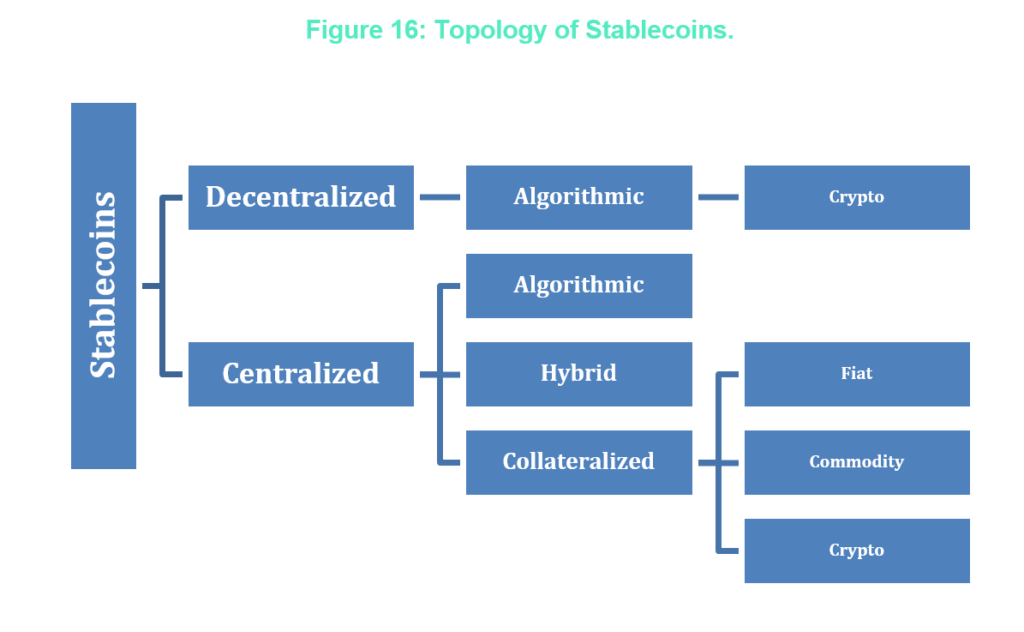
[2] “Bubble”, Investopedia, 2018, https://www.investopedia.com/terms/b/bubble.asp.

[3] Jim Edwards, “One of the kings of the ‘90s dot-com bubble now faces 20 years in prison,” Business Insider UK, Dec 6, 2016, http://www.businessinsider.com/where-are-the-kings-of-the-1990s-dot-com-bubble-bust-2016-12.

[4] Preston Teeter and Jörgen Sandberg, “Cracking the enigma of asset bubbles with narratives,” Strategic Organization 15, No. 1 (2017), http://journals.sagepub.com/doi/abs/10.1177/1476127016629880#articleCitationDownloadContainer.

[5] Jean-Paul Rodrigue, The Geography of Transport Systems. New York: Routledge, 2017. https://people.hofstra.edu/geotrans/eng/ch7en/conc7en/stages_in_a_bubble.html

[6] Jamie Dimon retracted his statement in an interview on Fox Business in early January, https://www.ft.com/content/e04e359a-e9e9-3f8e-8e2f-3f4373e5efb0.

[7] Jacqui Frank, Kara Chin and Joe Ciolli, “Paul Krugman: Bitcoin is a more obvious bubble than housing was,” Business Insider, Dec 15, 2017, http://uk.businessinsider.com/paul-krugman-says-bitcoin-is-a-bubble-2017-12?r=US&IR=T.

[8] Eng-Tuck Chea and John Fry, “Speculative Bubbles in Bitcoin markets? An empirical investigation into the fundamental value of Bitcoin,” Economic Letters 130 (May 2015), pp. 32–36, https://www.sciencedirect.com/science/article/pii/S0165176515000890.

[9] Ludwig von Mises, The Theory of Money and Credit (1912).

[10] Jake Weber, “The Bitcoin Bubble Expained in 4 Charts,” Mauldin Economics, Nov 13, 2017,

http://www.mauldineconomics.com/editorial/the-bitcoin-bubble-explained-in-4-charts#.

[11] Bitcoin Energy Consumption Index,” Digi Economist, 2018, https://digiconomist.net/bitcoin-energy-consumption.

[12] Ludwig von Mises, The Theory of Money and Credit (1912).

[13] Rahim Taghizadegan, Ronald Schöferle and Mark Valek, Austrian School for Investors: Austrians Investing between Inflation and Deflation. Mises Institute, 2014. https://www.amazon.com/dp/B01D2A4Z7S/ref=dp-kindle-redirect?_encoding=UTF8&btkr=1.

[14] Jörg G. Hülsmann, The Ethics of Money Production. Mises Institute, 2008.

[15] People who are unwilling or unable to take on debt do not directly receive any of the “economic stimulus”.

[16] Kenneth Rogoff and Carmen Reinhart, This Time is Different. Princeton: Princeton University Press, 2009.

[17] Peter Schiff, „Ep. 324: Obama & Yellen Strand Trump & Powell in Dodge,“ YouTube, Jan 31, 2018, https://www.youtube.com/watch?v=4NN7n3ABYx4&feature=share.

[18] “Bitcoin Obituaries: Bitcoin has dies 259 times,” 99Bitcoins, 2018, https://99bitcoins.com/obituary-stats/.