Listen Now to our exclusive interview with the Director of Economics at the Center for Aerospace and Securities Studies in Pakistan, Dr. Usman Chohan.
The Academic Blockchain Podcast is a weekly podcast where we interview academics regarding papers that they recently wrote on the topic of blockchain and cryptocurrencies.
In this inaugural edition, we discuss why Dr. Chohan believes that cryptocurrencies will be the future, and that stablecoins are just a short-term intermediary step. Dr. Chohan does not believe that stablecoins will be able to maintain their pegs in the long-term because:
Stablecoins that are backed by collateral are not scalable. If a stablecoin like Tether has to store dollar reserves, then eventually Tether would need to own and store trillions of dollars in order to service the world’s demand for a reserve currency.
Speculative attacks on coins that are unbacked can break the peg. This is what we saw when Thai authorities abandoned the US dollar Thai baht peg on July 2, 1997, and when the Bank of England broke their peg to the Deutsche Mark during the European Exchange Rate Mechanism (ERM) in 1992.
We discuss that Pakistan’s currency devalued from 10 rupees to 1 USD dollar in the 1980s to the current exchange rate of 150 to 1. We discuss why pegs fail, and why blockchain probably will not help currencies maintain their pegs.
We also discuss how the Triffin Dilemma is all about the trade-offs between short-term benefits and long-term costs when a country’s currency becomes the global currency. We discuss how the United Kingdom’s pound hegemony and the US dollar’s hegemony have not helped these countries in the long-run.
We also discuss how Saudi Arabia’s exclusive use of the US dollar for oil sales is keeping the entire economy running on dollars, and why any oil producing country that moves away from the dollar is a major target for US warmongering.
In the following weeks, we will be releasing our podcast with ConsenSys discussing their central bank digital currency white paper released during the World Economic Forum’s 2020 conference in Davos, Switzerland. On the lineup also includes an interview with Stanford University Professor Dan Boneh who recently wrote a paper on problems with MakerDao’s Oracle data.
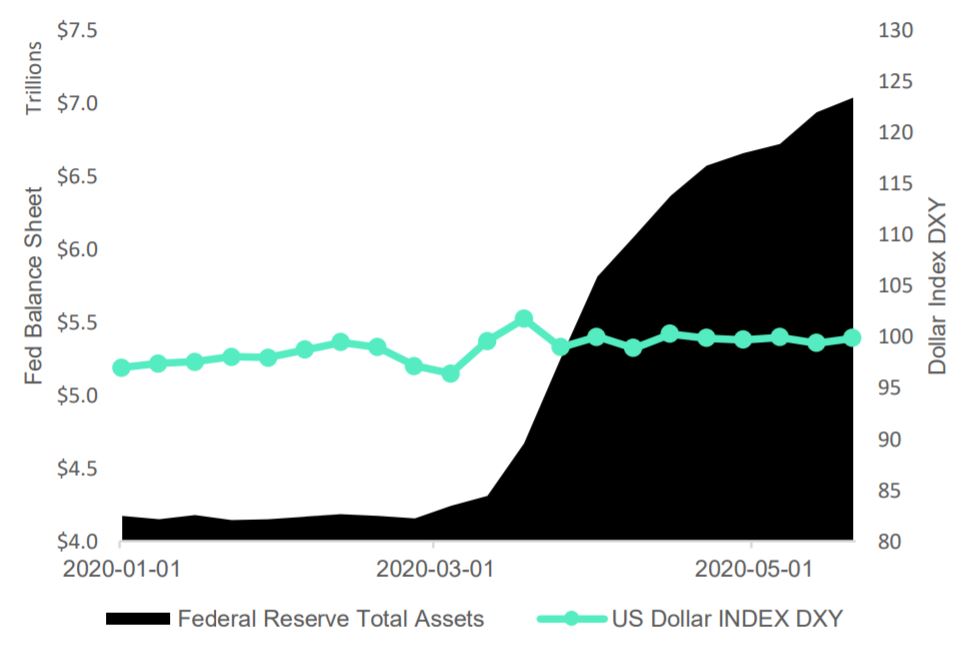
Tomorrow our weekly newsletter comes out. The report compares the Corona virus and the 9/11 Terrorist Attack crisis in 2001. Both are Main Street crises that the Fed is responding to by lowering rates. In the newsletter, we discuss all of the actions that the Fed has done over the past two weeks.
Today, thousands of cryptocurrencies exist and even more books on the topic of cryptocurrencies exist. Determining which books are worth the read is almost as difficult as determining which cryptocurrencies to invest in. A book that we recently read called Kryptowährungen und Blockchains was published last year in March 2019 by Dr. Niklas Schmidt. This book has already had to be reprinted several times due to popular demand and the English version, Crypto Currencies and Blockchain is set to be translated and release by the end of this year 2020.
The book closes the gap by
covering detailed insights about cryptocurrencies and blockchains for the
German-speaking readership. It is comprised of three main characteristics:
First and foremost, it contains about 400 Frequently Asked Questions (FAQs) that
provide an easily digestible introduction to the subject without having to read
the entire book– although we highly encourage the full read.
Secondly, the book covers a
wide spectrum of topics in great detail from technological functionality &
characteristics of the blockchain to its economic aspects & implications.
Some examples of this include: Bitcoin’s price development, the disruptive
effects blockchain has on various industries, and a legal overview covering
civil, tax, accounting, corporate, labour, commercial, data protection,
supervisory, money laundering and criminal law.
Thirdly, the content is
practical in that it contains many real-life examples and anecdotes so the
reader can have better context. Some chapters also offer helpful lists of the
industry’s current wallets, exchanges, blogs, newsletters, and apps.
Overall, this book we recommend without restriction and a great resource
for both beginner readers and those who want to acquire a deeper knowledge of
Bitcoin and beyond.
A Physical and Digital copy of Kryptowährungen
und Blockchains (German) can be purchased on the publisher Linde
Verlag’s Website.
The English version will be released this year (late 2020).
“I read the whitepaper regarding Bitcoin, was hooked and went down the rabbit hole.”
Plan B
Key Takeaways
When asked if the Bitcoin Halving is Already Priced In, Plan B Says “No.”
Plan B says that Bitcoin has done a 10x increase during the last halvings, and his model forecasts this trend to continue.
The largest critique of Plan B’s Stock to Flow Ratio Model is that it does not consider demand. Plan B answers this critique by saying that many famous financial pricing models including Capital Asset Pricing Model and the Black & Scholes Model do not consider demand.
Plan B is blogging under a pseudonym. Who exactly is behind this baseball cap remains unknown. We also asked him some personal questions in this interview. His Twitter handle is: @100trillionUSD.
As
explained in the previous chapter, we arranged an interview with the father of
the “Stock-to-Flow Model”. Plan B says that Bitcoin is here to stay.
He also expects the price explosion of Bitcoin to be foreseen by his model. Why
he is so sure about this? How does he deal with critics? Will he ever take off
his cap and show his face?
Mark: Plan B, almost a year ago the publication of your model really shook up the entire crypto community. How do you deal with all this attention you and your model have received? What have you experienced this past year?
Plan B: It has been a very interesting year since the publication of the article March 22nd 2019. The paper was well received and I gained valuable feedback from econometricians and math/stats people all over the world. I love the interaction with the community and the open source vision of sharing knowledge. I really enjoyed doing the podcasts. With 60k followers and a full-time job, I do have to make choices. It is almost impossible to read all the comments, DM’s (Direct Messages), Telegram messages, WhatsApp messages, emails, and I hope everybody understands. I want to keep focused on analysis, investing, and writing more articles.
Mark: Can you tell us, what you do for a living and why do you use a pseudonym?
Plan B: I am both an analyst & investor at an investment office of a large institutional investor in the Netherlands. As a team we invest $50+ Billion AUM. My main focus is on mortgages, loans, and structured finance. I do not want my employer to have any negative consequences from my Bitcoin “hobby”. Also, I consider it good operational security to remain anonymous.
Mark: Where did your interest in Bitcoin come from?
Plan B: If you have seen the movie The Big Short (2015), that was my life from 2007-2008: CDO’s (Collateralized Debt Obligations), ABS (Asset Backed Securities), and RMBS (Residential Mortgage Backed Securities) etc. The craziness of negative interest rates and QE (Quantitative Easing) forced me to rethink everything I knew about finance. So, I was actively looking for QE hedges in 2013 and found an article about Bitcoin on the website Zerohedge. I read the whitepaper, was hooked and went down the rabbit hole.
Mark: Why did you start to model the value of Bitcoin?
Plan B: I started modeling because I wanted to know what drives Bitcoin’s price. I noticed that there was a lot of technical analysis, but not much statistics / econometrics modeling. So, I tried to make a more fundamental model, based on Bitcoin value: it’s scarcity.
Mark: In our “In Gold We Trust Reports” we have been writing about the S2F ratio of Gold and Silver for many years. It’s great, that through your model, this concept of scarcity has been introduced to an even greater community. In terms of terminology, however, we prefer to talk about constancy, rather than scarcity when talking about SF (Stock to Flow). A higher SF ratio indicates a more constant quantity rather than a scarcer quantity of the good (as a higher scarcity indicates that the quantity actually goes down). Even though this is just a minor differentiation in terminology, we think that this could be helpful for a more intuitive understanding of the S2F concept. What are your thoughts in this respect?
Plan B: Unforgeable scarcity (Nick Szabo) is a well know concept in the Bitcoin community, so I see SF as a nice quantification of that concept. Frankly I think some people in the “commodity community” don’t have a very good definition of scarcity. For example, I talked to a lot of commodities investors that think platinum is scarcer than gold because there is less platinum in the world than gold. I prefer the definition of scarcity that relates production (flow) to stock. You could also interpret this as inability of producers to influence stock (and thus price): with oil producers have much influence, and with gold less. Maybe your definition of “constancy” is the same? This is something we should discuss further.
“The Drunk & His Dog” Analogy
The drunken sailor goes out with his dog on a leash, wanders around in a random fashion and the dog has to stay with him, but sometimes he is on the right, sometimes on the left, but he cannot go any further as he is on a leash.
You don’t know where the drunken sailor and the dog are going, but you do know they stay together.
Mark: Could you please explain to us the analogy regarding “the drunk and his dog” again and tell us the meaning for our readership?
Plan B: The drunk and his dog story is a popular story to explain cointegration. Correlation is about how two series move together. Cointegration is about two series staying together. So, the drunk walks a random unpredictable path, and his dog too, but the distance between the drunk and the dog is predictable, it is never larger than the leash. So, without knowing where the drunk or dog are going, we can predict they stay together. With stock-to-flow and Bitcoin it is special case of course, because we know where one of the two is going: SF. Cointegration is used to test if correlation is spurious or real: no cointegration = spurious. SF and BTC are cointegrated, so they are likely (no guarantee) not spurious.
Why Current Prices of BTC Do Not Reflect the Predictions of the SF-Model
Mark: Are people too dumb to get it? Plan B: No, it is enough if some people get it. Like with insider information, if only 10-100 get it, they will move the price. Dumb money is formally “noise” according to the EMH (Efficient Market Hypothesis), it is irrelevant. Mark: Is it bad model? Plan B: I think the cointegration is real, so the model is good. So far, I have not seen anything better. Mark: Are the ones that “get it” already invested? Plan B: Most will be invested, but I think that many who “get it”, also see the big risks such as government bans, a software bug, “the next Bitcoin”, death spiral, etc. These risks prevent them from going all in. Actually, this is true for myself as well: I am invested, but not 100%; if I knew 100% certain Bitcoin would go to $100k USD in 2021, I would go all in and even lend money. Mark: Are the markets inefficient? Plan B: No, the markets are efficient. Also, the $150 Billion Bitcoin market is efficient, as I have shown in the FX (Foreign Exchange) example in my article. Easy arbitrage between BTC/USD, BTC/EUR, and BTC/JPY markets is not possible. Mark: Do people know about the model? Plan B: Enough people know about it. I have 60k followers on Twitter and many of them are investment bankers, quants, miners, venture capitalists, hedge-fund CEO’s, and CIO’s, etc. The SF model was featured in MSNBC and in Forbes.
Mark: Your model has occasionally been criticized – that it only explains the Bitcoin price in reference to Bitcoin supply. If this is even possible, how do you incorporate demand?
Plan B: People that use the demand argument probably don’t have a statistics or investing background. The argument is theoretically right (price is a function of supply and demand) but there are a lot of famous pricing models that do not use demand (or supply) as input and still give good predictions. Some examples of this are the CAPM (Capital Asset Pricing Model) and Black & Scholes model, as both price with only risk / volatility (standard deviation, etc). The demand argument is really based on ignorance.
Mark: Let’s now throw a new thought into the equation: The model tries to explain the price of Bitcoin in USD. We know, that measuring value in fiat money over time is difficult, as fiat currencies are designed to be permanently inflated. In our mind, the model implicitly does not take into account fiat money inflation. If say, – at least for the sake of a thought experiment – the USD would hyperinflate within the next years, we would expect the model to vastly underestimate the USD value of Bitcoins. What are your thoughts regarding the dollar-inflation in regard to SF model?
Plan B: It is true that the SF model doesn’t correct for inflation. If we would do that, we probably see not much difference anyway because from 2009-2019 inflation was low. And indeed, in my opinion the SF model predicts USD hyperinflation because Bitcoin USD does this 10x every 4 years. Many people have problems with this thought, but for me it is not an improbable scenario, given negative interest rates and what central banks are doing with QE: they are going full Zimbabwe in my opinion.
Mark: What is the deal with the artist you commissioned? (The artist is going to make an artwork out of the charts).
Plan B: The artist Petek was intrigued by the charts and she asked permission to paint it. It will be a unique painting with some special elements that are yet to be revealed. It is exciting to see that a lot of other people are inspired as well and are commissioning a similar SF painting. Her idea is that she will make a series of paintings using different colors and materials based on SF. I think Bitcoin is not only about programming and money but also about a movement and a revolution. Art and science are two sides of the same thing, they belong together.
Mark: What other projects are you currently working on?
Plan B: I am cooperating with other Bitcoiners on research and writing more articles. I am working together with some investment funds, also traditional institutes, finding ways to include an exotic investment like Bitcoin in the existing asset mix. Also, I am doing chain-analytics, crunching the 300GB blockchain to find more patterns that can give insights and be used for proprietary trading, that is really uncharted territory.
Mark: (When) can we expect an outing of Plan B?
Plan B: I think the chances of me going dark are higher than an outing. I have no desire to become a public figure. Especially when the model works, which I hope and expect of course. People that want to meet me know where to find me, through my network, and everybody can verify it is me by my cryptographic signature (like on the articles).
A common claim among bitcoin enthusiasts is that it is a
“decentralized” method of making payments. Here are some notable outlets making
this claim:
Investopedia: “Bitcoin
offers the promise of lower transaction fees than traditional online payment
mechanisms and is operated by a decentralized authority, unlike
government-issued currencies.”
Business
Insider: “Because bitcoin is decentralized, it’s not directly subject to
market forces such as interest rates or currency debasement.”
St.
Louis Federal Reserve: “Bitcoin is a decentralized recordkeeping system,
with updating of the record of transactions in the blockchain.”
This is in addition to the hundreds of other websites, both
professional and amateur, that assert that bitcoin is a decentralized system.
But a new working paper from economists William J. Luther
and Sean Stein Smith is casting doubt on this characterization of bitcoin.
Luther and Smith offer a new taxonomy of the different methods of processing
payments: centralized, decentralized, and distributed. The differences may seem
superficial, but the implications can be significant.
Before we begin defining and understanding the different
systems, it’s best to review some basic concepts.
First, let us define a medium of exchange as a good which is
acquired in order to be exchanged for another good. Second, let us define money
as the most commonly accepted medium of exchange. Third, we must distinguish
between the production of money and the verification of an exchange: the
production of money is creating new monetary units and adding them to the
system; the verification of an exchange (a.k.a., clearing or processing) is
determining whether sufficient funds exist to fulfill a transaction. We can go
further and define trust as the belief that a transaction will be
verified before it actually is.
With those preliminaries out of the way, we can now proceed
to understand the three different systems of payment.
A centralized payment system has all transactions going through a third party for verification. The “third party”, in practice, may be several distinct parties networked as a series, with one verifying the work of another in sequence. The key feature is, however, that if the third party is unable or unwilling to process a payment, the two parties in a transaction will be out of luck.
Under a centralized system, there is effective a monopoly on
verification. No one other than the centralized authority is permitted to
produce money or verify transactions. As such, all other users must
trust the judgment of the central authority.
A decentralized system is one where there are many independent verification parties. As an extreme example, a system where every transaction has no intermediaries (like a barter system) is a decentralized system. But decentralization exists on a spectrum: a situation where there are dozens of independent firms competing for the privilege of verifying a transaction is also a decentralized system.
This was the case in the era of private coin production. In
the days of commodity monies, any private person with access to a mint could
create their own money. Producers would compete on the aesthetic and
value-to-weight ratios of their coins. The economist George Selgin documented
perhaps the golden age of private coinage, England of the 18th
century, in his book Good Money:
The commissioning and issuing of
commercial coins, which had been the preserve of a few industrial and mining
firms, was taken up by all sorts of small businessmen – grocers, drapers,
silversmiths, malsters, and pretty much anyone whose dealings generated a need
for small coin. Well, not just anyone: even small-scale token issuers were
almost always persons of good standing in their communities, whose token issues
were generally modest in comparison with their capital and command of credit.
Selgin
(2011, p. 123)
Of course, kings and other nobles have been exercising
virtual monopolies on money creation for millennia. So, what had happened to
cause a break in the centralized system? According to Selgin, the Royal Mint in
England stopped producing low-value copper coins as a cost-saving measure,
despite the fact that there was great demand for them. Conveniently, there were
many copper mines that were willing to sell their raw metal to those private
individuals who would go on to mint coins. As metals were the commonly accepted
medium of exchange (otherwise known as money), anyone with access to metals who
could fashion them into something attractive for consumers could create his own
money. And as Selgin (2011) documents, they were indeed attractive:
The other thing most
eighteenth-century tokens had in common… was their extraordinary appearance.
According to Francis Klingender… the tokens displayed a unique ‘combination
of intellectual vigor, social consciousness, and imaginative design’
(Klingender [1943], 46.) [Citation corrected.]
Selgin
(2011, p. 133).
Under this system, the functions of producing money and
verifying transactions are divorced. The mint buys the raw materials and
produces the money. A person then makes a direct exchange with the producer for
the money, with no third-party intervening. The person who now owns the money
will get use it at a new transaction. The transacting parties themselves verify
each transaction, while the producers focus on minting easy-to-verify coins. If
the users of the coins lose their trust in a coin, they stop patronizing the
producer and he or she goes out of business.
Since every step in this process involved only two
transacting parties, these are all decentralized markets.
Eventually, of course, the central powers took notice of
what was happening and took over the money production process again. The
initial excuse is to ensure safety of the parties. Then overtime more duties
are assumed by the regulator. This is called regulatory creep. In the
1900s, regulatory creep led to the advent of the modern central banking system
with the systematized backing of fractional-reserve banking (FRB). Under an FRB
regime, while the central bank and government mint create so-called “base
money” (cash and ex nihilo virtual deposits into the accounts of
chartered banks), it is the private banks that end up generating most of the
media of exchange in the economy. Each bank does this by lending out the
deposits of their checking account depositors.
Since each bank makes the decision to expand the supply of
money via loans of demand deposits, the system functions as a decentralized
network of money producers. However, the verification of transactions is still
centralized. Thus, the current monetary regime is a blended
centralized-decentralized system.
That is, until the existence of bitcoin. Bitcoin is
neither a centralized nor a decentralized system. Instead, it is a distributed
system.
A distributed monetary system distributes the role of verifying transactions to everyone on the network. This is distinct from a decentralized system, where the power of creating and verifying money is split up among many people. A distributed system has a two-fold approach to verification: first, the entire network shares a ledger that documents every transaction that has ever happened; second, the network has a shared protocol or procedure for verifying an update to the ledger via some kind of consensus rule.
The principles of distributed monetary systems come from the
world of distributed computing. The major innovation of bitcoin was that it was
the first to recognize how distributing trust among the entire network can be
an attractive method of transacting. In effect, bitcoin is a trustless payment
network, as buyer and seller no longer have to trust each other or a third
party. Instead, only trust in the faithful execution of the automatic protocol
is required.
This removal of interpersonal trust is a giant achievement.
Trade axiomatically makes us richer. But in order to trade, we must trust the
person we are trading with. Historically, trade has been mostly within tribes,
among family members or other closely-knit individuals where trust was high. Trust
was the only way to exchange.
After intertribal and cross-regional trade was discovered,
and exchanging with strangers became a common occurrence, the necessity of
money became apparent: it is difficult to know what others want, but everyone
will want money. Direct exchange gave way to indirect exchange, albeit
decentralized. While money superficially looks like an inefficiency, it
facilitated a much smoother market. A decentralized market does not require a
fully trusting society, but just enough trust that you find it unlikely to be
taken advantage of.
The early markets were decentralized. Buyers and sellers now
only needed to trust each other in an exchange. Over time, as tribes settled
down to form cities, kingdoms, and empires, centralization of trade in the form
of government fiat money, government mints, and so on, became the norm. Trust
from the counterparty was replaced with trust in the centralized authority.
However, centralized authorities have tendencies to restrict trade on a whim,
in the name of security, nationalism, or other infamous ends.
Bitcoin offers a way forward. There is no longer a need to
rely on a mercurial central authority to verify transactions and create money,
nor do you need high trust. By extending the scope of the market, many more
exchanges can happen, creating more opportunities for innovation,
cost-reductions, and other benefits of making a connection with other people.
Luther and Smith (2020, pp.14-25) do point out, however,
there is more to bitcoin than its distributed payment network. Firstly, it is
the governance of the protocol itself. Here, changes to the protocol must be
arrived at via popular consensus among the developers and miners. We can
describe the decision-making process as broadly decentralized, despite the fact
that some mining pools are more influential than others. Secondly, there is
also the issue of exchanges and e-wallets. As they are third parties that
verify transactions, they are centralizing forces in the bitcoin space.
The original bitcoin whitepaper does not mention “decentralization” at all. Instead, the system was called a “peer-to-peer distributed time-stamp server.” Why did a distributed system become mislabeled as a decentralized one? Perhaps because many have an intuition that the current regime is highly centralized; and since bitcoin is not centralized, it must be the opposite: decentralized. However, there is a third way of organization: distribution.
A distributed system is not the same thing as a
decentralized system. Decentralized systems require high trust between buyer
and seller; meanwhile distributed systems require all peers on the network
to share and communicate with each other constantly. As such, distributed
systems can offer less privacy than a decentralized system, wherein all
exchanges are only between buyer and seller. Furthermore, distributing among a
large number of participants the responsibility to store every transaction
between every participant on the system, may prove to be more costly (in terms
of storage costs, energy costs, and time to approve a transaction) than a
centralized system where only one entity is responsible.
On the other hand, decentralized systems can be cumbersome,
costly, and the degree of trust required to fulfill them can serve as a
hinderance to trade. A move towards decentralization would mean more trust is
needed to engage in an exchange, in addition to regulatory creep. By reducing
the level of trust required to verify a transaction, bitcoin has the potential
to open up trade among more strangers who otherwise wouldn’t trust each
other.
References
Luther, William and Sean Stein Smith (2020) “Is Bitcoin a Decentralized
Payment Mechanism?” Social
Science Research Network.
Klingender, Francis Donald (1943) “Eighteenth Century Pence
and Ha’Pence.” Architectural Review 93: 41-46.
Selgin, George. (2011) Good Money. Independent
Institute.
“The high stock-to-flow ratio, the liquidity of the market, and its unique features as a monetary good set gold apart from all other asset classes and make it an efficient hedge against systemic market risk.”
The
“Plan B” valuation model for the development of Bitcoin’s price
quickly gained worldwide attention. In it, the price of Bitcoin is modelled
with the “stock-to-flow ratio”, a proxy for scarcity.
Historically,
the stock-to-flow ratio was an almost perfect exogenous regressor for the
development of the price of Bitcoin (R2 was 95%).
According to the model, the price of Bitcoin should rise to USD 55,000 after the next “halving” in May.
Since the article “Modeling Bitcoin’s Value with Scarcity” appeared on the online platform Medium in March 2019, it has already been translated into over 25 languages and will soon spread worldwide. But what exactly is it all about and what conclusions can be drawn from it? In the following article, we’ll explore these and other questions.
The
basis for the entire model is the so-called “Stock-to-Flow Ratio”, a
concept that interested readers of the Crypto Research Report and its sister
report, the “In Gold We Trust Report“,
have been familiar with for many years. For those who are not yet familiar with
the concept or who would like to refresh their knowledge of it, please refer to
the info box on the left.
The
author of the article, who blogs under the pseudonym “Plan B”, dared
to try to model the price of Bitcoin with the “Stock-to-Flow Ratio”
(hereinafter SF). The concept, which was originally applied to gold and other
precious metals, hit the Bitcoin scene like a bomb. How did it come about that
a concept for commodities could be applied to a cryptocurrency?
The Stock-to-Flow Ratio The stock-to-flow ratio is a ratio of two figures corresponding to raw materials, which can ultimately be used for price modeling. The term “stock” refers to how much of a certain raw material is mined or would potentially be in stock if the entire stock was offered. In this concept, “flow” stands for the production quantity within a certain period, usually within one year. If you now compare these two figures, you will see relatively quickly that this can be used as a measure of the constancy of the quantity of raw materials. An example: While the total amount of gold ever mined is about 190,000 tons (stock), the annual production is about 3,000 tons (flow). If you divide the stock by the flow, you get a stock-to-flow ratio of 63.3, which means that at the current production level, it would take more than 63 years to double the gold stock or rebuild the current stock. So, the larger the number, the more constant is the raw material that is examined. While the “stock” is a given size and grows yearly exactly around the “flow”, the “flow” depends on various factors, such as the rarity, the price and the difficulty of extracting the raw material.
Two main factors contribute to the value of
gold–– the most important precious metal for investors:
1. The Relative Rarity
2. The Difficulty of Extraction or
The Extraction of the Raw Material.
Similar to gold, Bitcoin is both scarce and
expensive to extract. Therefore, an analysis of the price development of
Bitcoin with the SF model, which was originally designed for commodities, seems
to be reasonable due to its similarity to gold.
Figure: Bitcoin vs. Gold – Stock-to-Flow-Ratio
Bitcoin and Gold Stock to Flow
Source: Medium Original
Article, ZPX, Satoshi & Co. Research
A special feature of the Bitcoin protocol is
that the code already determines how the Bitcoins offering – and thus the stock
to flow ratio – will develop in the future.
The
maximum number of Bitcoins is 21 million (maximum stock). The number of newly
generated Bitcoins is also fixed (flow). However, the Bitcoin flow is not
constant over time. Every 210,000 blocks the so-called “block-reward”
is halved. This is the number of Bitcoins that the successful miner receives
for its validation services. Miners currently receive 12.5 Bitcoins per block,
but the next “halving” will take place in May of this year. From then
on, only 6.25 Bitcoins per block will be “mined”.
By way of comparison, in the case of gold or silver, for example, it cannot be completely ruled out that one day a huge find will be made, and the flow will shoot up, because more can be mined.
The “Halvings” lead to: Inflation of Bitcoin getting smaller and smaller until it reaches zero, and an increasing SF ratio as the flow is halved.
Since Bitcoin is denominated to eight decimal places, the reward per block will arrive at 0 exactly after the 33rd “halving”. Based on a halving every four years, the last Bitcoin will therefore be mined in 2140.
Table: Development of the “Block Rewards”
Period
Number of New Bitcoins per Block
Genesis Block – November 2012
50
November 2012 – July 2016
25
July 2016 – May 2020
12,5
May 2020 ~ May
2024
6,25
May 2024 ~ May
2028
3,125
Source: Incrementum AG
Plan B examined a total of 111
data points between December 2009 and February 2019 and determined the
respective market capitalization of Bitcoin and the corresponding SF ratio.
Because the S2F ratio is constantly increasing, time is already included in the model as an exogenous variable.
Then the author pulled the data
and one thing was immediately apparent: The higher the SF ratio, the greater
the market capitalization. If one regresses the rising stock to flow ratio with
the logarithmic price time series of Bitcoin, one finds a surprisingly high
explanatory value. The correlation can also be seen with the naked eye.
The natural logarithm was used. This makes it possible to show the correlation of both quantities linearly and thus opens up possibilities for a solid statistical investigation.
For the Number Crunchers: If one models the price of BTC directly by SF and converts the resulting formula In (Market Capitalization) = 3.3 * ln(SF) + 14.6 Then you get the law of potency: Market Capitalization = Exp(14.6) * SF3.3
In Plan B’s infamous stock to flow chart, the
small dots represent Bitcoin’s historical price data over time. The large grey
and yellow dots show the respective market capitalization of silver and gold
and their respective stock to flow ratio. The regression suggests what can be
seen with the naked eye: a statistically significant relationship between S2F
Ratio and the market capitalization of Bitcoin.
For the Number Crunchers: Test Data of the Regression: R2: 0.95F-Test: 2.3E-17P-Value: 2.3E-17
Plan B argues that the
correlation is so strong that the dominant driver for the price must be
scarcity, or SF ratio. However, the author also acknowledges that other factors
such as regulatory measures, hacks, and other news have an impact on the price;
therefore, not all the data points are perfectly in line. The fact that the S2F
ratio of gold and silver also fits very well into the picture is a further
validation of the model.
Since the “halvings”
have such a great influence on the SF ratio, Plan B has color-coded the months
until the next “halving” in the chart. Dark blue are the halving
months and red are the points shortly after the “halving”. The
current S2F ratio of ~25 will thus double to ~50 in May 2020, which is already
close to the S2F value of gold. Based on
this model, the forecast market value for Bitcoin after halving in May 2020 is
$1 trillion, which would correspond to a Bitcoin price of $55,000.
We dug a little
deeper and found out that there were already several variants of the model that
Plan B calculated:
Points of Criticism with the “Plan B” Model The model is based purely on the supply side (maximum number, Bitcoins per block, etc.) and does not take into account the demand for Bitcoins.Regulatory measures, possible hacks, etc., i.e. (largely non-quantifiable) control variables, are not included or built into the model. • Historical data is not a source of forecasts. • The statistical correlation between the SF ratio and the price of Bitcoin is not a causality, only a correlation. • If the model is correct, this should already be reflected in the prices. • At some point Bitcoin will become truly deflationary (the loss of BTC per year would exceed the annual mining production), resulting in a negative SF ratio. What happens to the price then cannot be predicted by the model. Lack of stationarity of the data. The high R2- value could be a consequence of the missing stationarity of the data.The empirical work of Plan B is not precisely documented, which makes it difficult to find methodological weaknesses.
Another
interesting model is the so-called “time-based model”, as it explains
the increase in the value of Bitcoin over time with a different underlying
causality. The model states that Bitcoin increases in value as more and more
market participants know about Bitcoin, deal with it and take the step to buy
it. The narrative for the increase in value is thus the adoption, but not the
scarcity (S2F). The estimates of this model are more conservative, and it is
assumed that the price of Bitcoin will not break the $100,000 barrier until
2021-2028.
Table: Bitcoin Price Development Model Overview
Model
Original Model (Until
Dec 2018)
“Additional
Data Model”
“Out of Sample”
Model
“Time-Based”
Model
Value
After the 2020-Halving
55,000
USD
60,000
to 9,000 USD
100,000
USD
Between
2021 & 2028: 100,000 USD
Special
Feature
The first rapidly spreading model for price
evaluation of Bitcoin with scarcity as proxy.
Supplements “The Original” with additional
data (older and younger).
Uses only data prior to November 2012, so no halving
has occurred in the data set yet.
The reason for the price growth in this model is the
progressive adoption of Bitcoin.
“S2F and price are proportional and react and change proportionally.”
Plan B, Stephan Livera Podcast November 2019
Definition: “A power
law is a relation in which a relative change of one quantity leads to a
proportional relative change of the other quantity – independent of the initial
quantity of these quantities”.
Exactly such a law of potency
emerges when one examines the regression of the “original model”: At each
halving, the SF ratio doubles, and market capitalization increases tenfold –
this is a constant factor. Plan B therefore suggests:
“The possibility of a power law with a
95% R2 over eight orders of magnitude makes me confident that the main driver
of the Bitcoin value is correctly captured by the SF ratio”.
The stock-to-flow model has shaped the crypto year 2019 like no other
development. The accuracy with which the model traces price developments of the
past is outstanding. It was also possible to observe how the model drove
additional researchers and critics to take a closer look at the price
development of Bitcoin. In the medium and long term, this invested human
capital will contribute to a better understanding of the crypto world and its adoption
to a broader population. The partly heavily criticized Model from “Plan
B” will have the opportunity to prove itself as a forward-looking
achievement starting this May – and it deserves exactly this opportunity.
“LAST NIGHT’S U.S. STRIKE, KILLING IRANIAN GENERAL SOLEIMANI, IS THE SORT OF EVENT THAT GETS MARKETS MOVING. AS ONE MIGHT EXPECT, OIL JUMPED AND SO DID GOLD. OIL IS UP 3% AND GOLD JUMPED 2%. IN THIS NEW WORLD THERE IS A THIRD SAFE HAVEN ASSET, BITCOIN (BTC). IT IS UP 5%.”
Clem Chambers, Forbes
Is Bitcoin currently acquiring a new status as a safe haven asset, as digital gold? There is some evidence for this, the Iran crisis provides interesting clues. The Halving could help too.
“Luck in the crisis? The Iran-conflict could trigger the next Bull Run (on Bitcoin).”
BTC-ECHO
Suddenly the price of Bitcoin took a leap. And then another
one. The reason for the first leap was the targeted killing of Iranian General
Qasem Soleimani on January 3, 2020 by the US. The Bitcoin price then took its
second leap due to the Iranian counterattack against Western military bases in
Iraq. Twice the world held its breath. Twice Bitcoin shot up together with
gold. And twice it all looked like a new safe haven was born. But is Bitcoin
really the new digital gold?
The correlation between the two assets has rarely been as
high as it was in early 2020, and some analysts see a clear connection between
the shiny precious metal and the digital coin. Others urge patience. One event
does not make a safe haven.
But the growing tension between Washington and Tehran is a
Bitcoin story – in more ways than one. It was not the first time that the
cryptocurrency has reacted sensitively to a political event – and it will not
be the last. Comparison with gold is also understandable: For in the daily practice
of Iranians (or Venezuelans before them) the two assets play a very similar
role. And Bitcoin has not only just arrived with the current worsening of the
situation in Iran. Cryptocurrencies have long been part of everyday life there.
Here is what Brian O’Hagan had to say about his experiences
in Iran in 2018:
“People who own savings in rials see their
purchasing power diminish every day. They are looking for ways to protect their
wealth, and find a refuge for what little cash they have. They are looking for
stores of value to survive the economic collapse: dollars (but they can’t find
any in Iran) or gold. People in Iran are increasingly turning to
cryptocurrencies to protect themselves from an economic collapse and to evade
the financial repression. And the government is noticing.”[1]
Figure 1: Inflation Rate Iran
Source: Reuters Eikon, tradingeconomics.com, Incrementum AG
“Iran removes four zeros from the national currency.”
Haldelsblatt.com
The US sanctions have been making it difficult for Iranian
companies and private individuals to trade with foreign countries for years. In
addition, there is high inflation in the country, which has a negative impact
on the purchasing power of Iranians. Perfect conditions for the adoption of
Bitcoin, as we have also seen in Venezuela. Another parallel: thanks to
extremely low energy costs, mining in these countries is much cheaper than
elsewhere.
As far as the official side is concerned, Iran is very ambivalent.
That’s understandable. On the one hand, Bitcoin can help circumvent US
sanctions. On the other hand, it also provides the population with a way to get
money out of the country. This then leads to excesses such as a significantly
inflated Bitcoin price within Iran. In September 2018, there were reports of an
Iranian Bitcoin exchange rate of almost 26,000 dollars.[2]
“Now Iranian President Hassan Rouhani demands a crypto-currency for the entire Muslim world in order to make itself less dependent on the US dollar.”
Cryptomonday.de
Like China and other US antagonists, the Iranian regime has a great fear of capital flight. The country’s banks have therefore been forbidden to engage in the crypto business. Mining is handled with a more pragmatic approach. The industry is now recognized by the government and it cannot even be ruled out that the regime itself is active in mining to fill its coffers.[3] At the same time, Iran is working on a state cryptocurrency – just like Venezuela and China. More on this later.
And it is not only Tehran that is taking the issue
seriously- Washington is too. At the end of 2018, the Iran sanctions were
extended for the first time to the Bitcoin wallets of two individuals. Even the
“New York Times” has already been to Iran to visit the Bitcoin mines
there: “Iran’s economy has been hobbled by banking sanctions that
effectively stop foreign companies from doing business in the country. But
transactions in Bitcoin, difficult to trace, could allow Iranians to make
international payments while bypassing the American restrictions on
banks.”[4]
This brings us to the three megatrends we see for 2020:
“Bitcoin is going to be a safe haven.” FinanzundWirtschaft.ch
Bitcoin
will be talked of as a safe haven and escape route – and will increasingly be
compared to gold.
The
Halving will bring attention – but not necessarily higher prices.
While
Facebook’s Libra project is running into more and more problems, some central
banks will launch government cryptocurrencies.
In the first few days of the year, volumes in Bitcoin
markets doubled. In the midst of an ongoing bear market, investors and fans saw
a silver lining on the horizon. Around the escalation of tensions between Iran
and the USA, Bitcoin was traded as a safe haven asset. The correlation with
gold was stronger than it has been for years. The mood on the Bitcoin market
has also improved as a result, with sentiment no longer being bad but neutral.[5]
Figure 2: Trading Volume of Bitcoin in the Beginning of 2019 Compared to 2020
Source: coinmarketcap.com, Incrementum AG
However, the vast majority of analysts agree that one data
point is not enough, that the safe haven story must stand up to further
scrutiny – and that the prevailing downward trend has not yet been broken. One
analyst doesn’t believe the Iran story at all and speaks of a technical rally.[6]
Be that as it may, the comparisons between Bitcoin and gold will now be heard more often. Bloomberg analysts even see gold as a proxy for the Bitcoin price because the assets are so similar. Both are scarce in quantity and are particularly suitable for value storage. Bitcoin has the advantage of simplified transport and dominates in the digital world. Gold has the advantage of a history going back several thousand years – and dominates in the real world. Find out more about the similarities and differences of Gold and Bitcoin in the article “Bitcoin vs. Gold – a Fictitious Debate” in this episode of the CRR.
At the same time, Bloomberg does not speak highly of Altcoins,
whose market share continues to shrink: “The fact that a store-of-value
asset with fixed supply and increasing adoption is more likely to appreciate in
price will keep Bitcoin supported in 2020. We expect movements in gold to
remain a proxy for Bitcoin. The broader crypto market is at risk of more mean
reversion of the parabolic 2017 rally and depends on advancing Bitcoin for
buoyancy. Our takeaway is straightforward: Bitcoin is winning the adoption
race, notably as a store-of-value in an environment that favors independent
quasi-currencies.”[7]
Figure 3: Bitcoin Dominance in Comparison to Altcoins
Source: coinmarketcap.com, Incrementum AG
Unlike Bitcoin itself, which benefits from its scarcity,
Altcoins suffer from a constantly growing oversupply. We have already examined
this process in our previous reports and do not see any change in the trend.”
Just too many crypto-assets competing for adoption will keep broad market
prices biased to the downside, in our view. A future of appreciating prices for
cryptocurrencies is unlikely until rapidly increasing supply is curtailed. In
2019, the number of tradable crypto assets listed on Coinmarketcap.com
increased by about 3,000 – up to 5,078, the most ever.”[8]
Figure 4: Number of Altcoins Over Time
Source: coinmarketcap.com, Incrementum AG
In the first week of the year alone, Bitcoin increased its
market share by 1.0 percent, while both ETH and XRP fell by 2.6 percent.
Interestingly enough, the tense Iranian situation had a positive effect on
the anonymous cryptocurrencies Dash and Monero, which increased their market
share by 15 percent each. In our eyes, this is proof that the crypto sector
also has a meaning in real events and that these coins are not just bought for
speculative purposes.[9]
This development, the experience from Iran and the price
movements in early 2020 clearly show in the eyes of Bloomberg analysts that
Bitcoin is establishing itself on the market as a store of value. Again, the
similarity to gold is striking. Unlike many in the crypto-community, analysts
do not see gold and Bitcoin as enemies, but as friends: “Gold prices will
keep climbing in 2020 and so should Bitcoin, in our view. The digital version
of the metal is in the maturing process of consolidating the rapid price
appreciation of its youth. Bitcoins’ ever-more inverse relationship with the
U.S. dollar indicates the maturation process of the new quasi-currency toward a
digital version of gold.”[10]
“The (Peterson) correlation between gold and BTC rose to 0.217, last seen in October 2016.”
Coin News Telegraph.com
The correlation between Bitcoin and gold had already been on
an upward trend since the beginning of 2019 and, according to the analysts of
Arcane Research, reached a peak in January 2020, which was last seen in the
summer of 2016.[11]
But there is another correlation that should make Bitcoin
investors less happy. We’re talking about Tether. In recent months two studies
have come to the conclusion that the price of Bitcoin, at least in the past,
has been very strongly dependent on the development of the stablecoins money
supply.[12]
The accusations of the US researchers John Griffin
(University of Texas) and Amin Shams (Ohio State University) are particularly
blatant. They have written a paper to prove that only Tether and the stock
exchange Bitfinex alone were behind the huge price increase at the end of 2017.
They talk of massive manipulation. Griffin told Bloomberg: “Our results
suggest instead of thousands of investors moving the price of Bitcoin, it’s
just one large one. Years from now, people will be surprised to learn investors
handed over billions to people they didn’t know and who faced little
oversight.” Tether and Bitfinex categorically deny the allegations.[13] Now the controversy around Tether is by no
means new. We have reported on this on several occasions, and for the sake of
completeness, we list the study and the allegations here. Unfortunately, we
cannot judge whether there is something behind it or not.
Another factor that accompanies Bitcoin and will become
acute this year is the story of the Halving. Bloomberg has collected quotes by
industry leaders on the event, which is expected to take place in May 2020. The
conclusion: Some hope for price increases, others consider the halving to be
priced in, and yet others see it as the best way to educate people about
Bitcoin. We are most likely to be found in this third camp. The fact that we
even know that the supply of fresh coins will be cut back this year is a
great victory for the transparency of Bitcoin’s monetary policy. It is also
the basis of the comparisons to gold that we cited in the previous chapter. Find
out more about the Halving in the Article “The Stock to Flow Model Mark Valek
held an Exclusive Interview with “Plan B” in this episode.
Taking a look at past halvings, you quickly understand why
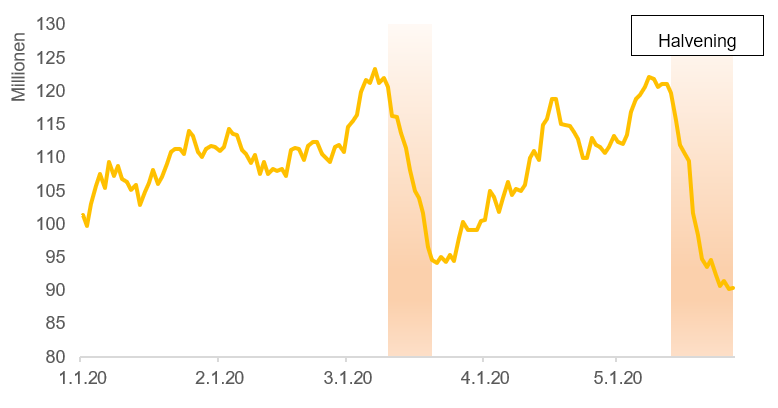
many enthusiasts are looking forward to 2020: “In a halving, Bitcoin
rewards that go to the so-called miners that support the coin’s network drop in
half in order to prevent inflation from eroding the purchasing power of the
coins. In the previous reductions, the price rose about 8,000% in the year
after the 2012 decrease and around 2,000% in the 18 months following the 2016
cut, according to data compiled by Bloomberg.”[14]
What do the pros say?
“Unlike most Bitcoiners, I don’t think the
halving is particularly bullish. I am of the view that most people with a
Bitcoin position understand that it’s capped in supply, so the issuance change
shouldn’t make a difference. Also, the halving is perfectly forecastable, so I
have a hard time believing that it constitutes an informational shock. Bitcoin
supply has been described and understood from January 2009 and has followed the
ordained trajectory ever since.”
Nic Carter, Co-founder of Coin Metrics
“As Bitcoin is often influenced by
momentum thinking — and the halving is magnified by a transformation of the
economic structure — I’d estimate it will have a positive influence on
price.”
Dave Balter, Chief Executive Officer of Flipside Crypto
“Many market participants have been asking
the question — is the Bitcoin halving priced in? That’s the wrong way to frame
it. A small single digit percentage of the world currently owns Bitcoin. For
those that currently own Bitcoin, a large portion of them understand that
Bitcoin’s newly issued supply is cut in half every four years. This is likely a
significant reason why they own it — because of Bitcoin’s provable scarcity.
For the many billions of people around the world that do not own Bitcoin, few
understand this provable scarcity characteristic. So for those billions, it
cannot be priced in. To the extent those billions of people discover Bitcoin in
the future and decide to buy some, there will be less new available supply to satisfy
that increased demand to purchase Bitcoin.”
Travis Kling, Founder of Ikigai Asset Management
We find the perspective of Kling particularly interesting.
How can one assume an efficient market if the market has so few participants so
far? The halving will in any case give the media the opportunity to point out
the positive sides of Bitcoin and to explain the functioning of the original
cryptocurrency in detail once again. This could further strengthen the
Bitcoin-as-Safe-Haven narrative and further weaken the Altcoins.
But it would also be the perfect time for a state actor to
enter the field of cryptocurrencies. Even if that has little to do with Bitcoin
per se.
Anyone who belittles the efforts of central banks in the
crypto area could overlook important points. One thing is true, though: Neither
China, nor the Eurozone or Sweden are planning any real competition to Bitcoin.
The new digital currencies will be just that: currencies – no digital store of
value.
“The preparation for the e-Krone (Sweden) is well advanced.”
Business Insider.de
State cryptocurrencies, which also allow state surveillance,
could even drive some users into the arms of Bitcoin, Dash and Monero, which at
least partially guarantee anonymity. But: “Politicians are looking to
destroy this competitive advantage for non-state digital currencies by making
them less secure. Governments are investing heavily in a technology that could
one day – in theory – crack the public-key cryptography underpinning Bitcoin:
Quantum computing. The Trump administration has committed $1.2 billion to this
endeavor. China is active too.”[15]
China even takes a particularly nefarious approach. In
November 2019, President Xi even caused a 30 percent increase in Bitcoin
prices, because he had spoken positively about the blockchain and expressed the
government’s interest in the technology: “The irony is striking,
considering Bitcoin’s anarchic origins. But there’s something broader going on
here. The future of digital money is being shaped increasingly by national
governments. Politicians are under pressure to make electronic payments more
efficient, to neutralize the threat of cryptocurrencies to their sovereignty
and to crack down on illicit money flows. None of that is good news for the
blockchain’s true believers, however much a Beijing stamp of approval boosts
the price of a Bitcoin.”[16]
Meanwhile, Chinese media report that the state
cryptocurrency is almost ready. What exactly this digital yuan will look like
and when it will be launched is still unclear. According to reports, China has
been working on the project since 2014. What we do know: The currency is to be
put into circulation via the commercial banks in the same way as the paper
currency. Users can then open accounts with these banks and use the
crypto-yuan. The first pilot projects are to start in Shenzhen and Suzhou.[17]
“Switzerland cannot authorise Libra in its present form.”
Swiss Federal Council Ueli Maurer
It is a certain irony that Mark Zuckerberg, of all people,
warned of precisely this development. If the West is not open to new blockchain
projects like its Libra-Coin, China will take the lead in this area, Zuckerberg
told the US Congress: “China is moving quickly to launch a similar idea in
the coming months. We can’t sit here and assume that because America is today the
leader that it will always get to be the leader if we don’t innovate.”[18]
Zuckerberg sees Libra as the western counterpart to China’s plans, where cryptocurrency is to be combined with close monitoring of the population. But Libra is severely handicapped in the West. The skepticism is huge in the USA and in Europe. Recently, Switzerland has also bowed to the pressure. Libra will not receive permission to set up the headquarters of its consortium in Switzerland in the foreseeable future, the government said. The status of the project is open, its future remains uncertain.[19]Recently, some of the most important supporters have backed out: Mastercard, Visa, E-Bay and Stripe.[20]
At the same time, however, according to the Bank of
International Settlements, almost three quarters of all international central
banks are working on some form of digital currency.[21] But: Only five projects are in the pilot
phase. It is highly unlikely that a digital Euro or digital Pound will be
introduced the day after tomorrow. It is true that individual countries in
Europe, such as Sweden, have already made great strides on the road to a
cashless society – and are therefore very interested in a state cryptographic
currency. However, the so-called “E-Krona” is still a long way off it
seems.
In the EU, the focus so far has been on the further
development of existing systems. However, there is a joint crypto project that
the ECB is running with the Bank of Japan: “Project Stella”. As an
individual state, France wants to position itself particularly prominently and
wants to “test” a digital currency in 2020. But that’s all it will
ever be, because France, as a member of the Euro, is not allowed to introduce
its own currency.[22] In a position paper at the end of October,
the German Banking Association also spoke out in favor of a European digital
currency. But the ECB only wants to make plans for a digital Euro if the
private sector does not manage to make international transfers cheaper and
faster.[23]
Within the Bank of International Settlements, a Frenchman
will be responsible for the digitization of money: Benoît Cœuré, a former
member of the ECB’s Executive Board, heads a new department which is charged
with developing public alternatives to projects such as Libra. “The first
task facing Mr Cœuré, who starts in January and will serve a five-year term,
will be to co-operate with the Swiss National Bank to create a central bank
digital currency for wholesale use between banks, safeguarded by so-called
distributed ledger technology (DLT)”.[24]
“Facebook has 2.4 billion active users. And it’s planning its own digital currency called Libra. Politicians in Europe – including Germany’s finance minister – fear for their currency power.”
Zeit.de
The efforts of the central banks have made one thing very
clear: From an economic perspective, this is not about Bitcoin. It’s about the
danger posed by Libra. It is about the possibilities of saving on cash
logistics. And it is – unfortunately – about the surveillance of citizens.
Against this background, Bitcoin should actually find
fertile soil in which a new bull market can flourish. The story of Bitcoin as a
store of value, of “digital gold”, becomes more credible with each
crisis. It’s also simpler and better digestible for the masses than the hype
about blockchain, from which, apart from Bitcoin itself, not many useful
applications have emerged so far.
The combination of these factors should make for a good year
for Bitcoin. Even though we do not know when the downward price trend will
really end. In the days after the short Iran crisis, when the price of gold was
long since on the way down again, the Bitcoin price did actually continue to
rise. A sign of life, if you will. From a market that is still in its infancy.
We must not forget that. Just around the last pump to around
8,650 dollars per Bitcoin, public television in Germany even reported with a
positive undertone about the introduction of Bitcoin options at the CME stock
exchange. “Bitcoin reaches the mainstream,” was the headline. We
share this opinion. We have stated the same many times.[25]
Polehin.com is an actively developing platform that creates
comfortable conditions for carrying out any operations with cryptocurrency.
The service is
ideal for buying, selling, exchanging and storing cryptocurrency and tokens for
euro, dollar, pound anywhere in the world.
A lot of people trust their cryptocurrency with the secure wallet Polehin.com and conduct more than 8000 transactions daily at the most favorable rate.
The service
provides users with a convenient interface with all the necessary functions.
The wallet allows
you to make instant internal transfers without commissions, make transactions
with more than 200 cryptocurrencies, send and request cryptocurrencies using
the details of a personal crypto & bitcoin address, email, QR code, track
the balance and all transactions performed using the transaction history.
New users can
store cryptocurrency without any fear of loss, and advanced crypto traders can
quickly exchange coins and tokens at the exchange rate.
You can ensure the
security of the application with a password code, fingerprint scan or face
unlock, and confirm the transaction with a confirmation code sent by mail.
If you have any
difficulties, the 24h support service support@polehin.com will help you quickly and competently deal with
problems.
Anyone can add
their token or blockchain to their wallet – you just need to contact support.
Polehin.com constantly updates and improves the products
provided, offering users only the best.
Julius Baer is one of the leading Swiss wealth managers with a focus on personal advice for wealthy private clients. This asset manager’s advisory service for “Ultra / High Net Worth Individual (HNWI)” is now also for digital assets.
The customer segment of wealthy private individuals has been a large target group in the crypto space for several years. Different products are being offered by asset managers such as Vontobel, AMUN or GenTwo.
Although there exists a plethora of cryptocurrency investment opportunities. Professional and accredited investors appear to be unable or unwilling to invest. The best performing regulated alternative investment funds (AIF) for cryptocurrencies, the Systematic Distributed Ledger Technology Fund managed by CAIAC Fund Management AG in Liechtenstein and advised by Crypto Finance AG, had over a 100% return since inception in March 2019. Despite the phenomenal return, the fund has only managed to attract €14.36 million in assets under management.
This HNWI target group does not belong to the so-called “digital natives” that grew up with smartphones and the internet. This group is also not part of the “decentralized natives” that are skeptical of centralized institutions because of the 2008 banking crisis. In contrast to the generation of millennials, this target group is not tech-savvy and often has no interest in dealing with blockchain technology. In addition, there is no major loss of trust in central institutions. They grew up with them and perceive government and financial intermediaries to be secure.
Even more, this target
group still has a high level of trust in long-term investment experience and
established companies like Julius Baer. If a HNWI now has the opportunity to
easily integrate a completely new asset class with attractive returns into its
portfolio allocation, it even offers
many advantages for the customer:
Long-term
trust in the asset manager through existing client relationship
No new
KYC process necessary (as with a new provider such as Grayscale)
No
responsibility regarding private keys of crypto assets
Diversification
within the existing overall portfolio
Monthly
analysis of overall risk and return metrics by asset managers
No
technical know-how (about blockchain, hash function etc.) necessary for
investment
Contact
person digital assets available via asset manager
Liquidity
of the assets due to the cooperation between Julius Baer and Seba Bank
Not only the customer,
but also the asset manager can benefit from this new offering, since in
comparison to new providers in the market, they can already draw on an existing
and above all wealthy customer base. Therefore they have lower acquisition and
marketing costs and may even attract new customers from this offering of
digital assets. As a traditional asset manager, this expansion from traditional
to digital assets can therefore be a great opportunity for Julius Baer.
The cooperation with
SEBA Bank AG, which is licensed under FINMA in Switzerland, is a great
advantage here. SEBA is considered a dynamic FinTech and has been one of the
pioneers in the financial industry since its foundation in November 2019.
Julius Baer benefits from the following services from SEBA:
Custody storage
Trading and liquidity
management
Asset and wealth management
Transaction banking
Tokenization
Offering of bitcoin, ether, litecoin,
stellar and ethererum classic
In the press release of
January 21, 2020 Julius Baer states:
“Julius Baer now
gives its customers access to various solutions for storing and transacting
digital assets to meet increasing demand.”
Julius Baer increased
its total mandate penetration around advisory business from 24% in 2013 to 52%
in 2019 and plans to increase this number to above 70% for the future. In
return, the proportion of self-directed orders and execution only business
shall be reduced.
The switch to an
increase in advisory services goes hand in hand with an expansion of advice in
alternative asset classes. At the end of December 2018, the proportion of
assets invested in alternative investments, which should also include crypto
assets, was only 1%.
AuM breakdown by asset mix as of Decmber 31, 2018 of around CHF 400
bn
The current focus target
group is wealthy private individuals who have little knowledge about digital
topics such as crypto and blockchain technology. There is a potential risk that
this client base might cease, if the new generation of “digital natives” manages
their assets themselves. However, the offering of digital assets by Julius Baer
could also be interesting for younger investors who have no time to deal with
the technology or who are generally not interested in the technology and only
participate in this new asset class due to reasons of return generation and
diversification aspects.
Now we want to to tell about one of the most popular solutions of a
kind – DeepTradeBot, a unique combination of Blockchain technology, artificial
intelligence and cloud computing.
Crypto trading platforms sometimes provide clients with too many
instruments along with a complicated UI, and there may be 2 issues: it is too
hard for a rookie to get started on using the platform effectively, but for the
seasoned traders that takes a long time to spend in the system in any case.
These facts are exactly why automated trading platforms enjoy
considerable attention in the todays reality.
DeepTradeBot provides traders with a possibility to use AI features
that make crypto trading more efficient while one can afford spending less time
for the process. The entire solution has been created to be easy to use. Let’s
have a look on its functions.
DeepTradeBot AI bots trade
on popular platforms
The trading robots functionality is founded on deeply machine
learning and neural networks multiplied by the effectiveness of cloud computing
and BigData technological innovations.
The system works jointly with Bittrex, Exmo, Kraken, Binance, Bitfinex and Huobi exchanges, and provides the chance to lease one of 4 trading bots offered:
DeepTradeBot has multiple AI robots
Each of them becomes activated at the best time, and allows to trade
successfully regardless of the recent market situation.
The most principal modes are:
High frequency trading:
A bot analyses the price sensitivity on the trading platforms by
their order books, that could not be monitored by visually.
To do this, the bot accumulates every alternation in the order book
and evaluates the probability of price movements.
Arbitrage trading:
The simplest model, always accessible, but with a yield of just 5%
to 15%.
It’s function is to provide supplementary protection when the other
modes make less profit than average;
Algorithmic trading based on technical indicators;
Trading with the help of fundamental analysis.
The bot analyses the news “stuffing” through social networking sites
like Facebook and twitter, etc. Thus making use of its man-made intellect
capabilities DeepTradeBot definitely makes the most of the program work for a
trader: it analyses numerous recognised feedbacks from traders, regulators,
creators (such as criticism or support) who make a negative or positive news
background by their posts.
These records in turn possess a straight effect on the rates and
trading volumes. The automatic news keywords parsers allow the bots to evaluate
the potential news impact from a specific source.
It’s depending on historical details about the information effect on
rates and trading volumes.
Top 3 main advantages of
DeepTradeBot
Increased
Winrate
Usually it takes a minimum of 1 second to transmit a signal using
the API which the other robots, or even a web socket used to work with. During
this period, the Winrate may be lessened by 40%.
The secret to attaining a higher Winrate rating for deepTradeBot is
always to obtain trading indicators from the exchange server.
Better interface
One and only thing you need is to refill your balance, get a bot,
and enjoy savings on fees, have a greater money turnover, a larger Winrate, and
accordingly – profits.
Lower fees
A large trading volume on exchanges opens the opportunity to acquire
very low trading commission fees: the greater the trading volume is, the lower
the percentage on top trading platforms.
Thus, due to margin trading and trading with big volume, the bots
make profits even in cases where there’s little volatility and insignificant
arbitrage opportunities in the market.
DeepTradeBot Pricing and Options
DeepTradeBot has four bots to select from, including a free one
which permits new customers to test the platform for free.
It offers the next bots to rent:
MiniBot 5 NFS / Free Bot
StandartBot 10 NFS / $10 USD
ProBot 15 NFS / $25 USD
NetPremium 40 NFS / $45 USD
Each one features its own rental conditions, minimal and maximal daily revenue range, trading pairs etc.
The currencies available to use for today are BTC, ETH, LTC and
DOGE.
AI Trading Advantages
A bot is not emotional
It’s not a secret that the entire world is near world-wide
robotisation. Self driving automobiles, communication bots, smart houses are
the today’s reality.
And when today’s robots perform rather low-qualified functions,
tomorrow they may take over the processes necessitating intricate logical
activities.
Using the AI trading we are at the dawn of this epoch.
Probably the most challenging job in trading is to avert being
emotional, but have rather flexible
thinking.
But this is quite easy for an AI bot.
Non-adaptive trade systems are suitable cause they can use the
proper trading methodology whenever the conditions are correct.
Instead of being emotional and performing errors, trade robots will
always enter the market at the correct moment.
A bot doesn’t get tired
It is not possible for a trader to work 24/7 without a break. It’s
very hard to keep pace with the speed the crypto market develops with, every
day of the week.
Trading bots are functioning in automatic mode, and never get
fatigued. Thus it looks wise to get a 24/7 automatic AI-based assistant that
will take care of your trading activity during the whole day and week.
The fact is a single successful deal can completely refund you the
cost of the robot rent and save your time and money.
A bot is always same attentive
You have probably noticed that once the Bitcoin price increases, the
cost of a definite sheetcoin may immediately drop down, as if there was a kind
of rule.
Such a simple dependency can be seen with the human eye. Artificial
Intelligence is also able to to discover, follow and anticipate much more
deeper and even multi-level dependencies that are absolutely unnoticeable to
the unaided eye.
But the main benefit of a robot is it is not just intended for this
type of procedures, although the much more data it analyses, the smarter it
might be.
Self-learning is the main feature of DeepTradeBot.
Is AI Trading for You?
Should you be looking for ways to improve your crypto trading
results, DeepTradeBot may be worth to use.
The free of charge bot will give you a great possibility to try the
service without any having extra charge.
The crypto trading instruments and activities are developing day by
day. DeepTradeBot will assist you to succeed in this promising industry with
very minimum expenses.
The DeepTradeBot strategies will certainly help you to enjoy
earnings no matter which way the industry is trending right now.
Although the biggest edge is DeepTradeBot is working 24/7 and offers
you maximum of extra time throughout the day.
Can cryptocurrencies become embedded in the fabric of our shopping habits? As the world embraces digital payments, cryptocurrencies face a unique opportunity to revolutionize the way we transfer money. Several companies around the world are on a mission to find a perfect payment solution for the digital future, but two projects in the DACH region may be the closest to starting a financial revolution. Will they manage to write cryptocurrencies into our grocery receipts?
With the progressing digitalization of the financial sector, the way we shop constantly changes. Cash is losing importance, as mobile payments are revolutionizing the market. In fact, by 2022 mobile transactions are predicted to become the second most popular payment method, just after debit cards. Experts estimate that the total transaction value of digital payments may continue to rise with an annual growth rate fixed at 12%, reaching its all-time high of US $6,699,201 million ($6.7 trillion) by 2023.[1]
Several companies are developing a secure digital payment method, which allows people to pay with digital currencies. Ready to address the needs of the changing market and take advantage of the shift in people’s purchasing habits, they set out to create a tool, which would support effortless Bitcoin and Ethereum transactions in numerous supermarkets and shops. One major project of such kind is Ingenico’s and Salamantex’s collaboration aimed to create the software for various types of digital currency payments.
Ingenico, an expert
in providing seamless payment solutions, has been on the market for over 30
years successfully adapting to the evolving financial landscape. Salamantex, on
the other hand, was founded in 2017 and has been dedicated to creating
crypto-friendly fintech software ever since. Ingenico’s and Salamantex’s
project is designed to encourage cryptocurrency use in everyday life by
authorizing payments in Bitcoin, Ethereum, and Dash in the supermarket
terminals. How does it work? You can choose to pay in a cryptocurrency as you
settle your bill. After your payment’s been authorized, the transaction amount
is simply converted to the sellers’ preferred currency just as it is
transferred to their accounts.
The companies presented the first POS terminal at the
EuroShop 2020 trade fair in Düsseldorf, Germany. Their collaboration combines Salamantex’s
digital enthusiasm and appetite for innovation with Ingenico’s vast experience
and secure solutions. Over the years, Ingenico’s built a reputation of a
reliable terminal producer: there are
over 30 million of their terminals around the world. Integrated with
Salamantex’s software, which also works as a mobile & web application and
plug-in for online shops, they may start the brand-new era of digital payments,
especially in the DACH region, where they mainly operate. According to
Statista’s new reports, the German digital payment sector is set to generate a
total transaction value of US $127,443 million ($127 billion) in 2020[2],
compared to Austria’s US $15,082 million ($15 billion)[3] and
Switzerland’s US $20,927 million ($20 billion).[4] These
numbers are expected to gradually rise in all the mentioned countries, which is
promising for Ingenico, whose terminals
are approved by all major German payment network operators.
As German and Austrian companies are on their quest to
revolutionize payment systems in the European Union, Switzerland is undertaking
its own mission to offer a cryptocurrency payment option for Swiss merchants
and customers. Worldline, the popular financial services provider, and Bitcoin
Suisse, Switzerland’s largest crypto company, announced they would cooperate to
enable digital transactions in cryptocurrencies in brick and mortar stores and
on online stores across Switzerland. Worldline operates in 30 countries and has
85,000 payment terminals in Switzerland alone. In 2018, Worldline generated
$2.2 billion in revenue from their payment services.
Bitcoin Suisse’s CEO, Dr Arthur Vayloyan, called their
collaboration “a major step forward on the journey to bring crypto payments
into broader adoption”, adding that “Bitcoin Suisse is proud to serve as the
processor of cryptocurrencies in Worldline’s payment service system”.
So who will win the race to bring crypto payments to our
local grocery store? Well, first it’s not a race anymore, because Worldline is
buying Ingenico for a valuation of $8.6 billion. However, the problem with
crypto payments is that cryptocurrency users do not want to spend their
cryptocurrencies. They believe the price will go up further, so they only spend
their monthly return from staking or lending. However, this infrastructure will
be used by some, especially die-hard crypto fans.
In that sense, Switzerland’s project will most likely gain
more traction initially, because Switzerland is undoubtedly one of the most
crypto-friendly countries in the world. The Swiss city of Zug accepted Bitcoin
as a valid payment method for public services in 2016 when public trust in
cryptocurrencies was much lower. In addition, the Swiss Central Bank has an
ambitious plan to launch its own pure digital currency. Although there is
progress in Germany on the custody side, all countries in the European Union
are still under pressure from the European Banking Association to steer clear
of crypto assets.
Will cryptocurrencies win people over once they become
relevant everyday payment methods? Whose project will make history and whose
idea will bite the dust? Whatever awaits our digital kingdoms, one thing is
sure: innovation will always find a way to redefine who we are and how we shop.