

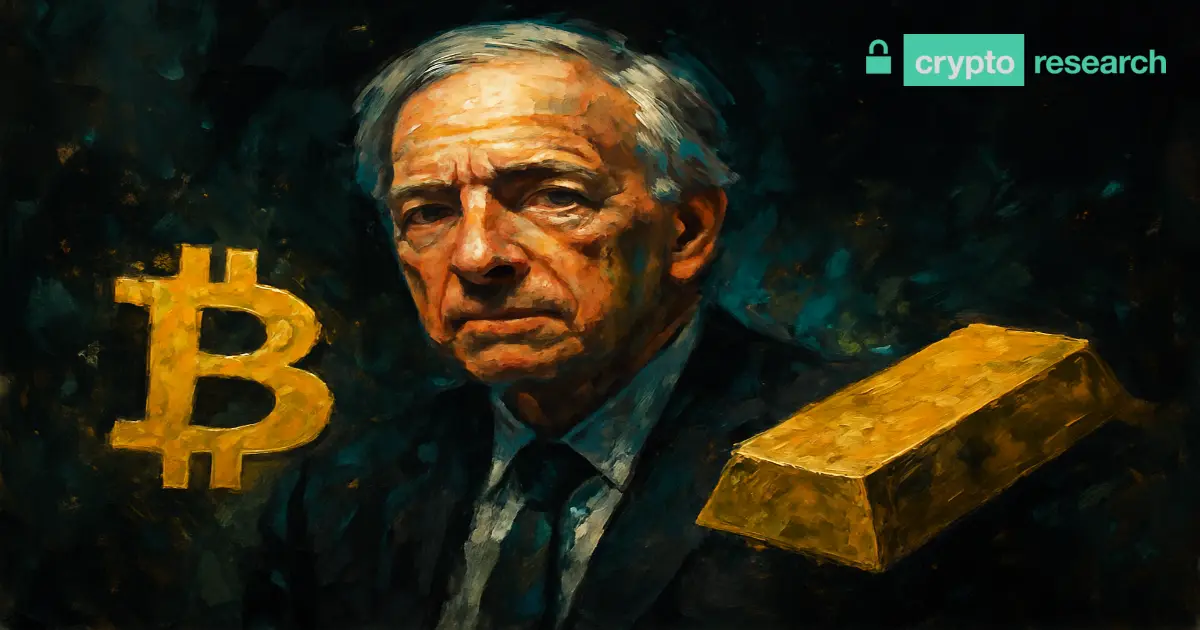


Ray Dalio Asserts Bitcoin Cannot Replace Gold as Primary Store of Value
Billionaire investor Ray Dalio declared that Bitcoin cannot supplant gold as the foremost store of value, emphasizing gold’s historical significance and its firmly established position in central bank reserves. Dalio had previously stated that while Bitcoin has undoubtedly risen in prominence over the past decade, it lacks the institutional backing and historical pedigree that gold enjoys.
Context
Ray Dalio, founder of Bridgewater Associates, one of the world’s leading hedge funds with over $150 billion in assets under management, has long been a key voice in financial markets. For decades, his keen insights into macroeconomic trends and investment strategies have garnered respect and attention from investors worldwide. As cryptocurrencies like Bitcoin gain traction and attract scrutiny from traditional financial institutions, Dalio’s nuanced perspective on digital assets becomes increasingly relevant. While he acknowledges Bitcoin’s innovative features, he maintains gold’s superiority as a reliable store of value, especially amidst the ongoing dialogue about the evolving role of digital currencies in the global economy.
Key Details
Dalio elaborates that gold’s unparalleled position as a store of value arises from its thousands of years of history as a form of money. He described gold as the “most established form of money” because it is the second-largest reserve asset held by central banks globally, following the US dollar. According to the International Monetary Fund (IMF), central banks worldwide hold about 35,000 metric tons of gold, making it integral to the financial system. In direct contrast, Dalio sees Bitcoin as a relatively nascent asset, which, despite its rapid growth and increased market capitalization—peaking at nearly $1 trillion in 2021—lacks the same level of institutional acceptance and historical validation.
Moreover, Dalio raised important concerns regarding Bitcoin’s volatility, particularly its unpredictable price movements during periods of market upheaval. He observed that Bitcoin often tracks with technology stocks and speculative assets, undermining its status as a traditional safe-haven investment. While gold tends to maintain its value during economic uncertainty, Dalio posits that Bitcoin’s erratic behavior does not position it as a reliable alternative.
Dalio also addresses the security features associated with Bitcoin, noting its potential vulnerabilities to technological advancements like quantum computing. He expressed concerns about how such advancements could threaten Bitcoin’s encryption and, by extension, its long-term viability and function as a store of value.
Implications
Dalio’s assertions reinforce the sentiment that, despite Bitcoin’s escalating adoption and market presence, it does not yet rival gold’s established status as a primary store of value. Investors and policymakers may benefit from considering these insights while strategizing asset allocation—particularly during economic turbulence, where traditional fail-safes, such as gold, have historically proven their worth.
Outlook
Looking ahead, the ongoing battle between traditional assets like gold and emerging digital currencies like Bitcoin shows no signs of waning. Investors and financial analysts should monitor key developments, such as prospective regulatory changes that could reshape the cryptocurrency landscape, along with shifts in central bank policies regarding the management of reserve assets. These factors will significantly influence the respective roles that both gold and Bitcoin occupy in the global economic framework, potentially altering investment strategies and the broader financial environment for years to come. As the debate unfolds, it’s clear that the foundations of value—whether anchored in history or innovation—remain central to discussions among financial experts and investors alike.