Tucker Carlson recently shared some pretty wild ideas about Bitcoin, touching on everything from CIA conspiracies to fears of totalitarian control. He seems to grasp the appeal of financial freedom, but gets turned around on how Bitcoin actually works. This confusion shows how even smart commentators can misunderstand what Tucker Carlson Bitcoin discussions are really about: fixing broken money, not hiding from the system.
Key Takeaways
Bitcoin’s Purpose: Bitcoin was created to fix the money system itself, not primarily for privacy.
Fiat System Issues: The current dollar system is prone to inflation and benefits those close to the money spigot.
Young People’s Struggles: Many young people are drawn to crypto due to a lack of financial opportunities in the traditional system.
Roger Ver: Citing Roger Ver as a Bitcoin proponent shows a lack of understanding of Bitcoin’s history and the “block size wars.”
CBDCs vs. Bitcoin: Tucker fears totalitarian control from digital currencies, but this applies to Central Bank Digital Currencies (CBDCs), not Bitcoin.
Satoshi Nakamoto: The creator’s identity is irrelevant to Bitcoin’s function and security; the network runs on math, not trust.
Gold vs. Bitcoin: While gold has a history, it failed due to trust issues, paving the way for Bitcoin as a superior monetary technology.
Tucker’s Take on Privacy and Autonomy
Tucker starts by saying he loves the idea of Bitcoin because he wants his financial transactions to be private. He doesn’t want his money tracked, and that’s a fair point. But here’s the first big mix-up: Bitcoin wasn’t really made to be a privacy tool. Its main job is to fix the money system itself. Think about it – the current system, the US dollar, is designed to lose value over time. The people who get the new money first, like those in government or on Wall Street, get ahead, while everyone else sees their savings shrink because of inflation. Bitcoin, on the other hand, has a fixed supply of 21 million coins. No printing more, no bailouts, no manipulation. That’s what real financial freedom looks like.
Young People and the Crypto Craze
He also talks about how young people are into crypto because they feel like the job market has failed them and they can’t get ahead financially. There’s some truth to this. The system has definitely let people down, but it’s the money that’s broken, not just the jobs. Many young folks are looking at crypto as a way to make it in this world, hoping for a quick win. It’s important to separate Bitcoin from the thousands of other cryptocurrencies out there. Bitcoin isn’t a get-rich-quick scheme; it’s more like an escape route from the endless cycle of inflation. When Tucker talks about people looking for financial opportunity, he’s often describing the speculative side of crypto, not the core promise of Bitcoin.
The Roger Ver Misstep
Then Tucker brings up Roger Ver as someone who “still believes in the promise of blockchain.” For those who know Bitcoin history, this is a red flag. Roger Ver was a big player in the “block size wars” back in 2017. He pushed to change Bitcoin’s rules to make it bigger, which would have made it harder for regular people to run the network and given more power to big miners. The community didn’t go for it, and Bitcoin stayed decentralized. Roger then promoted his own version, Bitcoin Cash, which hasn’t done well. Pointing to Roger Ver as a hero shows Tucker hasn’t done his homework on Bitcoin’s past.
Fear of Totalitarian Control: CBDCs vs. Bitcoin
Tucker expresses fear of digital currency, saying it could lead to “totalitarian control” if the government can freeze accounts or stop people from buying food. He’s right to be worried about that, but he’s talking about Central Bank Digital Currencies (CBDCs), not Bitcoin. CBDCs are what governments would use for surveillance and control. Bitcoin, however, is the opposite. No one can freeze your Bitcoin, reverse a transaction, or take your money. It’s permissionless. Ironically, Tucker Carlson Bitcoin fears describe the danger of government money, not decentralized money.
The Satoshi Mystery and Gold
One of the most talked-about parts is Tucker’s distrust of Bitcoin because “nobody can tell me who Satoshi is.” He even guesses it might be the CIA. This is a common conspiracy theory. If the CIA created Bitcoin, why would they make it open source and impossible to control? That goes against everything governments do with money. And honestly, Satoshi’s identity doesn’t matter. The network is decentralized and works based on math, not trust. We can check the code, verify the supply, and see how it operates. It’s like not needing to know who invented the internet to use it. It just works.
He also mentions being a gold buyer and feeling vindicated. Gold has been around for a long time, but it failed because it relied on trust in banks and governments. Governments eventually printed more paper money than gold they had, and then got rid of gold altogether. That’s how we ended up in the mess of fiat money. Bitcoin, on the other hand, is self-custodied, verifiable, and can be moved easily. It’s the future of money, and it doesn’t rely on trusting anyone.
Hey everyone, let’s talk about Bitcoin, or BTC as it’s often called. You know, that digital money everyone’s buzzing about. We’ve seen some wild swings, and people are always asking if it’s going up or down. In this Bitcoin price analysis 2025, we’re going to break down what’s been happening with the price of Bitcoin (BTC) lately, look at what might happen next as we head toward 2025, and see what the experts are saying. It’s a complex world, but we’ll try to keep it simple.
Key Takeaways
Bitcoin (BTC) has shown recent upward momentum over the past week, though it experienced a dip last month, which could present a buying chance.
Technical indicators show mixed signals, with some timeframes suggesting bullish trends and others bearish, indicating market uncertainty.
Key events like the Bitcoin halving and the introduction of spot Bitcoin ETFs are seen as major drivers for BTC’s price movements.
According to the latest Bitcoin price analysis 2025, expert predictions for Bitcoin’s price vary widely; some anticipate it could reach over $100,000, while others suggest much higher figures.
The Bitcoin market cycle theory, which involves four distinct phases, suggests that the crypto market might be entering a new growth phase.
Bitcoin (BTC) Price Performance Analysis
Recent Price Movements and Trends
Bitcoin’s price action over the past several months has been a subject of intense observation. We’ve seen periods of significant upward momentum, often driven by broader market enthusiasm and specific industry developments. For instance, the last 7 days showed a notable increase of 5.66%, indicating a positive short-term trend. However, this upward movement is often punctuated by sharp corrections. Looking back over the last month, there was a decrease of 1.31%, which wiped out an average of $1,455.66 from its value. This kind of fluctuation is typical for Bitcoin, highlighting its inherent volatility.
The interplay between these gains and losses paints a picture of a market still finding its footing, with strong underlying interest battling against profit-taking and external pressures.
Short-Term Volatility and Opportunities
The cryptocurrency market, and Bitcoin in particular, is known for its rapid price swings. This volatility, while presenting risks, also creates opportunities for traders. The recent 24-hour price increase of $1,533.44 is an example of how quickly sentiment can shift. A 4.85% volatility figure suggests that significant price changes can occur within short timeframes. For those who can manage the risk, these dips can be seen as potential entry points, while rapid ascents might offer chances to secure profits.
Identify Support and Resistance Levels: Understanding key price levels where buying or selling pressure historically intensifies is vital.
Monitor News and Developments: External events, such as regulatory announcements or technological upgrades, can trigger sudden price movements.
Employ Risk Management Strategies: Utilizing stop-loss orders and position sizing can help mitigate potential losses during unexpected downturns.
The rapid nature of these short-term movements means that staying informed and agile is not just beneficial, but necessary for anyone actively participating in the Bitcoin market.
Long-Term Growth Trajectory
Despite the short-term choppiness, the long-term outlook for Bitcoin often points towards a sustained growth trajectory. Historical data, while not a guarantee of future results, suggests a pattern of higher highs and higher lows over extended periods. The introduction of financial products like Spot Bitcoin ETFs has also been cited as a factor potentially contributing to increased demand and, consequently, long-term value appreciation. Analysts often look at the overall market capitalization, which currently stands at approximately $2.21 trillion, as an indicator of Bitcoin’s established presence and potential for continued expansion within the global financial landscape.
Technical Indicators and Market Sentiment
Moving Average Analysis Across Timeframes
Looking at Bitcoin’s price movements requires a peek at its technical indicators. In our Bitcoin price analysis 2025, moving averages are a common tool analysts use to smooth out price data and identify ongoing trends. They can show us where the price has been and give some hints about where it might be headed. Different timeframes offer different perspectives, helping traders make informed decisions about Bitcoin’s short- and long-term potential.
On the four-hour chart, Bitcoin has shown some bullish signs recently. The 50-day moving average is trending upwards, which usually points to a strong short-term upward movement. However, the 200-day moving average has been dropping since late October 2025, suggesting the longer-term picture isn’t as clear.
Shifting to the daily chart, the picture gets a bit more bearish. Here, the 50-day moving average is actually above the price and is falling. This could act as a ceiling, making it harder for the price to climb. On the flip side, the 200-day moving average has been rising since late September 2025, indicating some underlying long-term strength.
When we look at the weekly timeframe, Bitcoin appears more bullish again. The 50-day moving average is below the price and climbing, which often means it’s acting as a support level. The 200-day moving average has been on an upward path since early April 2025, supporting the idea of a sustained trend over a longer period.
Interpreting Market Sentiment Indicators
Beyond just price charts, understanding what traders and investors are feeling is key. Market sentiment indicators try to capture this collective mood. They can range from looking at how much people are talking about Bitcoin online to analyzing trading volumes and order book data. For instance, some platforms track the ratio of bullish to bearish sentiment, giving a snapshot of the general feeling in the market. Right now, there’s a mix of opinions, with some seeing opportunities and others expressing caution. The recent price action, like the drop around October 10th, definitely made some people nervous, but on-chain data suggests that people who hold between 100 and 1,000 BTC, sometimes called the ‘dolphin’ cohort, are still accumulating. This group includes ETFs and larger companies, and their buying habits have historically been a good sign for Bitcoin’s price momentum. In fact, this cohort added over 681,000 BTC in 2025 alone, while others saw their holdings decrease.
The Role of Fear and Greed Index
The Fear and Greed Index is a popular tool that tries to measure market sentiment by looking at several factors, including volatility, social media buzz, and market momentum. It assigns a score from 0 (extreme fear) to 100 (extreme greed). When the index is in the ‘extreme fear’ zone, it can sometimes signal a buying opportunity, as investors might be overly pessimistic. Conversely, ‘extreme greed’ might suggest the market is getting overheated and a correction could be on the way. Keeping an eye on this index can help gauge whether market movements are driven by rational analysis or emotional reactions. It’s a simple way to get a feel for the overall mood, but it’s just one piece of the puzzle.
Understanding these technical signals and market moods isn’t about predicting the future with certainty. It’s more about recognizing patterns and understanding the forces that are currently shaping the price of Bitcoin. Different indicators can give conflicting signals, which is why looking at a combination of them, along with fundamental factors, is usually the best approach for making informed decisions. The current market conditions are fueling debate among investors and analysts regarding the future trajectory of Bitcoin’s price, with some seeing signs of accumulation around the current Bitcoin price.
Here’s a quick look at how sentiment can be viewed:
Extreme Fear: Often seen as a potential buying signal.
Fear: Indicates caution and potential downside.
Neutral: A balanced market, neither overly optimistic nor pessimistic.
Greed: Suggests high confidence, possibly leading to overvaluation.
Extreme Greed: May signal an overheated market and a potential correction.
Factors Influencing Bitcoin’s Value
Impact of Spot Bitcoin ETFs
The introduction of spot Bitcoin Exchange-Traded Funds (ETFs) has significantly altered the landscape for Bitcoin investment. These financial products offer a more regulated and accessible avenue for both individual and institutional investors to gain exposure to Bitcoin without the complexities of direct ownership. This has led to a noticeable increase in demand, as ETFs must acquire actual Bitcoin to back their shares, directly impacting the spot price. Furthermore, the approval of these ETFs has often triggered a sense of urgency, a ‘fear of missing out’ (FOMO), among investors, which can accelerate buying activity and contribute to price surges. The accessibility provided by ETFs has broadened the investor base, drawing in those who might have been hesitant to engage with the cryptocurrency market previously.
The Significance of Bitcoin Halving Events
Bitcoin halving events are pre-programmed occurrences that reduce the reward miners receive for validating transactions. Historically, these events have occurred approximately every four years and have been closely followed by significant price increases. The rationale behind this is a reduction in the rate at which new Bitcoins are introduced into circulation, creating a supply shock. When demand remains constant or increases while the supply of new coins diminishes, basic economic principles suggest a rise in price. Michael Saylor of MicroStrategy, for instance, has pointed to these halving events as a key driver for future bullish trends due to this inherent supply constraint.
Regulatory Landscape and Energy Consumption Concerns
The regulatory environment surrounding Bitcoin and other cryptocurrencies is a dynamic and influential factor. Government policies, potential crackdowns, or the introduction of new regulations can create uncertainty or provide clarity, both of which can impact market sentiment and price. For example, news of potential regulatory hurdles can swiftly lead to price declines, while favorable regulatory developments can boost investor confidence. Additionally, the energy consumption associated with Bitcoin mining has drawn considerable attention. Concerns about the environmental impact can lead to negative sentiment and, in some cases, influence regulatory decisions or corporate adoption policies. The ongoing debate about Bitcoin’s energy usage remains a critical point of discussion for its long-term viability and mainstream acceptance.
The global money supply is another element that can play a role in Bitcoin’s valuation. As the amount of fiat currency in circulation changes, assets like Bitcoin, which have a fixed supply, can become more or less attractive as a hedge against inflation or a store of value.
Expert Price Predictions for Bitcoin (BTC)
Short-Term Price Targets and Projections
Looking at the immediate future, Bitcoin’s price action is a bit of a mixed bag, according to recent analyses. While some indicators suggest a bullish short-term trend, others point to potential resistance. For instance, the 50-day moving average on a four-hour chart is trending upwards, which is a positive sign. However, the 200-day moving average on the daily chart has been falling, hinting at a weaker long-term outlook. This kind of divergence means we could see some choppy price movements in the coming weeks. It’s not uncommon for Bitcoin to experience significant swings, and these short-term fluctuations can present both risks and opportunities for traders looking to capitalize on quick moves.
Mid-Term Forecasts for 2025
As we look towards 2025, the expert predictions become more optimistic, though still varied. Many analysts are projecting Bitcoin to reach new highs, with some estimates placing the minimum cost around $113,245 and the maximum potentially hitting $119,345. The average trading price is often cited in the range of $125,444. This outlook is influenced by several factors, including the ongoing adoption of Bitcoin ETFs and the anticipation surrounding future market cycles. It’s important to remember that these are projections based on current data and trends, and the crypto market is known for its unpredictability.
Here’s a snapshot of some monthly expectations for 2025:
Month
Minimum Price
Average Price
Maximum Price
October
$111,622.06
$118,533.28
$125,444.50
November
$114,727.97
$119,217.19
$123,706.41
December
$113,245.54
$116,897.68
$120,549.82
Long-Term Outlook and Ambitious Estimates
When we extend the view further out, the predictions for Bitcoin become even more substantial. Some forecasts suggest that by 2027, the price could reach an average of $291,256, with a potential maximum of $342,171. Looking even further, by 2033, estimates are pushing towards an average price of $2,794,095 and a staggering maximum of $3,200,874. These ambitious figures are often based on the idea of Bitcoin becoming a more established digital asset, a hedge against inflation, and its increasing integration into the global financial system.
The long-term potential of Bitcoin is often tied to its scarcity, its decentralized nature, and its growing acceptance by both individuals and institutions. As the supply remains capped at 21 million coins, increased demand, especially from institutional investors, could theoretically drive prices significantly higher over extended periods.
It’s worth noting that market sentiment can play a big role. Currently, technical indicators show a mixed sentiment, with a slight bearish leaning (58% bearish vs. 42% bullish). The Fear and Greed Index is also showing a score of 30, which falls into the ‘Fear’ category. This suggests that caution might be warranted in the short term, even as longer-term outlooks remain positive for many analysts.
Bitcoin (BTC) Price Forecasts for 2025
Looking ahead to 2025, Bitcoin price analysis 2025 remains a key topic of discussion among analysts and investors. While past performance is never a guarantee of future results, several factors suggest a potentially dynamic year for the leading cryptocurrency, with market sentiment, ETF adoption, and halving events likely to play major roles in shaping Bitcoin’s price trajectory.
Projected Minimum and Maximum Values
Forecasting exact price points is challenging, but many analyses within the Bitcoin price analysis 2025 outlook point toward significant upward potential. For 2025, some projections place the minimum expected value around $113,245.54, with the maximum potentially reaching $119,345.02. These figures are based on various technical indicators and market sentiment analyses. It’s important to remember that these are just estimates, and actual Bitcoin prices could deviate significantly.
Average Trading Price Expectations
Beyond the extremes, the average trading price expectation from the Bitcoin price analysis 2025 report hovers around $125,444.50. This middle-ground estimate attempts to balance the optimistic outlook with the inherent volatility of the crypto market. Several factors, including the ongoing adoption of spot Bitcoin ETFs and the anticipation surrounding future halving events, are expected to play a major role in shaping this average.
Monthly Price Fluctuations
Predicting precise monthly movements is even more speculative, but general trends can be observed. For instance, October 2025 might see average trading prices around $118,533.28, with fluctuations between $111,622.06 and $125,444.50. Similarly, November 2025 could average around $119,217.19, with a range from $114,727.97 to $123,706.41. December 2025 is projected to have an average cost of $116,897.68, with a potential range from $113,245.54 to $120,549.82. These monthly figures highlight the expected volatility within the year, even amidst an overall positive trend.
The market sentiment for Bitcoin in late 2025 appears cautiously optimistic, with technical indicators suggesting a potential for growth, though short-term fluctuations are to be expected. The influence of institutional investment and broader economic conditions will likely be key drivers.
Several prominent figures in the financial world have offered their own predictions, adding to the diverse range of expectations. Some analysts maintain a positive long-term outlook for Bitcoin, citing intact structural integrity and active accumulation. Expectations are high for the coming periods, with some analysts projecting Bitcoin could reach substantial figures. For example, some forecasts suggest Bitcoin could reach $200,000. The potential for Bitcoin to act as a store of value and an inflation hedge continues to be a significant talking point, influencing many of these optimistic price targets.
It’s also worth noting the potential for more ambitious estimates. Some industry leaders have put forth forecasts that suggest Bitcoin could reach $150,000 by the end of 2025, with even higher targets for the longer term, such as $500,000 within five years or even $1 million within the same timeframe, driven by its finite supply and increasing adoption.
The Bitcoin Market Cycle Theory
Understanding Accumulation, Mark-up, Distribution, and Mark-down
The Bitcoin market, much like traditional financial markets, tends to move in cycles. These cycles are often described by four distinct phases: accumulation, mark-up, distribution, and mark-down. The accumulation phase is when savvy investors begin buying Bitcoin, often after a period of decline, anticipating future price increases. This is followed by the mark-up phase, characterized by a significant rise in price as demand grows and more investors enter the market. Eventually, the market reaches a distribution phase, where early buyers start selling their holdings at high prices, leading to a plateau or slight decline. Finally, the mark-down phase occurs when prices fall sharply as selling pressure increases and sentiment turns negative. Understanding these phases is key to grasping Bitcoin’s historical price action.
Alignment with Historical Four-Year Cycles
Bitcoin’s market cycles have historically shown a strong correlation with its four-year halving events. The halving, which reduces the reward for mining new blocks, effectively decreases the rate at which new Bitcoins are created, impacting supply. This supply shock, combined with increasing demand, has historically preceded significant bull runs. Analysts suggest a 4-year cycle, tied to the Bitcoin Halving, indicates a potential shift from a nearly 3-year bullish trend towards a bearish outlook. Observing these patterns can offer insights into potential future market movements, though it’s important to remember that past performance is not indicative of future results.
Potential for New Growth Cycles
Despite the cyclical nature of the market, Bitcoin has consistently demonstrated resilience and an ability to rebound. In the context of Bitcoin price analysis 2025, the introduction of spot Bitcoin ETFs has been a significant development, increasing accessibility and institutional adoption, which could influence the length and intensity of future cycles. The “dolphin cohort,” wallets holding between 100 and 1,000 BTC, has shown consistent accumulation, adding over 681,000 BTC in 2025 alone — a sign of robust long-term demand. This ongoing accumulation, coupled with technological advancements and increasing global acceptance, points towards the potential for new growth cycles and continued relevance for Bitcoin in the evolving financial landscape. The market is currently seen by some as being in a “late-stage maturity segment” of an uptrend, with the coming weeks being crucial for observing accumulation rates.
The cyclical nature of Bitcoin, influenced by events like the halving and evolving investor behavior, suggests a recurring pattern of growth and correction. While predicting exact timings is challenging, historical data provides a framework for understanding potential market phases and their drivers.
Bitcoin’s Evolving Role in the Global Economy
Bitcoin as a Store of Value and Inflation Hedge
Bitcoin’s initial conception was as a peer-to-peer electronic cash system, but its journey has seen it increasingly recognized as a digital store of value, often compared to gold. This shift is partly due to its fixed supply, capped at 21 million coins, which contrasts with fiat currencies that can be printed indefinitely. In times of economic uncertainty or rising inflation, many investors turn to Bitcoin as a hedge, seeking to preserve their wealth. The scarcity model is a key driver here; as more people see it as a safe haven, demand can increase, potentially pushing its value up, especially when traditional assets are underperforming. This perception has been bolstered by events like the global economic slowdowns that have historically driven interest in digital assets.
The narrative of Bitcoin as ‘digital gold’ is gaining traction, particularly among younger generations and those disillusioned with traditional financial systems. Its decentralized nature and resistance to censorship further solidify its appeal as an independent store of value.
Increasing Institutional Trust and Adoption
The landscape of Bitcoin adoption has dramatically changed with the introduction of spot Bitcoin ETFs. These financial instruments have opened the doors for a wider range of investors, including large institutions, to gain exposure to Bitcoin without the complexities of direct ownership. This has led to increased demand and has been a significant factor in recent price surges. The accessibility provided by ETFs has also fueled a sense of urgency, sometimes referred to as FOMO (Fear Of Missing Out), among investors who want to participate in what they perceive as a growing market. The approval and subsequent performance of these ETFs signal a growing acceptance of Bitcoin within the traditional financial system. This growing trust is a major step towards broader integration.
Increased Demand: ETFs require the purchase of actual Bitcoin to back their shares, directly impacting market supply and demand dynamics.
Market Liquidity: ETFs can improve the ease of trading Bitcoin, potentially reducing volatility in the long run, though large flows can still cause short-term price swings.
Regulatory Clarity: The existence of regulated financial products like ETFs can provide a sense of legitimacy and reduce perceived risks for institutional players.
Technological Advancements and Financial Inclusion
Beyond its role as an investment asset, Bitcoin’s underlying blockchain technology continues to evolve, with ongoing developments aimed at improving its scalability and efficiency. While Bitcoin itself might not be the fastest for everyday transactions, its network effects and the innovation it has inspired are significant. Furthermore, Bitcoin has the potential to play a role in financial inclusion, offering access to financial services for individuals in regions with underdeveloped banking infrastructure. The ability to send and receive value across borders with minimal intermediaries is a powerful proposition for the unbanked and underbanked populations globally. Projects focused on layer-two solutions and payment channels are working to make Bitcoin more practical for daily use, further expanding its utility and reach in the global economy. The ongoing development in this space suggests that Bitcoin’s impact may extend far beyond its current market performance, influencing how we think about money and transactions worldwide. You can find more information on its development and historical price movements.
Wrapping Up: What’s Next for Bitcoin?
So, looking at all this, it’s pretty clear that figuring out exactly where Bitcoin’s price will land is a tough game. Our Bitcoin price analysis 2025 shows that while Bitcoin has jumped recently, its future path remains uncertain. Some experts are highly optimistic, predicting much higher prices for 2025, while others remain cautious about factors like energy consumption and new regulations that could affect the market. Still, Bitcoin’s strong community and history of recovery suggest long-term potential. As always, keep an eye on market news and trends before investing. This Bitcoin price analysis 2025 is for informational purposes only, not financial advice.
Frequently Asked Questions
What has Bitcoin’s price done recently?
Lately, Bitcoin has been on a bit of a rollercoaster. It saw a nice jump over the last week, which is great news for investors. However, it did dip a little in the past month. This kind of up and down movement is pretty normal for Bitcoin, and sometimes those dips can be good chances to buy in.
What are some expert predictions for Bitcoin’s price in 2025?
According to the latest Bitcoin price analysis 2025, experts have different ideas about where Bitcoin will be next year. Some think it could trade between $113,000 and $119,000, while others have far more ambitious targets, predicting it might even reach $210,000 or higher. Despite the wide range of forecasts, many analysts agree that Bitcoin’s long-term growth potential remains strong.
What is the Bitcoin Halving, and why is it important?
The Bitcoin Halving is an event that happens about every four years. It cuts the reward that miners get for adding new Bitcoins to the network in half. This makes new Bitcoins harder to get, which can lead to higher prices because there’s less supply.
Are Bitcoin ETFs good for Bitcoin’s price?
Yes, the introduction of spot Bitcoin ETFs (Exchange-Traded Funds) in the US has been a big deal. It makes it easier for big companies and more people to invest in Bitcoin, which can increase demand and potentially push the price up.
What are the main things that affect Bitcoin’s price?
A lot of things can move Bitcoin’s price! Big news like the approval of ETFs or the halving event can cause big changes. Also, how governments are treating Bitcoin (regulations) and how much energy it uses are important factors that people watch.
Will Bitcoin keep going up in the future?
Many people believe Bitcoin will continue to rise over the long term. It’s seen as a digital store of value, like digital gold, and more and more institutions are starting to use it. While there will likely be ups and downs, the overall trend for many experts is positive.
Keeping your digital money safe is a big deal, right? Especially with all the news about crypto hacks. That’s where cold wallets for cryptocurrency come in. Think of them like a super secure vault for your digital coins, keeping them offline and away from prying eyes. We’re going to look at some of the top cold wallets for cryptocurrency available in 2025, helping you figure out which one might be the best fit for your needs. It’s not as complicated as it sounds, and getting it right means a lot less worry about your investments.
Key Takeaways
Cold wallets store your private keys offline, offering better protection against online threats compared to hot wallets.
Look for features like Secure Element chips, PIN protection, and air-gapped functionality for enhanced security.
Always buy cold wallets directly from the manufacturer or authorized resellers to avoid fake devices.
Securely store your recovery phrase (seed phrase) in a safe, offline location; it’s your backup if you lose your device.
Consider factors like coin support, user interface, and backup options when choosing the best cold wallets for cryptocurrency for your situation.
Ledger Nano X
The Ledger Nano X has been a go-to for many crypto holders for a while now, and for good reason. It’s built to keep your digital assets safe offline, which is the whole point of a cold wallet. You can store a pretty big number of different coins on it, over 1,800 according to Ledger, and it handles up to 50 different types of wallets. That’s a lot of flexibility if you’re into various cryptocurrencies.
One of the standout features is its Bluetooth connectivity. This means you can manage your crypto directly from your smartphone, which is super convenient for checking balances or making quick transactions without needing to pull out a computer. It’s got a decent screen, an OLED display, that’s clear enough to see what you’re doing when you confirm transactions. Plus, it uses physical buttons, which some people really prefer for that tactile confirmation.
Here’s a quick look at what makes it tick:
Secure Element Chip: This is a dedicated chip designed to protect your private keys from sophisticated attacks. It’s pretty standard on good hardware wallets these days.
Bluetooth Connectivity: Allows for easy pairing with mobile devices (iOS and Android) for managing your crypto on the go.
Wide Coin Support: Accommodates a vast array of cryptocurrencies and tokens, making it suitable for diverse portfolios.
Large Application Capacity: You can install up to 100 applications on the device, letting you manage different crypto assets and services.
It’s not all perfect, though. The firmware isn’t open-source, which some privacy advocates aren’t thrilled about, even though Ledger says it’s independently verified. Also, while the Bluetooth is handy, some folks are a bit wary of any wireless connection for security reasons. For those who want to keep things strictly offline, this might be a point of consideration. Still, for a balance of security, convenience, and broad coin support, the Ledger Nano X remains a strong contender in the cold storage market.
Trezor Safe 3
The Trezor Safe 3 is a solid choice for those looking for a good mix of security and price. It’s not the cheapest option out there, but it brings some serious protection to the table. One of the standout features is its Secure Element chip, which is certified at EAL6+ level. This basically means it’s built to resist sophisticated attacks aimed at pulling out your private keys. For anyone concerned about transparency, the Safe 3 also keeps its code open-source, which is a big plus for many in the crypto space.
It supports a wide range of cryptocurrencies, over 5,500 to be exact, so you’re likely covered no matter what you’re holding. The interface is pretty straightforward, making it easier to manage your assets.
Here’s a quick look at some of its key aspects:
Secure Element Chip: EAL6+ certified for robust protection against physical and digital attacks.
Open-Source Code: Allows for community verification and transparency.
Broad Coin Support: Compatible with over 5,500 different cryptocurrencies and tokens.
On-Device Confirmation: All transactions must be verified directly on the hardware wallet itself.
Passphrase Protection: An extra layer of security beyond the PIN.
While the Trezor Safe 3 offers strong security, it’s important to remember that no device is completely impenetrable. Understanding how to properly manage your recovery phrase and PIN is just as important as the hardware itself. Trezor aims to keep you in control of your crypto keys, removing the risk that comes with third-party custodians.
Compared to some other options, the Safe 3 is priced quite reasonably at around $79. It’s a good middle-ground device that doesn’t skimp on the security features that matter most for safeguarding your digital assets. If you’re looking for a reliable hardware wallet that balances advanced security with a user-friendly experience, the Trezor Safe 3 is definitely worth considering for your crypto key management.
COLDCARD
When it comes to securing Bitcoin, the COLDCARD stands out as a serious contender, especially for those who prioritize an air-gapped approach. This device is built with Bitcoin-only in mind, meaning it’s designed from the ground up to protect your most valuable digital asset without ever touching the internet. This isolation is its main selling point, making it incredibly resistant to online threats and malware.
Setting up the COLDCARD involves a few key steps to ensure maximum security. You’ll want to verify the device upon arrival, update its firmware if necessary, and carefully set up your PIN and passphrase. The air-gapped nature means transactions are signed offline, then transferred to an online device for broadcasting, which adds a layer of complexity but significantly boosts security.
Here’s a look at some of its security features:
EAL6+ Certified Secure Element: This chip is designed to protect sensitive data, like your private keys, from physical and software attacks.
Air-Gapped Operation: The device is never connected to the internet, preventing remote hacking attempts.
Open-Source Firmware: Transparency allows for community review and verification of the code.
Tamper-Evident Packaging: Helps ensure the device hasn’t been compromised before you receive it.
While the COLDCARD is a robust choice for Bitcoin security, its Bitcoin-only focus might not suit users holding multiple types of cryptocurrency. The interface, while functional, is also quite basic, which some users might find less appealing compared to more graphically rich options. However, for the dedicated Bitcoin holder focused on security above all else, the COLDCARD offers a strong defense. It’s a tool that requires a bit more attention to detail during use, but the trade-off is a high level of protection for your holdings, making it a solid option for long-term cryptocurrency custody solutions.
The COLDCARD’s design philosophy centers on minimizing the attack surface by keeping the device offline. This approach, while requiring a slightly different workflow for transactions, is a deliberate choice to provide a high degree of security against the ever-present online threats.
Tangem
Tangem presents a rather unique approach to cold storage, moving away from the traditional seed phrase model that many hardware wallets rely on. Instead, it uses a pair of secure smart cards, functioning much like a credit card. This design aims to simplify the process significantly, especially for those who find managing seed phrases daunting or prone to error. The core idea is to eliminate the risk associated with writing down and storing a recovery phrase, which can be a weak point for many users.
Here’s a breakdown of its key features:
Seedless Operation: Tangem cards don’t use seed phrases. Recovery is handled through backup cards, meaning you don’t have to worry about losing or misplacing a critical piece of paper.
Offline Functionality: The cards themselves are designed to operate completely offline. They connect to a smartphone via NFC, but the private keys never leave the secure chip on the card. This air-gapped nature is a significant security advantage.
Ease of Use: The interface is designed to be intuitive. You simply tap the card to your phone to initiate transactions, making it accessible even for individuals new to cryptocurrency.
Multi-Asset Support: Tangem wallets can store a wide array of cryptocurrencies, supporting over 6,000 different digital assets, which is quite extensive for a cold storage solution.
The Tangem system is built around the concept of making advanced security accessible. By abstracting away the complexities of seed phrase management and relying on secure, offline chips, it aims to provide a robust yet simple way to safeguard digital assets. This makes it a compelling option for both beginners and experienced users looking for a more streamlined cold storage experience.
While the convenience is a major draw, it’s important to note that the security relies on the integrity of the smart card itself and the NFC connection. For users who prioritize a completely offline, air-gapped experience with a familiar seed phrase backup, other options might be preferred. However, for those seeking a user-friendly, seedless cold storage solution that offers broad cryptocurrency support, Tangem is a strong contender in the 2025 security guide.
Ledger Stax
The Ledger Stax is a bit of a departure from the usual hardware wallet look. It’s got this really sleek, almost futuristic design with a big touchscreen and a curved E Ink display along the side. If you care about how your crypto gear looks, this one might catch your eye. It’s built to hold your cryptocurrencies and NFTs, aiming to be a central spot for your digital assets.
The Stax is priced at $399, positioning it as a premium option in the cold storage market.
Here’s a quick look at what it offers:
Broad Cryptocurrency Support: It can handle over 5,500 different cryptocurrencies and tokens, which is a pretty wide range.
Mobile Connectivity: You can manage your wallet using your Android or iOS device through Bluetooth. This makes it easier to interact with your assets on the go.
Application Capacity: The device can store up to 100 different applications, giving you flexibility to add various crypto-related tools.
Secure Key Storage: Your private keys are kept safe inside a dedicated hardware chip, isolated from internet-connected devices.
Cross-Platform Compatibility: It works with major operating systems like Windows, macOS, Linux, and even mobile platforms.
One point to note is that the Ledger Stax, like other Ledger devices, uses a closed-source system. This means the internal code isn’t publicly available for review, which some security-minded individuals prefer to avoid.
While the design is certainly a standout feature, it’s important to remember that the core function of a cold wallet is security. The Stax aims to balance a modern user experience with robust protection for your digital holdings.
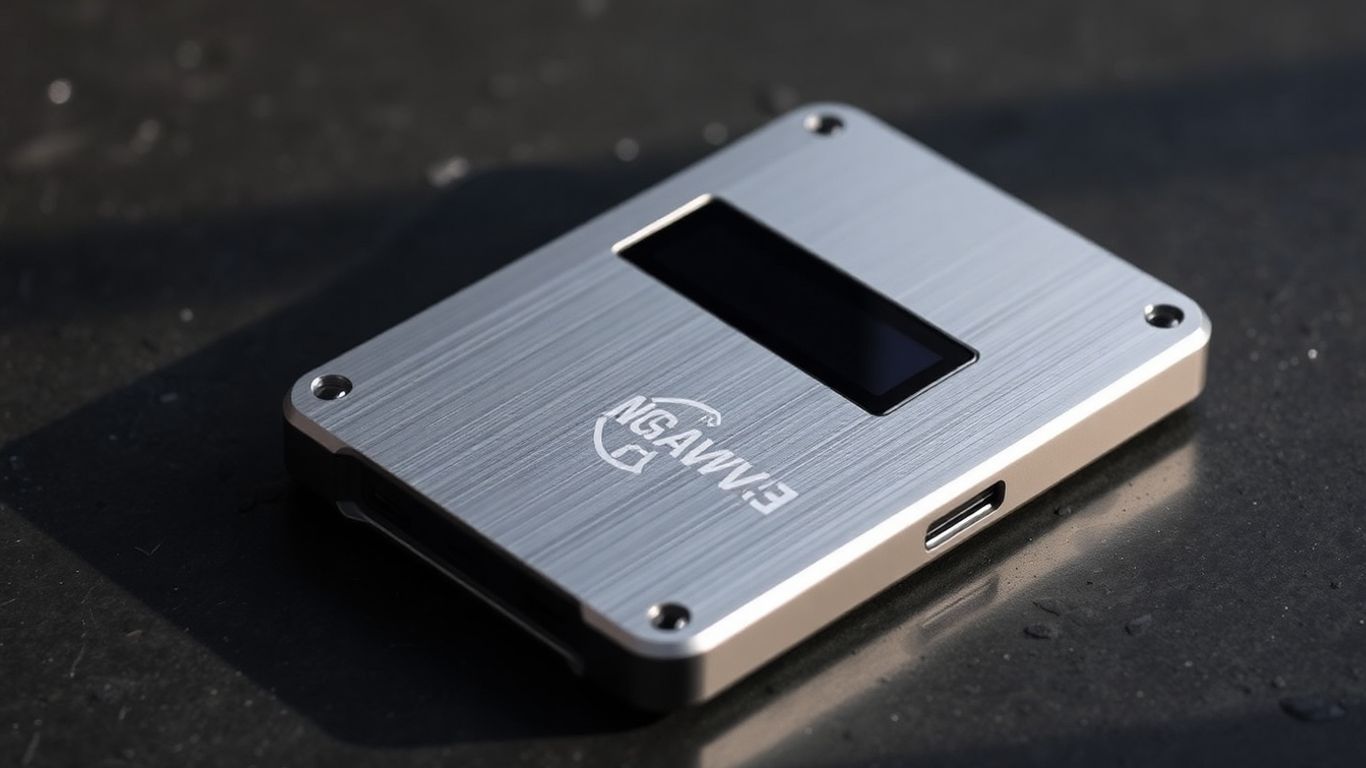
NGRAVE Zero
The NGRAVE Zero wallet positions itself as a top-tier option for individuals prioritizing absolute offline security. Its design centers around being completely air-gapped, meaning it never connects to the internet or any other network. This approach significantly reduces the attack surface for potential threats.
One of the standout features is its robust authentication system, which includes biometric scanning. This adds a layer of personal security, making it harder for unauthorized individuals to access your funds even if they physically possess the device. The wallet also supports a substantial number of digital assets, over 3,500, including NFTs, which is a good range for most users.
For recovery, NGRAVE offers an optional accessory called Graphene. These are durable, fireproof plates designed to store your recovery phrase. This is a smart move, as traditional paper backups can be vulnerable to environmental damage or degradation over time. The combination of air-gapped operation and advanced recovery options makes the NGRAVE Zero a strong contender for long-term, secure storage.
However, this level of security and the included features come at a cost. The NGRAVE Zero is one of the more expensive hardware wallets on the market. Additionally, its focus on maximum security can make it less convenient for frequent transactions or for users who are new to hardware wallets. The setup process might require a bit more attention than simpler devices.
Here’s a look at some of its key aspects:
Security Focus: Fully air-gapped design with EAL-7 certification.
Authentication: Biometric and PIN protection.
Recovery: Optional durable Graphene plates for seed phrase storage.
Asset Support: Over 3,500 cryptocurrencies and NFTs.
Connectivity: USB-C for charging and firmware updates (no data transfer).
While the NGRAVE Zero offers a very high level of security, its price point and complexity mean it’s best suited for users who understand the trade-offs and are willing to invest in advanced protection for their digital assets.
Cypherock X1
The Cypherock X1 takes a different approach to securing your digital assets by splitting your private keys across multiple smart cards. This method, known as decentralized key storage, means no single device holds all the information needed to access your funds. It’s an air-gapped solution, meaning it doesn’t connect to the internet, which significantly reduces the risk of online attacks.
This wallet is open-source, which is a big plus for transparency and security audits. It also supports multi-signature transactions, allowing you to set up co-signers for added control. For those concerned about failed PIN attempts, the Cypherock X1 includes a "brick pin" feature that effectively disables the device after too many incorrect entries. Backups are handled via a microSD card.
Here’s a look at some of its features:
Air-gapped design: Ensures no internet connectivity for enhanced security.
Decentralized key storage: Private keys are split across multiple smart cards.
Open-source firmware: Allows for community verification and trust.
MicroSD card backup: Provides a physical backup option.
Brick pin: A security measure against brute-force attacks.
While the Cypherock X1 offers robust security, it’s worth noting that some users find its interface less intuitive compared to more mainstream options. The price point is also something to consider when evaluating your options. For those prioritizing a unique, decentralized security model, the Cypherock X1 is definitely worth a closer look, especially if you’re interested in exploring advanced key management techniques.
BC Vault ONE
The BC Vault ONE positions itself as a robust option for cryptocurrency storage, particularly appealing to those who manage a diverse range of digital assets. Its primary draw is its extensive support, reportedly handling millions of cryptocurrencies, which is a significant advantage for users holding many different types of tokens. This broad compatibility means you’re less likely to run into issues if you’re invested in less common altcoins or newer projects.
One of the key security features of the BC Vault ONE is its fully offline design. This air-gapped approach means the device never connects to the internet, significantly reducing the risk of online threats and hacking attempts. For added security, it offers encrypted backups, a critical component for safeguarding your private keys. While it lacks wireless connectivity like Bluetooth or Wi-Fi, this is a deliberate design choice to maintain its offline status and enhance security. This focus on offline storage aligns with the broader market’s need for mature custodianship solutions, especially as digital assets gain traction [c9f1].
Here’s a look at some of its notable characteristics:
Offline Storage: Designed to be air-gapped, keeping your private keys isolated from online threats.
Extensive Asset Support: Capable of managing a vast number of different cryptocurrencies.
Encrypted Backups: Provides an additional layer of security for your recovery information.
No Wireless Connectivity: Lacks Bluetooth and Wi-Fi, which is a security advantage.
While the BC Vault ONE offers a high degree of security through its offline nature and encrypted backups, its lack of wireless features can make day-to-day transactions less convenient compared to devices with mobile app integration. Users need to weigh the trade-off between maximum security and ease of use for frequent trading.
The BC Vault ONE is priced around $182.50, placing it in the mid-to-high range for hardware wallets. This cost reflects its advanced security features and broad asset support. For individuals prioritizing a wide selection of supported assets and a strong emphasis on offline security, the BC Vault ONE presents a compelling case for consideration in their digital asset management strategy.
D’CENT
The D’CENT wallet stands out with its integrated biometric fingerprint sensor, adding a significant layer of security for accessing your digital assets. This feature aims to make the process of authorizing transactions more secure and convenient than relying solely on PINs or passwords. It supports a wide array of cryptocurrencies, reportedly over 3,600, which is quite extensive and covers most user needs.
The setup process is generally straightforward, and the device itself is compact, making it easy to carry around. For those who might run into issues, D’CENT does provide customer support. However, it’s worth noting that this wallet operates manually, meaning transactions require direct interaction with the device and do not utilize Bluetooth or Wi-Fi connectivity, which can make frequent use a bit more cumbersome.
Here’s a look at some of its key features:
Biometric Fingerprint Sensor: For enhanced security and quick access.
Extensive Coin Support: Compatible with over 3,600 cryptocurrencies.
SD Card & QR Code Backup: Offers alternative methods for backing up your recovery information.
Long-lasting Components: Utilizes Ferroelectric RAM, designed for extreme longevity.
While the D’CENT wallet offers robust security through its fingerprint scanner and broad coin support, its reliance on manual transaction confirmation without wireless connectivity might be a drawback for users prioritizing speed and convenience in their daily crypto activities. The interface, while functional, has been described by some as a bit dated compared to newer devices on the market.
For users concerned about the physical security of their private keys, exploring options like securely storing cryptocurrency is always a good idea. The D’CENT wallet, priced around $139, presents a solid option for those who value biometric authentication in their cold storage solution.
Ledger Flex
The Ledger Flex represents a notable step forward in Ledger’s line of hardware wallets, aiming to blend advanced security with a more user-friendly experience. It features a 2.84-inch E Ink touchscreen, which is quite readable and uses less power than traditional displays. This wallet is designed to keep your private keys isolated from your computer or phone, a standard practice for cold storage but executed here with Ledger’s characteristic attention to detail.
One of the standout features is its connectivity. The Flex supports USB-C, Bluetooth, and Near Field Communication (NFC), offering flexibility in how you interact with your digital assets. While Bluetooth and NFC add convenience, they also introduce potential attack vectors, though Ledger implements these with security in mind. The device utilizes a certified EAL5+ Secure Element chip, the same kind found in passports, to protect your sensitive information.
Here’s a quick look at its capabilities:
Secure Element Chip: Protects private keys and transaction signing.
E Ink Touchscreen: Provides clear transaction details and interaction.
Multiple Connectivity Options: USB-C, Bluetooth, and NFC for varied use cases.
Broad Coin Support: Compatible with thousands of cryptocurrencies and tokens.
While the Flex offers a robust feature set, it’s worth noting that it, like other Ledger devices, is closed-source. This means the internal workings aren’t publicly auditable, which can be a concern for some security-conscious users. However, for those who trust Ledger’s established reputation and value the combination of a secure chip, a clear display, and versatile connection methods, the Ledger Flex is a strong contender in the cold storage market. It’s a solid choice for managing a diverse portfolio of digital assets, and you can find more details in our full Ledger review.
The design prioritizes a secure transaction verification process directly on the device’s screen, minimizing the need to trust your connected computer or mobile. This approach is key to maintaining the integrity of your holdings.
Wrapping Up Your Cold Storage Strategy
So, we’ve looked at a bunch of cold wallets for keeping your crypto safe in 2025. Picking the right one really comes down to what you need. Do you want something super simple, or are you okay with a bit more complexity for extra security? Features like secure chips, how you back things up, and even how the wallet looks are all things to think about. Remember, the best wallet for your digital money is the one that fits your personal situation and makes you feel confident about your assets. It’s not just about buying the most expensive gadget; it’s about making a smart choice that works for you long-term.
Frequently Asked Questions
What exactly is a cold wallet and why should I use one?
A cold wallet is like a super-secure piggy bank for your digital money (like Bitcoin). It keeps your money completely offline, meaning hackers can’t reach it through the internet. You should use one to keep your digital money safe, especially if you plan to hold onto it for a long time, like saving up for something big.
How do I set up a cold wallet? Is it complicated?
Setting up a cold wallet usually involves a few simple steps. You’ll get a special list of words, called a recovery phrase, which is super important – write it down and keep it safe! Then, you’ll follow the instructions to set up a PIN. It’s like setting up a new phone, just be sure to follow the steps carefully.
What happens if I lose my cold wallet device?
Don’t panic! If you lose your physical cold wallet, you can usually get your digital money back using that special recovery phrase you wrote down during setup. Think of it as the master key to your money. That’s why keeping that phrase super safe is the most important thing.
Are cold wallets better than hot wallets?
Yes, for keeping your digital money super safe, cold wallets are generally better. They’re offline, making them much harder for hackers to attack. Hot wallets are connected to the internet, which makes them easier to use for quick buys and sells, but also more risky.
Can I store different types of digital money in a cold wallet?
Most cold wallets can hold many different kinds of digital money, not just Bitcoin. It’s like having a big wallet that can hold different coins and tokens. Always check the wallet’s description to make sure it supports the specific digital money you want to store.
How much do cold wallets usually cost?
Cold wallets aren’t free, you usually have to buy the device itself. Prices can vary, with some basic ones costing around $50 and fancier ones going for $150 or more. It’s a one-time cost for a lot of security!
A pivotal transition: from Bitcoin strength to altcoin rotation
The crypto market has entered a pivotal transition phase — Bitcoin dominance is peaking, liquidity is rotating into altcoins, and institutional demand is reshaping the market structure. This is precisely when disciplined, research-driven strategies can outperform.
In 2025, spot Bitcoin ETFs purchased roughly 1,000 BTC per day on average, while digital-asset treasury companies acquired even more—about 1,755 BTC per day. Over the last 90 days, a handful of altcoins have outperformed: ZEC (+489%), BNB (+42%), ETH (+6.67%) versus BTC (−6%). In this environment, active management—grounded in fundamentals rather than narratives—can capture asymmetric opportunities while controlling drawdowns.
This article covers:
1️⃣ The three main reasons why Bitcoin belongs in a portfolio including historical performance, diversification, and the macroeconomic environment. 2️⃣ How altcoins can enhance Bitcoin’s risk-adjusted return, and therefore, also belong in a portfolio. 3️⃣ Why active management is a “must-do” for cryptocurrency investments and what fundamental analysis means in the context of cryptocurrencies. 4️⃣ How Zeltner & Co.’s actively managed strategy — the Cryptocurrency Frontier AMC — brings these ideas together in practice.
Three main reasons why Bitcoin still belongs in portfolios
1️⃣Return profile: Since 2014, Bitcoin’s average annual return is roughly 46%, making it one of the most compelling long-term assets despite high volatility.
2️⃣Diversification: Bitcoin’s historically low correlation to equities and bonds means that even a modest allocation can improve a portfolio’s efficiency.
3️⃣Macro context: In a world of persistent debt burdens and currency debasement, Bitcoin’s fixed supply (21 million) provides a scarcity premium that many investors now treat as a digital store of value.
Bitcoin in a Balanced Portfolio
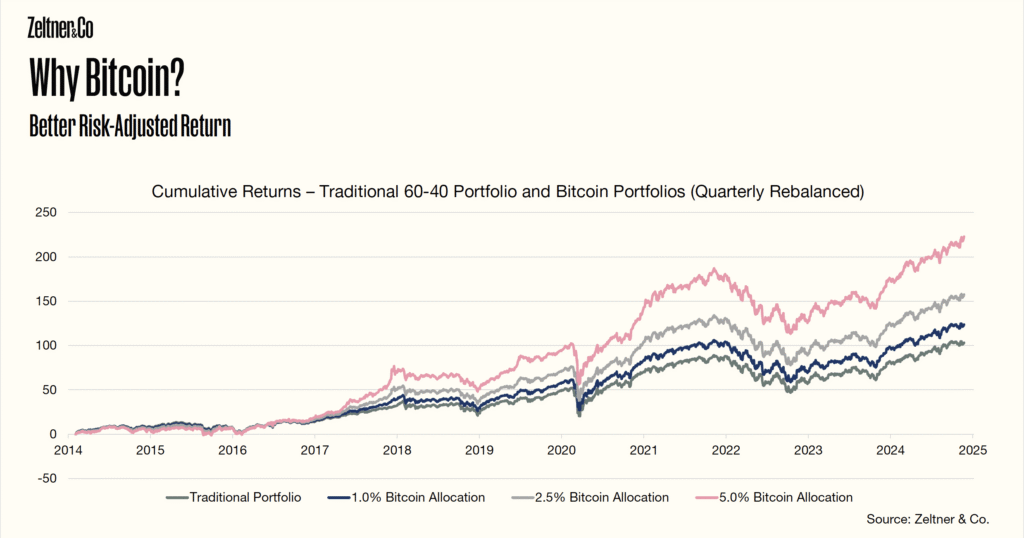
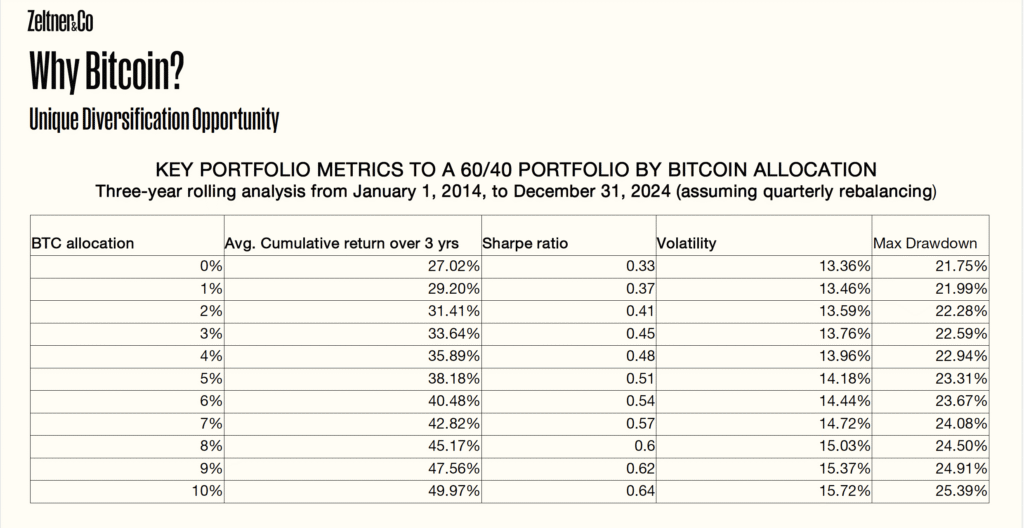
At the Zeltner & Co. investor breakfast in Zurich on September 25, we shared our analysis of a traditional 60/40 portfolio from 2014 onward:
The traditional 60/40 portfolio without Bitcoin returned 103%.
A portfolio with just 5% allocated to Bitcoin returned 223% over the same period.
In other words, a small Bitcoin allocation — quarterly rebalanced — more than doubled overall returns.
To test whether this only applies to early investors, we ran a rolling three-year analysis covering every investment window since 2014. The result? Every single three-year holding period for Bitcoin produced a positive return.
Even those who invested at the all-time high in November 2021 at $69,000 and held through a full three-year cycle would still have achieved a positive return, despite Bitcoin losing 77% of its value at one point during that period.
This consistency through time is what makes Bitcoin such a powerful addition to diversified portfolios.
The three-year rolling results table tells a simple story:
A 0% Bitcoin portfolio had an average 3-year return of 27%, with a max drawdown of 21.75%.
A 10% Bitcoin portfolio increased the average 3-year return to 50%, while only slightly raising the max drawdown to 25.4%.
The data is clear: Bitcoin improves return potential far more than it increases risk, thanks to its low correlation with traditional markets.
Two reasons why altcoins can complement Bitcoin allocations
After understanding Bitcoin’s role, the next question is: why invest in altcoins at all?
There are two key reasons — technology and seasonal performance cycles.
1️⃣ Technology
Altcoins expand the functionality of blockchain beyond Bitcoin’s base layer. There are certain use cases that Bitcoin’s design simply cannot fulfill, including:
Stablecoins, which provide price stability and are vital for on-chain commerce.
Trading and lending protocols, which form the backbone of decentralized finance (DeFi).
Each of these represents a new frontier of innovation — and potential value creation — that Bitcoin alone cannot capture.
2️⃣ Seasonal Patterns
Crypto markets tend to move in cycles. Historically, altcoins outperform Bitcoin during mid-cycle phases when liquidity expands and risk appetite increases.
For example, over the past 90 days, 25coins from the top 100 coins measured by market capitalization have outperformed Bitcoin, underscoring that we are currently in an altcoin rotation phase — what many refer to as the start of “Altcoin Season.” Altcoins in our portfolio, such as ETH with a 90-day return of +6.67% and Tron with a 90-day return of 2.81% have outperformed Bitcoin’s 90-day return of -6%.
Portfolio Example: Solana’s Growth
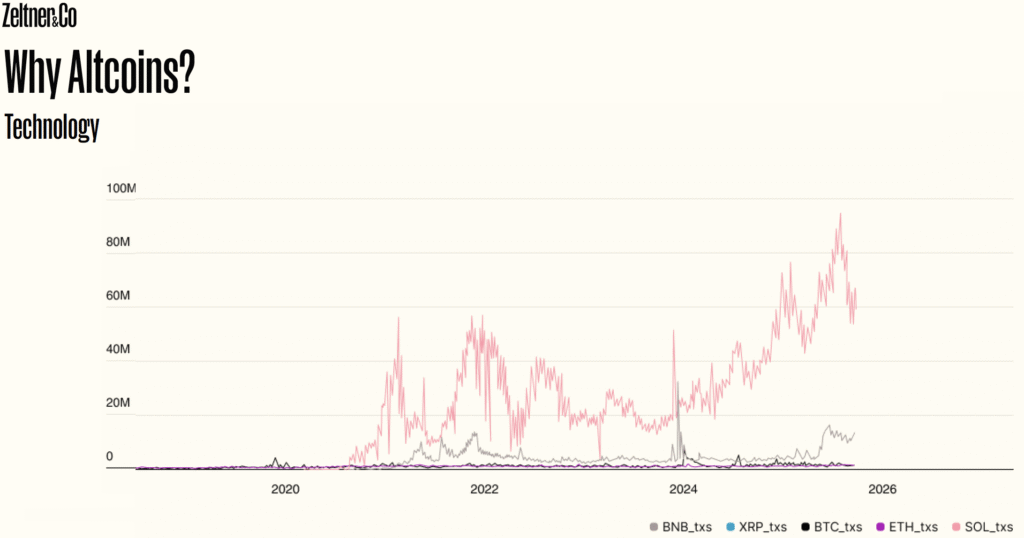
Take Solana, for instance. This is another example of an altcoin that has outperformed Bitcoin over the last 90 days. Bitcoin’s design prioritizes security and decentralization; however, that comes at the cost of transaction speed and cost. As a result, applications requiring fast, low-cost payments, such as on-chain trading and lending, have moved to more scalable blockchains like Solana.
In 2025, Solana processed 100 million non-governance transactions per day, representing many multiples more than Bitcoin. While Bitcoin has cemented its role as a store of value, altcoins such as Solana address different targetable markets, such as real-world asset tokenization and decentralized finance.
How Zeltner & Co. invests in cryptocurrencies: fundamental analysis with active management
Now that we’ve discussed why Bitcoin and why altcoins, let’s turn to the third and most practical question — why the Zeltner & Co. Cryptocurrency Frontier AMC?
The Zeltner & Co. AMC integrates fundamental analysis, active management, and a proven performance track record.
What Does Fundamental Analysis of Cryptocurrencies Mean?
In traditional finance, fundamental analysis means visiting firms in person and doing field research to glean new information about a particular company or investment.
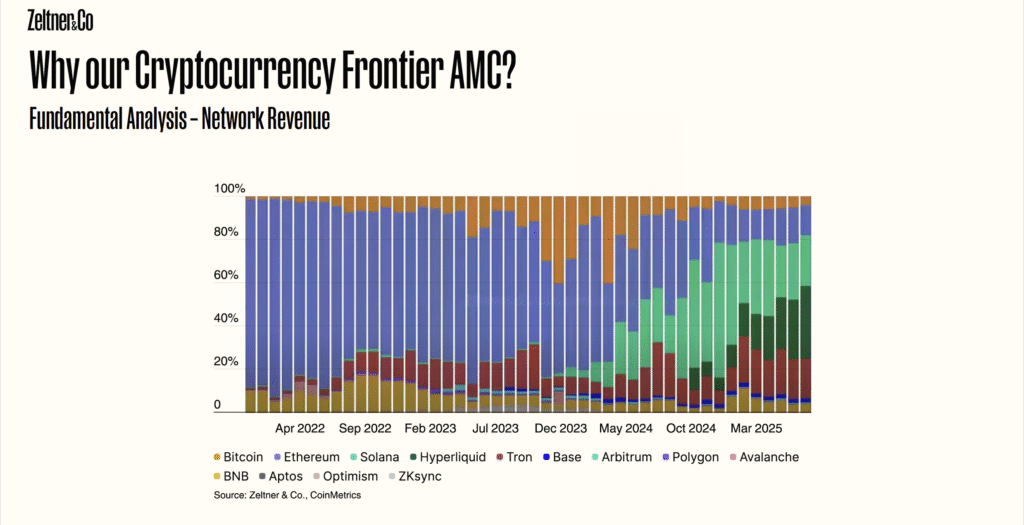
In crypto, it’s different. Zeltner & Co. analyzes on-chain and off-chain data to assess real economic activity — including:
Network revenue per chain
Economic transaction volume
Developer activity
Understanding the real-world economic use of a blockchain allows us to separate projects with real user demand from those driven by hype or speculation. One of the key charts to monitor is network revenue per chain. The data shows that Ethereum’s dominance in total network revenue is declining, while Solana’s share is growing significantly.
If you invest in a passive, market-cap-weighted strategy such as the 21Shares Crypto Basket 10 Core ETP, you would remain overweight Ethereum — a backward-looking approach that fails to capture where user activity and value creation are actually going.
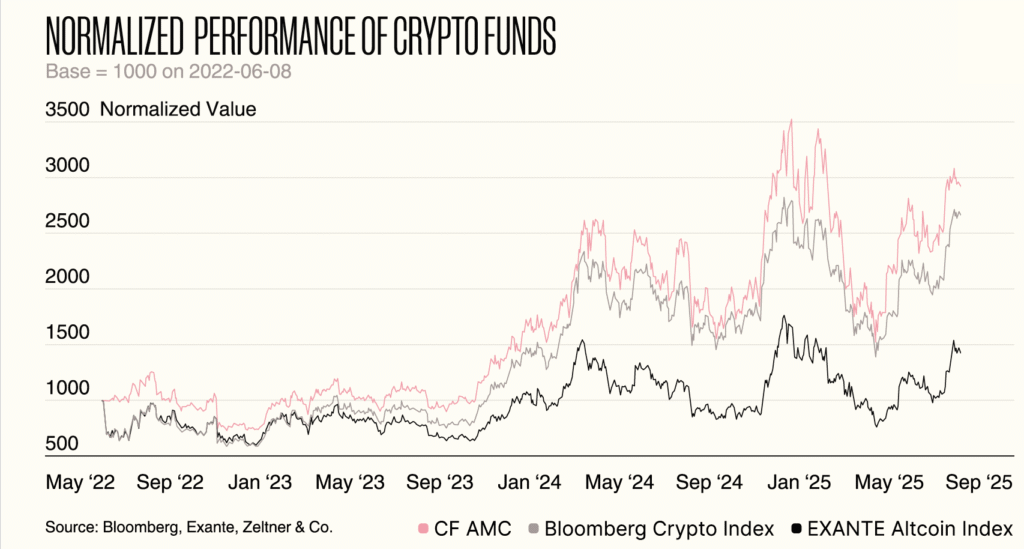
Zeltner & Co.’s active management strategy adapts to these shifts dynamically — overweighting the networks where growth is happening, not where it once was. Since the Cryptocurrency Frontier’s launch in June 2022, the AMC has delivered a +192.8% cumulative return, outperforming both the Bloomberg Crypto Index (+168%) and the EXANTE Altcoin Index (+42.3%) over the same period.
This outperformance is not a coincidence—it stems from proactive asset rotation and disciplined position sizing. During the 2025 cycle, Zeltner & Co. increased exposure to high-quality altcoins such as Solana, Chainlink, and Aave when on-chain revenue and developer metrics signaled strength. Conversely, they reduced risk in weaker projects when liquidity or activity declined.
The result has been smoother performance through volatile phases and stronger participation during market recoveries.
Even as Bitcoin remains the anchor of their portfolio, the alpha generation comes from understanding when and how to overweight emerging assets—an approach that few passive strategies can replicate.
Outlook
With Bitcoin’s dominance elevated and institutional adoption advancing, we expect continued dispersion between assets. That’s fertile ground for research-driven selection, risk budgeting, and disciplined execution—exactly the edge active management is designed to provide.
For qualified investors
To learn more about Cryptocurrency Frontier AMC, request the latest factsheet or book a 15-minute call with the Zeltner & Co. team at www.zeltnerco.com
Disclaimer
This article is provided for informational purposes only and does not constitute investment advice or an offer to buy or sell any financial instrument. Past performance is not indicative of future results. The Cryptocurrency Frontier AMC is available only to qualified investors under applicable Swiss regulations.
Gold is soaring while Bitcoin seems to be taking a breather, and this contrast might be more than just a market trend. It could be part of a bigger plan. A fascinating theory suggests that Washington might be allowing gold prices to rise to help manage U.S. debt and boost confidence in the dollar. The idea is that this is a temporary step before a shift towards Bitcoin as the ultimate global asset.
Key Takeaways
The current economic climate, with high U.S. deficits and shifting global trade, creates a need for monetary stability.
A theory proposes that revaluing gold could be a way for the U.S. to absorb inflation and restore confidence in the dollar.
This gold revaluation might be a precursor to Bitcoin becoming a more central part of the global financial system.
Stablecoins could be playing a role in bridging the gap, acting as a new form of petrodollar system.
Bitcoin’s current price action might be suppressed intentionally to allow this transition to unfold smoothly.
The Macroeconomic Storm
As of late 2025, the economic picture is pretty stark. The U.S. is facing record peacetime deficits, the Federal Reserve is cutting rates even as inflation remains sticky, and countries are buying fewer U.S. Treasuries than before. On top of that, global energy and trade are becoming more fragmented, with places like the Middle East, China, and India increasingly settling oil deals outside the dollar. This all puts a strain on trust in the U.S. financial system, which is the bedrock of the dollar’s strength.
Washington is in a tough spot. Raising interest rates could destabilize the massive national debt, but printing too much money erodes confidence. The strategy, according to this theory, is to buy time and quietly re-anchor the financial system. This involves using gold, an asset the U.S. holds a lot of, to soak up inflation and rebuild credibility, while keeping Bitcoin, which is outside of direct control, from disrupting the process.
The Petrodollar System’s Cracks
For decades, the dollar’s global dominance was tied to oil. Every barrel sold in dollars meant more demand for U.S. debt. But this system is showing signs of wear. Nations are looking for more neutral ways to trade. Macro analyst Luke Gromen points out that if the petrodollar system weakens, gold is the most likely asset to step in as a global currency for oil. He notes that the ratio of gold to oil has been increasing, and countries like India and China are already buying Russian oil with Chinese yuan. This suggests the petrodollar system is indeed facing significant challenges.
Gromen explains that if the U.S. can’t shrink its deficits without causing a debt spiral, it might have to inflate away its debt. This means the real value of U.S. Treasury bonds could decline. He suggests looking at the ratio of gold ETFs (GLD) to long-term Treasury ETFs (TLT) as an indicator, noting that gold is outperforming Treasuries significantly.
The Gold First Theory
This is where the "Gold First Theory" comes into play, largely developed by former Wall Street trader Josh Mandel. The idea is that the U.S. could re-anchor the dollar by revaluing its gold reserves. Currently, the U.S. holds about 8,100 tons of gold, officially valued at a price frozen since 1971. If this gold were valued at today’s market prices, or even higher to cover a significant portion of the U.S. monetary base, the Treasury’s liabilities would look much more manageable. Mandel’s calculations suggest revaluing gold to around $16,000 per ounce could cover about 75% of the monetary base. This would effectively reprice gold, restore confidence, and pave the way for the next phase of the dollar system – one that’s digital and global.
Stablecoins: The New Financial Lifeline
To manage this transition, stablecoins might be playing a key role. The U.S. administration seems open to stablecoins, potentially using them to fill the gap in demand for Treasury issuance. This could create a new petrodollar system, where dollar-backed stablecoins circulate globally, still supporting the Treasury market. Essentially, the U.S. can’t sell enough long-term debt at affordable rates, so it’s exporting short-term debt through these digital dollars. This buys time while gold’s value increases.
The Bridge to Bitcoin
If stablecoins are the bridge, Bitcoin is seen as the end goal – a truly neutral asset outside any single nation’s control. Luke Gromen suggests that individuals should consider holding a portion of their wealth in both gold and Bitcoin. He believes that while Bitcoin might outperform gold in the long run, both are necessary to navigate the current monetary challenges. He likens owning gold and Bitcoin to building an ark to get through a monetary flood.
Gold’s Role in U.S. Debt
Luke Gromen further analyzes the relationship between U.S. gold reserves and foreign-held U.S. Treasuries. He points out that the market value of U.S. gold reserves currently covers only about 11% of foreign-held debt. Historically, this figure has been much higher, reaching 20% in the late 1980s and averaging around 40%. For gold to simply return to its long-term average, it would need to quadruple in price, reaching $15,000 to $16,000 per ounce. This suggests that the current gold rally might be a form of debt devaluation disguised as a bull market, potentially setting the stage for a monetary reset.
The Future of Money: Gold and Bitcoin
This theory helps explain why Bitcoin’s price might be suppressed. If gold is being allowed to rise to stabilize the system, Bitcoin’s volatility might be intentionally dampened. The massive liquidation event in crypto recently, occurring on a low-liquidity Friday just as gold hit new highs, could be seen as a deliberate move to keep Bitcoin’s price steady. The narrative is controlled: gold rebuilds confidence, and then the system pivots towards Bitcoin.
However, there’s another perspective: perhaps Bitcoin’s price action is simply a rotation of capital, with investors moving into gold and equities, believing the crypto cycle has peaked. Regardless of the reason, gold is doing the heavy lifting now, but Bitcoin remains the ultimate escape hatch when trust in other assets collapses. Unlike gold, which can be repriced by decree, Bitcoin cannot. It settles itself, making it the logical endpoint of this monetary realignment.
A Controlled Transition?
Whether this gold revaluation is a deliberate strategy or not, the incentives are clear. The U.S. has a strong reason to revalue its gold holdings before fully embracing an asset it can’t control. If gold repairs the balance sheet, Bitcoin can secure the future. Signs of this shift are already appearing: record global Bitcoin hash rates suggest large-scale mining, the U.S. government is acquiring seized Bitcoin, and even political figures are showing interest in Bitcoin. The limited supply of 21 million Bitcoin means every player in the global financial game is starting to recognize its importance. Gold might be the state’s ark, but Bitcoin is humanity’s.
MusiKhan, a native Tune-to-Earn mini app built on Telegram and powered by HanChain, connects legally verified music copyrights with blockchain-based utility. Through staking, streaming, and performance-driven rewards, it transforms music into a real-world asset class within the decentralized economy.
Recently, MusiKhan achieved several significant milestones that strengthen its position within the TON ecosystem.
The project was approved for the TON Nest Grant Program, a recognition that validates MusiKhan’s technological capabilities and its potential to contribute to the broader TON ecosystem. MusiKhan has also secured a grant from STON.fi, further reinforcing its role as a key innovator within TON’s DeFi landscape. Together, these grants highlight the project’s credibility as one of the pioneers bringing real-world music copyrights into Web3.
Alongside these achievements, MusiKhan has been officially listed in Telegram App Center’s Staking Section. This milestone expands MusiKhan’s visibility to millions of global Telegram users, providing direct access to a growing audience already engaged with TON-based services.
These accomplishments mark a new chapter for MusiKhan as it continues to grow its catalog of exclusive Web3 music assets and solidify its role as a core player in TON’s emerging DeFi and content ecosystem.
The rise of cryptocurrencies and blockchain technology has brought new challenges in verifying online identities. With bots and artificial intelligence becoming more sophisticated, simply using CAPTCHAs is no longer sufficient. New solutions are emerging to reliably distinguish real human users from bots and fake accounts. Being able to prove you are human is becoming critical in the world of crypto.
The Threat of Bots and Synthetic Identities
Bots have become ubiquitous on social media, in online games, and across the internet. They are used for spreading misinformation, artificially inflating follower counts, conducting coordinated attacks, and unfairly winning competitions or earning rewards. With advancements in AI, bots are now capable of convincingly mimicking human behavior.
Synthetic identities, or fake accounts controlled by bots, are also used for nefarious purposes like scamming and manipulating markets. On blockchain platforms, these fake accounts can be used to game incentives, extract value, and attack protocols. Reliably determining whether an account is run by a real human is critical.
CAPTCHAs and Beyond
CAPTCHAs have been the go-to solution for distinguishing humans from bots online. Users are presented with tasks like identifying distorted text or objects in images, which are easy for humans but difficult for bots. However, modern AI can now solve many CAPTCHA challenges with high accuracy. More advanced proof-of-human tests are required.
Some solutions use behavioral analysis and machine learning to detect patterns characteristic of bots and flag suspicious accounts. However, these methods are imperfect and it can be challenging to keep up with evolving bot tactics.
Cryptographic Approaches
More robust cryptographic approaches are emerging to address the limitations of CAPTCHAs and purely AI-driven solutions. These introduce cryptographic challenges that require a human to be present to solve.
For example, World ID uses what’s called an Orb to capture images of the user’s face and eyes and generate a unique iris code. This iris data is immediately encrypted and sent to the user’s phone, and then it is deleted from the Orb. The iris code is processed through advanced anonymization techniques to create a cryptographic proof of being human without retaining any personal biometric data. This allows verification of unique humanity while preserving privacy.
This process is designed to confirm users are unique, real humans, not to identify them. The decentralized and open source nature of systems like World ID will also allow the challenges to adapt to evolving threats of bots and synthetic identities.
Tradeoffs and Considerations
There are still challenges and tradeoffs involved in identity verification systems. Convenience and accessibility need to be balanced with security. Some cryptographic approaches require purchasing additional hardware, which poses adoption challenges.
Protecting user privacy is also critical, as biometric data could be exploited for surveillance. Systems use zero-knowledge cryptography to preserve privacy. The human challenges remain robust while minimizing data collection. As AI advances, new identity verification systems are required to distinguish real human users from bots and synthetic identities. CAPTCHAs alone are no longer sufficient as bots become more sophisticated. Emerging cryptographic proof-of-human approaches introduce challenges that are easy for humans but difficult for bots. With careful consideration of tradeoffs, decentralized identity platforms may enable reliable identification while protecting user privacy.
To maintain leadership in the rapidly changing altcoin industry, real-time accurate information is essential. AltcoinBeacon establishes itself as the essential resource for crypto investors who want timely altcoin information alongside thorough research and expert market analysis.
Due to its dependable editorial standards and consistent delivery of accurate information, AltcoinBeacon continues to guide investors safely throughout the intricate digital asset ecosystem.
The contemporary crypto marketplace requires investors to understand more than simple trends about popular coins for achieving success. Investors need detailed understanding of new altcoin projects and blockchain technology developments as well as current regulatory changes to make informed decisions.
AltcoinBeacon solves the essential problem by offering prompt and reliable information which enables readers to understand current trends and maintain preparedness for smart investment choices.
According to Syed Ali Haider who serves as Senior Editor at AltcoinBeacon, “Modern crypto investors aren’t satisfied with basic headlines.” Investors want specific actionable information that helps them anticipate risks while receiving analysis which reflects market dynamics.
Journalists at Altcoin Beacon provides readers with live market intelligence through their commitment to both precise reporting and deep analytical capabilities.
What Makes AltcoinBeacon Different?
The primary distinction of AltcoinBeacon stems from its primary focus of the entire altcoin sector. Readers will find complete information through the platform about new token launches as well as important regulatory changes and blockchain technological breakthroughs and groundbreaking partnerships.
The research articles of the publication provide in-depth analysis of important trends including DeFi innovations, NFT integrations throughout different ecosystems and Layer 2 blockchain solutions becoming increasingly prominent. All content undergoes strict fact-checking procedures, so investors receive the most dependable information for their strategy development.
AltcoinBeacon distinguishes itself from other platforms since it operates in an industry where false information often misleads users. While sensationalism drives less trustworthy platforms AltcoinBeacon upholds journalistic integrity by delivering supported analysis to readers during all market conditions including volatile periods. Through this approach investors gain better education while receiving protection from fraudulent crypto activities that still affect the space.
A Commitment to Investor Empowerment
The main objective of Altcoin Beacon remains to empower investors through its platform. The platform provides detailed market explorations along with real-time reporting to help readers develop essential knowledge for successful altcoin market participation.
AltcoinBeacon serves as an authoritative guide that helps investors who are experienced or new to digital assets to safely explore the fast-evolving world of digital assets. The platform’s dedication to clear explanations and expert insights combined with its relevance has earned it worldwide recognition as a respected authority among investors.
About AltcoinBeacon
AltcoinBeacon functions as a top crypto news outlet which delivers real-time unbiased expertly researched information about the altcoin market. AltcoinBeacon stands as the trusted authority for digital asset exploration beyond Bitcoin because of its commitment to precise research and deep market understanding and investor empowerment practices.
ABD Systems, a company with over 13 years of experience in IT solutions, recently announced that its new crypto project, the ABDS Token, successfully completed KYC verification through CertiK, earning high recognition in the process. This achievement wasn’t just the standard KYC check but was done with special distinction.
The ABDS Token, a new crypto project focused on making digital finance simpler, safer, and more accessible, recently reached a significant milestone by earning the highly coveted CertiK Gold Badge.
This achievement marks a big step forward for ABD Systems, the company behind the project, and its growing user base. It enhances trust and positions the project as a credible player in the crypto industry.
The CertiK Gold Badge is the highest level of certification that this well-recognized company can offer, awarded only to projects that meet the strictest security and transparency standards.
By achieving this, ABDS Token has demonstrated its strong commitment to following rigorous Know Your Customer (KYC) verification procedures. These procedures involve a comprehensive review of the team behind the project, ensuring their legitimacy and dedication to maintaining a secure platform.
For investors and users alike, this level of scrutiny offers reassurance that ABDS Token is trustworthy and built on a solid foundation of accountability.
Moreover, this recognition is particularly important as it strengthens the project’s credibility at a time when trust is a critical factor in the industry. Further, this distinction solidifies the project’s position and reassures the community that it is managed by a reliable team with a proven track record.
Besides, the timing of this achievement couldn’t be better, as ABDS Token was recently listed on well-known exchanges like MEXC, BitMart, LBank, and DigiFinex, with more listings expected soon. The CertiK Gold Badge only adds to the momentum, making it easier for the project to attract new investors and partners.
What’s ABDS Token and How This Secure and Accessible Solution for Digital Finance Has Got the Attention of So Many People
ABDS Token, built on the Ethereum blockchain, offers a unique blend of top-tier digital security and personalized support.
What truly makes ABDS Token stand out is its focus on making digital finance more approachable and user-friendly. Unlike many crypto projects that operate only in the digital realm, ABD Systems goes a step further by providing a secure token and in-person support at its physical locations.
Also, ABDS Token integrates seamlessly into the broader ABD Systems ecosystem, offering various real-world uses. It enables users to make payments for products and services, unlock premium features within the network, and participate actively in the platform’s governance.
Additionally, those looking to maximize their investment can stake their tokens to earn rewards, further enhancing the token’s appeal.
About ABD Systems
ABD Systems was founded in 2009 by two visionary entrepreneurs. They started with an ambitious goal: to become a leading technology company in their home country.
Over time, the company has grown into a major force in the IT sector, driven by a strong focus on innovation, collaboration, and continuous growth.
What sets ABD Systems apart is its dedicated team, working together to tackle challenges and achieve collective success.
The company’s mission is rooted in creating a future without limits. Its core values also guide ABD Systems in developing cutting-edge technologies and simplifying processes that positively impact society and local communities. Thus, its commitment to excellence is especially evident in its wide range of products and services tailored to citizens and government sectors.
With the recent launch of the ABDS Token, ABD Systems is taking its tradition of innovation to the world of digital finance. Their goal is to build a more inclusive and secure financial environment for everyone, further solidifying their position as a forward-thinking leader in technology.
Contact
To learn more about ABD Systems, check out the ABDS Token, and stay updated on future distinctions they’ll have by visiting the official website. Moreover, you can follow them on X (formerly Twitter) to stay updated on the latest news and developments.
As Bitcoin transitions from a niche interest to a mainstream financial asset, various investment avenues have emerged beyond direct purchase. This article explores the expanding landscape of Bitcoin ownership, including ETFs, ETPs, and Trusts, reflecting its growing acceptance. According to the 2023 Global Crypto Hedge Fund Report by PwC, CoinShares, and AIMA, spot trading in crypto-assets has surged, with 69% of hedge funds participating, up from 43% the previous year. The report also highlights a decline in derivative investments due to counterparty risks. This article examines these trends and the performance of digital asset funds, offering insights into the evolving strategies of crypto hedge funds.
From a niche for blockchain enthusiasts, Bitcoin continues to grow and gain acceptance as a mainstream financial instrument. As the adoption has risen, different ways are arising to own the asset other than the traditional way of buying the asset directly such as ETFs, ETPs, Trusts, etc.
According to the 5th Annual Global Crypto Hedge Fund Report (2023) by PwC, CoinShares, and AIMA, over two-thirds (69%) of all participants in the survey are engaging in crypto-asset investments through spot trading, a notable increase from 43% in the previous year’s report. The survey was conducted in Q1 2023 across a sample of 131 crypto-native hedge funds.
In contrast with directly investing in the spot market of cryptocurrencies, several alternatives exist such as derivatives, venture capital, and structured products. According to the PwC report, the proportion of respondents investing in crypto-assets via derivatives declined to 38% in 2023, down from 52% in 2022, possibly due to a heightened awareness of risks associated with counterparties such as Genesis and FTX.
91% of Digital Asset Funds are Invested in Bitcoin
Source: PwC, CoinShares, AIMA
The majority of crypto hedge funds performed significantly better than the price of BTC during 2022. While Bitcoin’ performed -64% from 31 December 2021 to 31 December 2022, most strategies handled the bear market better than the benchmark (with the exception of fund of funds).
Digital Asset Fund Performance by Strategy 2022
Source: PwC, CoinShares, AIMA
Regarding investment strategies, 31% of respondents in 2023, up from 2022’s 10%, are taking a passive approach. The complexity of the technology in this sector can be challenging for those not deeply immersed in it. Consequently, a growing number of fund managers seem to be opting for passive strategies to access this market despite passive strategies returning a loss of 37% on average in 2022.
In the realm of hedge funds, 23% report utilizing actively managed funds or funds of funds for their crypto-asset investments. Additionally, 15% indicate their involvement through venture capital investments in this sector.
For investors that want exposure to Bitcoin without handling their own private keys, there are several alternatives such as passive funds, active funds, mining stocks, and venture capital. This section dives into some of the household names in the Bitcoin ecosystem.
Assets Under Management of Largest Bitcoin Passive Products
#
Fund
AUM ($)
Inception Date
Expense Ratio
Domicile
1
Grayscale Bitcoin Trust (GBTC)
Grayscale is the world’s leading crypto asset manager in assets under management with around $24 billion just under their Bitcoin Trust. It has similar trust for other cryptocurrencies like Ethereum, Litecoin, Solana, etc. The investors are issued shares against the capital they invest and the trust purchases BTC with the invested money. The price of a share reflects the value of Bitcoin held per share. However, the price of a share may not reflect the true value of the Bitcoin held as it may be sold at a premium or discount. Additionally, it is not available for exchanges and only over-the-counter (OTC).
$24.05B
25/09/2013
2.0%
United States
2
Purpose Bitcoin ETF (BTCC) BTCC is the world’s first and largest spot Bitcoin ETF with $1.4 billion in assets under management. Based out of Canada, it provides investors an opportunity to own BTC without going through the hassle of creating an account or wallet for purchasing Bitcoin.
$1.4B
09/11/2021
1.49%
Canada
3
ETC Group Physical Bitcoin (BTCE) Based out of Germany, BTCE is the largest spot Bitcoin ETP in Europe with $1.04 billion in assets under management. It is also the first European Bitcoin ETP to offset its carbon emissions. 100% physically backed by Bitcoin, it offers the investors an alternative to selling on the exchange by letting them redeem the ETP for actual Bitcoin.
$1.04B
08/06/2020
2.0%
Germany
4
XBT Provider Bitcoin Tracker Euro (COINXBE) Launched in 2015, XBT Bitcoin ETP is the world’s first Bitcoin-based security available on a regulated exchange, allowing for convenient exposure to the leading digital asset. Based out of Sweden, it has $778 million in assets under management and it closely tracks the price of actual Bitcoin.
$778M
18/05/2015
2.5%
Sweden
5
CoinShares Physical Bitcoin (BITC) CoinShares physical Bitcoin ETP offers investors a straightforward alternative to directly buying Bitcoin. Domiciled in Jersey, it has $531 million in assets under management. Users can also redeem the fund units for actual Bitcoin.
$531M
19/01/2021
0.98%
Jersey
6
21Shares Bitcoin ETP (ABTC) 21Shares Bitcoin ETP (ABTC) is 100% physically backed by BTC. It tracks the performance of BTC and offers investors a simple and secure way to gain BTC exposure in their portfolio. Based out of Switzerland, it has $519 million in assets under management.
The evolving landscape of Bitcoin investment reflects its growing stature in the financial world. This article has delved into various investment options, from direct purchases to sophisticated financial products like ETFs, ETPs, and Trusts. The insights from the 2023 Global Crypto Hedge Fund Report reveal a noticeable shift towards spot trading among hedge funds, indicating a preference for simplicity amid complex market conditions. Conversely, the decline in derivative investments underscores heightened risk awareness. As fund managers adapt, exploring passive and active strategies, the crypto investment domain continues to reshape, promising diverse opportunities and challenges for investors keen on leveraging Bitcoin’s potential.