

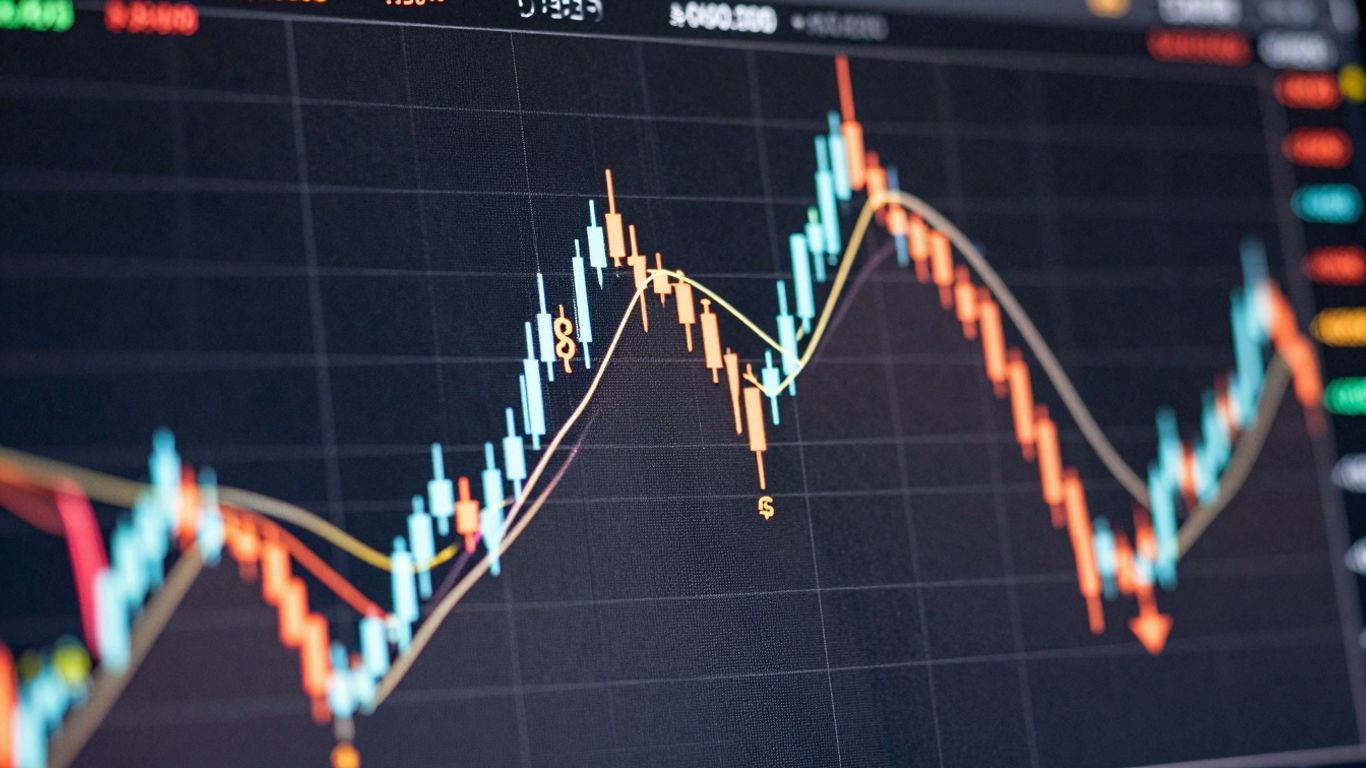

So, you’re looking into the coin volatility index and wondering what it’s all about for your investments. It sounds complicated, but really, it’s just a way to measure how much prices are jumping around. Think of it like checking the weather before a trip – you want to know if it’s going to be calm or stormy. Understanding this index helps you get a feel for the risk involved with different digital coins and how they might act in your portfolio. We’ll break down what it means and why it matters for anyone putting money into crypto.
Key Takeaways
- The coin volatility index helps measure how much an asset’s price is expected to move.
- Understanding volatility is key to assessing the risk and potential rewards of any investment.
- Historical volatility looks at past price swings, while implied volatility tries to predict future ones.
- Tools like Bollinger Bands and Average True Range can help you see volatility in action.
- Managing your portfolio means considering how volatile assets like Bitcoin might affect your overall holdings.
Understanding The Coin Volatility Index

When we talk about the price of a cryptocurrency, like Bitcoin or Ethereum, we often hear about how much it moves around. That’s basically what volatility is all about. It’s a way to measure how much and how quickly the price of an asset swings up and down over a specific time. Think of it like the difference between a calm lake and a stormy sea; the sea is much more volatile.
Defining Market Volatility
Volatility in financial markets refers to the degree of variation in trading prices over time. For cryptocurrencies, this can be quite pronounced. A highly volatile asset sees its price change dramatically over short periods, while a low-volatility asset tends to be more stable. This fluctuation is a key characteristic that investors and traders pay close attention to. Volatility measures the degree of price fluctuation over time, aiding in risk and opportunity assessment.
Historical Versus Implied Volatility
There are two main ways we look at volatility:
- Historical Volatility (HV): This looks backward. It’s calculated using past price data to see how much the price actually moved. It tells you what happened.
- Implied Volatility (IV): This looks forward. It’s derived from the prices of options contracts and gives an idea of what the market expects to happen with price swings in the future. It’s more about expectations.
The Significance Of The Coin Volatility Index
The Coin Volatility Index (CVI), or similar measures, aims to give investors a snapshot of expected future volatility in the cryptocurrency market. It’s not just about looking at past price charts; it’s about trying to gauge the market’s current mood and its anticipation of future price swings. This index can be a useful tool for:
- Assessing the overall risk level in the crypto market.
- Identifying potential trading opportunities that arise from significant price movements.
- Understanding the general sentiment and uncertainty among market participants.
A rising CVI might suggest that traders expect larger price swings in the near future, perhaps due to upcoming news or general market uncertainty. Conversely, a falling CVI could indicate a period of relative calm or consolidation. This forward-looking aspect makes it different from simply looking at historical price charts.
Understanding volatility helps investors gauge risk. High volatility can mean bigger potential gains, but also bigger potential losses. It’s a double-edged sword that requires careful consideration in any investment strategy. For instance, a rising CVI might suggest that traders expect larger price swings in the near future, perhaps due to upcoming news or general market uncertainty. Conversely, a falling CVI could indicate a period of relative calm or consolidation. This forward-looking aspect makes it different from simply looking at historical price charts. You can find real-time data on many crypto price tracking sites.
Quantifying Cryptocurrency Price Swings
To really get a handle on how much a cryptocurrency’s price can jump around, we need to look at some numbers. It’s not just about saying "it’s volatile"; it’s about measuring that volatility. This helps us understand the risk involved and spot potential chances to trade. Understanding this volatility is crucial for investors to assess the risk and potential associated with their investments in cryptocurrencies.
Measuring Price Fluctuations Over Time
First things first, you need the actual price history for the crypto you’re interested in. This usually means getting the closing price for each day over a specific stretch of time, like the last 30 or 60 days. The more data you have, the better picture you get, but you have to start somewhere. Once you have the prices, the next step is to figure out the daily percentage change. This is called the daily return. You do this by comparing today’s closing price to yesterday’s. After you’ve calculated all the daily returns for your chosen period, you find the average of these returns. This gives you a baseline for the typical daily movement.
Now, we need to see how much those daily returns actually bounced around that average. That’s where standard deviation comes in. It’s a way to measure how spread out your data points (the daily returns) are from the average. A higher standard deviation means the prices swung much more wildly on a day-to-day basis compared to the average. This number is a key indicator of how unpredictable the price has been.
Here’s a simplified look at the process:
- Collect Daily Closing Prices: Get the price data for your chosen cryptocurrency over your selected timeframe.
- Calculate Daily Returns: Find the percentage change from one day’s close to the next.
- Compute Average Daily Return: Sum up all the daily returns and divide by the number of days.
- Determine Standard Deviation: Measure how far each daily return deviates from the average return.
Standard deviation gives you a snapshot of how much prices have moved around their average on a given day or week. But markets don’t just move in daily or weekly chunks; they operate over months and years. To compare volatility across different timeframes or assets, we need to annualize it. This process scales up the shorter-term standard deviation to represent what it might look like over a full year. For assets traded daily, like most cryptocurrencies, we typically use 365 days. This standardization allows for a more apples-to-apples comparison.
This quantitative approach is what allows us to move beyond subjective feelings about market ups and downs and instead use concrete figures to understand Bitcoin volatility and other digital assets.
The Role Of Volatility In Asset Pricing
Volatility isn’t just about numbers; it’s also a reflection of how people feel about an asset or the market as a whole. When there’s a lot of uncertainty, news that causes fear, or major economic events, volatility tends to increase. This is because investors are reacting strongly, buying or selling in large numbers based on their emotions and expectations. High volatility can signal that the market is unsure about the future direction of an asset. Conversely, low volatility might suggest that investors are confident and the market is stable. When prices are swinging wildly, it often means there’s a lot of disagreement or uncertainty among market participants about an asset’s true value or future prospects. This can be driven by anything from new regulations to technological breakthroughs or even just widespread rumors. While Bitcoin has historically shown significant price swings, its volatility has actually started to decrease as the market matures. Many trading websites also show volatility information easily, helping traders understand these price movements.
| Time Period | General Volatility Level |
|---|---|
| Early Years (e.g., 2010-2013) | Extremely High |
| Mid-Life (e.g., 2014-2018) | High, but decreasing |
| Recent Years (e.g., 2019-Present) | Moderately High, stabilizing |
This trend shows that while crypto remains a volatile asset, its behavior is evolving as the market matures. When thinking about adding cryptocurrencies like Bitcoin to an investment mix, it’s not just about how much Bitcoin itself swings around. What really matters is how those swings affect the overall risk of your entire portfolio. Historically, Bitcoin hasn’t moved in lockstep with traditional assets like stocks and bonds. This lack of strong correlation means that adding Bitcoin can sometimes act like a bit of a shock absorber for your portfolio. However, if you put a really big amount of money into Bitcoin, its own high volatility can start to dominate your portfolio’s risk profile. But when the Bitcoin part of your portfolio is kept at a more modest size, its tendency to move independently can offer some diversification benefits.
Historical Versus Implied Volatility
When we talk about how much a cryptocurrency’s price might move, there are two main ways to look at it: historical volatility and implied volatility. They give us different pieces of the puzzle, and understanding both is pretty important for traders.
Analyzing Past Price Movements
Historical volatility, often called HV, is all about looking backward. We calculate it using the actual price data from the past. It tells us how much the price of an asset did move over a certain period. Think of it like checking the weather report from last week to see how stormy it was. It’s a factual measure of past price swings. We can look at daily, weekly, or monthly price changes to get a sense of how choppy the waters have been.
Forecasting Future Price Expectations
Implied volatility, or IV, on the other hand, is about looking forward. It’s not directly calculated from past prices. Instead, it’s derived from the prices of options contracts. These options prices reflect what the market expects to happen with price swings in the future. So, if options are expensive, it suggests the market anticipates bigger price moves. It’s like asking a bunch of people what they think the weather will be like next week and using their opinions to make a forecast. Implied volatility is essentially the market’s consensus on future uncertainty.
Divergence Between Historical And Implied Measures
Sometimes, historical and implied volatility can tell different stories. For example, if prices have been pretty calm lately (low historical volatility), but options prices are high, it might mean traders are expecting some big news or event to shake things up soon. Conversely, if prices have been wild (high historical volatility), but options are cheap, the market might be settling down or not expecting much action ahead.
Here’s a quick breakdown:
- Historical Volatility (HV):
- Measures past price movements.
- Calculated from actual historical price data.
- Tells you what has happened.
- Implied Volatility (IV):
- Measures expected future price movements.
- Derived from options contract prices.
- Tells you what the market thinks will happen.
Understanding the difference helps traders gauge whether current market conditions are calm but expected to become turbulent, or if recent turbulence is likely to subside. It’s about comparing what has been with what might be.
Key Volatility Indicators For Crypto Trading

When you’re trading cryptocurrencies, you can’t just ignore how much the prices jump around. That’s where volatility indicators come in. They’re like your dashboard for understanding how wild the market is getting. Think of them as tools that help you see if prices are likely to make big moves soon, or if things are pretty calm.
Bollinger Bands Explained
Bollinger Bands are pretty neat. They show a price range, with an upper and lower band, and a middle band that’s usually a simple moving average. When the crypto market gets really active and prices swing a lot, these bands stretch out. If things calm down, they pull closer together. This expansion and contraction gives you a visual cue about the current level of volatility. It helps traders spot potential shifts in market momentum.
Average True Range (ATR) Utility
The Average True Range, or ATR, is another useful one. It measures the degree of price volatility by looking at the average range of price movement over a set period. Unlike some indicators that just look at price direction, ATR focuses purely on how much prices are moving, up or down. A higher ATR means prices are moving more, suggesting higher volatility. It’s great for setting stop-loss orders or understanding how much risk you might be taking on.
Other Relevant Volatility Metrics
There are other ways to get a feel for volatility too. The Commodity Channel Index (CCI) can signal when a crypto asset might be overbought or oversold by comparing its current price to its average price over time. When CCI goes above +100, it suggests prices are much higher than average, and below -100 means they’re much lower. While not strictly a volatility measure like ATR, its extremes can often coincide with periods of increased price swings.
Understanding these indicators isn’t about predicting the future with certainty. It’s about getting a better sense of the market’s current state and potential for movement. This helps you make more informed decisions about when to enter or exit trades, and how much risk you’re comfortable with.
Here’s a quick look at how some of these indicators can be used:
- Bollinger Bands: Look for price touching or breaking outside the bands, especially when bands are narrow (low volatility) followed by a sharp expansion (high volatility).
- ATR: Use a rising ATR to suggest increased risk and potentially wider profit targets, or a falling ATR to indicate a calmer market.
- CCI: Extreme readings (+100 or -100) can sometimes precede periods of significant price movement, signaling potential shifts in market sentiment.
Interpreting The Coin Volatility Index
So, you’ve got this Coin Volatility Index (CVI) thing, and you’re wondering what it actually tells you about the crypto market. It’s not just a number; it’s a way to get a feel for how much prices are expected to jump around. Think of it like checking the weather forecast before you plan a trip – you want to know if it’s going to be calm or if there’s a storm brewing. Understanding this index helps you get a better sense of the risk involved with different digital coins and how they might behave in your portfolio.
Assessing Market Risk Levels
The CVI gives you a snapshot of the market’s expected turbulence. A higher index reading usually means traders anticipate bigger price swings, which translates to higher risk. Conversely, a lower reading suggests a period of relative calm. This forward-looking aspect is what makes it different from just looking at past price charts. It’s about what the market thinks might happen next.
- High CVI: Indicates expected significant price movements, implying higher risk and potential for larger gains or losses.
- Low CVI: Suggests anticipated smaller price fluctuations, pointing to lower risk and potentially more stable price action.
- Rising CVI: Often signals increasing market uncertainty or anticipation of significant events.
- Falling CVI: Can indicate a market settling down or a lack of major upcoming catalysts.
The CVI acts as a barometer for market sentiment regarding price fluctuations. It helps traders gauge the general mood and the level of uncertainty present in the cryptocurrency space.
Identifying Trading Opportunities
When the CVI shows a significant increase, it can signal that opportunities for profitable trades might be emerging. Big price swings, while risky, can also lead to substantial percentage returns if a trader can correctly predict the direction. For instance, if the CVI is rising sharply, it might be a sign that a major price move is on the horizon, prompting traders to look for entry or exit points. This is where understanding the Crypto Fear and Greed Index can also be helpful, as extreme fear or greed often correlates with high volatility.
Reflecting Market Sentiment And Uncertainty
Beyond just price action, the CVI reflects the collective expectation of market participants. When the index is high, it suggests that traders are feeling uncertain or are anticipating major news or events that could impact prices. This uncertainty can stem from regulatory news, technological developments, or macroeconomic factors. A low CVI, on the other hand, might indicate a market that is more complacent or has already priced in known information, leading to less dramatic price action.
Strategic Application Of Volatility Insights
Tailoring Strategies For Different Volatility Levels
Understanding how volatile the crypto market is right now helps you pick the right approach. When things are really jumpy, meaning high volatility, you might want to consider strategies that can handle big price swings. Think about shorter-term trades or using stop-losses more aggressively to protect your capital. On the flip side, during calmer periods with low volatility, you might look at strategies that aim for slower, steadier gains, perhaps involving longer holding periods or different types of trades that benefit from less price movement.
Here’s a general idea:
- High Volatility: Focus on quick entries and exits, tighter risk management, and potentially profiting from sharp moves. This could involve scalping or swing trading.
- Medium Volatility: Strategies that balance risk and reward, perhaps trend following with wider stop-losses, or options strategies that benefit from moderate price action.
- Low Volatility: Strategies that might involve range trading, looking for assets that are consolidating, or even income-generating strategies like covered calls if applicable.
The key is not to force a strategy onto a market that isn’t suited for it. Trying to scalp in a low-volatility market is usually a losing game, just like trying to hold a long-term trend trade during extreme choppiness can be.
The market’s mood, as indicated by volatility, dictates the most effective trading playbook. What works wonders in a bull run might be a recipe for disaster in a bear market or a sideways chop.
Integrating Volatility With Other Technical Indicators
Volatility indicators, like the Coin Volatility Index (CVI), are rarely used in isolation. They work best when you combine them with other tools that give you different pieces of the market puzzle. For instance, you might look at a trend indicator to see the general direction of prices and then use a volatility indicator to gauge how strong or likely that trend is to continue or reverse. If a trend indicator suggests an uptrend, but the volatility index is showing a sharp increase, it might signal a potential exhaustion point or a sharp correction is coming. Conversely, a steady or decreasing volatility index during an uptrend could suggest a healthy, sustainable move.
Consider these combinations:
- Volatility + Trend Indicators (e.g., Moving Averages): Confirming the strength and potential longevity of a trend. High volatility during a trend might mean it’s strong, or it could mean it’s about to reverse.
- Volatility + Momentum Indicators (e.g., RSI): Identifying potential overbought or oversold conditions that are more likely to lead to a reversal when volatility is high.
- Volatility + Volume Indicators: High volume accompanying high volatility often confirms strong conviction behind price moves, while low volume with high volatility can be a warning sign of a potential fakeout.
Risk Management In Volatile Markets
Volatility is directly linked to risk. When prices swing wildly, the potential for both profit and loss increases dramatically. Therefore, managing risk becomes paramount. This means having a clear plan for how much you’re willing to lose on any given trade (your stop-loss level) and sticking to it. It also involves position sizing – not putting too much of your trading capital into a single trade, especially when the market is unpredictable. A high CVI might prompt you to reduce the size of your positions or even sit out of the market until conditions become more predictable. Prudent risk management is the bedrock of surviving and thriving in the often-turbulent cryptocurrency space.
Comparing Crypto Volatility To Traditional Assets
Bitcoin’s Volatility Trajectory
When you look at Bitcoin, it’s pretty clear it’s had some wild rides. When it first showed up, prices could jump or drop by huge amounts really fast. This is pretty typical for new markets where everyone’s still trying to figure out what something is worth and how it might be used. Think of it like a brand-new company – investors are unsure, so prices can swing a lot. Over time, though, as Bitcoin got more known and used around the world, those big swings have actually gotten a bit smaller. It’s still more jumpy than, say, stocks or bonds, but the really crazy ups and downs aren’t as common as they used to be. Charts show this trend; Bitcoin’s price changes year over year are more predictable now, though still noticeable.
Here’s a general idea of how Bitcoin’s volatility has changed:
- Early Years (e.g., 2010-2013): Prices were extremely jumpy.
- Mid-Life (e.g., 2014-2018): Still high, but the swings started to lessen.
- Recent Years (e.g., 2019-Present): Moderately high, and seems to be settling down a bit.
This shows that while crypto is still a volatile asset, it’s changing as the market grows up.
Crypto Versus Equities Volatility
Cryptocurrencies, especially Bitcoin, tend to be a lot more volatile than traditional assets like stocks. Stocks usually move up and down in smaller steps. This means that if you invest in crypto, you might see bigger potential profits, but you also face a higher chance of losing money quickly. On the flip side, stocks are generally seen as less risky because their prices don’t change as dramatically in short periods.
The difference in price swings between crypto and traditional assets like stocks is a major factor for investors to consider. It directly relates to the level of risk involved and the potential for quick gains or losses.
Implications For Diversification
When you think about adding cryptocurrencies to your investment mix, it’s not just about how much Bitcoin itself moves. What’s more important is how those moves affect the overall risk of your whole investment portfolio. Historically, Bitcoin hasn’t moved exactly the same way as traditional assets like stocks and bonds. This means that adding Bitcoin can sometimes help balance out your portfolio’s ups and downs. If you keep your Bitcoin investment at a reasonable size, its tendency to move differently can offer some benefits for diversification. Plus, you get exposure to a different kind of potential return.
Wrapping Up: Volatility as a Trading Compass
So, we’ve looked at what the coin volatility index is all about. It’s basically a way to see how much prices are expected to jump around in the crypto world. It’s not just about what happened yesterday; it’s more about what traders think might happen tomorrow. Understanding this helps you get a better handle on the risks involved with different coins. Remember, high volatility can mean big wins, but also big losses. It’s a tool that, when used with other information, can help you make more sensible decisions about your investments. Keeping an eye on these kinds of indicators is just part of being a smart investor in the fast-moving crypto market.
Frequently Asked Questions
What is the Coin Volatility Index all about?
Think of the Coin Volatility Index like a weather report for crypto prices. It helps us guess how much a digital coin’s price might jump around in the future. It’s like checking if the market is expected to be calm or stormy.
Why is understanding volatility important for traders?
Volatility tells you how much an investment’s price can change. High volatility means prices can go up or down a lot, which can mean bigger profits but also bigger losses. Knowing this helps traders decide how to trade and manage their risks.
What’s the difference between looking at past prices and guessing future ones?
Looking at past prices (historical volatility) shows you how much a price *actually* moved before. Guessing future price moves (implied volatility) uses current market info, like options prices, to predict how much people *think* prices will move next.
Are there tools to help see volatility?
Yes! Tools like Bollinger Bands and the Average True Range (ATR) are like special glasses for traders. They help show how much prices are moving and how fast, making it easier to spot changes.
How does the Coin Volatility Index help with trading?
This index gives you a clue about the market’s mood. If it’s high, people expect big price swings, which can mean chances for quick trades. If it’s low, the market might be calmer. It helps traders figure out when to jump in and when to be careful.
Is crypto more jumpy than regular investments like stocks?
Generally, yes. Cryptocurrencies, especially newer ones like Bitcoin when it first started, tend to have much bigger price swings than traditional investments like stocks. While they’ve become a bit more stable over time, they’re still known for being more unpredictable.