



By Octavia Mateescu
Picture Ana, a designer who posts about money for a few thousand followers. One evening a follower asks her a simple question under a post: “What’s your actual allocation?” Ana starts typing “mostly index funds, a bit of crypto” and stops. She realises she has never seen the whole thing in one place, so she doesn’t actually know.
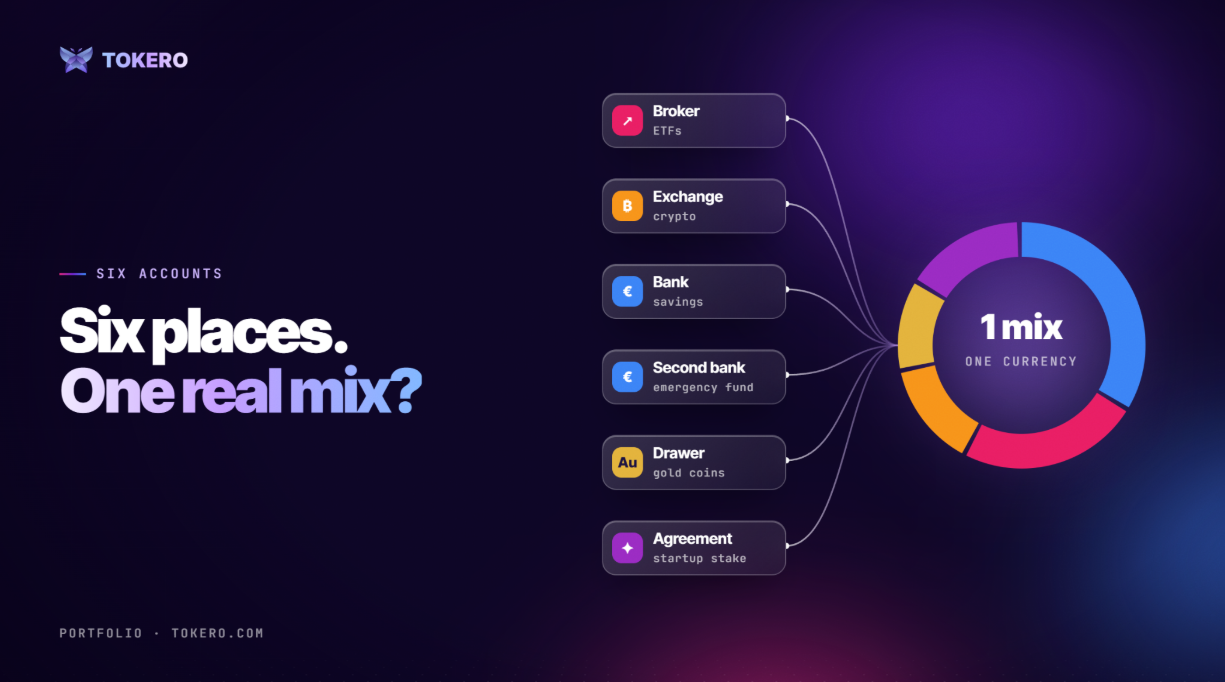
Her ETFs sit in a broker’s app. Her crypto is on an exchange. Her savings are in a bank account, and an emergency fund is in a second bank. In a drawer there are three gold coins her grandmother gave her. And there is a small stake in a friend’s company, written on a shareholder agreement she has not opened since she signed it.
That’s six places, and none of them knows about the others.
The question nobody can answer from memory
Plenty of people who save and invest are in Ana’s position. It isn’t carelessness. Every account was opened for a good reason at a different time, and every app shows its own slice in its own currency. The broker shows dollars, the bank shows euros, the exchange shows whatever pair you last looked at, and the gold and the startup stake show nothing at all.
So when someone asks “what’s your mix?”, we answer with a story we tell ourselves, built from whichever app we opened most recently. The story is usually wrong. That isn’t because we are bad at numbers. We have just never added the slices up in one currency.
That matters more than it sounds. Your allocation is the one thing you actually decide when you invest: how much sits where. If you can’t see it, you aren’t really deciding it. Each app is quietly deciding it for you.
What Ana did instead
Ana opened a portfolio tracker and gave herself a rule: list only what she could remember without logging in anywhere, and stop after ten minutes.
She typed in the ETFs and the crypto, the two bank balances, and the three coins by their weight. She put the startup stake in at the value of her original cheque, because that was the only figure she honestly had.
The tracker converted everything into one currency and drew it as a single chart. The shape was not the one she had been describing. The “bit of crypto” was a smaller share than she thought. The cash, split across two banks, was much larger than she had ever pictured, because she had never seen the two balances side by side. And the stake she never counted turned out to be a real slice of the whole.
None of it was good or bad news. It was simply the first true picture she’d had. For the first time she could ask a real question: is this the mix I actually want?
Then she went back to her follower. She didn’t post her balances, because she didn’t want to publish what she is worth. She shared the shape instead: the percentages, no amounts. The thread that followed was the most useful conversation her account had had in months, because people were comparing what they had built, not what they claimed.
How it works
Ana’s tracker is the Portfolio tool on TOKERO, a network where creators talk about money. Three things make it work for a case like hers.
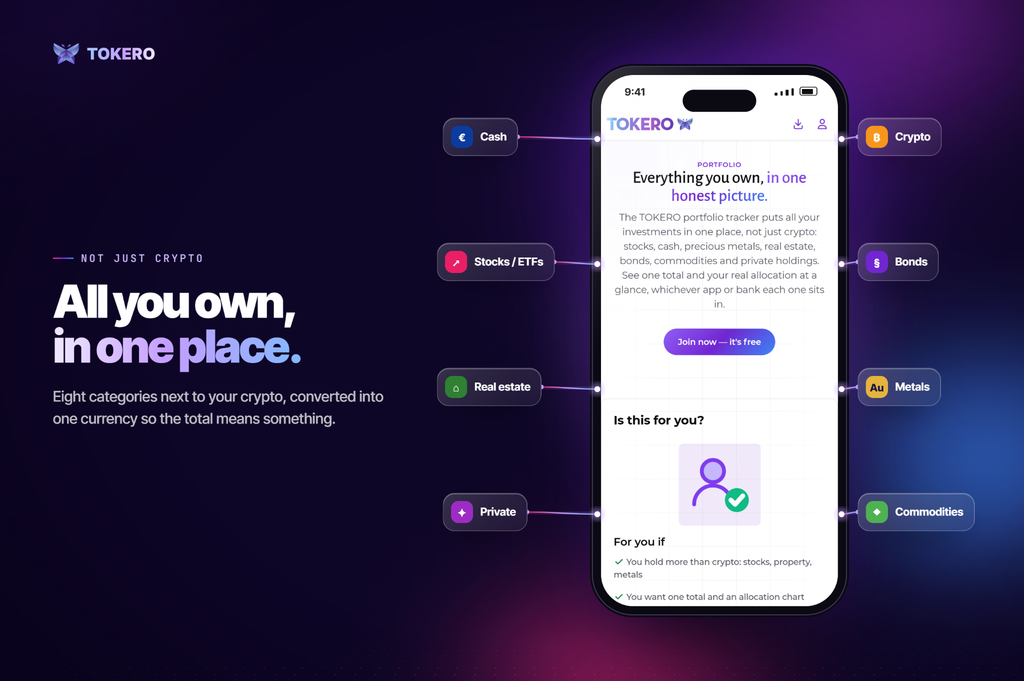
One total across eight categories. Crypto, cash, stocks and ETFs, real estate, bonds, commodities, precious metals and private investments sit in one list, converted into one currency so the total means something. Traded assets, and metals by weight, are priced automatically. The rest, such as the startup stake, you value yourself.
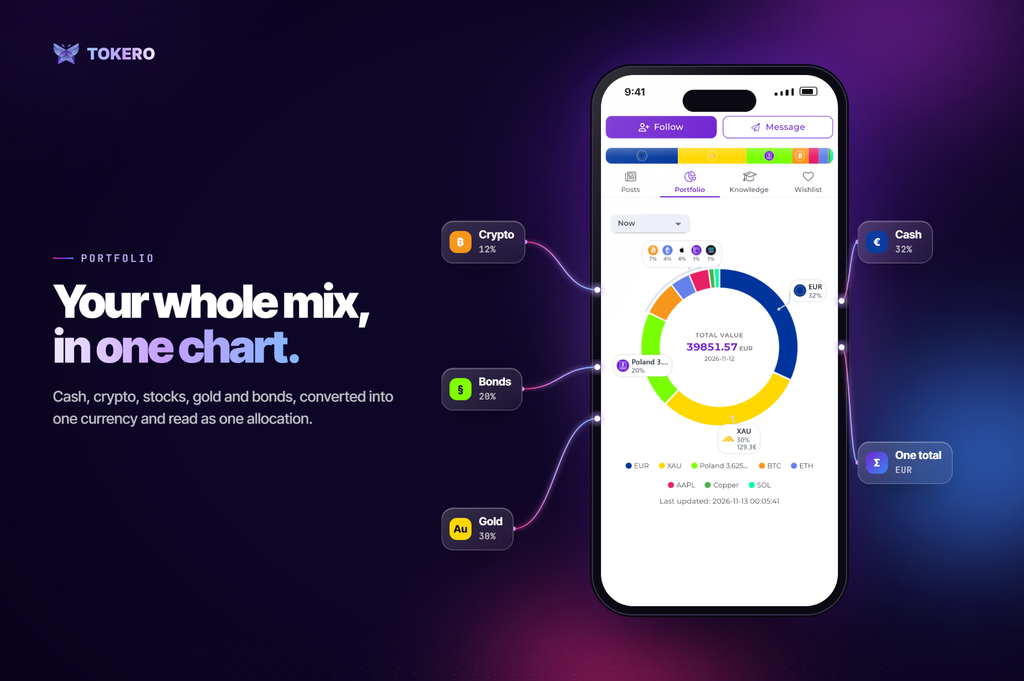
An allocation you can read at a glance. The holdings become a single donut chart with a legend ordered by value. This is the view that turns a pile of accounts into a decision, and the one that often doesn’t match what you would have said.
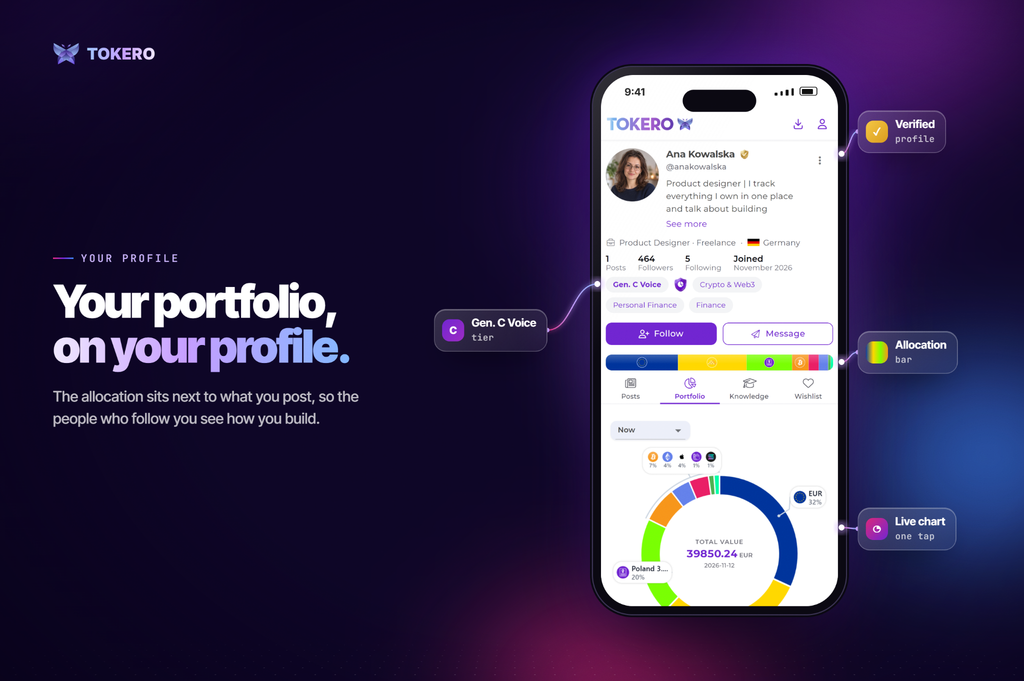
Share the shape, keep the amounts. You can share a snapshot of your portfolio as a post. One setting decides whether visitors, and any snapshot you post, show amounts; leave it off and they see the percentages, not what you are worth.
It’s worth being clear about what it isn’t. It is a tracker, not a brokerage: nothing in it buys, sells or moves your money. It gives no advice and predicts no returns. It shows what you entered, nothing more. If you want trading tips, this isn’t the tool for you.
The free plan tracks up to 20 assets across crypto, cash and stocks/ETFs, enough to put your accounts side by side. Paid plans raise the asset limit and add more categories; the gold coins and the startup stake in Ana’s list sit in categories the higher plans open.
Try the ten-minute version
You don’t need to fill it in in one sitting, and nobody does. Ana listed only what she could remember, and stopped after ten minutes. Start the same way. The first three or four entries are usually enough to show you something you didn’t expect about your own mix.
Octavia Mateescu is a software developer at TOKERO, where she builds the tools creators use to publish and share their work across networks.